


Ah, Jesus
what is it about your name
and the taking of it, that yet-to-be-tapped-out vein —
the way we fondle it
like a wedding ring in a pocket —
the way you star in a song, put a kick
in a joke or a story: ‘What Furniture Would Jesus Pick?’ —
the way you find yourself nailed in so many tats
on so many murderers’ backs —
the way, when we curse or cum,
those sibilants are Braille for the blind tongue —
the way you are still the flayed talisman, last cry
of the fallen, if also the fall guy —
the way your dashboard afterlife is set
against the roll of the road, our last wild bet —
‘Ah Jesus’ is from Everything You Always Wanted To Know by Mark Granier (Salmon Poetry, 2025) — big thanks to Salmon Poetry for letting us reproduce it here.
Everything You Always Wanted To Know, the title of the new Salmon Press collection by Mark Granier, flags not only the poet’s often-confessional narrative style but also the broad range of his chosen subjects. A reflection of this range comes less in the title poem (in which the poet finds Burt Reynolds “in my mother’s bed, / stowed under her pillow in a Cosmo centrefold”) than in the late-placed ‘The Themes’. How many times, the poet asks, can he work within “the modest elbow room a poem / makes for itself”. He wonders if poetry is, for him:
[…] the wrong
preoccupation, being more
daydreamer than thinker,
a tinkerer of thoughts
slipping their own knots,
a boy halfway up the stairs,
stopped by an odd cloud
in the landing window,
who has long since forgotten
what he was going down for.
Here are multifarious thoughts and memories that have been “tinkered” with as they have “slipped their own knots”. This imagery is clearly significant to Granier. He is an accomplished photographer and it comes as no surprise that the book’s cover image is a view of clouds out of a stairwell’s landing window.
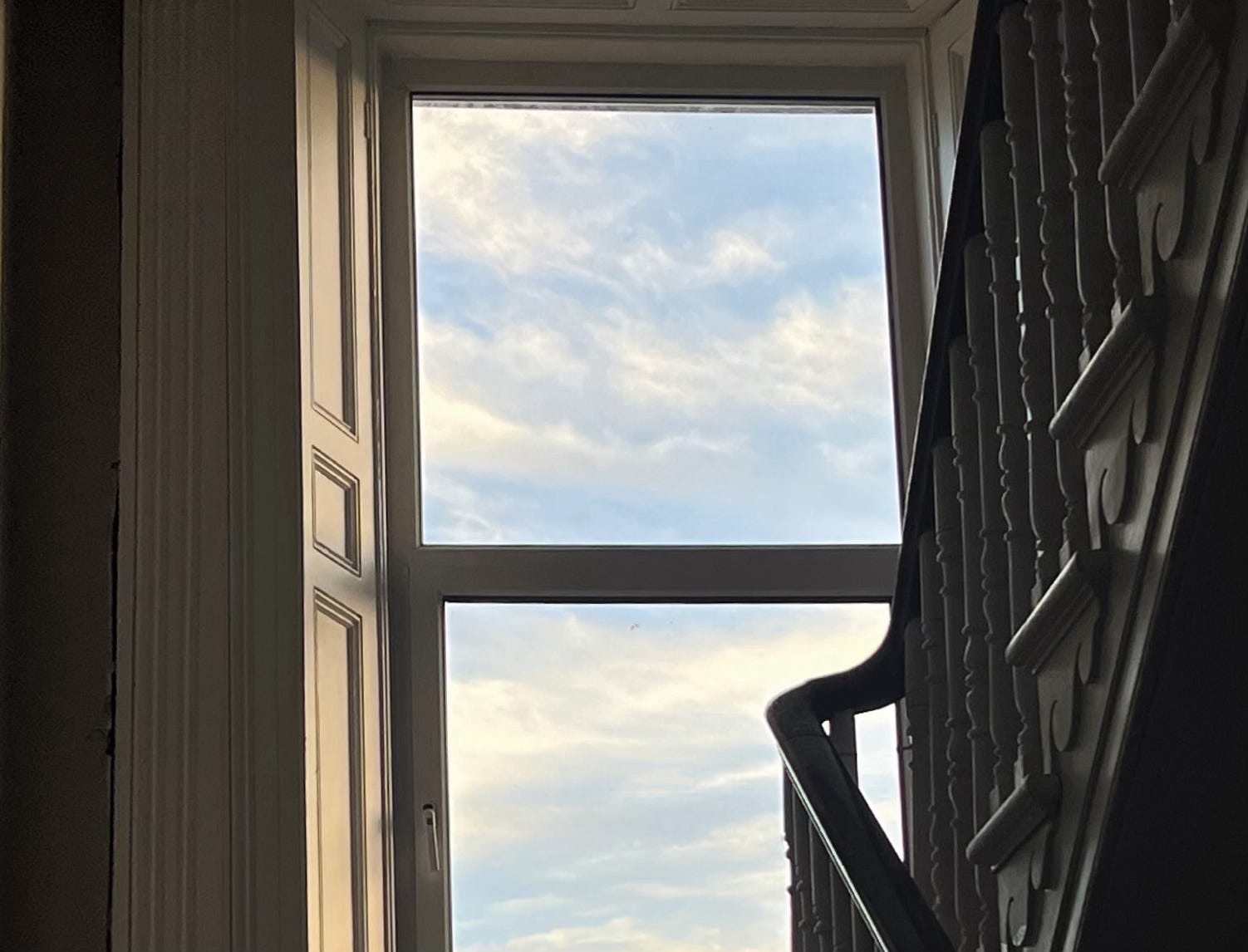
In fact, the poet’s photographic background is apparent in the visual nature of much of his poetry, including a nod to an existentialist philosophical foundation in ‘“There Is No Loitering Permitted Till 7 a.m.”’:
My first taste of La Nausée:
I was nineteen, up late
in grandmother’s drawing roomwhen I saw — really saw — my hand
under the lamp
Many other poems are also drawn from the poet’s memories. ‘Newts’ recounts childhood play when he was “ten and a half” and his cousins were
eight, six and four. Nobody called us
and we never caught any newts. I open this doorto remember how it feels to be poured
outside time, into the fall of a moment
fulfilling itself without any need to know it.
The sense of positive but fleeting absorption in a moment appears in a different form in ‘Accosted’, a memory of the author at twenty-five on a sunny San Francisco day: “Happiness: it clasps your arm, stops you / in the street, then lets you go”. ‘Torremolinos, 1972’ is a less appealing memory of the fifteen-year-old poet’s fear on being unwittingly picked up and taken home by a man while on a family holiday:
Maybe he would have been startled by the images
strobing behind my eyes: nothing sexual,
but torture, dismemberment: panels from my favourite
horror comics, Creepy and Eerie.Maybe it was this weird naivety
that protected me.
Granier’s skilful use of language in ‘Swathe’, with the interplay of s, i and l sounds, is particularly impressive in this passage:
Some still remember the Iliad
of insects, the soft flick
of mayflies — bodies too small
to be swatted — hitting the glass,
our summery slipstream dense
with flight paths ending in smears
of sticky ichor, the flailing
of impotent wipers
Other narrative poems about the past include ‘Dublin, 5.32pm, May 17, 1974’, which recounts how a cousin of the poet’s was lucky to survive the Dublin car bombings carried out by the Ulster Volunteer Force (UVF), and ‘Gastarbeiter’, which describes a rumour about vacancies in the Munich city morgue for washers of corpses in 1979. “The money, apparently, was good.”
Not all the poems are based on memories. The opening piece, ‘To The Pavement’, is a good example of the writer’s imagination at work in the here and now:
Great welcome mat
bled on, pissed on, dressed up
in the rain-slicked night’s lurid
dabble of lights, or midsummer’s
long-legged shadow-puppetry —
treadmill, hard mattress,
you take the daily weight of us
and our absence
‘Listening to Bray’, is a paean to Bray in County Wicklow in Ireland, where Granier lives. It describes the sound of skateboards “on the newly paved area around / the touched-up Victorian bandstand” and concludes with the laughter and coughing of the afternoon drinkers who gather every day at the same riverside bench, and the “smacking of wings as four swans / race for lift-off”. The choice of the onomatopoeic “smack” is perfect here, as is his description of the “luxuriant […] seedy, waist-high crop” of wild grass on Bray Head in ‘Grass’:
Bend closer, and each shivering tip rises,
tapestry-bright, distinct as a headdress
or a working quill, as if the field were breathlessly
inscribing its own epic.
Poems of the everyday are counterbalanced by pieces that address more serious concerns. ‘Anyway’ is a meditation on ageing and social connection in the context of both that “baffling contraption, the past” and also the “aimless” approach of “the great // nothing”. ‘Colonoscopy’ reflects on the poet’s arrival in “the lounge / of late middle age”, while ‘Post Op’ describes his feelings after having “a small / enigmatic part removed”. He watches images from Gaza on the hospital television which show Palestinian hospitals and schools being “smeared into ashy blurs”.
The collection includes several composite and sequential poems. ‘Brevities’ comprises six titled three-line pieces on themes as diverse as what the rain says, hearing a pop song in Crete in 1999, and the heat death of the universe. The subjects of the six untitled four-line pieces in ‘Beds’ include what lies under beds, Rembrandt’s half-bed, and the way Auden’s face resembled “a rumpled bed, slept- / and loved-in”. ‘Customs’ is a particularly clever sequence. Each stanza begins with “Where I come from …”, and the poem lists customs in five seemingly different places. The reader is intrigued throughout and becomes even more so when they read the footnotes.
Granier really does seem to be a poet who can take on any subject
If this book’s thematic versatility is not apparent so far, consider also that ‘On Difficulty’ presents a philosophical reflection worthy of its title, ‘Workshop’ proposes a good writing exercise, and ‘The End, Etc.’ provides a historical overview of Seventh Day Adventism. ‘Crown Shyness’ is prefaced with a Wikipedia explanation of its title as “a phenomenon observed in some tree species, in which the crowns of fully stocked trees do not touch each other, forming channel-like gaps”. So, in Granier’s words, “If you want to see the pattern that they’ve made / you need to look up from the forest floor / in summer.”
There are also pieces on family, friendships, and old flames. Granier really does seem to be a poet who can take on any subject. As with many large, diverse collections, not all poems will appeal to everyone, and some are (to this reviewer) slightly opaque. But Granier is a poet who writes in a distinctively engaging way, and this is a considered and strong collection.
Tim Murphy is an Irish writer based in Spain. He is the author of two full-length poetry collections. His first collection, Mouth of Shadows (SurVision Books, 2022), is reviewed by Richie McCaffery here. His second collection, Upward Spiral: haiku & senryu (Red Moon Press, 2025), is reviewed by Billy Mills here.
As well as browsing our Substack, it’s worth visiting The Friday Poem website where you can browse our Archive of more than 700 posts dating back to early 2021.
Help support The Friday Poem – buy us a coffee to help us stay awake as we strive to bring poetic excellence to your inbox every Friday. If you can’t afford to donate, no worries, we’re going to keep on doing it anyway! Big thanks for everything, you lovely poetry peeps.
Lovely review of a lovely poet. Did not know Mark Grainer. I will look out for him now - what a collection of gems. Thanks for introducing me