


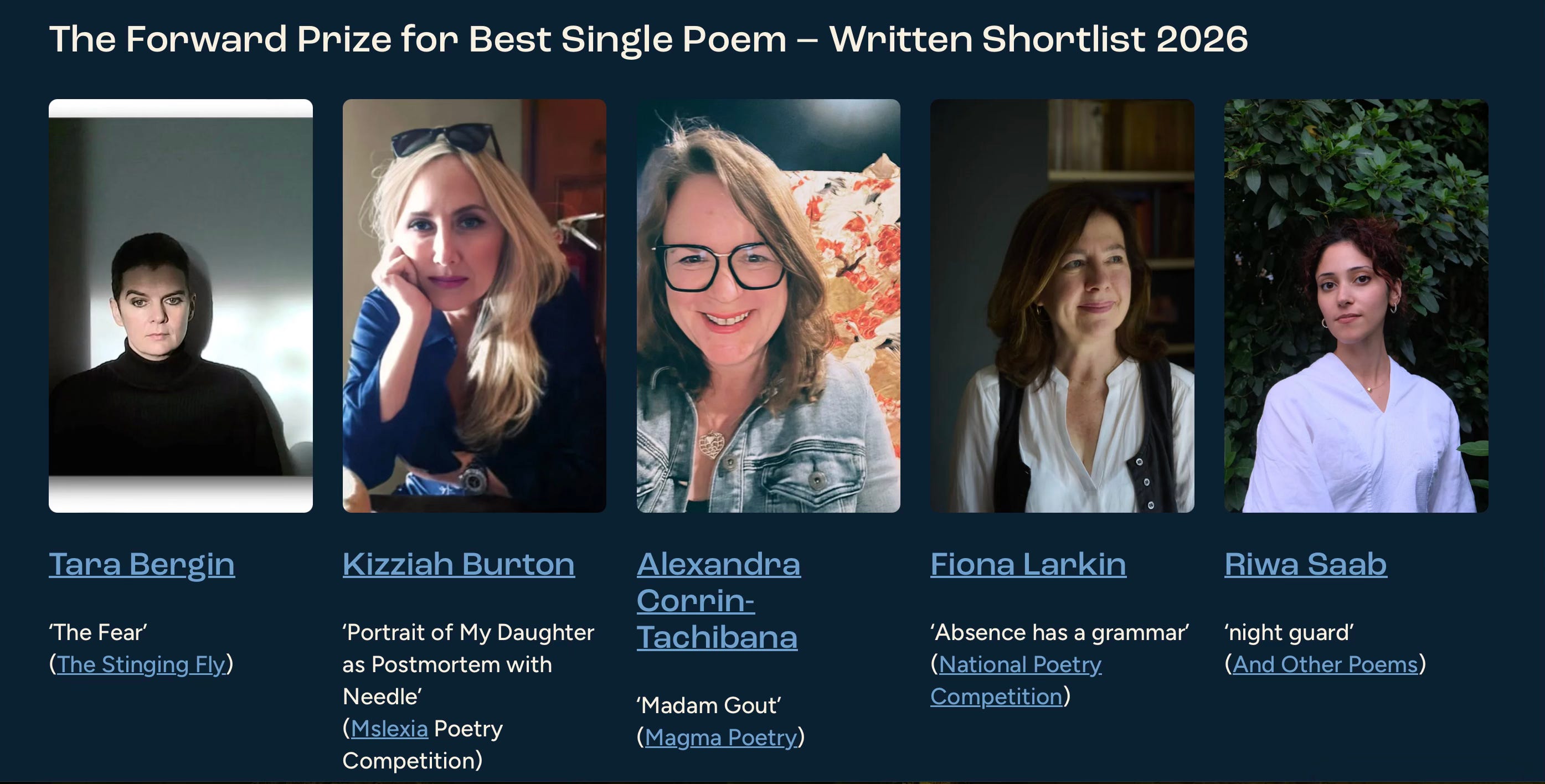
If this group of poems is representative of contemporary poetry in 2026, what does that say? Well, all are written by women. That’s nice – women are clearly doing OK in the poetry prize stakes at the moment. Although it does mean the group skews the diversity balance in at least one key aspect. In terms of shape on the page, these poems are all very different. Two are very long, one is fairly short; some are conversational, some have long sentences that range over a number of lines, some use short lines and taut, heightened language; one is centred, one is in two large blocks of uncapitalised prose. There’s some sonic play, but very little full rhyme. So there’s clearly a happy variety of poetic styles in play here, though nothing in a specific form – no sonnets, villanelles, sestinas etc. (The one poem that might be considered to follow a traditional form is Alexandra Corrin-Tachibana’s zuihitsu, but in this case that’s not exactly a constraint.) Perhaps poets (or women poets, at least) are feeling pretty free, or are pushing back against constraints at the moment. In terms of theme, we seem to be interested mostly in our own physical and mental vulnerabilities, and close family relationships. Anxiety. Loss. Grief. Failure.
Five poems. I’m not going to critique each one individually at length (phew! you’re thinking; me too), or rank them in some kind of order. I’m going to try to find something about each of them that I think works well, and something which I think doesn’t. We’re including one page of each poem – three of them fit on a page anyway, and hell, how long a read can you bear? If the first page of each of the two other, longer ones tempts you to read on, huzzah, there’s a link to the whole poem as well. Long poems need to work hard to get you to keep reading. Do these two do enough?
Here’s Tara Bergin’s ‘The Fear’, first published in The Stinging Fly, and here’s a link to the Forward Conversation with Tara Bergin.
The Fear
I assumed the fear belonged to the woman in front of me.
It was the sort of fear someone like her might have.But then she turned around to me and said,
Is that your fear?No, I said, I thought it was yours.
It’s not mine, said the woman. I don’t know whose it is.Next! said the cashier.
Hi, said the woman,
I think someone’s left their fear behind.The cashier looked at me.
It’s not mine, I said.
I don’t know whose it is.The three of us considered the fear.
It doesn’t look like the sort of fear you would forget about,
the cashier said.You’d be missing it straight away,
I said.Or maybe if you’re busy, said the woman,
it would only come back to you in the middle of the night.I suppose we were all thinking of our own fears.
Right, said the cashier.
I’ll put it in the back until the end of the day.
If no one claims it, I’ll give it to one of the girls.
What do I like about this poem? Well, I understand it. It’s clear, written in short, proper sentences, properly punctuated. It does the job it sets out to do, and it does it well. It’s what I think of as an ‘aha’ poem – that closing line brings a revelatory twist. It’s also beautifully real – it’s just women standing in line in a shop, waiting to pay – at the same time as being beautifully surreal. Fear isn’t a concrete thing, but here, in this poem, it is. I’m not sure what the centred layout adds, but the writing is confident and skilful so I’m prepared to go with it.
Paradoxically, what I liked most about it at the start – the clarity, the ease of understanding – is what I like least about it after I’ve read it a few times. It does a job, but it’s not a very ambitious job. The language is plain, unembellished (not a single adjective, not a single adverb), and leaves little space for interpretation. There’s not a lot to discover, to worry at, to tease out. There’s not a lot to say about this poem. Once you’ve read it once, maybe twice, you might not feel the need to read it again. However, you wouldn’t forget it.
Here’s the first page of ‘Portrait of My Daughter as Postmortem with Needle’ by Kizziah Burton, and here’s a link to Kizziah Burton’s Forward Conversation.
Portrait of My Daughter as Postmortem with Needlei.See: the need nestled in needle, a word cradled in another word like my daughter’s hand nestled in another’s hand, paying attention. A mother’s. A father’s. A friend’s. A pretender’s.See: the hand in handling, in handled, in handfasting See: a daughter’s hand waving goodbye See: the mouths of her words, her talking hands, her finger alphabetsSay: withness See: the witness in withness Say: willowy sounds weave hands and words and loves together Say: weave wind bend bind fragments of time images gistSay: coherence See: incoherent Say: one may encounter in another a fragment of themselves See: the not selfSee: a girl searching the drawer where grandmother squirrels away the silver spoons See: a girl starving for words not yet born in her mouthSay: time exhausted See: time is less than what is needed See: time less is not the same thing as need less or wit less or with less or word less or heart less. Or window less. Or self less. Or life less.See: End Less Say: less is more Say: economy Say: price less See: the difference Say: goodbye Say: I miss you - more or less See: too late[…]
Want to read more? Here’s a link to the full poem.
This is about as far from Tara Bergin’s poem as you can get. Where Bergin’s is clear and straightforward, this is oblique and layered. Where Bergin’s poem is composed in simple, standalone sentences, this poem ranges, repeats, digresses, in six numbered parts, over five pages. There’s wordplay (“the need nestled in needle”). There’s a preoccupation with the sound of words, the connections between similar sounding words, and the rhythms of repeated phrases. It seems that the poem will reveal its story not so much through specific meanings conveyed in words and sentences but almost as a sort of incidental, sideways understanding.
Paradoxically – again – while I found this beguiling at first, I soon found the incessant fractal-like flowering of language annoying. I don’t know whether the poem – which explores maternal grief at the sexual assault, possible abduction, possible death of a daughter – is autobiographical (and of course this shouldn’t be relevant) but for me the poem doesn’t quite convince. There’s too much going on, or it’s trying too hard, or it’s more concerned with clever wordplay than meaning. The poem simply doesn’t hold my attention all the way through. I’m still not sure whether the failure is in me, or in the poem.
Here’s the first page of ‘Madame Gout’ by Alexandra Corrin-Tachibana, and here’s a link to Alexandra Corrin-Tachibana’s Forward Conversation.
Madam Gout
a zuihitsu after Benjamin FranklinA few days before you get gout, you go to Blackfriars Bordeaux Banquet, with wine pairings.You dine on -smoked duck, baby Beef Wellington, asparagus & seared salmon poached pears & Comté.The next day your wee reeks of asparagus. You expect this. Ancestry DNA revealed this as one of your traits. At the Bordeaux dinner, you laugh with the girl with auburn hair, who looks like The Vixen in The Chase.Days later, on the train, you’re chatting to a tattooed Norwegian, who says your sushi lunch box is very posh. You feel your foot twitch but try to forget about it. You tell him you’re 8% Norwegian. You found out through Ancestry DNA. He shows you pictures of Trondheim.痛風 (tsuufuu) is Japanese for gout, your husband tells you when you get home.The next day, you cannot put your foot down or get a boot on. You hobble through the surgery carpark in damp socks. The doctor shows you a PowerPoint with a caricature of a gouty foot. Your uric acid is very high. You could fry an egg on your big toe.[…]
Want to read more? Here’s a link to the full poem.
This poem is a zuihitsu, which is a “genre of Japanese literature consisting of loosely connected personal essays and fragmented ideas that typically respond to the author's surroundings”. A zuihitsu can ‘feature’ poetry, says Wikipedia, but technically isn’t poetry. This makes sense, as the language of ‘Madame Gout’ is actually pretty prosaic — a menu, a list of famous gout sufferers, notes, reminiscences, brief excerpts that read like chatty diary entries. The whole feels accessible, readable, understandable, and quite entertaining, although for me the ending lacks both punch and illumination.
But is the piece poetic enough to claim the Forward Best Single Poem prize? There’s little in the way of what we would generally consider poetic technique. Rhyme, rhythm, cadence, musicality — none feature in any obvious way. It’s more of a ‘piece‘ than a poem, and more of a collage than anything else. If you read a poem for insight into the human condition, or beautiful phrasing, or to be moved, this one probably won’t do it for you.
Here’s ‘Absence has a grammar‘ by Fiona Larkin, and here’s a link to Fiona Larkin’s Forward Conversation.
Absence has a grammar
I am learning to use the abessive
case as if I were Finnish,
to indicate that what I miss
is so much a part of me
that its loss is structural.The suffix -tta turns a word
into a shadow of itself.
Emptied of substance,
light blows through it.
I think of moonshine,of a bottle of Koskenkorva,
the Finns’ national liquor,
renamed Koskenkorvatta
when there’s none left.
Koskenkorvatta, I howl.Itkin syyttä means
‘I cried without reason’,
but when a child is away
there is reason enough.
Tonight itkin syyttä.If I join -tta to son
it impels me to write this –
not a sonata, nor sonnet,
but still, of course,
a little song of longing.
‘Absence has a grammar’ won the 2024 National Poetry Competition. Larkin wrote it to process and express the intense sense of physical absence she felt after the relocation of her son to Australia. The poem deals with the Finnish language's "abessive case" (adding suffixes to nouns to denote that something is missing). She uses this complex grammar system as a metaphor for the loss she felt.
I think it’s clever, and beautiful, and moving. The metaphor works, the language is austere (there’s only one adjective in the whole poem — “little” in the last line) and the use of Finnish words adds interest. The play on ‘son’, plus the suffix -tta, to make ‘sonnet’ and ‘sonata’, is particularly neat. There’s nothing in the poem that shouldn’t be there. I’m still trying to find something I don’t like about it. Which I guess adds up to ‘it gets my vote’.
Here’s ‘night guard’ by Riwa Saab, and here’s a link to Riwa Saab’s Forward Conversation.
night guard
it so happens i’ve failed as a daughter. i don’t call
enough. i left, and i don’t plan on coming back soon.
they said i can only meet god in my homeland. such a shame,
all the people that will never meet god, because
they’ve never been to my homeland. because of the stress
i’ve begun grinding my teeth. my friends say i need
a night guard, and i picture it so clearly: a cloaked
shadow mounted on his tall horse, so tall that its neck
aches to look down at us – maybe like god – perched
outside my bedroom as i sleep. the chiming of silence
wakes me, and i leap onto the horse, we gallop onto the hills,
just me and him, the dark of night. nothing sexy happens. we only
watch the sky quiet, as a thousand shooting stars float overhead
and all the military bases below them diffuse. suddenly
we have rivers. the marshes in iraq drink again, the earth
was never thirsty, never drained, our cities never on fire.
and from the 6x4 photograph of my far, unnamed cousin,
we peel him out. we pull all the martyrs out of the photographs
in all their dimensions, away from the fate of the cardboard box,
the corner of the closet, the things they salvaged when the men’s
grins dribbled with gunpowder, spilling onto the floors of
our stolen houses. no, a nightguard is only a bit of plastic –
our landscapes ground down with collapsed buildings,
and all i’ve sacrificed are my teeth
Riwa Saab’s poem creates a busy, dreamlike, insomniac landscape. It’s predicated on the misunderstanding of what a night guard actually is — a plastic mouth guard which you wear at night, usually to prevent tooth grinding. Saab’s night guard is a cloaked horseman who whisks her into the sky, magically cleanses her homeland of war, drought and fire, and rescues the dead, but disappears when she realises her mistake.
I like the surrealism of this poem, and the onward rush of detail. The nature of dreams is that they’re disjointed and rambling, and the poem successfully reflects that. It’s deliberately prosy, with no particular technique on show – it’s more a stream of (semi-) consciousness. For me, the downside is that it doesn’t seem to build to any real conclusion or climax – I find the ending flat.
So that’s my two penn’orth. Do you agree? Do you disagree? Do comment.
Hilary Menos is Editor of The Friday Poem. Buy her books here (signed, posted from France so the postage is a bit of a sod, sorry).
Vital Statistics: The Friday Poem has over 3800 subscribers. It’s run by four people – Hilary Menos (Editor), Helena Nelson (Consulting Editor), Bruno Cooke (Spoken Word Editor) and Andy Brodie (Web Editor), with contributions from a team of reviewers and writers.
Until recently we maintained the Friday Poem website (thefridaypoemdotcom) as an archive of 700 posts published between 2021 and 2024 (including most of the original Friday poems) but following a catastrophic hack in late April we made the difficult decision to take this down. We’ll be republishing some of these posts – poems, features and reviews – on Substack in the future.
Help support The Friday Poem
Buy us a coffee to help us stay awake as we strive to bring poetic excellence to your inbox every Friday. Heartfelt thanks to everyone who donates, especially to our regular donors. If you can’t afford it, no worries, we’re going to keep on doing it anyway! Big thanks for everything, you lovely poetry peeps.
I don't like any of them. I would agree, I suppose, that the Larkin is in some sense the best but I find it performative and annoying; it has no sonic interest; and I think it's a mistake to use a large number of words that your reader cannot reasonably be expected to know how to pronounce. I also think it's silly to shortlist a poem that has already won a major prize. So just grumpiness from me I'm afraid.
The first page of Kizziah Burton’s poem compelled me to read the rest and I liked it a lot. I enjoy the word play and I like that it’s understandable while not always making complete sense. There are thoughts and phrases I want to go back to which is always a good thing. I also very much enjoyed Absence has a grammar and, like you, can’t find much to criticise there.