


Notes Towards a Wächterlied
For years we staked our faith on evensong
and medieval paintings where
the angels, if they chose to speak at all,
said nothing that might implicate a god.
Back in the days when everybody slept
through winters such as this, our simple dwellings
drowsed beneath the snow, a sweet
momentum in the far rooms of the house
where nothing was remembered or forgotten.
Strange now, to be waking to a world
so ill-contrived that nothing ever sings:
rain on the skylight, voices in the roof,
those pretty seraphs scorched into the walls,
too faint to name, though some of them had wings.
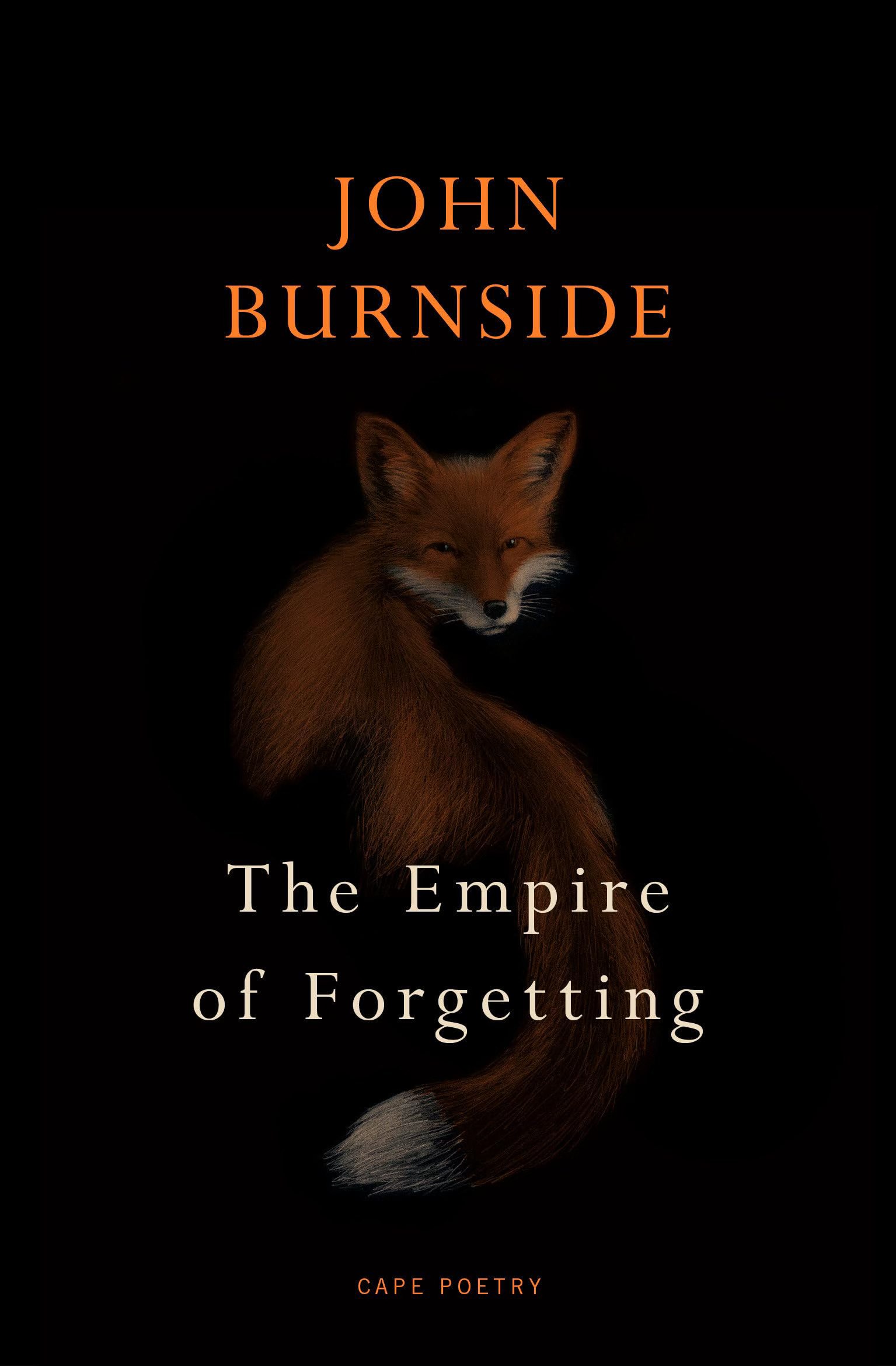
‘Notes Towards a Wächterlied’ is from The Empire of Forgetting by John Burnside (Cape, 2025) — big thanks to Cape for letting us reproduce it here.
The Empire of Forgetting reveals the poetry John Burnside was working on before his death on 29th May 2024. Admirers of this poet will be moved to hear the distinctive music of his voice in poems he almost certainly knew would be his last.
Rather than discuss the whole collection, I’d like to focus on just one piece, advancing a private theory that ‘Notes Towards a Wächterlied’ is of key significance, as well as a personal valediction from the poet to his readers. I’ll be making a somewhat convoluted argument here, and it may take a while to explain. Please bear with me.
It seems to me that ‘Notes Towards a Wächterlied’ is about human beings (or some of them) waking up after a long sleep to what is happening in the world at an environmental and ecological level. (Burnside suffered from severe sleep apnoea and often alluded to sleep, most overtly in his 2021 collection, Learning to Sleep).
The first stanza speaks, in suitably solemn iambic pentameter, of times when religious faith was the norm. Burnside grew up Catholic and even considered the priesthood for a while as a boy, so I think he’s partly talking about his childhood faith but also speaking generally of past times. The first line mentions ‘Evensong’, which is not Catholic, but Anglican; I think he likes the warm, elegiac ring of the word and uses it here as a metonym for institutionalised religion. He conjures a sunset-tinted world where religion is a comfort blanket and where God and his angels are beyond reproach or questioning.
The second stanza sees a world drowsing as if under a blanket of snow with a hazy ghostliness familiar to anyone who’s read Burnside (his writing is suffused with a sense of mysteries half-glimpsed behind the veil). Snow is the most frequently recurring image in Burnside’s work, symbolising such things as innocence, spaciousness, time paused, purity and a state of grace. He’s spoken at length about this in the London Review of Books: John Burnside · A Winter Mind. The paradoxical phrase “where nothing was remembered or forgotten” could be interpreted in different ways. To me, it speaks of lives lived in a cosy dream-state; an acceptance of one’s lot and place in history; a trust (or delusion) that life will continue as it always has.
In the final stanza, we’re waking out of this numbed and drowsy state to a changed and unsettling world. We find ourselves in an “ill-contrived” place where old certainties are gone. The birds have stopped singing; the rains are falling; the angels have all but faded into the architecture. That final phrase (“though some of them had wings”) might refer to dead people he’s loved and lost, such as his mother. But there’s perhaps a flutter of hope in the final “wings” – as if the poet couldn’t bring himself to conclude without a chink of light. It could also be an oblique, poetic anticipation of his departure from the world.
In a nutshell, this poem is a reflection on a world that’s changed out of all recognition in the seventy years since Burnside was born and continues to change in ways we’re only just beginning to confront. The title of the whole collection, The Empire of Forgetting, says the same thing I think; we’ve been deluding ourselves for a long time.
this poem is a reflection on a world that’s changed out of all recognition … and continues to change in ways we’re only just beginning to confront
But let’s look at the title: Notes Towards a Wächterlied. It’s here, I think, that things get particularly interesting. Burnside’s fondness for epigraphs in Latin and other languages, as well as esoteric titles such as this one, can risk the charge of elitism. I’m convinced, however, that his intention is never to shut people out, but to invite readers into his mind. Burnside was raised ‘dirt poor’ (his own words) in a house with no books. He was an autodidact for the most part, with an indefatigable and wide-reaching curiosity. Something he does in many poems is to add scholarly dimensions via the title and/or epigraph. The reader is free to simply read the poem for its music, or to research the allusions.
‘Wächterlied’, as is explained in the notes to this collection, refers to a piano piece by Edvard Grieg (Opus 12 No 3). It’s a simple, hymn-like tune which Grieg wrote after watching a performance of Macbeth, specifically the porter’s scene in Act II Scene III. The porter is a watchman at the castle gates, hence ‘Wächterlied’, meaning Guardian’s Song or Watchman’s Song.
In Macbeth, the porter’s scene is a comic interlude in a dark play. Shakespeare’s porter is a coarse, clown-like character who is roused from a drunken stupor by knocking at the gates. He launches into a bad-tempered rant about feeling like he's the watchman at the gates of hell, getting no rest because so many souls are knocking for admittance. The porter satirises some of the people who a gates-of-hell watchman might have to admit (a greedy farmer, an equivocating priest, a deceptive tailor), then turns to the audience, asking, “What are you?” (i.e. What sort of sinner are you?). His language is bawdy at times and his last words are “I pray you, remember the porter!”.
Is it possible that Burnside casts himself as the porter? He was, as they say, ‘fond of a drink‘, and it’s not hard to imagine him in the role. As watchman at the gates of hell he’s been listening to the knocking, unable to sleep, for years. As he leaves the stage, he’s asking us to remember him and what he’s been saying. It’s as if “I pray you, remember the porter!” is Burnside’s farewell to his readers.
As watchman at the gates of hell he’s been listening to the knocking, unable to sleep, for years
But if Burnside is the porter, why ‘Notes towards a Wächterlied’? Why reference the Grieg piece at all? The poem doesn’t sound like a bawdy, drunken song. He could simply have called it The Watchman or The Guardian. I have a possible answer …
It seems that in the Schiller version of Macbeth, which is the version Grieg saw, the porter’s scene was rewritten by Schiller, removing all the rough and bawdy bits. He’d decided that the audience couldn’t take it. Hence Greig’s watchman sings a gentle song which, although it has a slightly spooky middle section, is almost a lullaby.
Burnside had been reading Schiller in recent years. His previous collection (Ruin, Blossom) took its title from Schiller, so a link to the German poet’s version of Macbeth seems plausible. Maybe Burnside, in this elegiac, musical poem, is sparing us a little too. There’s a dark message in there, but it’s gently put. As Eliot famously said, “humankind cannot bear very much reality”.
Or maybe Burnside had simply come to a point of quiet acceptance, knowing there was nothing more he could do as a poet. Lines from other poems in The Empire of Forgetting would suggest this, for example:
Fog on the roads, the harvest gathered in
by lantern-light; our work, if it is work
accomplished.
What Burnside accomplished in his sixty-nine years was remarkable. He’s left us a huge and impressive body of work. Whether or not he meant us to remember him as the porter we’ll never know – the idea may be pure fancy on my part. Regardless of that, John Burnside will certainly not be forgotten, and Grieg’s Wächterlied makes a fitting requiem for a kind and modest man who couldn’t sleep for watching the world.
Rest in peace, John.
Annie Fisher’s background is in primary education, initially as a teacher and later as an English adviser. Now semi-retired she writes poetry for both adults and children and sometimes works as a storyteller in schools. She has had two pamphlets published with HappenStance Press: Infinite in all Perfections (2016) and The Deal (2020), and one recently from Mariscat Press: Missing the Man Next Door (2024). She is a member of Fire River Poets, Taunton.
As well as browsing our Substack, it’s worth visiting The Friday Poem website where you can browse our Archive of more than 700 posts dating back to early 2021.
Help support The Friday Poem – buy us a coffee to help us stay awake as we strive to bring poetic excellence to your inbox every Friday. If you can't afford to donate, no worries, we’re going to keep on doing it anyway! Big thanks for everything, you lovely poetry peeps.
Thank you for this analysis concerning one of my very favourite poets. If this poem is representative of the collection as a whole, it will send me to my local independent bookshop to purchase a copy.
I love John Burnside and am sad that no new collections will be available for us to read. Your analysis really illuminated this poem for me, its grave aspects, yet almost raising a smile at points. Thank you.