


The Friday Poem Spoke Word Editor Bruno Cooke ranks the five shortlisted poems for the Forward Prize for Best Poem - Performed 2025 in order of how awesome they are, and gives us his thoughts on the prize accepting British Sign Language entries for the first time.
Where the heck does the time go? Two years ago, when Forward launched its first ever prize for Best Single Poem – Performed, I wrote that the literary establishment was finally waking up to the public’s enduring interest in, and the literary value of, performed poetry. It was arguably the first big hitter to award both cash and prestige to poets who prefer performance over the page.
The following year, I cast a vaguely knowledgeable and admittedly rose-tinted eye over the shortlist, ranking them in order of most to least awesome. I also mused on what I regarded as legitimate and illegitimate criticisms of good and bad examples of the form. On the one hand, people who like page poetry can be unfairly snobby about the spoken word. On the other hand, a lot of spoken word poetry is really quite bad; one night of amateur performance in the basement of a London bar can make someone write it off entirely. Emoting does not make you a poet. Performers should work on their performances in the same way page poets work on their poems. Edit. Rehearse. Don’t eat your words, or milk them. Don’t take the piss. Yes, you can encourage one word to rhyme with another. Recognise the fact that you have both the eyes and ears of your audience, so consider the way you come across visually as well as aurally.
But, but. 2025 is different. This year, the Forward Prize for Best Poem – Performed includes British Sign Language (BSL) entries. And visual vernacular, or VV. What’s that, you ask? I’m glad you did, because I sure as hell didn’t know. And now that I do know, I find its inclusion very interesting.
The Cultures of Disability blog, part of Manchester Metropolitan University, describes VV as a “physical form of performance that draws on sign language, mime, and techniques from the theatre”. It is a “sensory spectacle” enjoyable to all, “whether they know sign language or not”. Popular in the States, VV was developed by a student of mime. VV artists use face and body to tell a story, without recourse to a formalised language such as BSL. The Guardian calls it “sign language, mime and dance rolled into one”. “It’s a way of expressing visual vignettes,” one proponent of the form told the paper. You might be forgiven for calling it interpretive dance, though those operating in the field might find that offensive. Gestures, facial expressions, full body movement, sprinklings of BSL and (possibly the coolest part) cinematic effects. This is from Extraordinary Bodies, an Arts Council England-funded performing arts project:
Cinematic effects are a key feature of performances, such as creating long shots or zoom, playing with fast or slow motion, and panoramic views. Role shifting is another way to play with storytelling. An artist can use movement to morph into different characters, or even objects, to help build a story. By combining these techniques, artists create a very visually exciting and accessible way to enhance storytelling.
So, that’s visual vernacular, and these are the tools at the disposal of a visual vernacular performer. Basically, anything they can do with their body and face. Meanwhile, the verbal poet-performer’s arsenal contains all the words and noises available to them, spoken however they choose: loudly, quietly, harshly, softly, quickly, slowly, huskily, plainly. In a funny voice, or with an accent. With melody, or without.
Visual Vernacular involves gestures, facial expressions, full body movement, sprinklings of BSL and (possibly the coolest part) cinematic effects
What about BSL poets? I have a feeling I could write a lot about BSL, and BSL poetry. So far, I’ve found it impossible to get my head all the way round it. How does a non-BSL communicator interpret BSL poetry? Subtitles? But BSL has no written form. Sure, it’s possible to translate BSL into English and vice versa, but it’s not equivalent to translating German into Mandarin, or Malay into Urdu. BSL is a different type of language altogether. If you’re new to the form, here’s a curated collection of signed poetry videos, many of which do not come with subtitles. So, what’s the point of watching them? To guess at their meaning? Some of those that do come with subtitles, such as Gary Quinn’s ‘The stars are the map I unfurl’, illustrate that there’s rarely a set-in-stone way to transliterate a sign into text. In poetry, the question of transliteration gets blown wide open. As a result, if a BSL poet wants non-BSL communicators to understand their poem, they must write it twice: once in sign, again in text.
I get the impression that a signed poem is more like a sequence of performed ideas than it is a text based on language. As a hearing person, that’s hard for me to fathom, although I find it fascinating. At the same time, I find it extraordinary that Forward has chosen to include both BSL and visual vernacular poetry alongside verbally performed poems in one single prize category. Not least for the job it gives the judges. I see how someone who understands BSL can judge BSL poetry. I see how someone who is used to critically evaluating VV poetry can judge a series of VV performances. Pitting them fairly against each other seems an uphill task. And that’s before the addition of verbal performances.
How does a non-BSL communicator interpret BSL poetry? Subtitles? But BSL has no written form
Without the emotive power of voiced speech, are BSL poets at a disadvantage when performing their work? Or is it the other way around? BSL has somewhere between 20,000 and 100,000 key signs – not words. English has more, but many of its words are obsolete. To be able to judge fairly, should a judge be fluent in BSL? Can a deaf person be a fair judge of verbally performed poetry?
Until the invention of the printing press, most human storytelling happened orally, that is, aurally: using sound. We sang songs, we watched plays, we listened to poetry. After the printing press, we read books. Now, we watch films. We go on Instagram with the sound muted so as not to annoy people around us. Are we rewiring ourselves to read visual cues rather than sonic ones? When consuming culture, whether it’s in the form of novels, poetry collections, silent film, or videos on social media, our reliance on listening to people’s voices seems to be diminishing, replaced by subtitles and inter-titles, or text on a page.
I find it extraordinary that Forward has chosen to include both BSL and visual vernacular poetry alongside verbally performed poems in a single prize category. Not least for the job it gives the judges
Having had a bit of time to sit with it, I have to say I like the decision to include BSL and VV poetry in the prize category. But it does raise questions, which we have to assume the judges were up to the task of answering.
For her part, Rommi Smith, one of the judges, said the inclusion of BSL poetry was “a beautiful reminder that poetry is multifaceted in its definition”. (What she didn’t say was: I did not sign up for the impossible task of objectively comparing visual vernacular poetry with spoken word poetry. I’ll have to give it to the Deaf poet because otherwise I’ll get cancelled. So, that’s good.)
Meanwhile, judge Lisa Kelly said: “I am especially thrilled that the Best Single Poem - Performed now includes British Sign Language entries and am grateful that the Forward Prizes, which I have long associated with its commitment to innovation and connecting with new audiences, will help bring closer understandings between the Deaf and Hearing worlds”. (She didn’t say, how can I award £1,000 to this person prancing about on a stage when at least the others wrote actual poems?! Also good.)
When reviewing this year’s shortlist, consider the above. I will too. The things I look out for include clarity of expression, originality of language, boldness of message, and power of performance, whether that be in word or (*deep breath*) sign.
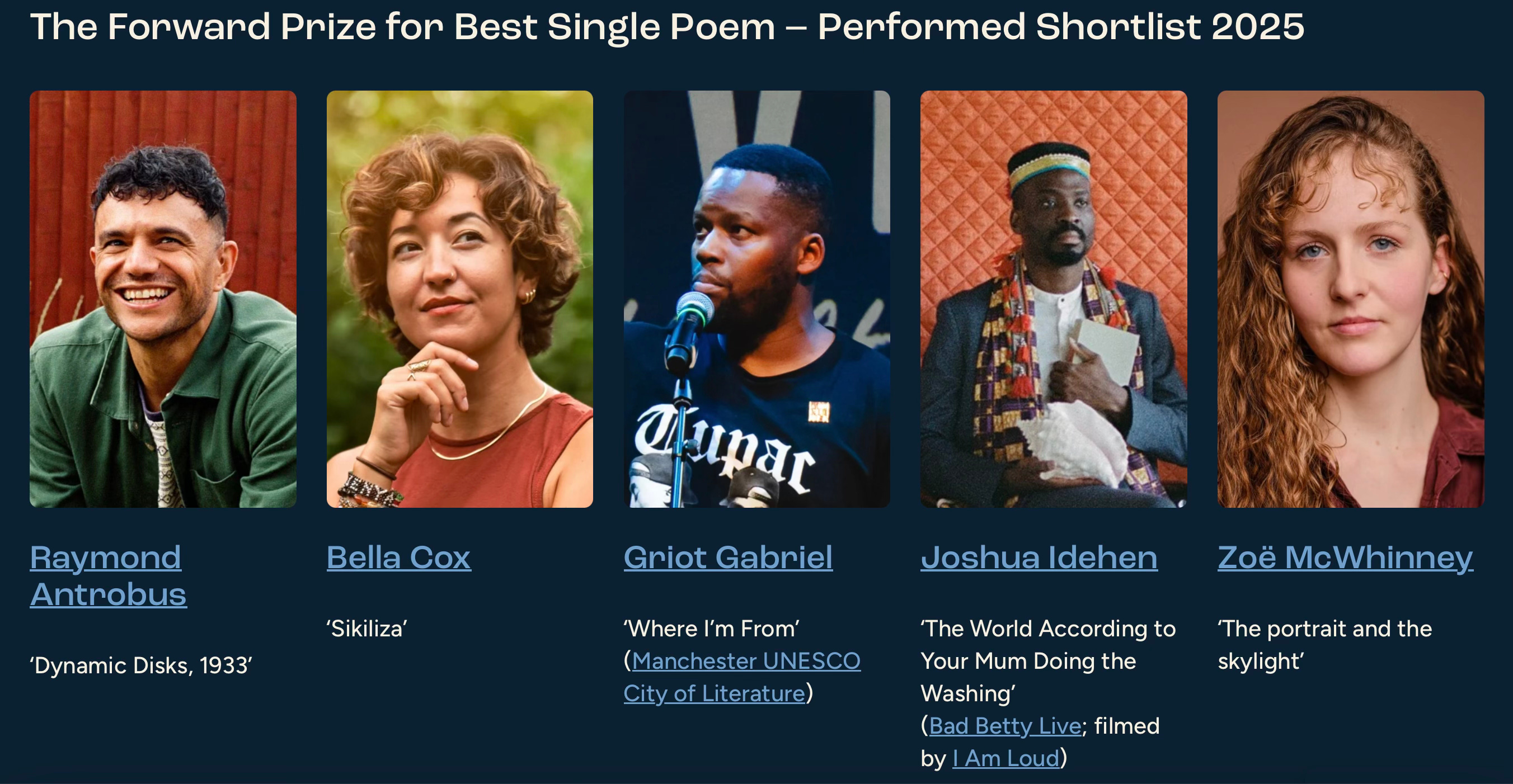
5. Zoë McWhinney, ‘The Portrait and the Skylight’
It is hard to get audiences involved in a story without recourse to language. Mime artists study for many years. I like the idea of visual vernacular poetry, but I do not get much from this performance. This may be due to the quality of the recording: the visuals are unimpressive and the audio is… inaudible. But surely there are more comprehensible and therefore perhaps more moving examples of the form? Also, maybe VV performances would benefit from a title that equips audiences with a tool they can use to understand the poem? If a piece has no other verbal input, a lot rests on the title.
4. Bella Cox, ‘Sikiliza’
A lot of work has gone into this beautifully polished performance. Cox performs confidently, speaks clearly, has obviously rehearsed. Good quality recording. But the poem doesn’t tell a story, and relies on a tiresome 1-2-3 structure without it being obvious why.
3. Raymond Antrobus, ‘Dynamic Disks, 1933’
There is something mesmerising about Antrobus’ performance. It seems to take advantage of the prize’s openness: slick, impassioned performance meets strangely beautiful use of language. Brittle and precise. Still, the rise and fall of the poem itself – the arc – relies on people finding meaning in its vagueness, relating to something in the way they relate to horoscopes.
=1. Joshua Idehen, ‘The World According to Your Mum Doing the Washing’
Ticks numerous boxes. Good quality recording, spoken clearly with an appreciation of comic timing. The idea is excellent and instantly memorable. An instant classic. The thing that holds it back for me is that it isn’t uniquely a performance piece. It does just as well on the page. I’d like to see more performance.
=1. Griot Gabriel, ‘Where I’m From’
I really like this. Simple mission, doesn’t fart around. Likeable persona, paints a loving yet complex image of Griot’s hometown. Uses rhetorical devices that work: repetition, figurative language, pause. Poetry audiences have certain formal expectations and, in this case, the things that may strike some listeners as hackneyed could help others understand how to interpret the work. It delivers. That said, there’s a degree of ‘poet-voice’, which some may find grating. So, imperfect – hence joint first with Josh.
Bruno Cooke is The Friday Poem’s Spoken Word Poetry Editor. He recently launched a Substack publication called My Special Interest, and has written one novel (Reveries, available from You Know Where), four plays and two feature screenplays. Besides writing about poetry for The Friday Poem, Bruno writes poetry of his own and runs On Our Bicycles, a repository of bicycle touring guides. He has lived in China, Sri Lanka and the Philippines, and cycled in 50+ countries. In April 2023, Bruno set off round the world by bicycle; receive updates via his personal blog.
As well as browsing our Substack, it’s worth visiting The Friday Poem website where you can browse our Archive of more than 700 posts dating back to early 2021.
Help support The Friday Poem – buy us a coffee to help us stay awake as we strive to bring poetic excellence to your inbox every Friday. If you can't afford to donate, no worries, we’re going to keep on doing it anyway! Big thanks for everything, you lovely poetry peeps.
Thanks for this thoughtful account. I do agree with you about the impossibility of judging these things together. Sticking just to the conventionally spoken-word poetry I thought the Idehen was very hackneyed -- haven't we all read a version of that a thousand times in endless memes/magazine articles? And it wasn't brilliantly performed either. I thought the Gabriel was obviously the best -- another rather trite structure, but much less so and well delivered. But all of these seemed in both quality and professionalism miles away from this French spoken word poet Souleymane Diamanka, for example (whose poems genuinely work on the page too -- that's how I first read them) https://www.youtube.com/watch?v=Khd0LsC2D_g I don't know enough to know whether French spoken word poetry is just generally a lot better / more developed or whether Diamanka is unusually brilliant. One thing I find striking about Diamanka is that, like a successful musician, he has a real sense of and confidence in his audience -- this is very attractive and strikes me as now v. unusual in the wider poetry world (though you see a bit of it I think in someone like Hollie McNish -- I suppose it is partly just a function of actually *having* an audience . . . )
Great to be helped so eloquently and fairly into thinking about these new and wonderful poetic worlds. Thank you.