


Keegan-Michael Key and Jordan Peele used to have a sketch comedy show called Key & Peele. My favourite skit is called Cooking Shows Can Mess with Your Head. It’s set in a MasterChef-style kitchen, with worktops, chopping boards, gleaming silver fridges, and a trio of nervous, aspiring chefs. Gregg Wallace is there, wearing a towel. Jordan Peele, director of Get Out, Nope and Us, plays a contestant called Drew.
Drew delivers his dish (chicken quiche with cremini mushrooms, baby spinach and feta cheese) to Gideon, the judge, played by Keegan-Michael Key. Gideon looks at Drew severely, then takes a bite. The background music is suspenseful. “Unbelievable,” Gideon says.
But does he like it?
“Well, Drew, I have a huge problem with this dish.” Drew looks tense. But Gideon clarifies the ‘problem’: namely that Drew didn’t make the dish for him sooner. “Because if you had,” he says, “then I’d know how good you are at cooking food …”(the strum of a guitar signals to us that we’re nearing a positive conclusion, but Gideon’s not done yet) “… that’s bad.” Sorry, Drew.
However, it turns out that Gideon means Michael-Jackson-Bad. But … is that bad as in really good? Or bad as in actually bad, like Jackson looked at the end of his life? Drew loses patience. “I don’t know you if you like the dish or not,” he says.
The sketch came to mind when listening to Muttertongue Trio’s new ‘experimental poetics’ album Muttertongue: what is a word in utter space, and reading the book that comes with it. Muttertongue is a bit like Drew’s dish. I could start describing it in ways that sound very positive. It’s experimental, for example, and bold. Unpredictable, beguiling, thought-provoking. I’ve never read or heard anything quite like it. But these descriptors are ambiguous, even deceptive. If a piece of art is most easily considered in platitudinous terms like ‘experimental’ and ‘bold’ – if it makes you think ‘I’ve never read anything like this’ rather than feel its journey – maybe it’s missed its mark.
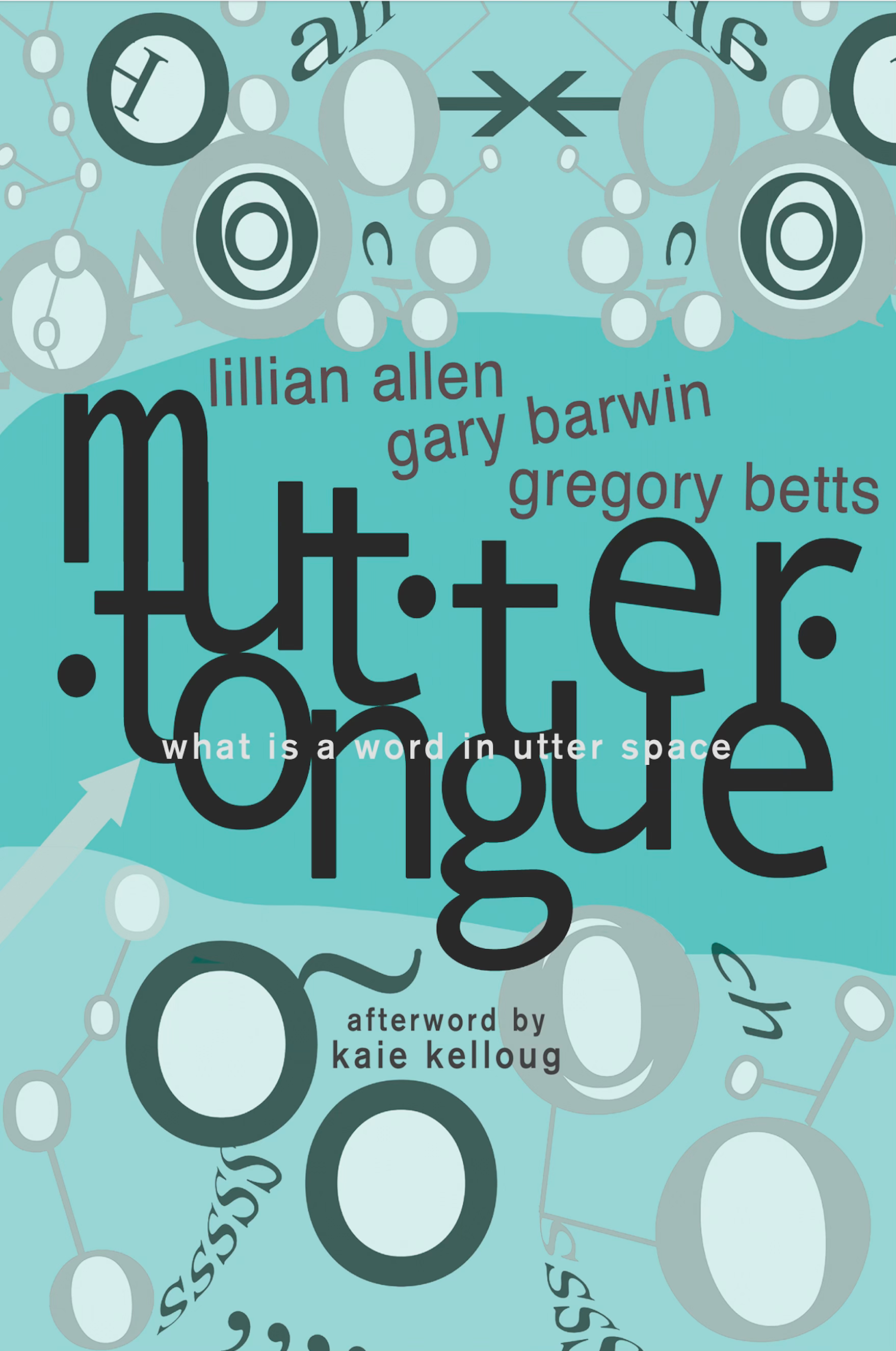
Formatted all in lower case, what is a word in utter space is a 57-page collection of poems (yes we’ll call them poems) and an album comprising nine recordings. Some items have words; many don’t. It’s experimental poetics, it’s what we’re here for. Track four is titled ‘The Unreadable’, which is how I would describe most of the book. I believe it’s meant to be that way. So why read it?
what is a word in utter space is published by Exile Editions, an independent, family-run, Canadian small press. Muttertongue Trio consists of Jamaican-born dub poet Lillian Allen, Jewish musician Gary Barwin and educator Gregory Betts. Muttertongue is also the name of the book, and the album. Both are, at times, delightfully playful. At other times, they’re headache-inducing.
The tracks on the album are mostly voice recordings with effects applied: reverb, layering, distortion. Track one, ‘Breathing’, for example, is a combination of guttural grunting, maniacal screeching, heavy stage panting, and orgasmic gasps. It’s immersive, and hard to listen to without giggling at the mental image of the three poets in process of recording it. It’s also hard to take seriously, but we needn’t – that’s fine. Track two, ‘Laughing Thumb’, has more of a jazz feel. There’s instrumentation: a bass guitar adds melody while a simple drumbeat keeps rhythm. Vocally, it consists of voice and breath. No words, nor singing per se.
In ‘Lullaby’, the poets make baby sounds, then discordant whale sounds. There is reverb. Track four is a reading of the poem on page 19 (they’re unnumbered), which opens with the lines: ‘what is a word / a word / what is a word / word / what is a word’, and continues in this way, eventually becoming slightly less repetitive and marginally more meaningful, without sustaining much movement in either direction. Track five introduces some funky effects. There’s attention to detail, it’s detailed noise. But it’s still just noise, with no discernible meaning. And then comes track six. At last, we have lift-off! By which I mean, the deliberative creation of meaning using heightened language. That which we usually call ‘poetry’.
‘What is a Word You Use’ makes references to the erstwhile Scottish colonisers of what we now call Canada. Confusingly, this sixth track corresponds to a poem on page 15, which is either the second, third or fourth poem in the collection, depending on your definition of the word ‘poem’. The first is a flow chart; the second consists of the sentence, ‘I’m taking a breath here / hence the blank page’; and the third is something like a cityscape made of printed letters overlapping so you can’t make them out. After these, the text of ‘What is a Word You Use’ is reassuringly scrutable:
they sailed stuffed in the Hector
cleared o’ Lochbroom
as mother sounds echo
from fo’c’sle to boom
before an unreadable land rising
what is a word you usesuch Scots that birthed a country
in the image of Gaelic sorrow
as mother sounds echo
in the lash of Old Tomorrow
peace, order, old horrors
what is a word you use
as mother sounds echo
‘Hector’ was a Dutch-built sailing vessel that took Scottish settlers to Boston Massachusetts in around 1770, and to Nova Scotia in 1773. Gaelic families had been forced off their ancestral lands ten years earlier by landlords seeking higher rents. The Industrial Revolution was underway, and cities needed more food. This in turn led to a change in attitudes towards land. Rather than simply a place to live, it became an asset. So “in the image of Gaelic sorrow”, Scots (specifically in this case crofters who had been cleared from the shores of Loch Broom, on the west coast) “birthed a country”. Or sort of: the first Europeans to settle the area were the French, who arrived in 1604. ‘New Scotland’ dates back to 1629.
Anyway, the voyage of ‘Hector’ took 11 weeks. En route, dysentery and smallpox killed a tenth of the settlers. Yikes. So what about the lines, “as mother sounds echo / in the lash of Old Tomorrow”? It took me a while, but I now understand that ‘Old Tomorrow’ is one of the nicknames given to John A MacDonald, the first prime minister of Canada, because of his tendency to procrastinate. Perhaps this is common knowledge among the Muttertongue Trio’s intended audience. Either way, the poem digs into some important history. But it doesn’t do much with it, besides repeating the lines “what is a word you use” and “as mother sounds echo”, and asking its reader to join the dots connecting the ‘Hector’, Loch Broom, the Highland Clearances and John MacDonald.
Back to the music. Track seven, ‘While’, sounds like a group of people trying to communicate with each other without having access to words, which is probably what it is: consonants and vowels and verbal gesticulations, in accents resembling French, German, and a Southern drawl. Then laughter, and (in my case) a yearning to listen to Adriano Celantano’s nonsense song, ‘Prisencolinensinainciusol’, which he wrote in protest after being advised to begin writing in the English language, and which is much more fun than ‘While’.
Track eight has, I shit you not, a solid beat. Listening to it is like inhaling pure oxygen
Track eight has, I shit you not, a solid beat. Listening to it is like inhaling pure oxygen. Track nine marks a return to the status quo: looped voices, echoed voices, sonic performance art. Voices competing with each other in what sounds like an argument. Anger. Frustration. But since there are no characters and no story, there’s neither feeling nor meaning, only the mild headache of listening to people shout at each other.
Speaking of headaches, let’s talk about the book. Its introduction describes the project as an exploration of … deep breath … “the space between oral cultures, orality, language, dub sound and semiotic-sonic play, working from a provocative premise that post-colonial and decolonizing forces in/against Canada are themselves a leading edge in avant-garde sonic literary expression and can be aligned with avant-garde experiments with language, coding and decoding, and pushing into new territories for poetic expression across cultures”.
It then launches into a conversation between the three poets. Lillian Allen says she feels language itself as a colonising force, because in order to form words, she has to “call upon certain cells” in her body. This is an interesting idea, but underdeveloped. “Is language like a cult? A currency for white civility? Can language decolonize, allow us to step outside social history and the colonial gaze? Re-chart possible futures? Can it shift social relations?“
Well, can it?
In this conversation, Allen, Barwin and Betts each explain how they have been exploring their cultural heritage – Jamaican, Yiddish, Gaelic. Between them, they make some charming observations. Betts remarks that Irish signmakers are often less economical with their words than their Canadian counterparts. He says his kids are “naturally suspicious of the tricks adults use with words – idioms, mannerisms, euphemisms, white lies“. And Barwin says language can’t be trusted. But their interaction lacks direction. Questions go unanswered or ignored, jumbles of queries fired out into the ether. There are non-sequiturs, and paragraphs that add little for the reader. The poets delight in playfulness; their conversation meanders. But one can write playfully, using language for fun, and still write in a way that engages an audience.
To the poems. But they are best not judged as poems. They consist of words, but they aren’t for reading. So how can we judge them?
I mentioned the flow chart and the cityscape. One poem consists of staves, timestamps, arrows and the words ‘[Music]’ and ‘[Laughter]’. Another is the letters ‘d’ and ‘b’ in columns, blurred and struck through. The one after it comprises two columns of blurred shapes. After that, a grey octagon shaded into a square, with the endings of words arranged into columns. Later, the word ‘looking’ is repeated 12 times.
Readers will decode pieces of word-based graphic art as long as they have the motivation and patience to do so
Readers will decode pieces of word-based graphic art as long as they have the motivation and patience to do so. Muttertongue reminded me of You’ve got so many machines, Richard: an anthology of Aphex Twin poetry (Broken Sleep Books, 2022) sections of which were deliberately uninterpretable. The reader can’t help but ask, what is the point? And if you can’t see one, why should you be expected to keep reading?
If these poets were my friends I would give them the benefit of the doubt. But I am a reader, a lay reader. I am confronted by squiggles on a page. Or words copied and pasted across multiple pages and half obscured by polygons. Visual effects applied to verses, or not even that, to arbitrarily ordered sequences of disparate phrases, reminiscent of a 12-year-old’s experiments with Microsoft PowerPoint circa 2006.
So yes it all looks very nice, or at least looks sort of interesting. Or at least weird, and therefore interesting if you like weird things. But this is published material, so it is not unreasonable to wonder why they’ve applied these specific visual effects to these specific words, what these specific effects add to the sequence of words, and so on. Whether they’re refracted and distorted, or reversed and obscured, or placed inside the outline of a three-dimensional shape, ought there not to be some discernible purpose to the visual element? So is there one?
The Muttertongue Trio evidently delight in playfulness. But the thing about good art – I think – is that play is only the start, not the whole thing
Muttertongue Trio evidently delight in playfulness. But the thing about good art – I think – is that play is only the start, not the whole thing. First comes the fun bit. Playing with language, coming up with wacky storylines, seeing what colours you get when you mix two paints together. Then you apply processes to it. Filtration: you weed out the rubbish. And crafting: you make it mean something.
This second process is iterative and requires rigour, discipline, patience and experimentation. It’s nebulous and doesn’t necessarily have an obvious start or end point. It involves putting ideas together and taking them apart again, committing to something and trialling it and knowing when to abandon it, being willing to sink time and energy into a thing without any reassurance that it’s going to work. And crucially, at some point during this process, you have to introduce the idea of an intended audience. It is true that we write for ourselves – by which I mean that we writers benefit from the act of writing. But who do we write for? Who do we publish our material for? To put writing done purely for our own amusement in front of other people is self-indulgent. To want them to like it is optimistic. To expect them to like it is, I’m afraid, misguided.
And what about expecting them to pay for it?
Exile Editions is an independent literary publisher based in Toronto. It was founded in 1976 by poet, novelist and artist Barry Callaghan, who had previously founded the magazine EXILE Quarterly, and it is currently headed by Michael Callaghan. Exile publishes poetry, fiction and nonfiction by authors from around the world.
Bruno Cooke is The Friday Poem’s Spoken Word Poetry Editor. He has lived in China, Sri Lanka and the Philippines, cycled in 50+ countries, and written for several news, opinion and humour websites. Find more of his creative writing on his personal Substack publication called My Special Interest.
As well as browsing our Substack, it’s worth visiting The Friday Poem website where you can browse our Archive of more than 700 posts dating back to early 2021.
Help support The Friday Poem – buy us a coffee to help us stay awake as we strive to bring poetic excellence to your inbox every Friday. If you can’t afford to donate, no worries, we’re going to keep on doing it anyway! Big thanks for everything, you lovely poetry peeps.