


Wortley heights
The police tape and paramedics remind you
that it took two fake wedding rings to get you up there,
that you had to tell the woman from the Council
you were pregnant and hope no-one checked.
The rent was a pittance but you were still so hard up
you walked five miles, did a day’s work,
then walked back, bought five tins of stewing steak,
one for each night of the week. It used to sway
in the wind, the city a marble rolling off the sideboard
and everyone you ever loved falling past the window.
’Wortley Heights’ is from Gain Access by Ian Harker (smith|doorstop, 2025), winner of The Poetry Business 2025 International Book & Pamphlet Competition — big thanks to The Poetry Business for letting us reproduce it here.
In 2016 the Yorkshire Evening Post reported a landmark ruling banning non-residents from entering two residential tower blocks in Leeds after “law-abiding tenants had endured years of misery at the hands of groups congregating to take drugs and binge drink.” The disturbing catalogue of problems included used needles, walls smeared in blood, lifts and stairs being used as toilets, homophobic and racist graffiti daubed on walls in blood and excrement.
Ian Harker’s latest pamphlet, Gain Access, contains privileged insights into the lives of residents of Leeds’ social housing stock. We see the precarious state of those lives, and that housing. The title, which I take to be directly relevant to the writer’s role as a housing officer, acts also as an invitation into his world and those of his clients.
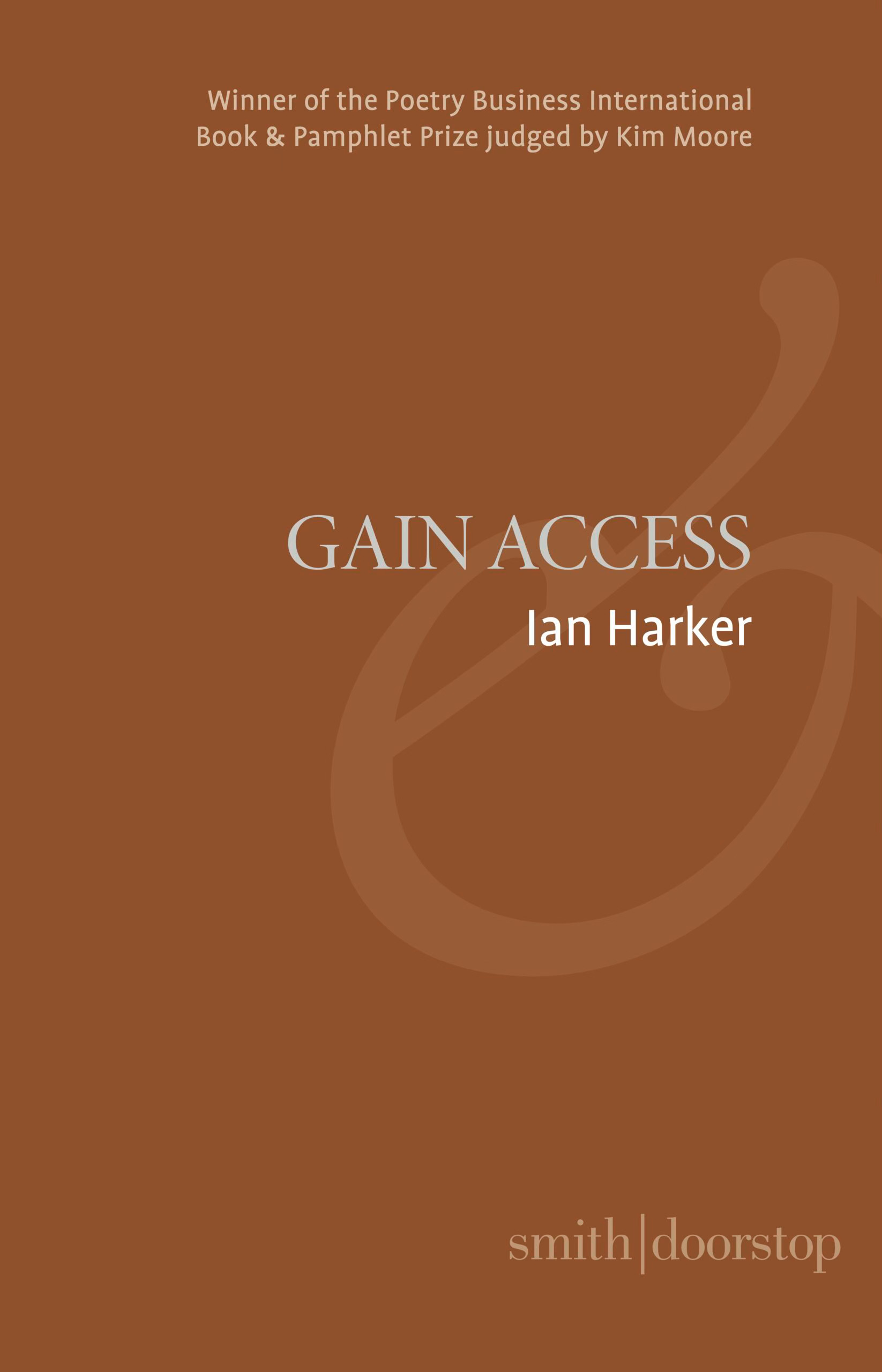
At its best, the writing gives us bursts of humanity alongside tales of despair and chaotic lives. In the title poem, as “(t)he joiner is drilling the lock” of a home, Harker is hoping that he won’t be greeted with squalor or violence and “that there aren’t two people / passed out in the bedroom.” This is a job requiring compassion (and a strong instinct for self-preservation). The housing officer’s lanyard is authority in this poem, although in ‘Strategies for coping with stress’ it is something to be removed after work “especially in Tesco”.
Harker’s writing is most effective – and affecting - when it unrelentingly compiles images of his clients and their situations. We sense how difficult the job is for him, and how demeaning it can be for them. We see it in the overwhelm of ‘The letters’ which “are waiting for you when you get home [...] in the street [...] when you go out”, or the litany of pathos and bathos in ‘Handover notes’:
How the Rottweiler cross
called Chaos is a softie.
How the guy at number 17 isn’t.About the parrot at number 1
with no permission who sings
Kid Creole and the Coconuts.
Elsewhere Harker gives his clients (invented) names; in this poem they are indistinguishable from their homes. And many of these homes are places we might prefer not to live, either because “Longtails” (rats) “are getting into people’s kitchens through amazingly small gaps / left by joiners” (‘Welcome to housing’), or because, as in ‘Sky Pool’, they are criminally-built death traps reminiscent of Grenfell Tower.
Poetry about work fascinates me, and the ethical dilemmas of writing about colleagues and clients (especially where duty of care is involved) are real. Hannah Lowe’s The Kids, is a fine example of handling this well. Like Lowe, Harker is never merely anthropological in his description of the people he is paid to (and tries to) help.
Harker is never merely anthropological in his description of the people he is paid, and tries, to help
‘Taxed’ – a retort to the under-occupancy rules of the 2012 Welfare Reform Act – depicts the collision of political theory and people’s physical lives:
The woman at the bus stop in the silver lamé trainers
is found to be hiding a spare bedroom in her shopping bag.[…]
The single Mum keeps hers concealed in her pram
[…]
Glen keeps his in one of his lock-ups. He should have handed it in
when Mum died
Remembering former clients in ‘We’ll meet again’, the poet shows us an old couple who “hope it’s alright” to have given some of their food parcel to a neighbour “because / We don’t eat pasta, not at our age.” He captures in a few lines their gratitude, their generosity, and their concern that they may have contravened some unknown regulation. And he shows us his compassion without virtue signalling or self-congratulation.
He is also generous is his depiction of himself when he’s doing his best, as in ‘Handover notes’, or feeling his worst, as here in ‘Strategies for coping with stress’:
It’s normal to hear your phone ringing when it isn’t ringing.
It’s normal to hear notifications on your laptop
when it’s four AM and your laptop is switched off in the spare room
and it’s Sunday and you’re in Spain.
It is not surprising that occasionally Harker’s righteous indignation steers him towards pronouncements such as those which close the first two poems in the pamphlet. The first, ‘Gain Access’, ends: “That one of them isn’t standing on the stairs /
screaming at me to get out of his fucking house”, and the second, ‘Welcome to housing’, ends: “No one has permission for anything.” I’m not convinced that endings like these are always poetically satisfying. Overall though, this is not only a work of great heart, and careful craft. It’s an important social and personal document.
Carl Tomlinson lives on a smallholding in Oxfordshire. He works as a business coach and virtual finance director. His work been published online, in anthologies, and in Orbis, South, The Hope Valley Journal and The Alchemy Spoon. His debut pamphlet Changing Places was published in 2021 by Fair Acre Press.
As well as browsing our Substack, it’s worth visiting The Friday Poem website where you can browse our Archive of more than 700 posts dating back to early 2021.
Help support The Friday Poem – buy us a coffee to help us stay awake as we strive to bring poetic excellence to your inbox every Friday. If you can’t afford to donate, no worries, we’re going to keep on doing it anyway! Big thanks for everything, you lovely poetry peeps.