


Regarding nature
all of nature with its forms and creatures
exist together, interwoven with each other.
tendrils flail, petals fall, a peal of silent
bells, a small world turns upon this axis
of abundance. each purple flower, each
thwarting thorn. to yield, or else to pierce,
to quell its reliquary perfume. small things
all. the night, aching with almond, lilies,
olives, dusk on the tongue, anise and pale
anemone. small things that call to care.
swinebread, sow-bread, cyclamen. there
is spiced and smoking flax enough to
wrap the word. to wither or to quicken.
must all our dewy hymns succumb to
dust? the flower is fleeting, but flowers
return. from forms and frailties infinite,
much yet to hope, much yet to learn.
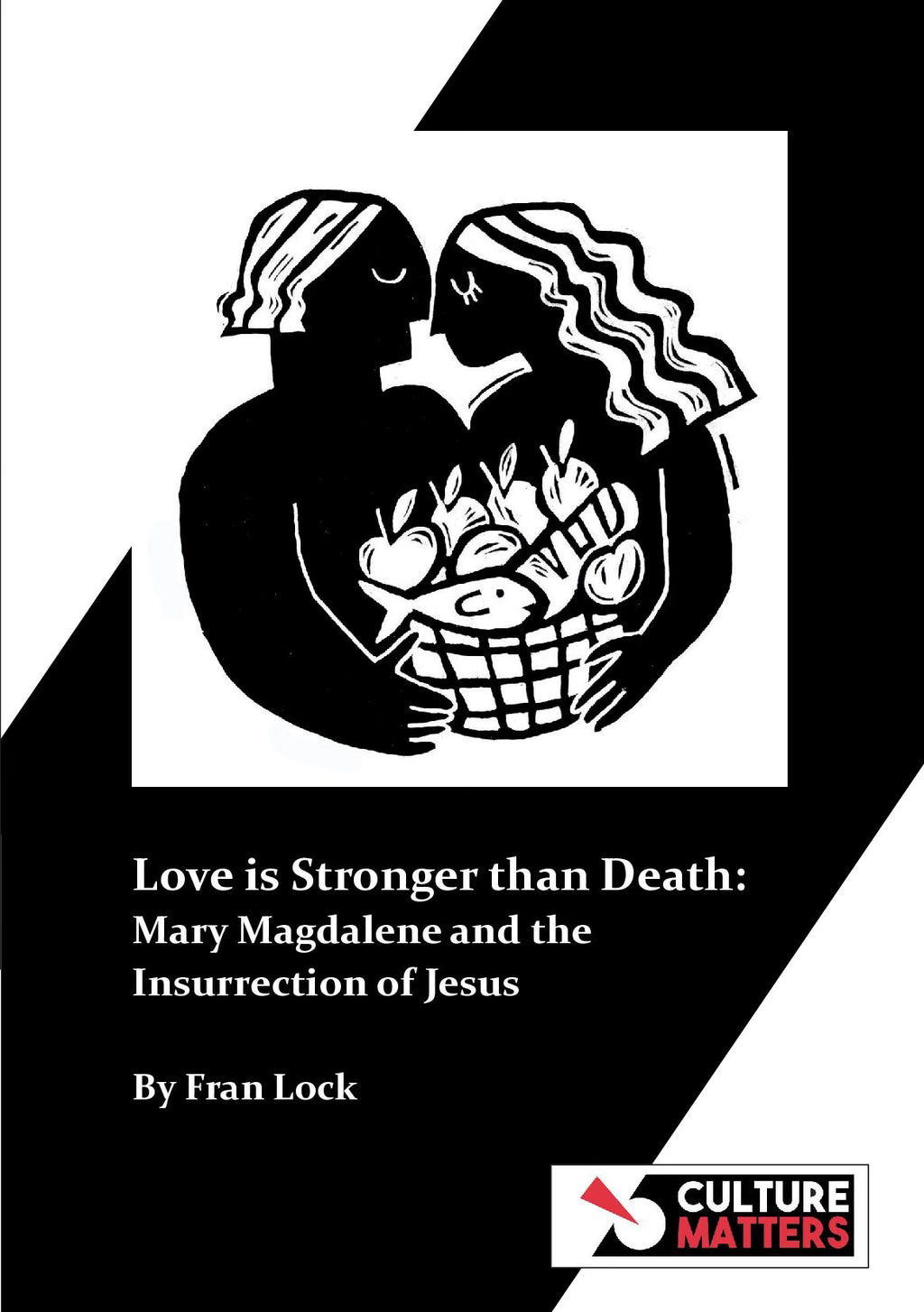
‘Regarding nature’ is from Love Is Stronger than Death: Mary Magdalene and the Insurrection of Jesus by Fran Lock (Culture Matters, 2025) — big thanks to Culture Matters and to Fran Lock for letting us reproduce it here.
In Love Is Stronger than Death: Mary Magdalene and the Insurrection of Jesus, Fran Lock is concerned with refocusing our view of the biblical Mary Magdalene – a medieval blurring of various different ‘Marys’ – and discarding the image of her as ‘redeemed prostitute’ that has been handed down to us via the distorting lens of the early church fathers. In doing so, Lock claims – or reclaims – both Mary and Jesus (and by extension the concepts of ‘God’, and ‘Love’) for a politically revolutionary cause.
As always with Lock, you don’t have to agree with what she is saying to admire the power of what she says and the skill with which she says it. But if you’re really going to engage with her and open yourself up to the radical treatment she gives these big themes, her lapel-grabbing poetic hectoring will require you to scrutinise your own views carefully.
The collection begins with an extract from George W MacRae’s translation of The Thunder, Perfect Mind from the Coptic Nag Hamadi scriptures, in which a female voice lists, with repeated ‘I am’s, her various and multitudinous seeming contradictions. This sets the oppositional tone for the collection, which does not let up.
I am control and the uncontrollable.
I am the union and the dissolution.
I am the abiding and I am the dissolution.
Intense and didactic, Lock’s poems build layer upon layer of the most beautiful and persuasive revolutionary rhetoric. They become as rhythmical (and perhaps as repetitious) as a fist banging on a tabletop. More than once I recalled footage of Lenin addressing the crowds in Red Square, because while this is in part a reassessment of Mary and her relationship with Christ, and of what Christian love might mean, it is also a revolutionary call to action in the manner of The Communist Manifesto. In place of ‘Workers of the world, unite!’, we have:
[…] so, on your feet, you
lumpenly done-by, insipid with
liturgy, picking the sin from the treads
of your wellies. get up […]
[…] up
you beautiful loafers, serfs, the barbed-
wire wills of you girl, like a slip
of paper in a psalter, pressed, up to
your ankles in pasqueflower. there
is trouble ahead, there is work to do.
(from ‘I come with the...’)
Lock’s Mary is drawn from the non-canonical Gospel of Mary, a fragmentary Coptic text which, in relation to Jesus, places her on equal footing with (or even higher than) the Disciples. She is not only the one person who remains with him at Calvary and the first to see him resurrected in his tomb, but she is also portrayed as an inspirational leader, trusted and loved by Jesus above all his other (male) disciples.
Lock claims – or reclaims – both Mary and Jesus (and by extension the concepts of ‘God’, and ‘Love’) for a politically revolutionary cause
The voice of all the poems (Mary’s voice, although it seems to blend with Lock’s own, particularly in those poems which address modern Britain directly) refers to Jesus as “my beloved” throughout; but the love being worshipped here is not sexual or romantic. It is not quite a Christian love either (although the multiple references to mouths, particularly open ones, do make me wonder if there is a hidden pun on agape /əˈɡeɪp/ and agape /ˈaɡəpiː/).
Love here is a powerful giving of the self to ‘The People’, a rejection of money and power in favour of the freedom of the oppressed from their oppressors. It is, in fact, a radical political impulse and intimately tied up with the notion of sacrifice, Jesus’s crucifixion being the ultimate example. But Lock takes it further. Just as the miraculous Resurrection of Christ comes about because of the political insurrection of Jesus (the cleansing of the temple), his insurrection in turn becomes a metaphorical prototype for our own reawakening or resurrection – a social rising, a surrection, or revolution:
[...] we
are the resurrection. the hinge
on which the word hangs,
the axis upon which history
turns.
(from ‘Our resurrection’)
As the biblical Jesus returned and rose from death, so must the ‘we’, the powerless, the proletariat (“the swaggering pentameters of truants and scallies”, “the men who exist on offcuts / of overtime”, “all the daughters of enforcement”), return from a symbolic death of apathy and rise against the powerful owners of the means of production, the bourgeoisie, the ‘them’ or, in the most accusatory poems, the ‘you’ (or ‘us’, I suppose, depending on who the reader is).
[…] you
are the bane and the burden. you break our
legs and sell us crutches. you’ve handed
us an apple, saying eat around the razor-
blades.
(from ‘and woes...’)
And so the powerless are to rise up against the powerful. Why? Lock is not suggesting anything as simplistic as a parallel between Heaven and some future Socialist Utopia. But we do, I think, find that her understanding of Christian and Revolutionary love leads towards a different kind of parallel, one between the Communist Manifesto, with its claim that “the free development of each is the condition for the free development of all”, and the Gospel of Mary, where Mary reports Christ as saying, “all of nature with its forms and creatures exist together, interwoven with each other”.
(Lock’s) understanding of Christian and Revolutionary love leads towards a different kind of parallel, one between the Communist Manifesto […] and the Gospel of Mary
In both texts, then, the wellbeing of the individual is fundamentally bound up with the wellbeing of the crowd. Lock uses a quote from Mary’s Gospel to begin ‘Regarding nature’, the most radiant poem I have read in a long time. It’s an unusually restrained 15-line piece in which we can almost see, touch, and smell flowers giving themselves to the world. It is utterly gorgeous, and ends with what is, for me, the collection’s lyrical heart and intellectual highlight:
[…] the flower is fleeting, but flowers
return. from forms and frailties infinite,
much yet to hope, much yet to learn.
As in Marx, and as in Mary’s Gospel, the strength of the One is rooted in the Many, and vice versa; and in that inevitable return of the plural, there is cause for hope. In a collection which defines much in terms of the negative, this positive core feels crucial. The positive does not leaven the negative, so much as show us the engine that powers revolutionary thought. What God is not is as important as what God is: “god is not a badge you polish to belonging”, “the kingdom / of god is not / a promise, but / a possibility”. These negatives are all of a piece with the revolutionary mindset. One thing must be pulled down, after all, before its replacement can be built.
And the same goes for the figure of Mary herself, who is purged of the Patriarchy in an early poem, ‘Seven Devils’, where Lock draws from Luke 8:2 and has Jesus cast devils of multiple but ultimately male ‘negatives’ out of Mary (“seven sins / seven stains, seven bosses — / seven men”). The voice that speaks to us in subsequent poems – on behalf of all women, in Lock’s view (“The fate of Mary Magdalene is the fate of all women”), is symbolically cleansed of the centuries of male misrepresentation and repression.
It is a voice that is impossible to ignore.
Chris Edgoose is a poet and blogger at Wood Bee Poet. He lives near Cambridge in the UK, and has had work published in several magazines in print and online.
As well as browsing our Substack, it’s worth visiting The Friday Poem website where you can browse our Archive of more than 700 posts dating back to early 2021.
Help support The Friday Poem – buy us a coffee to help us stay awake as we strive to bring poetic excellence to your inbox every Friday. If you can’t afford to donate, no worries, we’re going to keep on doing it anyway! Big thanks for everything, you lovely poetry peeps.