


THE CLIMBING VINE
From rocky soil it came
from next to nothing
stretched on the rack of its genome
the pain of its talent running through it
embracing the legs of the decking for comfort
Unidentified           no immediate family
exiled from the chatter of annual plantings
not much in common with the cavalier flowering perennials
Even the sun said          Whoever you are
I am not made of moneyEverything it owned strapped to its body arm over arm in its wet clothes it hauled itself to the second-floor balcony
            and where it spread out            redistributed its weight
like a traveler on a platform
the structure’s joints creaked
and the muscles stood out in the nails
Had they let it            it would have scaled the house
            to stand on the roof where God might notice
what had been accomplished in his absenceWould have torn the house down and stood on the ruin
tossing its hook at the downspout of heavenThey pruned it its strength of conviction redoubled
Cut it back to the trunk
a litter of tendrils wobbled outRazed it to the ground a shoot appeared like a prisoner through a manhole They had to eradicate it at the level of the idea
But here …
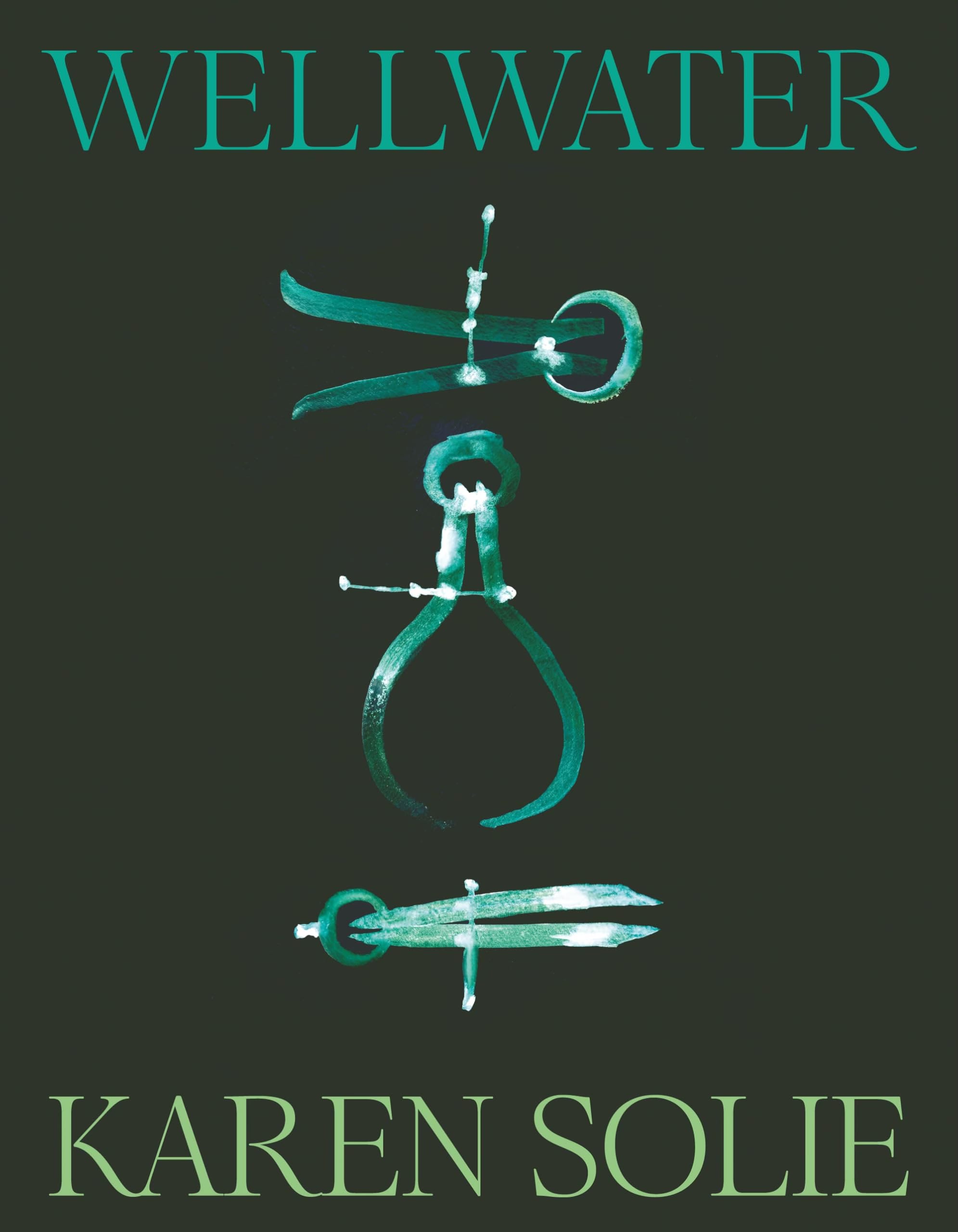
The Climbing Vine is from Wellwater by Karen Solie (Picador, 2025) – big thanks to Picador and to Karen Solie for letting us reproduce it here.
Karen Solie’s latest collection, Wellwater, has been shortlisted for the 2025 Forward Prize for Best Poetry Collection, and for the T.S. Eliot Poetry Prize 2025 – what do Friday Poem Editors Helena Nelson and Hilary Menos think of it?
Helena: So we’ve both read this book, perhaps a couple of times. We agree there are things we like, though there are a few reservations. It feels like a long book, not just in page length. I had to concentrate hard, because although some poems connect immediately, many require multiple readings – and even then, one can feel partly mystified. I loved ‘The Climbing Vine’ but I’m not sure whether this was because it was easy to follow, or because it’s an outstanding poem. Perhaps a bit of both.
Hilary: Yes, I also like ‘The Climbing Vine’, for many reasons, not least because it reminds me of that lovely poem by Simon Armitage,’Incredible’, which ends:
[…] With the critical mass
of hardly more than the thought of a thought
I kept on, headlong, to vanishing point.
I looked for an end, for some dimension
to hold hard and resist. But I still exist.
Helena: I can see a connection – but the two poems are completely different! The Armitage poem has a clear first-person narration, and it’s about shrinking, isn’t it? As the ‘I’ gets smaller, the world seems bigger; the perspective changes. Whereas the Solie poem has no lyric ‘I’. It’s all about a growing plant, a vine, which is getting steadily bigger. It’s about being unstoppable.
Hilary: I think both poems are about persistence. The incredible shrinking man continues to exist, no matter how small he becomes. The vine, too, has been attacked, razed to the ground. But in the face of attempts to obliterate it, it just keeps on coming. ‘The Climbing Vine’ has no lyric ‘I’, that’s true, but it might still represent a person. Or life in general – is it about the persistence of life despite everything? It’s clearly what one would call an eco-poem, with suggestions of genetic engineering gone wrong, perhaps, but to me it also seems to be to bring in echoes of scarce resources, climate refugees, invasive species. I find it quite threatening.
Helena: One review suggests The Vine’ might be about Solie herself, but I don’t think so. It’s unusual for her in having one central metaphor (the vine). She often throws in masses of imagery doesn’t she?
Let’s take a look at ‘The Trees in Riverside Park’ to tease out a few of her regular techniques. It’s a snow poem, set in a park in Saskatchewan. People are walking under the trees, and it reminds her of a childhood time when she and her brother were left in the car together in the snow, which in turn brings to mind their family home (a farmhouse) under the night sky. Then she zooms back to the present, in the snowy park. Here are the opening lines:
THE TREES IN RIVERDALE PARK
Diagonal paths quadrisect a square acre
white as the page in February.In the soil of this basic geometry
ash, elm, and maple thrive like understandings
whose bare logics are visible,
understandings the theorem has allowed.Between roam bodies of the sensible world —
people, dogs, all those lovers
of the material and immaterialillumined, as under working hypotheses,
by sodium bulbs whose costly inefficiencies
Los Angeles and Philadelphia have apparently
moved on from.
Hilary: As you said earlier, dense imagery and (for me) a general feeling of slipperiness. It starts quite simply with that white acre of park cut diagonally by paths. But why “white as the page in February”? The page is always white, isn’t it, while the park is just white when it snows? And this is only line two. So she’s playful, and a bit tricksy. But she also feels serious, as if she’s saying something momentous; she uses abstract nouns like ‘loss’, and big words like hypothesis, autonomy, periphery, theorem, representation. I found the mathematical terms a bit full on. And what’s the poem actually about?
Helena: I think maybe it’s a grief poem, and there’s a dead father behind this book, as well as the whole environmental damage thing. So it might just be grief and snow that make the poem ponderous.The park isn’t as white as snow in February. You just think it is because of her circuitous sentence structure. She really means: ‘in February the square acre is as white as snow’. But her chosen word order sounds smoother.
Hilary: Oh, OK. Do you think the wrong-footing is deliberate, a kind of joke? As for the central theme, yes, I can buy that it’s about loss, or death, and grief at loss or death, especially bearing in mind the last four lines:
bare spots left by departed cars demonstrating
how the outlines of loss might gradually alteras experience is filled in by its representation,
even if not made peace with.
I like that concluding image, and I feel I know what she means. But it’s pretty much in spite of the words rather than because of them. She does like it complicated – what on earth is the “representation” of experience? I get the bare snowless patches softened by falling snow over time and eventually covered (possibly totally) by snow. But the representation / experience line messes with my head.
She does like it complicated – what on earth is the “representation” of experience?
Also, I’m not sure what the rest of the poem is doing. This part near the end: “Now snow is blowing through the theorem / that the understandings broadly accommodate, / and sensible bodies adjust their collars to”, for example. Is it that she feels death is part of life and the sensible, adult response to it is to adjust to it? The snowscape makes sense as a way into that final “departed car” metaphor. Still, I don’t really follow this bit:
I’ve never understood what ‘starlit’ means.
On a clear night in their millions
they cast no discernible lightinto the dark expanse where a farmhouse sat
sleepless in its chair, and grid roads and bullshit caragana
disappeared, where the animals’ lives played out,
smells travelling slowly, low to the ground.
‘Starlit’ rather comes out of the blue. Then there’s a sudden switch in tense from present to past. Solie’s family did farm, so the building may be theirs, but a “farmhouse” that “sat sleepless in its chair”? “Bullshit caragana”? (Caragana is a tree – a Siberian pea shrub). My guess is she’s bringing in stuff from childhood to locate herself in a rural setting, but it makes for an odd little episode in the poem. Could it do without these lines? Hmmm. Is this about pace? Does the poem need a small section of something between the childhood bit and the present moment in Riverdale Park? Maybe. Either way, I like the way she loops off into the past after setting up that “theorem” imagery early on, and then comes back to it with:
Now snow is blowing through the theorem
that the understandings broadly accommodate,
and sensible bodies adjust their collars to,
But I have to say I really don’t understand what the theorem is, or what the “understandings the theorem has allowed” are. If I knew more maths would I understand it? It is rather delicious all the same.
Helena: The “understandings” are the trees, the ash, elm and maple, I think. At least the trees were described as “understandings” earlier. But I don’t think you can get inside the theorem. Whether deliberately or not, the metaphor’s muddled. The trees are logics/understandings allowed by the theorem. They’re thriving in the soil of geometry. But then the trees (the logics/understandings) later accommodate the theorem, through which snow is blowing and goodness knows what she means. By this point, literal snow has met metaphorical theorem and it’s an imagery blizzard. But the poet is enjoying herself. It makes sense to her.
Whether deliberately or not, the metaphor’s muddled
Hilary: Maybe I’m particularly literal, or sense-demanding. I feel I should be able to understand what she means by the theorem, the understandings, etc, and when it comes back around at the end, it should all make sense and add up. When I can’t process it to make metaphorical sense too, I feel inadequate. It’s a relief to hear you say her metaphor is muddled. But is this intentional? Is she suggesting we have to accept confusion in the world? I go back to “as experience is filled in by its representation” and I want to understand what she means, I really do. But I don’t.
Helena: I think she’s having more fun than is immediately obvious. I think all that theorem stuff is a kind of having fun, and so is remembering being left in the park for hours in a car with the engine running. That’s an awful thing to do to your children, though it’s a great family horror story. But I’d say her imagery is unrepentantly elaborate, and I fear she also enjoys ending sentences on prepositions (“sensible bodies adjust their collars to”).
Hilary: Yes, this is interesting. I flip between finding her on the one hand rather po-faced, and on the other, quite funny. She can be very throwaway. In the opening poem ‘Basement Suite’, for example, the basement is “cold on five sides, like childhood” and later there are “bars on the windows / in some places, like childhood”. The first use of this simile is shocking, an insight (maybe) into her own early years; it certainly conveys a dark sense of what a child might experience (neglect / abuse), familiar moaning-poet territory, though restrained. But what about the second instance, the bars on the windows? That’s a bit melodramatic. It opens the way to something like Stella Gibbons’ Cold Comfort Farm where Aunt Ada Doom saw something nasty in the woodshed. And yet Solie doesn’t go there. There are sharpening knives but “It’s not the underworld for Christ’s sake”. She’s walking a line.
Helena: She’s quite capable of writing in a straightforward way. Take ‘That Which Was Learned in Youth is Always Most Familiar’, for example, which immediately follows ‘The Trees in Riverdale Park’. It’s the one about her little nephew. A true story. Is this poem a tour de force? Or just powerfully emotive?
Hilary: Emotive. It’s an easy poem. Easy to understand, anyway. This five-year-old is inspired beyond his years:
[ … ] Auntie, I think there are two kinds of shapes.
Replaceable and irreplaceable shapes.
Triangles, circles, squares, we can make them. But this
— he held a clod of earth —is an accident. Will never happen again.
He threw it to the gravel
where it shattered in a rhetorical flourish
of one example made variousand each, he promised, singular.
Maybe we like it because it’s much more straightforward than its predecessors, we breathe a sigh of relief, and are better disposed towards it. The stanzas go in and out, like the varying shapes in the poem. It sounds like a profound idea – to divide the world into replaceable (he probably means conceptual) shapes and irreplaceable (unique?) shapes, but actually I’m not sure it’s all that profound. She’s attracted to the little boy’s notion of irreplaceability, it feeds into her position on environmental change. But theoretically that clod of soil could recur in precisely the same shape (monkeys, typewriters, Shakespeare). The poem is a rhetorical flourish in itself.
Helena: He’s five. Did he actually say irreplaceable? Or unreplaceable?
Hilary: He said irreplaceable. That what she says he says, anyway. Before the little boy speaks, she reflects on her own assumptions about childhood (just about to be disrupted). She says she never believed children had “an essential knowledge or intuition / that age, like water, like wind erodes, / in ignorance recast as innocence / by all the insipid diocese of wellness”. The what?
Helena: I think we’re victims of her circuitous sentence structure. She had never believed in the privileged insight of childhood (the whole Wordsworth thing). So far so good. But when she gets to “in ignorance recast as innocence”, this also completes the phrase “having never believed”. At least this is how I read it. If the completing clause wasn’t separated from the active verb by fourteen words, four commas, and a stanza break, it might read: “having never believed in ignorance recast as innocence”. As it is, the structure of the sentence is daunting. And yes, the “insipid diocese of wellness” is baffling. I would have thought “ignorance” is “recast as innocence” by ingenuous adults. The diocese is a step too far; and I’ve no idea why “wellness” is appropriate.
Hilary: Apart from a reference to wells, perhaps. But I do like the way she says – when referring to the mental “factory systems” romanticising children’s perception – that we need to be “reprogrammed”, “and the sooner the better, actually, / I’ve been a child”. That’s a lovely throwaway line. I like how she chucks that in.
I have a different problem with ‘Red Spring’, which is the sort of poem that attracts disproportionate attention. Jade Cuttle in The Guardian, for example, is hot on the trail. “The pages reek of fungicide and glyphosate, a weedkiller that is linked poignantly by the poet to a case of non-Hodgkin lymphoma,” says Cuttle (with relish). Environmental damage is topical; everybody understands it. But for me, there are so many chemical names that they lose their impact. Also, little subtlety. She says “I’m sorry, I can’t make this beautiful” – well, I think she needs to try harder, although beauty isn’t a prerequisite. This is a six-page piece, double-spaced in quatrains, and I’ve tried a number of times but I can’t read it right through – I feel hectored (“new viruses, fusarium head blight / against which are deployed the foliar fungicides // — ProsaroTM, FolicutTM — ”). I was writing about pigweed and algal blooms and birth deformities in Paraguay in Red Devon in 2013 – we farmed a 100 acres in Devon organically – so I’m one of the converted. But to me this feels more like tirade than poetry.
Helena: So were there poems you particularly liked? Any favourites?
Hilary: I like ‘Autumn Day’, which has fourteen long lines so perhaps it’s a fat sonnet. The setting involves people queuing in a town, to settle bills perhaps, or carry out bank business. I love it when she refers to a nearby coffee shop with “the vulgar muffins, overstuffed as geese / with funnels down their throats, truly the muffins of a culture on the brink / of steep decline.” What a wonderful image – the muffins in their paper cupcake cones, blowsy and overflowing, all wheat and sugar and cheap fat and certainly indicative of a culture in decline – we all know that a Western diet is associated with obesity, diabetes and heart disease. And I can really see how she arrives at the muffins as geese, with cones in their mouths, being fed grain to fatten them up.
Though if she’s also implying that the practice of gavage is indicative of a culture in decline I’d disagree. It’s been going on for 4,500 years, and locals here in the Tarn do it in the old way, by hand, with flocks of thirty or forty birds. And French culture isn’t in decline. In fact, it feels as if France – with its language of diplomacy, its Liberty, Égalité, Fraternité, its two-hour lunch (now on the UNESCO list of “intangible cultural heritage of humanity”) and its commitment to women’s rights (abortion is a constitutional entitlement) may be best placed to withstand the decline of North American culture.
Helena: Vive la France! Let’s talk about ‘Wellwater’, the title poem. Initially, I struggled to ‘get’ it. Now it seems more straightforward than many others. And it’s a poem that works on its own, that you could easily share with someone. Everybody has memories of childhood when – for nearly all of us – things seemed simpler and purer. In this case, she recalls driving a farm truck in summer to get water from a well. A hot day, and the poem ends with her drinking the water, which in those days wasn’t contaminated with chemicals.
Hilary: I like ‘Wellwater’ a lot, actually. It seems to me to tick a lot of the boxes I want a poem to tick. I like her tone – she writes with authority and evokes a sense of range and sweep. Maybe something like Les Murray’s sprawl. Her poetry feels large – it has that reach that I associate with American poetry (yes, I know she’s Canadian), but it doesn’t lose touch with the domestic and interior parts of life. She’s very human.
I like her tone – she writes with authority and evokes a sense of range and sweep. Maybe something like Les Murray’s sprawl
I particularly like the way she slides from the specific and mundane (baby oil, derricks) to the much higher register of the cathedral rock, from the reverential “site of worship” to to her throwaway “a mistake I’d made and lived to regret, / which is the only way I ever learn anything”.
My only reservation is about the word “souls” (”this site of worship / from which song was drawn to feed the souls / of planted trees not native to that place”). You have to earn the right to use a word like “souls”. I don’t think she’s done that here. I’d prefer the prose (and prosaic) version, i.e. just call the “souls” roots, and have done with it. That aside, I think it’s a banger.
Helena: Like ‘Autumn Day’, ‘Wellwater’ is a single block, though with narrower lines, and more of them. And it fits inside one page, so a manageable compass. I didn’t particularly mind the souls. But I had word order problems, like the page in February. I hit trouble in the opening lines:
I didn’t know what I had,
drove the watertruck underage to the well
in a swimsuit, anointed with baby oil
to encourage a uniform exposure,
a mild burn atop the tank as it filled
in that burgeoning era of means
to an end.
I got all snarled up here. It wasn’t wilfulness. I had an underage watertruck and a well in a swimsuit. And was the oil on the swimsuit, or was it on her? I puzzled over the “mild burn” on top of the tank too. Was it an oil well? (I’d forgotten the title by now.) I thought the tank was burning, but it must be her, right? Getting sunburnt? Then I was mildly irritated by the flourish in the line-break between “means” and “to an end”, a predictable trick.
Obviously you didn’t have difficulty with this opening. But once you’ve misread, it’s hard to undo the damage. Why couldn’t she say she was wearing a swimsuit while driving? Why does she have to squash so much detail into one sentence? Why does she complicate matters with line breaks that disrupt natural phrasing?
Hilary: It’s complicated, it requires some teasing out, it could be made easier, but I guess Solie doesn’t want it to be easy. And it sounds so good this way.
Helena: I’m not persuaded by the sound. But then it starts to run more smoothly. Except I’m lost with: “Blondie tore a strip off the wheatfield”. Is it my age? Is Blondie on the radio? If so, I still don’t understand the point.
Hilary: I’m assuming she’s referring to Blondie, the American rock band, set up and fronted by singer Debbie Harry. But “tore a strip off the wheat field” isn’t entirely clear. I know what to tear a strip off means – to criticise forcefully – but it sounds to me as if Solie is describing someone combine harvesting a wheat field in strips. While Blondie plays on the radio, perhaps. The agricultural reference fits.
Helena: I had to look up “malathion” but I didn’t mind that, and “glyphosate” had already made me think it was a chemical. (You, with your farming background, would already know.) I easily followed the important concluding section, except for the “cathedral”, which I looked up (a type of rock, a gift for this poet of souls). By now, she’s slipped in one line containing two end-stopped sentences (“It took 75 minutes. The things you remember.”). And her last line is one grammatical unit, and a humdinger: “The water, then, you could still drink it.” So she can spell it out when she wants to. On balance, I think it’s a resonant piece. And what it says is key to her theme of environmental damage, so it’s a good title poem. But I don’t love it.
I might love ‘Antelope’ (p 69) though. And before we close, I’d like to talk about the one before that, ‘Grasslands’ (p. 61), another fairly long piece.
Hilary: Whoa, yes, ‘Antelope’, exactly. What a tour de force! It opens:
They appear out of nowhere as if they know where all the doors are
between our dimension and where they are called
by their true name, where they are not the last survivors
of their evolutionary niche.
After that, it just gets better and better. It has many of the hallmarks of a Solie poem. It’s concerned with the environment – the “great plain” is now “aligned to the grid of monoculture”, and the antelope are “the last survivors / of their evolutionary niche”. It has splendid imagery, like the pronghorns brandishing their “hardware” (horns, presumably). She jumps from the huffing beasts to how they run, “entering a sublimity of motion that is like the sublimity of night.” She’s still sounding momentous, and having fun with words, but in the context of these amazing creatures, it’s appropriate. And there’s also a Dodge Polara with a big-block V8 engine, so she’s firmly at the gritty end of prairie pastoral. I love this poem. Do you?
Helena: Well, I love your phrase “at the gritty end of prairie pastoral”! But yes, I like this poem a lot. The opening phrases please me aurally, the play between “nowhere” and “know where”, and then multiple sound echoes: “appear”, “where” (4x), “doors”, “are” (x3), “our”, “their” (x3), “survivors”. There are even rhyme-echoes at the end of some lines : “barbs” / “forbs”, and at the end of the last two lines: “vision” / “Saturn”, which intensifies the closure. But I’m a little puzzled why she calls it ‘Antelope’ when she also makes it clear that this isn’t the “true name” of the pronghorn.
Hilary: Yes, I had to go and look that up too. Wikipedia says “Though not an antelope, it is known colloquially in North America as the American antelope, prongbuck, pronghorn antelope, and prairie antelope, because it closely resembles the antelopes of the Old World and fills a similar ecological niche due to parallel evolution.” I guess that satisfies me – the pronghorn represent the spirit of the past, of the Old World (Africa, Europe and Asia, thought of as the whole world by Europeans before they discovered the Americas), and Solie sets them in the present, in the ‘New World’ of the Americas, and the new world of industrial agriculture, the grid, intensive mono-cropping, etc.
She refers to antelopes in ‘Red Spring’ too, as “grass-fed spirits from the otherworld, before the grid”. One gets a real sense of fundamental change, of rift, of break, of a world transformed (and not in a good way).
Helena: I love the moment where there’s a sudden role reversal and the pronghorn speaks about her: “WTF is that / walking on the road”? It’s funny. And it works. I can see the expression on the pronghorn’s face. Like most of her poems, though, there are points where her imagery mystifies me. Why is the ground also “the prairie’s hall / of mirrors”? I can’t work that out. And although I love the last line, and I find the penultimate line both curious and attractive, I don’t understand it. She says the pronghorn “haunts / the open country, a candle in the five-mile corridor of his ten-fold vision”. These creatures can see a very long way. But is the open country a candle, or is the pronghorn the candle? Could it be a reference to its white rump patch?
Hilary: I thought the hall of mirrors referred to the fact that there are so many pronghorn that everywhere they look, they see something much like themselves.
Helena: Oh yes, I see that could be so, although as an image, I don’t visualise it easily.
Hilary: As for the candle, yes, I’ll buy the possibility that she means the rump. When a pronghorn is alarmed the white hair on its rump stands up. It doesn’t look much like a candle to me, but referring to it as a candle gives a reader the sense that it is a delicate and vulnerable thing that might be easily snuffed out. The reference to ten-fold vision, and also that rather lovely last line, probably derive from a meme which did the rounds in 2021. It claimed that because pronghorn had ten times magnified vision, they could, on a clear night, see the rings of Saturn (this has been debunked by Snopes).
Helena: This is amazing. I’m so glad we talked about it. I would never have deduced all this. Let’s move on to ‘The Grasslands’, which I think is the same territory, the huge rolling plains of Saskatchewan.
Hilary: I thought at first ‘The Grasslands’ was just another eco poem. It seems to address settlement of Indian lands by immigrant farmers, their destruction of the natural topsoil, and the transformation of the agricultural heartlands from Montana to Texas into the Dust Bowl (“the land blew away without the grass to hold it down”). The “back country” has distinct pleasures:
sylvatic plague in the fleas
and the fleas on the prairie dogs
in the prairie dog town featured in the brochure,rattler, coyote, black widow spider,
the water saline, you can boil it all you want.
“The best thing for it may be that we are not there,” says Solie, then asks, “But what good is a place left on its own?”
But on the fifth page of this five-and-a-half-page poem, with stanzas ranged all over, she says “And what good are you / left on your own? / Unmet at the meeting point, obsessed with endings, / all the nothing really adding up?” and suddenly it starts to feel like a much more personal piece. Is this where you went with it?
Helena: I found the opening bit about indigenous peoples distracting, because it has little to do with where the poem is going, but it’s emotive. It makes me think the ‘we’ of the poem is the avaricious immigrants (namely white westerners). But later I think ‘we’ is the whole human species versus the great grasslands, the unimaginable stretch of the galaxy, and I’m more attracted to that idea.
As well as the two similar statements you just quoted, there’s a third: “what good to us / is a place left on its own?” The addition of “to us”, emphasised by the line-break, further reinforces the idea of human self-centredness. The place left on its own does just fine (“the kingdom of grass is the kingdom of means”) but it provides no human resources. And yes, I think she switches deliberately into the personal, though using second person (“What you need to hear you must tell yourself”) to let it include the reader. By the very end, I have an image of a human being, absolutely tiny under the stars.
find it interesting (given the pervasive and emotive idea of human damage to nature) how much personification she uses … Humans get everywhere – they even take over the imagery!
I find it interesting (given the pervasive and emotive idea of human damage to nature) how much personification she uses: the grasses that “pass teaspoons of silence”; the “hospitality of grass” as a “dry loaf, cracked cup”; “an elderly grass blade / shrugging off a shawl of frost”; the river “muttering about irrigation”; and at night “a fragrant interval leans over your bed / like your parents in evening-wear on their way out the door”. It is utterly seductive. But it’s the antithesis of our insignificance, don’t you think? Humans get everywhere – they even take over the imagery! Even when she gets into the huge impersonal vista of the heavens, “The stars and planets’ backs are turned, they are deep / in a conversation of millennia”.
Hilary: Yes, that is interesting, and maybe also her point. The hubris of humans? It’s an old theme …
But I think I detect something even more personal than that in here. It feels to me as if Solie is facing her own solitude and dealing with how that feels for her. “Under the darkest night skies on Earth / an explanation is not forthcoming.” She finds no answers. That’s quite something.
Helena: Yes, I agree. She doesn’t use ‘I’ but this feels absolutely personal. I’m sure I would feel something similar out there in the dark such a remote space. It’s both scary and attractive.The poem incorporates a lot of sprawl in its lay-out, its space, its long lines, and it matches the landscape, you might say. But does it earn its five-page length, do you think?
Hilary: Yes, there is a lot of space in this poem. There are some long lines, but many of them are very short – just two, three or four words long – the stanzas (such as they are) are mostly two or three lines long, sometimes just one line, and many are single- or double-indented, so it’s very much not a blocky poem, more of a rangy, rambling poem full of pauses and deviations and digressions. A bit like the Frenchman River “meandering its tilted valley […] swinging its head side to side like a working horse.”
Long poems often come from people who think they have a lot to say and are determined to say it. But I find Solie’s work unassuming and quiet, and this makes me prepared to trust her. And in fact the poem seduces me, from one line to the next. The length and the layout slows my reading down, and I savour it. So I’m good with the length. But I sense that your answer might be different?
Helena: I found the first page, the long view of human incursion into the grasslands, distracting. I like it better when we reach the issue of humans versus nature, as opposed to humans versus other humans. On the other hand, the first page sets the scene, and the slow development. I like the early question: “Is it beauty, all this grass?” and the way she slowly works her way towards a beautiful answer:
the silvery, slender, rough,
needle-leafed, wavy-leafed, cut-leaf, thyme-leafed,
wild, false, tufted, and procumbent,
fringed and nodding, the long-bracted, shaggy,
pleated, brittle, the creeping and the smooth,
panicled and pale, common
and endangered,
So on balance I think length is a necessary feature, and its easy sprawl is far more satisfying than the one with all the chemicals (although the six pages of quatrains in ‘Red Spring’ are double-spaced, so it’s really shorter).
Hilary: Let’s talk about the final poem, ‘Canopy’. Always interesting to consider how a poet chooses to conclude a collection, I think. It’s a kind of elegy for times past, isn’t it? She’s remembering childhood picnics with her father, lighting camp fires, watching the owls. It has that same quality of reaching back through time that we talked about earlier. But things have changed for the cottonwood trees:
The heavy equipment passes
beneath them more often now,
edges of the widened road approach
yet they are there still, in excessof their average lifespan
and function. In spring
they champagne the air with cotton.
This isn’t exactly optimistic, but it isn’t havoc and destruction either; the trees are still there, against the odds, and now there’s celebratory champagne too. And the memories are good.
Helena: Yes, I think Canopy’ is a neat follow-on from the previous sonnet featuring her father (I imagine he’s the Howard Solie to whom the collection is dedicated). In fact, the two previous pieces are both fourteen-liners, perhaps love poems, first to a meadowlark, then her dad. Each is reassuring and uplifting in tone. These concluding poems are warmer than “all the nothing adding up” in ‘The Grasslands’. In ‘Canopy’, we see that her dad grew up in this territory. For her (as well as for him as a child) the canopy’s a safe and magical space. It stands outside time:
It was the same, Dad said,
when he was a child, owlets
in their canopy beds, time eddying
deep in the shelter of the cottonwoods
where demands of the yard and fields
couldn’t enter, as though by a spell
we didn’t cast but that welcomed us.
I love the owlets, and they’re mentioned twice: the innocent, the vulnerable. These young birds are peeping out of a tall thin poem (tree-shaped?). Karen Solie has thoughtful variety of shape in her work, always a connection between form and content. I don’t find the sound of the last poem as lyrically satisfying as the opening lines of, say, ‘Antelope’, but I like its world. And the way she builds aural resonance towards the end with‘n’ sounds rippling through “lifespan”, ”function”, ”spring”, “champagne” and ”cotton”. It’s a pleasingly musical line to end on: “they champagne the air with cotton”. I’ll take a glass of that.
Helena Nelson is a poet, critic, publisher and the founding editor of HappenStance Press and Sphinx Review. Her first collection, Starlight on Water (Rialto, 2003), was a Jerwood / Aldeburgh First Collection winner. Her second was Plot and Counterplot (Shoestring, 2010). She also writes and publishes light verse, including Down With Poetry! (HappenStance, 2016) and Branded (Red Squirrel, 2019). Her most recent collection is PEARLS: The Complete Mr & Mrs Philpott Poems (HappenStance, 2022). She is Consulting Editor of The Friday Poem.
Hilary Menos won the Forward Prize for Best First Collection 2010 with Berg (Seren, 2009) and is a two-time winner of The Poetry Business Book & Pamphlet Competition with Human Tissue (2020) and Extra Maths (2004). Wheelbarrow Farm (Templar, 2010) was a winner in The Templar Book & Pamphlet Competition 2010. Her second collection is Red Devon (Seren, 2013), and her most recent pamphlet is Fear of Forks (HappenStance, 2022). She read PPE at Oxford, took an MA in poetry at MMU, and has worked as a journalist, organic farmer, dramaturge, and builder’s mate. She is Editor of The Friday Poem.
As well as browsing our Substack, it’s worth visiting The Friday Poem website where you can browse our Archive of more than 700 posts dating back to early 2021.
Help support The Friday Poem – buy us a coffee to help us stay awake as we strive to bring poetic excellence to your inbox every Friday. If you can’t afford to donate, no worries, we’re going to keep on doing it anyway! Big thanks for everything, you lovely poetry peeps.
Just to say that, in these postings, I very much enjoy the way you dissect poems in such careful detail between you, and don't always agree exactly (!). Thank you.
This was excellent! "The insipid diocese of wellness”, refers, I think, to the wellness industry (the church of Goop), and its association of youth with purity.
"Sensible" (and the snow that "sensible bodies adjust their collars to”), seems to be playing on the word's various meanings; level-headed and grown-up, yes, as Hilary suggests, but also the old-fashioned meaning of "sensible" – i.e. capable of feeling; the bodies are sensible because they can feel the cold. ("I would your cambric were sensible as your finger" – Coriolanus).
These poems are constantly playing with diction in this way; Solie loves a double-meaning. Helena hits the nail on the head in saying "I think she’s having more fun than is immediately obvious." Each time I re-read these poems, I find new bits of fun. - TFS