


Aide-Mémoire
A goat has been following me for hours. There is a sign
hung around his neck that reads NEVER FORGET.
That’s not very original I think but I’ll see where it leads.
‘I have no grá for you goat’, I say, and clap my hands, say, ‘Go!’
His goat eye asks if I am half-cracked. ‘Grand’, I say,
and keep walking. He follows at a discreet distance, beard
jigging crooked as he jaws blankly at some grass he cropped
years ago, I suppose. What am I meant to remember?
Leaves are smeared on the street, a salad of dragged newspaper.
Nobody appears to notice what is following me. I detour
into a dive bar, roll a cigarette, drink a double whiskey
and try to decide where, if anywhere, all this might connect.
Goat stands by the door, NEVER FORGET dripping to the tiles.
I watch wet leaves fibrillate outside the window, think
of the small, delicate feather on this morning’s egg. Leaf, light,
leaf, light. Quick silverfish glimpses of a freedom that spooks
on approach. The goat chews on, relentless. I mash my cigarette,
touch my ear, and it comes off.
‘Aide-Mémoire’ is from After Party by Dean Browne (Picador, 2025) — big thanks to Picador for letting us reproduce it here.
Aide-Mémoire’: it’s an appropriately memorable poem. It opens After Party, and also opened Dean Browne’s pamphlet Kitchens at Night, winner of the Poetry Business pamphlet competition in 2022. That’s where I first encountered it and it’s stayed with me ever since. Partly it’s the impact of the last line – an Uh? – moment when the improbability of the poem is lifted to a whole new level – but also the strong sensory elements in the poem. I can see the sad, shaggy goat, I can even smell him. It takes a singularly good poet to achieve that leap into a sensory perception not directly invoked in the poem. Browne’s goat is a mix of Holman Hunt’s painting The Scapegoat, with its deep sorrow, and every scraggy real-life animal scrabbling at the Irish roadside. It’s also not too far from the slave, whispering ‘Remember thou art mortal’ behind Roman victors; a memento mori. The key question is, of course, “What am I meant to remember?” The following poems are a way of rattling that question, holding it upside down and shaking it, looking for some sort of answer.
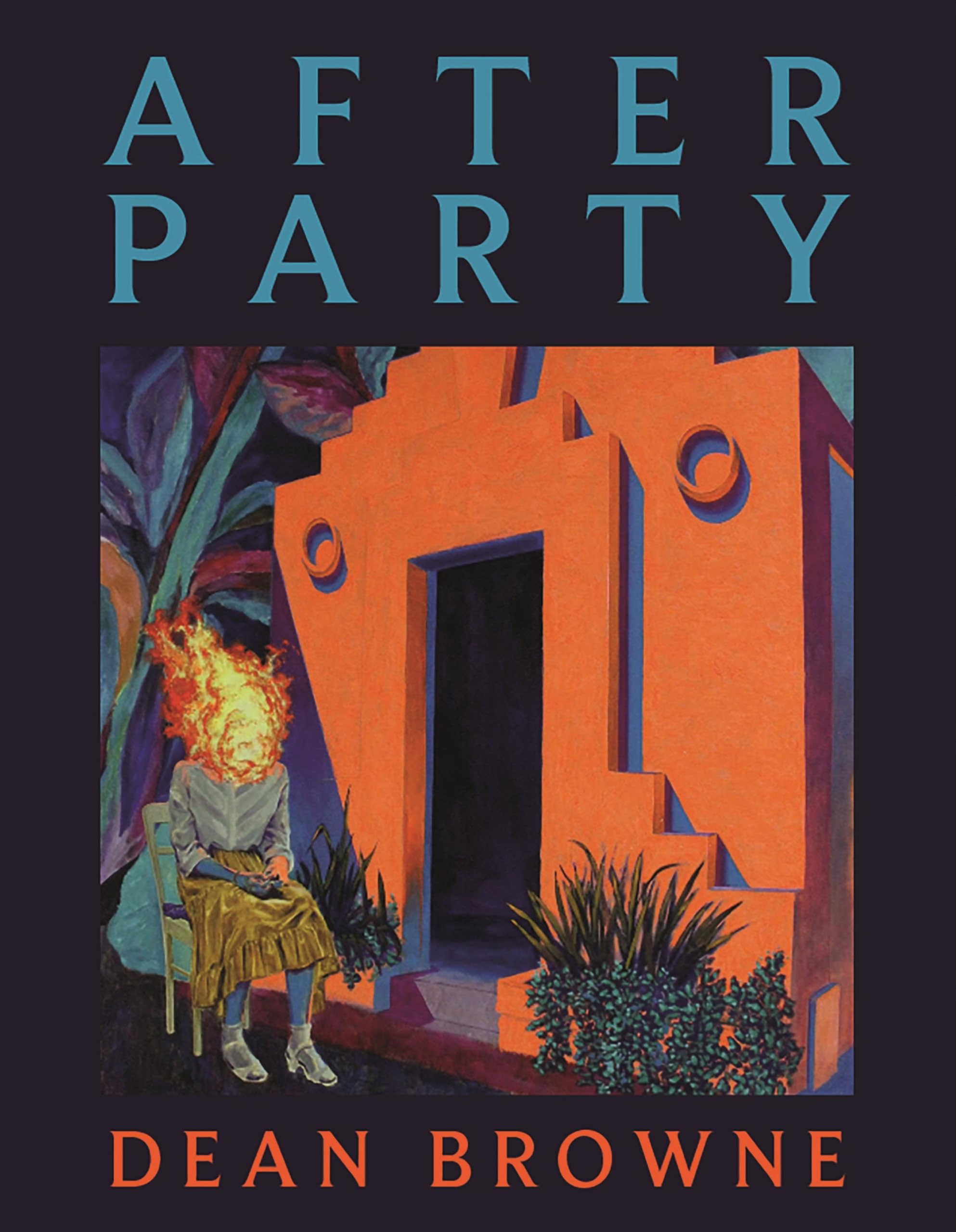
For the three years this poem has been following me around (rather like the goat, thus proving the accuracy of the title). I’ve been puzzling over one question of description: how far is it surreal? On the back cover these poems are described as being “a much-needed injection of the surreal – or the surreal-ish as he might prefer to say” and I’m inclined to go with the -ish. There’s a chilly and cerebral quality to the purely surreal and neither adjective fits this collection. They’re warmly human – despite Death never being far away – rooted in the senses, the smell and sizzle of cooking, the strangeness underlying the ordinariness of daily life. As Browne puts it, in ‘The Goatfish’:
Folding one sock into the other, or
kneeling to separate halm from rhubarb halm
in a straw hat, your ordinary is so strange
you might as well be filleting goatfish
on the far side of the moon — scraped scales
flying from you like a rash of Leonids. La.
A wild and wonderful image, especially the flying fish scales. Life, however, includes death, and for all this energy it’s a poem about grief and loss. We’re not told who has died, or their relationship, but she’s female; there’s a reference to Orpheus, so was she a lover? Browne can conjure up reality, particularly in hot kitchens, but holds back on naming people: we intuit his life but he’s never confessional. The poem opens “Tired of the new quiet and a cat hair / in the soup you never made as sweet as hers” and then expands, because “The world is more wide for your wandering”. The outside world throbs and clatters around him. You may wonder if the final word in the longer quotation is a typo: no. It comes from the one line of her speech he gives us, “the cut of you, la, and cups left in the sink?” Were these someone’s last words?
But let’s look first at Browne’s relish for garlic, sizzling pans and the immediacy of hands-on cooking, the counterweight to death and loss. In ‘Afternaut’ he calls for:
Garlic, and plenty of it in everything forever!
I’m in the kitchen with the music on,
cracking cloves from the provocative
bouquet on a chopping-board in Cork,[…]
I scale back the skin with a thumbnail,
finely slice a crescent with the rest
and dance it in a skillet with bream.
Let the pungent Esperanto speak
from my pores for a week.
I’ve skipped the first half of the poem in the voice of a recently-returned astronaut (Browne is drawn to space travel) to foreground the work of a real kitchen. This isn’t a one-off: in ‘Approach to Chilli’ he’s deep in another meal:
[…] Soon you will be home from a late shift
and I’ll have cooked us both a vicious chilli, spitting
with onion, tomato, the red and yellow peppers, lentils, beans,
dashed with paprika, cumin … too much habanero.
Not surprisingly he describes this as “… their tantrum / on our tongues …” but only after he’s raised in passing the philosophical question of how much of a table can you saw off before it ceases to be a table. How much is this a reflection on the relationship is a teasing question but the language points to tensions. Browne’s poems juggle ideas, keeping them in play simultaneously, with a sense of enjoying the clash of questions rather than reaching tidy conclusions. Look at how widely he can range in these opening lines from ‘Listening to Joni Mitchell’s Blue While Cooking Peposo’:
More paint than accompaniment, your chords,
the day I held the yellowed Tuscan recipe
I’d chanced on, bent over charity shop shelves
in Bantry square. Your voice arose from the blue —
I mean my Bluetooth pocket speaker, Spotified —
queued and looped and ringing fine as glass.
There’s a hint of a relationship in “I chopped tomatoes gorgeous as her mouth / that sea-lit evening”, but nothing more specific, nothing to exclude the reader’s own memories of cooking: for someone, somewhere, sometime. That’s what I find satisfying in Browne’s poems: his life (real and surreal) brings a remembered depth and colour to mine.
One more food poem, ‘Butternut Squash, for its cracker of an opening:
Well if it isn’t the Venus of Willendorf —
upright on the kitchen countertop,
plump pastel gourd in its zone
returning the illumination it receives.
Closer, more tanned than pastel — ecru?
Cousinly to pumpkin but more demure.
– and then the way it moves, unforced, into memory:
and how it felt to slide shoeless on
the cherrywood floor of a childhood
bedroom. Only a fool refuses to believe
in ghosts. I am cubing the squash
as precisely as I can, as if
somewhere it’s not too late
to describe these things. To try.
Trying is what these poems succeed at, finding words and images to make reality more real and the un-real more vivid: “The dead, they’re scattered everyway under, like a knocked-over / toy box” (in ‘Flinch’), or “these two buffeted currachs”, describing his favourite and well-worn shoes, or “hooked on the tonic blossom of that sweet first pull” (in ‘A Cigarette’) where he shares a cigarette with school friends. Those friends are, of course, lost to the past and so we come to the thread of ghosts, loss, death, woven into the work and never far from the surface. The stark chilliness of this, the other side of the sensory texture of ‘Aide-Mémoire, is established in the collection’s second piece, ‘Shadow Box’:
So this is the after party
our cherished stuff attends
when we’re gone.
A draughty, sunless place.
It’s the only place where the title of the collection appears. Browne hid the title for his pamphlet, Kitchens at Night, in the same way, within a poem rather than using a title poem. I find this works well, leaving the reader (me) to build up a pattern from the connecting threads. The setting of ‘Shadow Box’ is every charity shop you’ve ever visited, with “lives shunted to the side, / a price tag in biro”, and with all the misery of familiar objects severed from their once-comfortable homes:
the platoon of gooseneck
lamps at oblique angles,
the poignancy of a hedge-
hog posed in brass.A bald doll looking down
from its circle, one eye
turned back into the skull,
fixed on the future. Yours.
That’s an unusually direct ending for Browne but it serves as a reminder how his shift into the surreal-ish in the final lines can soften the truth that, to borrow Larkin’s line (from ‘Aubade’): “Most things may never happen: this one will”. Perhaps it’s easier to question the ending of things than of us, as in ‘Scuttle’, “Where do you dispose of them, / old keys?” A poem about a favourite pair of shoes (“they went the way of all things / beautiful”) has the wistful title ‘Today I Want to Miss Only My Favourite Shoes of All Time’; it’s so easy to miss that key ‘Only’ in the title. ‘Pinball’, is in memory of Matthew Sweeney, in which the poet asks for for a pinball machine on his grave rather than a headstone, for “tournaments among the tombs”.
I don’t pretend to understand all the surreal-ish goings on but, like the ending of ‘Aide-Mémoire’, I’m happy for them to stay with me into whatever future is left
There’s a balance in the collection, though: the inevitable future pitched against all the wild and wonderful inexplicable offerings from life in the meantime, and how best to tell them. There’s ‘The leg’, a cautionary tale for children about the necessity of staying safe around trains, in which the poet imagines a severed leg travelling on, making its own journey into a happy future. In ‘Horse Chestnuts’ there’s the strangeness children can sense but can’t explain when “My mam rang your mam rang his mam rang her mam.’”The repetitions of phrases and lines roll round, sinister and never reaching a conclusion.
This doesn’t worry me; I don’t pretend to understand all the surreal-ish goings on but, like the ending of ‘Aide-Mémoire’, I’m happy for them to stay with me into whatever future is left. Good poems work like that. Perhaps a good place to end is with ‘Prayer to Buster Keaton’, which ends:
Saint Buster, keep us from conniptions, keep us frisky
and adaptable on this path of fluke and gamble
glorious fuck-ups I’ll look back on and say, what luck!
Browne works via associations, linking things that are both real and surreal but never un-real. Nothing is stable. As a poet he has confidence, energy and the rare quality of writing memorable poems that insist on following you around, just like that goat. Great stuff!
D.A. Prince lives in Leicestershire and London. Her second collection, Common Ground (HappenStance, 2014), won the East Midlands Book Award 2015. Her most recent collection, The Bigger Picture (also from HappenStance) was published in 2022.
As well as browsing our Substack, it’s worth visiting The Friday Poem website where you can browse our Archive of more than 700 posts dating back to early 2021.
Help support The Friday Poem – buy us a coffee to help us stay awake as we strive to bring poetic excellence to your inbox every Friday. If you can’t afford to donate, no worries, we’re going to keep on doing it anyway! Big thanks for everything, you lovely poetry peeps.