


Once Upon a Time
Once upon a time there lived
a small joke
in the middle of nowhere.
This small joke
was dying to share
itself with someone
but nobody came to hear
this small joke.
So this small joke
told itself to the birds
and the birds told this small joke to the trees
and the trees told this small joke to the rivers
and the rivers told this small joke to the mountains
and the mountains told this small joke to the stars
till the whole world
started to swell with laughter
and nobody believed
it all began
with a small joke
that lived in the middle of nowhere.
Everybody kept saying
it was me
it was me.
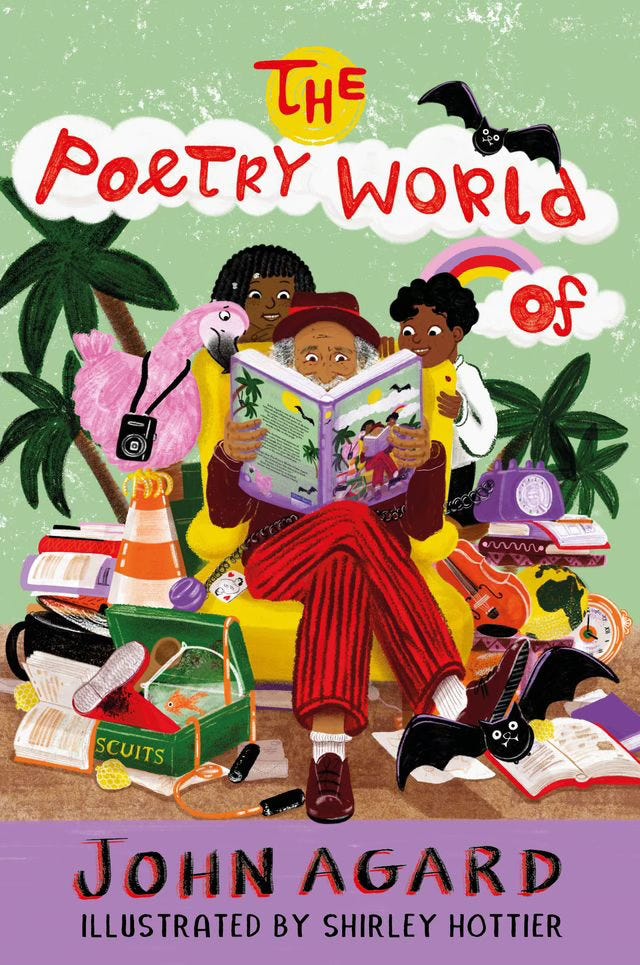
’Once Upon a Time‘ is from The Poetry World of John Agard, illustrated by Shirley Hottier and introduced by Darren Chetty (Otter-Barry Books, 2025) — thanks to Otter-Barry Books for letting us reproduce it here.
Hilary: John Agard has been around for as long as I can remember; I used to read his poem ‘Half-Caste’ to all four of my kids (you can watch Agard performing it on YouTube here) along with ‘Palm Tree King’ and ‘Listen Mr Oxford Don’. I found these not in children’s poetry books but from the Other poetry anthology (British and Irish Poetry since 1970). In Other, editors Richard Caddel and Peter Quartermain were consciously offering up an antidote to mainstream British poetry, and Agard’s poems rubbed shoulders with work from a diverse bunch of writers including Bob Cobbing, Geraldine Monk and Denise Riley. So at the time I didn’t think of him as a writer of children’s poetry so much as an exciting avant-garde or alternative poet.
But of course he has also built a reputation and a following as a poet for children, and now he’s gone and won the CLiPPA children’s poetry award for the third time, with The Poetry World of John Agard, a collection of poems drawn from some of Agard’s previous books – I Din Do Nuttin (1983), Say it Again, Granny (1986), No Hickory No Dickory No Dock (1990), Laughter is an Egg (1990), Grandfather’s Old Bruk-a-Down Car (1994), We Animals Would Like a Word With You (1996), Come Back to me my Boomerang (2001), and Points of View of Professor Peekaboo (2000). Past winners of the CLiPPA include Carol Ann Duffy, Jackie Kay and Michael Rosen and, like them, Agard writes successfully for both children and adults.
Annie: Interesting that you say he has been around for as long as you remember – the back cover of The Poetry World of John Agard describes him as “one of the most beloved and influential poets of all time”. That might be overstating it a bit but we’re in the world of poetry here, so we’re allowed to exaggerate! Having said that, there is something timeless and ageless about Agard, who’s been a legend in classrooms for years. A Caribbean Dozen, which he edited with his wife Grace Nichols, was a staple in every primary school I’ve ever worked in, and he’s been widely anthologised. One of my favourite poems to teach round Eastertime was always ‘A Date with Spring’, which the children loved to act out as a performance piece.
Hilary: Agard’s poems cover a wide range of subjects. As might be expected from his ethnic and cultural roots, race, ethnicity and culture are very important, but Agard’s work also draws on such diverse subjects as ancient mythology, academia, Caribbean folk tales, environmental issues, politics and patriotism. I like how he is gently political, in a way that children understand. For instance, in ‘Happy Birthday Dilroy’, Dilroy gets a pair of skates he wanted for a long, long time for his eighth birthday. But he still has a question:
But, Mummy, tell me why
They don’t put a little boy
That looks a bit like me.
Why the boy on the card so white?
Annie: John is also a superb performer, as your YouTube link illustrates. It’s worth checking out some of the many on-line clips of John Agard before settling down to the book. You can hear him reading ‘A Date with Spring’ (along with five other gems) on the BBC website.
He embodies his words in a way which captivates adults just as much as children and I always hear his mesmerising voice in my head when I read his poetry. It’s like dancing with him inside a carnival of language.
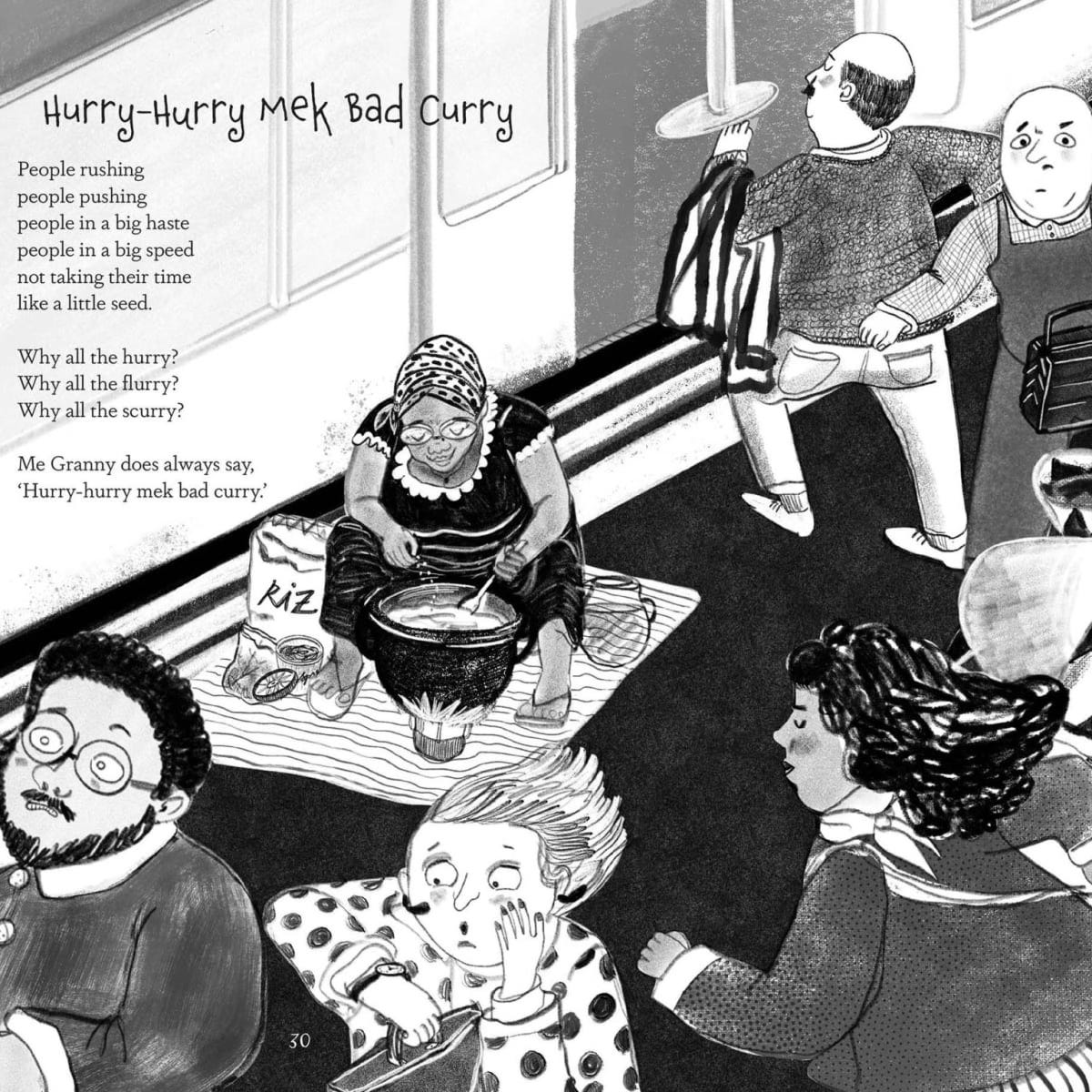
It’s great news for John and for Otter-Barry Books to have won the CLiPPA again, but it must be especially exciting for Shirley Hottier, whose name is not yet so well-known, but whose vibrant art works brilliantly with the poetry. Congratulations all!
John Agard was born in Georgetown, Guyana. He taught French and Latin at O-level after he completed his education, before working as a librarian. He moved to England in 1977, where he became a touring lecturer for the Commonwealth Institute to promote a better understanding of Caribbean culture. He visited 2,500 schools over the next eight years, and began to write poetry for children. He was given the Queen’s award for poetry in 2012, and in 2021 the BookTrust Lifetime Achievement Award. He is the author of more than 50 books for children and adults and has been cited as a major influence by Raymond Antrobus and Dean Atta. Chair of judges and Children’s Laureate for Wales Nicola Davies describes John as “extraordinary”. She said “You can carry John’s words in your head and your heart and warm your soul on them forever.”
The Centre for Literacy in Primary Education is a a small independent UK based children’s literacy charity working with primary schools to improve the life chances of children by making sure that every child has access to quality experiences of literacy. They have compiled a great list of award-winning children’s poetry which includes work by Philip Gross, Jackie Kay and George Szirtes. For those newer to poetry, there’s a really cool bit on its website where you can search for information about different poetic forms and devices – forms such as the ballad, the renga, or the triolet, and devices such as assonance, metaphor, or onomatopoeia.
Annie Fisher’s background is in primary education, initially as a teacher and later as an English adviser. Now semi-retired she writes poetry for both adults and children and sometimes works as a storyteller in schools. She has had two pamphlets published with HappenStance Press: Infinite in all Perfections (2016) and The Deal(2020), and one recently from Mariscat Press: Missing the Man Next Door(2024). She is a member of Fire River Poets, Taunton.
Hilary Menos is editor of The Friday Poem.
Vital Statistics: The Friday Poem has 3700-plus subscribers. It’s run by four people – Hilary Menos (Editor), Helena Nelson (Consulting Editor), Bruno Cooke (Spoken Word Editor) and Andy Brodie (Web Editor), with contributions from a team of reviewers and writers.
Until recently we maintained the Friday Poem website (thefridaypoemdotcom) as an archive of 700 posts published between 2021 and 2024 (including most of the original Friday poems) but following a catastrophic hack in late April we made the difficult decision to take this down. We’ll be republishing some of the poems, features and reviews on Substack in the future.
Help support The Friday Poem
Buy us a coffee to help us stay awake as we strive to bring poetic excellence to your inbox every Friday. Heartfelt thanks to everyone who donates, especially to our regular donors. If you can’t afford it, no worries, we’re going to keep on doing it anyway! Big thanks for everything, you lovely poetry peeps.
So much fun. Congratulations to John.
Hurray!