


Stilling Time
when she turned eighty my aunt refused to go
to bed, because that’s where most people die.
at eighty eleanor of aquitaine rode on horseback
like a man when she went to visit the king of spain.
a woman even older circumnavigated the world,
another ran marathons, one wrote racy books.
when i’m eighty i’m going to retrace my steps
to the grand canyon, breathe again the air
where i first encountered the majesty of creation.
i will touch a black stone ninety million years old
and feel young. i’ll bump into a family of elk
at dawn, we will hold each other’s gaze.
i’ll tell them i come in peace, leave my shadow
falling over the canyon edge, sinking into earth.
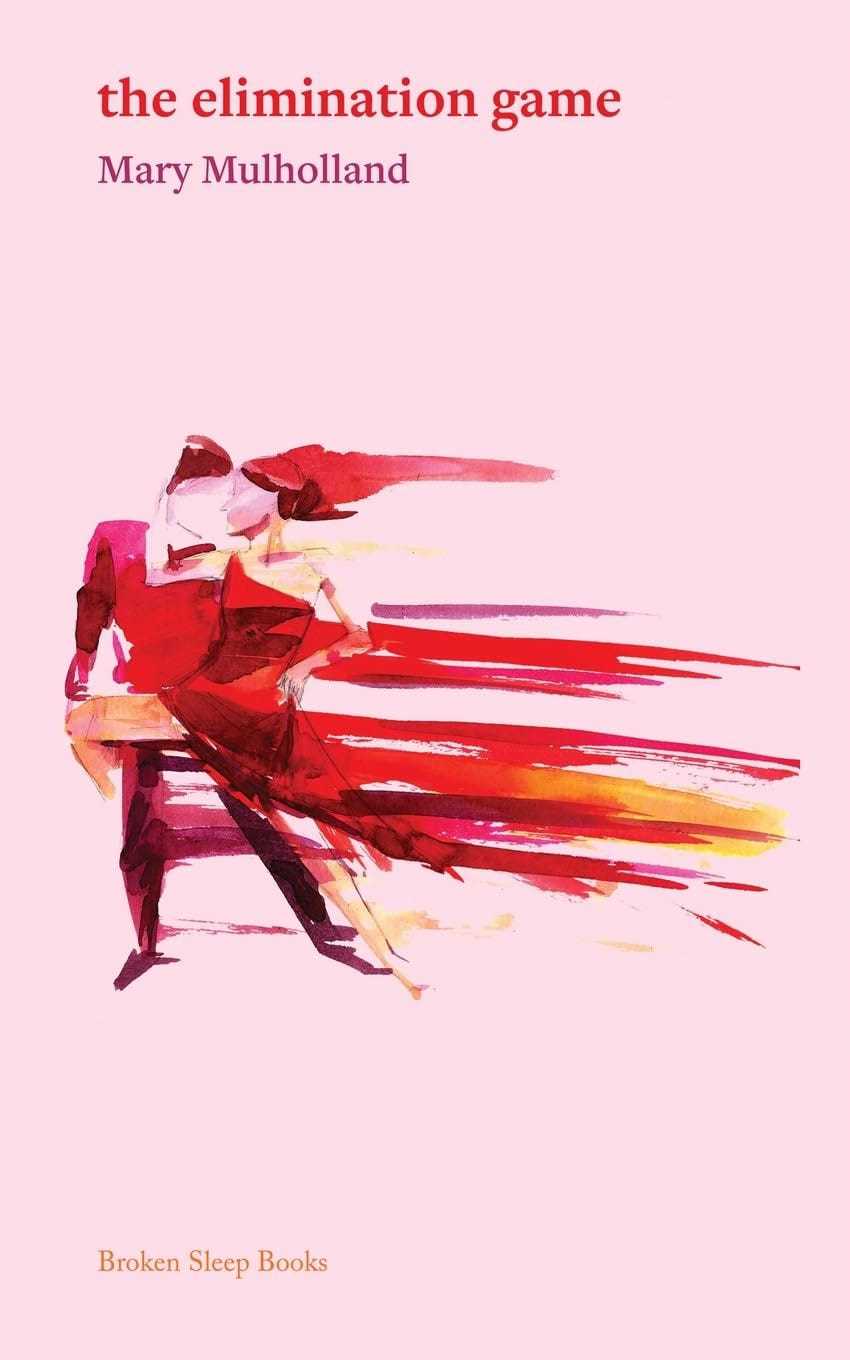
‘Stilling Time’ is from the elimination game by Mary Mulholland (Broken Sleep Books, 2025) – big thanks to Broken Sleep Books for letting us reproduce it here.
Mary Mulholland’s latest pamphlet, the elimination game, offers a clear-eyed and sharply observed look a what she terms “the elders’ luminous / adventure”. This adjective here seems particularly apt: these poems are filled with a sense of wonder, discovery and potential. This is a pamphlet that explores the possibilities of ageing: of life continuing to open up to new experiences and new challenges, rather than narrowing or closing down.
This seems to me to be a fresh (and very welcome) take on getting older. There are many excellent individual poems that explore ageing, but often the focus is on loss, grief at the passing of time, and nostalgia for the past. Here we have a broader and more optimistic take, with poems that reference sex, the Tango, Ruskin, cold swimming, and chickens, all permeated with a warm wit.
… these poems are filled with a sense of wonder, of discovery and potential
This wit is evident in the title poem, which starts by listing both familiar and more inventive terms that describe and erase women as they age. The more familiar terms include “winter chicken”, “over the hill”, and “perch-clinging”; the more inventive, “unhipped & cankered batty old trout”, “moth-eaten / goose with a sole”. Happily, the poem has a more defiant ending, involving roller-blading, Arctic swimming and Sahara treks. It reads as a clear two fingers up to the often gendered insults that surround the ageing process.
There is a lot of joy and a lot of life in this pamphlet, but that’s not to say that Mulholland isn’t candid about the reality of ageing, and about the tensions and sadness this can entail. She doesn’t gloss over the negatives, but she refuses to be defined by them. She is particularly interested in exploring historical stereotypes and taboos around older women, and personal (and often very touching) poems sit alongside those that examine ageing from a wider cultural or historical perspective.
‘Grandmother’s Footsteps, for example, finds humour in the juxtaposition of “James from the Arts Council” talking to a roomful of ladies “the age of his mother”, and has some sharp observations on the dismissive attitudes such women encounter (these “urn-waiting crones / reciting poetry to empty halls”). One recently deceased member of the group had, as Mulholland bluntly puts it “started late, in marketing / terms”. But Mulholland manages to find a quiet beauty in the scene. She peppers her clear and direct diction with some deft imagery, describing the poems the women are writing as “horse medicine for the soul”. I’d like to have seen her use these unusual metaphors and imagery more widely, and more boldly, throughout the collection.
In ‘Woodstock’ Mulholland remembers herself as a “kohl-eyed girl in a purple kaftan” at a music festival, and wonders how many other idealistic festival-goers grew up to become accountants, noting that she too contains “multitudes”. ‘Pietà’, one of my favourite poems here, starts with a crow that lands like a “black fan” on the poet’s face, then smartly moves from one image to the next – crow to black dog to photography to clouds – before creating a moving final montage. She writes:
a mother’s nights are lit with prayer, a ceiling
of crows, wanting her child to be happy
knowing what that entails.
In this tightly-focused pamphlet, Mulholland offers the reader variety, both in tone and style. She balances the personal with the political, and moves comfortably between subjects that invite humour and those that deal with a profound sense of loss. In terms of style, she uses unpunctuated free verse, beautifully half-rhymed couplets, formal quatrains and a palinode (a poem that effectively rejects the sentiments of a previous work).
I enjoyed the ‘answering back’ vibe inherent in the palinode. It seems to me to be a key element sparking the genesis of many of these poems: the refusal to grow old quietly. The tension around silence, and speaking out, is clearly referenced in ‘Trappist’, which ends: “she’s heading to an anechoic chamber, where she’ll live / with silence, cloud divination”. I think it can also be seen in the ‘The Regretting Room’. Rather than hide regrets, Mulholland baldly lists them, without further comments or explanation. As with many good list poems it is the way these phrases rub up against each other, the mix of the trivial and mundane set against the profound and the life-changing, that allows it to deliver a real punch.
… poems that reference sex, the Tango, Ruskin, cold swimming, and chickens, all shot through with a warm wit
The final poem in the collection, ‘Stilling Time’, places the human lifespan into a wider historical and ecological context. The poet imagines what it might feel like to be eighty, starting with her aunt, who, on reaching that age, “refused to go / to bed, because that’s where most people die“. She lists the achievements of other women at eighty – historical characters like Eleanor of Aquitaine (still riding across the continent) then segues to the future, and her own plans. Mulholland writes:
when i’m eighty I’m going to retrace my steps
to the grand canyon, breathe agin the airwhere I first encountered the majesty of creation.
i will touch a black stone ninety million years oldand feel young.
I am never quite sure about omission of punctuation and capital letters in poetry (though I realise this may be a sign of my age, as these days it’s increasingly commonplace). But here I feel it adds to those weightless and insubstantial feelings we inevitably have when we contemplate our own place in the grander scheme of things, be it looking up at the stars or staring over the precipice of the Grand Canyon. As Mulholland says: “I’ll […] leave my shadow / falling over the canyon edge, sinking into earth.” Even in a piece that features the Grand Canyon, Mulholland judiciously sidesteps grandiosity and pompousness, instead offering a thoughtful and delicate reflection on age and time. It is her focus on the everyday, combined with direct and easy diction and a keen eye for detail, that makes this pamphlet distinctive and memorable.
Emma Simon has published two pamphlets, The Odds (Smith|Doorstop, 2020) and Dragonish (The Emma Press, 2017), and one full collection, Shapeshifting for Beginners (Salt, 2023). The Odds was a winner in The Poetry Business International Pamphlet & Book Competition. Emma has been widely published in magazines and anthologies and has won both the Ver Poets and Prole Laureate prizes. She works in London as a part-time journalist and copywriter and has just completed an MA via the The Poetry School and Newcastle University.
As well as browsing our Substack, it’s worth visiting The Friday Poem website where you can browse our Archive of more than 700 posts dating back to early 2021.
Help support The Friday Poem – buy us a coffee to help us stay awake as we strive to bring poetic excellence to your inbox every Friday. If you can't afford to donate, no worries, we’re going to keep on doing it anyway! Big thanks for everything, you lovely poetry peeps.
Stunning. Thank you for sharing x