


Room
E shows me the bath that he lay in all night, his partner (who couldn’t hear him shouting) sits quietly. The bath sides were a sheer mountain face, he says, he kept slipping back down. ‘And tae think I used to climb aw those munros’. When his partner came in she got a right shock, went to ask the neighbour to help, a tall lad, six foot. ‘When I wis hauled oot ma hauns were cold and crinkly’. I notice the walls blooming with mould, a rash of grey roses climbs around the window. ‘The housing know all aboot it’, E tells me, ‘they want me to move oot, but there’s nowhere to go. Besides I like ma wee flat’ he says, ‘it’s on a good bus route, I can’t stand being stuck indoors’.
‘Room’ (p. 49) is from Glasgoscopy by Vicki Husband (Vagabond Voices, 2025) — big thanks to Vagabond Voices for letting us reproduce it here.
Vicki Husband is a community occupational therapist working in the NHS. She dedicates Glasgoscopy, her second full collection, to her patients and her colleagues. She won the Hippocrates Prizes for Poetry in Medicine 2024 with ‘Non-essential poem’, which is included in the book.
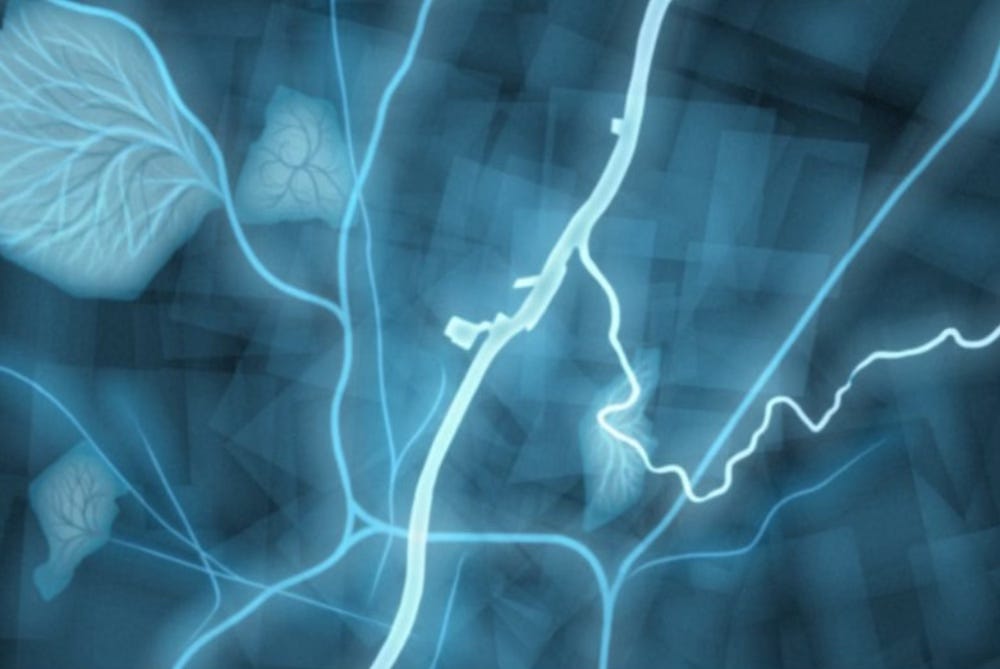
Glasoscopy is a close examination of Glasgow and its community. The book cover glows like a X-ray showing ghostly illuminated internal systems of the human body. Underneath the deep blue of negative space we see boxes which look like street maps laying out the city’s tenements and roads. The image neatly sums up one of Husband’s themes – how our environment shapes us, and in particular how physical architecture has an impact on nature and people. The city itself is a biome, living and breathing, and the people living in its tenements are part of its physiology.
The collection explores themes of poverty, loneliness, and resilience. It illustrates how vital healthcare is, particularly for those at the very margins who can least afford it. Vicki Husband doesn’t seem to me to have designs on her readers, but her subject matter resonates deeply with me. We are in a time of manufactured decline and crisis in NHS care in Britain, which threatens the humanitarian values upon which the Health Service was founded (for more information on the privatisation of the NHS, what it looks like, and the impact it has, see the Keep Our NHS Public briefing paper). The Covid pandemic, a global trauma which is rapidly being forgotten, also highlighted a raft of inequality and specific vulnerabilities for older people and those from ethnic minority groups (see research findings into the impact of Covid-19 on health inequalities across Scotland published by the Scottish Government in June 2021).
Vicki Husband doesn’t seem to me to have designs on her readers, but her subject matter resonates deeply with me
‘Non-essential poem’ is central to the collection, and is evocative of the Covid crisis. It shines an unforgiving light on the absurdity of what in one context appears essential (such as advertising) but in another is redundant. Nature bloomed joyously in the UK that spring, in stark contrast to the terrible loss of life. Many people were denied human touch; it was deemed dangerous and unnecessary. Husband writes:
While human touch is not considered essential, trees enjoy
a renewed focus of attention, their blooming seeming
marvellous; a touch of lukewarm sunshine miraculous.
She writes about going into the homes of people who haven’t been visited for “months, years”, and trying to navigate communication and human connection behind personal protective equipment (PPE):
[…] I arrive gesturing,
gesticulating in blue, eyes do the work of a whole face.
The patient she sees is not steady on his feet. Her reaction to steady him is a reflex: “I put my electric-blue palm / on his back, and we both note the small shock of contact”.
Many of the pieces here are prose poems which describe visits to fictional patients during the pandemic. Forty-one of them are simply called ‘Room’. The first twenty-four of these describe occupants, identified A to Z (no I, no U). Then we go back to ‘A’ and start again, with different occupants, though the list now contains omissions as though people are missing; one presumes dead.
This repetition of the word ‘Room’ invites the reader to consider its meaning in terms of a space, but these rooms are also like confined cells, shut off and contained. Each visit described takes on an anonymous feel, with patients identified only by the first initial of their name (as though in a medical case study). The shapes of the neat square prose poems evoke loneliness; many of these patients are lonely. They are older, often bereaved, and all with compromised physical health.
The shapes of the neat square prose poems evoke loneliness; many of these patients are lonely
Husband’s poetry illuminates the acts of intimacy which underpin truly relational healthcare. The power of relationships is now being shown to be essential in good health and social care (Gopinath et al, 2023). We see this over and over again as she engages with people teetering between life and death. Some of the poems are rich with dialect. We feel like we meet these people. They could be our neighbours.
In one room we meet A, who is under-nourished and who has a pint glass of orange squash (or possibly urine?) next to him on a side table. A is frail and struggling to walk. His home has become full of obstacles as his health declines. In her real life OT role, the poet would be assessing for adaptations to the home so that A can stay where he is. B is hoping to be housed in a ground floor flat opposite her own block. The flat is empty, and she is waiting, but the question is how much longer can she wait? Many of the characters here have mobility difficulties, and Husband makes astute observations about how they struggle to navigate ordinary architecture – stairs, baths, kitchens.
Covid is sparingly mentioned. In fact, the context in which Husband is making visits is almost invisible at first, with occasional and subtle mentions of ‘the virus’. There is no fanfare, just a matter-of-factness. In reality, however, it was a shocking and frightening time; many NHS staff had to adapt to work in conditions they could never have imagined. Numerous vulnerable people were isolated and lonely during lockdown, and this collection vividly brings that back.
Numerous vulnerable people were isolated and lonely during lockdown, and this collection vividly brings that back
These ‘room’ poems are interspersed with pieces about the environment, word searches, and medical jargon. ‘Suffixes’ presents two columns of words, apparently definitional, but the left-hand column can be read independently, creating a spellbinding poem. It is essentially an instruction on how to maintain compassion within medical care:
When ruled by the head
I separate each of my selves
Cut out the smallest
Of sensations
Later find they carry
The shape of me, the glue
For the record this
Is how a condition conditions one
Into a medical prejudice
Everything here emphasises the essential need to retain compassion and a sense of humanity, and how important these are to healing:
The body knows
How to absorb emotion
Apply compassion not compression.
Husband observes families trying to do the best they can for relatives. At the time, this was hard, especially given how communities had already dwindled and the social care networks around older people had been under resourced for some years. Ordinary people were often forced to make impossible decisions. In one room we meet Z, whose son has moved her out of her flat and into a care home, which we learn he regrets. She cries every day for her home, and he tries to reassure her that she is home. But this is a residential home, an alien and new space for Z. There is a sense of foreboding about her fate (many older people died in care homes during Covid).
‘References’ is both sharp and serious, presented like a properly evidenced academic paper. The piece is shot through with absurdity, with titles such as ‘A Systematic Review of Systematic Reviews of Systems of Reviewing’. Science operates in a social and political context, and invented papers such as ‘Deprivation, Inequality and the Dereliction of Duty’ and ‘How Managed Decline was Mis-managed’ remind us that powerful forces which determine health don’t often make the reference list. There are also acerbic reminders that sometimes the obvious things are the things which will help, such as ‘How Routes and Paths can Improve Access’ and that these obstacles in public space also contribute to ‘The Anatomy of Alienation Among Older Adults’.
The piece is shot through with absurdity, with titles such as ‘A Systematic Review of Systematic Reviews of Systems of Reviewing’
Glasgoscopy is a testament to those frontline health workers who carried on working through the pandemic, and also to the enormous emotional generosity on which the NHS was founded and continues to depend. As a health worker myself, I found it a moving reminder of how important it is to approach everyone with compassion. As a poet, I admire Vicki Husband’s ability to capture those unmapped and intimate moments and convey them simply and powerfully. Her capacity to create these sharp, witty poems, working in a place where politics, community and the medical profession meet, is impressive. She has made these older people, alone and anonymous in their rooms, visible – a gift to both them and us.
References:
Gopinath, M; de Lappe, J; Kartupelis, J; Larkin, M and Wilson, A (2023). The value and practice of relational care with older people: a research report by The Open University. The Open University. DOI: https://doi.org/10.21954/ou.ro.00015a63
Khadija Rouf is a clinical psychologist and writer with an interest in the arts and mental wellbeing. She works in the NHS. Her poetry has been published in Orbis, Six Seasons Review, and Sarasvati and included in the NHS poetry anthology These Are The Hands (2020). She won joint second prize in the health professional awards category of The Hippocrates Prize for Poetry and Medicine in 2021, and her pamphlet House Work was published on International Women’s Day 2022 by Fair Acre Press. She is also a member of British South Asian writers collective The Whole Kahani and has work in the anthology Tongues and Bellies (Linen Press).
As well as browsing our Substack, it’s worth visiting The Friday Poem website where you can browse our Archive of more than 700 posts dating back to early 2021.
Help support The Friday Poem – buy us a coffee to help us stay awake as we strive to bring poetic excellence to your inbox every Friday. If you can’t afford to donate, no worries, we’re going to keep on doing it anyway! Big thanks for everything, you lovely poetry peeps.
thoughtful, socially attentive review that honors both the poems and the patients
I need to check this out