


Sundew primes its red traps
for the keeled skimmer
with his gold and latticework
and the pearl-bordered fritillary
fresh from her natal feast of marsh violet.
Sphagnum mosses drink in draught after draught,
swell into hummocks, spread into rafts
where sedge flings out
its extravagant plumes of seed.
Underground, the mire preserves its dead,
guarding its acids, locking out oxygen,
starting the long translation from gley to peat.
Overhead, nightjar and warbler
test their stuttering machines.
This poem is from Goyle, Chert, Mire by Jean Sprackland (Cape, 2026) — big thanks to Cape for letting us reproduce it here.
Why include an unfamiliar word in a title? Chert? – yes, I know that one, a type of stone. Mire? – yes, a shoe-sucking marsh. But Goyle? That’s one for the imagination, or the footnotes, and Jean Sprackland tucks it away, beyond the title page note (“found in the dialects of Somerset and Devon; etymology unknown”) and into the body of the opening poem:
Broken gate jammed across the ditch,
tied with rope so old it has become interesting
and you suddenly remember art.[…]
This is the goyle bottom, the clogged
and leaf-logged anticlimactic place
where all loose items come to rest.
Isn’t it familiar – that sludgy ditch at the side of a country walk, ignored and unloved? It’s a good metaphor for life’s detritus. Sprackland has made her readers work just hard enough to be invested in the poem and, incidentally, has also given the geographical location. Fourteen lines, and no title: notice, too, the ‘you’ in the third line. Is ‘you’ the poet, addressing her inner self? Or is ‘you’ the reader? Or both? At this point in the book it’s easy to slide over the subtle shifts of pronouns, driven by curiosity about where this unpoetic (“anticlimactic”) ditch will take you, following the bidding of the final line: “Turn your back on the light and crawl in.”
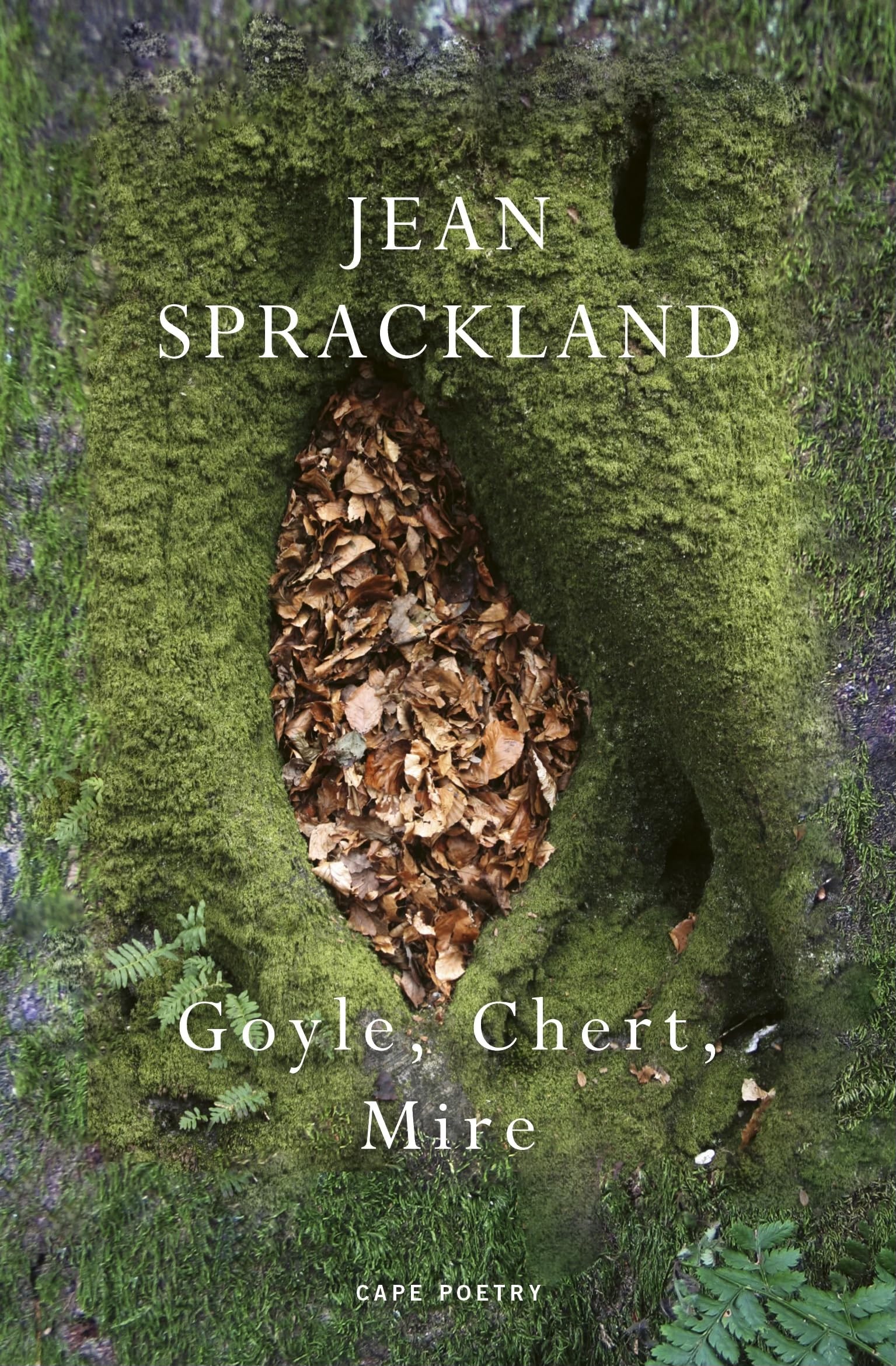
But first, how will this collection fit together? Three sections of fifteen poems, each part headed with one word from the title. No further titles. These are three sequences, each a different landscape. Don’t believe everything you read in reviews; one reviewer has described these as “unrhymed sonnets”. Fourteen lines, yes, and unrhymed, yes, but they don’t have the interior shift that characterises the sonnet form. There can be something overly self-contained and neat about sonnets that wouldn’t lend itself to the flow within each sequence, however tactfully it was employed. These poems are units for creating the larger structure of each sequence, fitting together and joined by cross-references. I’ve avoided using words like ‘blocks’, ‘bricks’, ‘building’ because they feel too heavy, too solid for how these poems connect. Fourteen lines is a constraint that proves effective because it’s unobtrusive; it allows plenty of space for variety in the content and can be read in one breath.
This method of structuring is a new departure for Sprackland. It’s her sixth collection (her first appeared in 1997), previous titles having won major prizes. Goyle, Chert, Mire, however, is her first use of single-form sequences and demonstrates what a powerful format this is. In brief, the Goyle sequence describes her land and its damp and dark boundary, her new home:
You will own this parcel of land,
said the solicitor (as if it came wrapped
and containing secrets). From here —
he clicked his propelling pencil — to here.
When you tried to pace it later, that line
was lost inside a hedge
Those “secrets” will appear, but not until the final section. Legal paperwork is precise but this land far less amenable to clarity. Sprackland is not ‘I’ here; there is only ‘you’, as established in the opening poem. This distances the writer from the “parcel of land” as she starts to learn its ways – “Your house is a simple instrument / for the telling of weather.” “And now the goyle / is the deep groove you think along.” ‘You’ also carries the suggestion of a solitary life when the only person you have to talk to is your inner self.
It’s not all house and land, however: “The recent illness flares and settles inside you.” If you (the reader) have read the publisher’s blurb on the inner flap, you’ll have seen that she’s referring to meningitis and its aftermath. If you haven’t (and, significantly, the illness is not named in the poems) you might interpret the references as a less-definable state, perhaps something closer to Alexander Pope’s “this long disease, my life.” The vocabulary of physical illness – quarantine, sickness, cures, recover – can equally function as metaphor. There’s a sickness in the natural world. It’s in seed-heads, or where “Cold sweat runs down the face of the wall”, or where an ash tree suffers “Lesion, necrosis, death of the crown”. All this is contained in the overarching description of exploring the route of the goyle: the personal and the natural world are fused and held together within the same time frame.
The Chert sequence – and chert is a local stone, too hard for sharpening scythes but good for roads – opens at a distance, in the third person:
A woman walks the same field for forty years,
and the field speaks to her because it knows her.
She stops, picks up a word, and with quick eyes and hands
translates it. Knife. Arrowhead. Pick. Adze.
The woman is an amateur archaeologist, field-walking, cluttered with the physical stuff of history, but also alert to a parallel play with metaphor even as she dismisses it:
Pain worked to the surface, words shaped into tools.
The field itself brings them forth
from the utter dark of the deep self —
Oh rubbish, she thinks,
it’s just walking and finding. She ought to stop.
Is this woman Sprackland herself, or perhaps a neighbour? Either way, she acts as an introduction to the history of the valley and the surrounding high ground, and to the following two poems where the stone-workers – women, children, paupers, miners – populate the landscape. In the fourth Chert poem the poet returns to using ‘you’, linking the finds to shards of broken crockery, “the kind of stuff your grandparents could afford / but not afford to lose.” Sprackland is aligning herself with the reader, again, and with a glance back to the almost-rejected metaphor in the opening poem:
No end to the fields you’d have to search
to find the shattered pieces of yourself.
In the next poem she also finds shreds of plastic with “their cellular determination to survive / over every timescale.” Sprackland’s initial focus is one valley, but her focus expands to include a part of the much larger world. Gradually, personal memory surfaces and ‘you’ is now the self-reflective ‘you’:
Language itself is prone to collapse, you think.
it’s like an old house
where the rain gets in and ruins everything.
The walls sag, the ceilings cave,
one room of words falls through into another.
Halfway through this section, the vocabulary of illness enters, at first in landscape description – “bruised blues, medicinal pinks, / sickroom yellows” – then more specifically:
In the quiet lanes of the parietal lobe
the illness has installed a truckload
of listening equipment[…]
You’re picking up static, said the doctor,
white noise outside the range of hearing.
For many poets this would signal a movement towards focus on the self and the effects of the illness, but Sprackland is not one of those. This is emphatically NOT an egocentric ‘my journey’ or ‘my battle with’ collection. It places the self within a larger, longer timescale and landscape. “Illness has scrambled the year” begins the penultimate poem in Chert. But “Despite all the losses you are still alive”. The final piece returns us to the ‘woman’ of the opening:
A woman walks the same river for forty days.
She comes here to recover.
Underfoot the bed of chert. Under it, greensand. Under it, ooze.[…]
So this is meaning, she thinks. Minor bodies
in their millions, scuttled and sinking, becoming sediment.
Day and night collaborate on the difficult work of translation.
This looks back to the start of Chert, these ‘forty days’ reminding us of the ‘forty years’ earlier. Now it’s the river that’s restoring words “from the utter dark of the deep self.” There’s a sense of recovery.
So, after this, where will the Mire sequence take us? At first it’s up, into the air, but then it shifts, with that significant adjective “desperate”, down to the water table:
All day a buzzard calls over the mire,
like the desperate note of a whistle
blown by a search party. You are marooned
on quag and quaking bog – a dark
anoxic brew of mud and dead matter.
We learn more about how she came to buy this house on a springline via a land agent, the language reminding us of the solicitor at the start:.
They have no value, said the agent,
spreading his empty hands on the desk,
wet places, these waste places.[…]
I’d forget it if I were you. These barren places
are only fit to be fenced off, written off,
cursed, or wished away.
But Sprackland also shows readers the alternative, how the value of this land can be read by those with greater knowledge and a wider vision:
Archaeobotanist, anthrocologist,
palynologist, paleoentomologist:
all come with their various petitions,
all kneel and name what they seek:
God of the mire, grant us artefact, ecofact,
furnace, cesspit, midden and posthole.
All those ‘-ists’ really exist, specialists working on the minutiae buried in mud, accessible only to those with the patience for seemingly undramatic research. Sprackland’s attention is drawn to their equipment (“a chambered or Russian sampler”) and the skills to “magnify five hundred times” until “under your lens, eleven thousand years / swim into focus looking much like now.”
I’ve lived with it for months and it’s not going on the shelf yet: it offers more every time I look into it
Quietly self-effacing, the poet reflects on the ‘illness’ as she gets it into perspective – ”The illness pressed at one wet valve, / then another, and another, / trying its luck until it sprang a lock.” She can recognise this as “Petty vandalism, nothing more”, imagining a future historian prising apart her diary pages before returning to the immediacy of the shipping forecast, the winter weather and finally – in the poem that heads this review – the world outside, spring bringing it into life, renewed. There are no pronouns in this final piece, only the fullness of the natural world. Sprackland’s previous collection (Green Noise, Cape, 2018) considered what’s been described as “the background noise of the world” and Goyle, Chert, Mire has built on that.
The reader can map these poems in many ways, tracing words, phrases, repetitions within each sequence and then the collection as a whole. Sprackland makes the whole thing look easy but you can’t move a single poem out of position, nor would you want to. She understands where strength comes from in a collection and how to work with it. It’s an intelligent and mature set of poems, firmly committed to what can be achieved by craft when it’s balanced with human experience. I’ve lived with it for months and it’s not going on the shelf yet: it offers more every time I look into it.
D.A. Prince lives in Leicestershire and London. Her second collection, Common Ground (HappenStance, 2014), won the East Midlands Book Award 2015. Her most recent collection, The Bigger Picture (also from HappenStance) was published in 2022, and her pamphlet Continuous Present was published by New Walk Editions in 2025 (and reviewed on The Friday Poem here).
Vital Statistics: The Friday Poem has 3700-plus subscribers. It’s run by four people – Hilary Menos (Editor), Helena Nelson (Consulting Editor), Bruno Cooke (Spoken Word Editor) and Andy Brodie (Web Editor), with contributions from a team of reviewers and writers.
Until recently we maintained the Friday Poem website (thefridaypoemdotcom) as an archive of 700 posts published between 2021 and 2024 (including most of the original Friday poems) but following a catastrophic hack in late April we made the difficult decision to take this down. We’ll be republishing some of the poems, features and reviews on Substack in the future.
Help support The Friday Poem
Buy us a coffee to help us stay awake as we strive to bring poetic excellence to your inbox every Friday. Heartfelt thanks to everyone who donates, especially to our regular donors. If you can’t afford it, no worries, we’re going to keep on doing it anyway! Big thanks for everything, you lovely poetry peeps.
Excellent review . I felt the mud .
I became more and more drawn into this muddy land by your own insights and exploration. Thanks.