


Spirit in the Sky
When the after-party has wound up
and Johnny Depp and John Wayne are long gone
to the next hot ticket in the next hot town,
men with trucks come to break down and take apart
the viewing lounge, the steel pole, the 400 kW sound system
in a kind of reverse stop-frame animation
and the grass unflattens itself from the weight of impressions
and the horses approach, alert to the smell of cordite,
the fine print of ash on the mountain,
the echo of star mines in blue and red and gold,
silver salutes hitting the high white notes
and smoke trails like dead men’s fingers.
Here, now, in the valley, feeling the air still
shudder from the impact of the sonic boom,
I wonder what we’ve been sold.
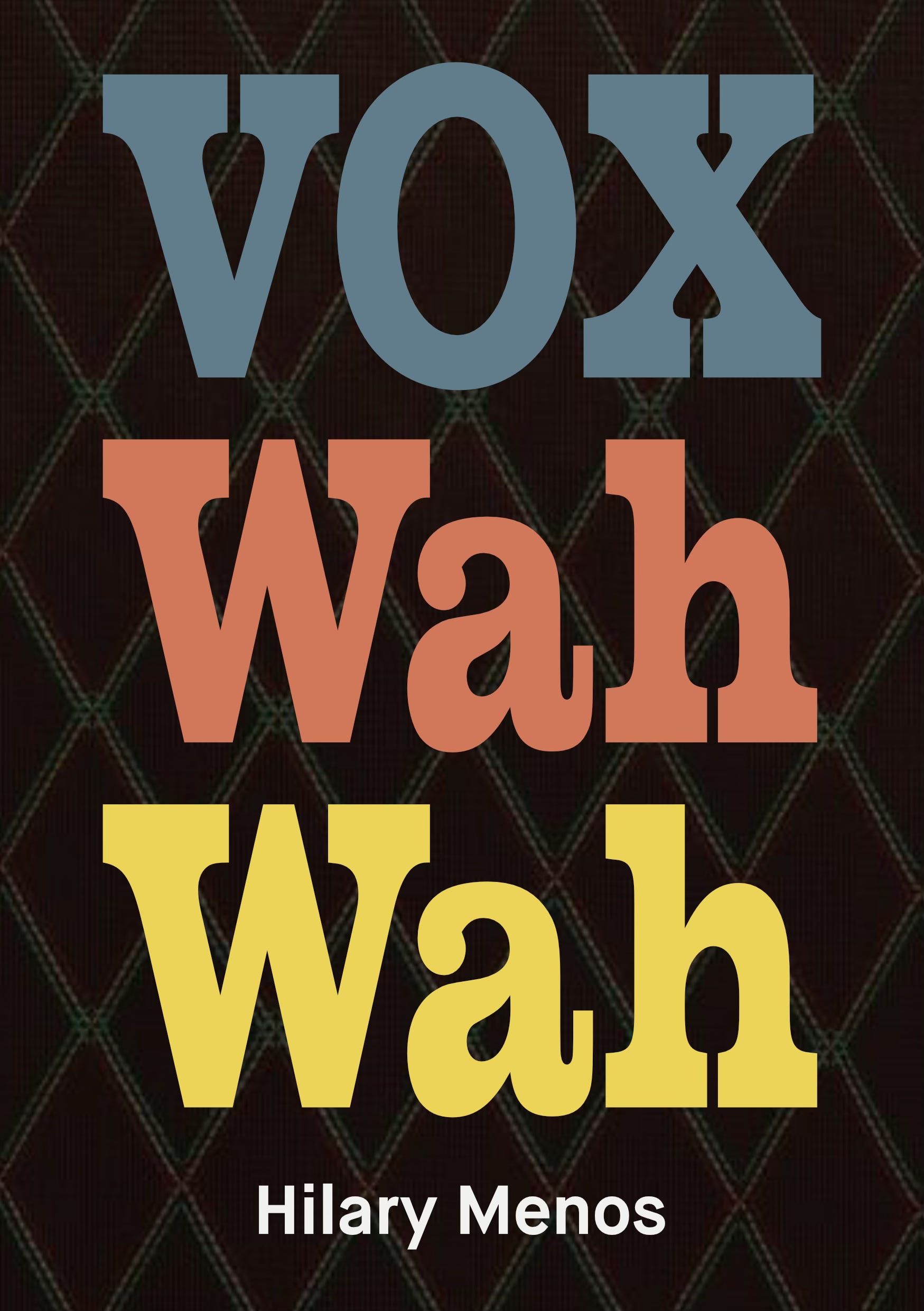
‘Spirit in the Sky’ is from Vox Wah-Wah — watch the ‘Spirit in the Sky’ film-poem embedded further down in the review. Buy Vox Wah-Wah from New Walk or if you are in the EU email Hilary for a copy.
Rock’n’roll takes centre stage in this new pamphlet by Hilary Menos, backed by that evergreen trio, Love, Sex and Death. Here are Hendrix, Chuck Berry and Etta James, Pink Floyd, Sinatra and Elvis. They’re caught out of time, playing their famous solos, dazzling in their sequins and rhinestones, creating the world of sensation and spectacle that for better or worse we still inhabit, back when that world could perhaps be thought innocent. Typically of Menos, just as much attention is paid to what happens behind the scenes, where the limelight doesn’t reach. The first poem of Vox Wah-Wah, called ‘The Queen of Tone’, is a celebration of Hendrix’s performance of ‘Star Spangled Banner’ at Woodstock, but also of pick-up winder Abigail Ybarra who
controll[ed] the tension, winding in just enough air,
her hands shaping the resonance of every Fender guitar
with consistent inconsistency
so Hendrix could hold and shape raw sound
and find new tone for the old tune.
Because (as Menos might have added), in rock‘n’roll there’s no such thing as an unstrung hero.
‘The Queen of Tone’ is a good scene-setter for the collection, assuring readers new to Menos that this is a poet whose work can be engaged with deeply. Most of the poems are superficially straightforward, but later readings suggest the depth of Menos’s knowledge and intention. The original ‘Star Spangled Banner’ was a war poem, written as an American patriotic response to the British after the Battle of Baltimore in 1812. In Menos’s version, the way in which Hendrix’s performance is described with reference to the lyrics (“the gunfire, the sirens, the screams and the moans / the mournful bugle forever calling lights out”) reminds us of this fact, but also makes us believe that Hendrix himself knew what was at stake when he began to play it. The 1812 war saw thousands of enslaved Black Americans side with the Brits in the hope of emancipation. Hendrix’s own ancestors had been enslaved and, when this is borne in mind, his famous rendition gains moral force as an inescapably ironic comment, played by an American patriot, of the contortions inherent in African-American identity.
It is possible, and rewarding, to read the collection (as the essays of Joan Didion or Camille Paglia are read) as a sympathetic but clear-eyed commentary on American pop culture
On another level of interpretation, the challenge to “hold and shape raw sound” can be read not only as a description of Jimi’s axe-work but also as the predicament of poets. Menos’s previous pamphlet, Fear of Forks (HappenStance, 2022), mostly comprised still-lives and domestic sketches – albeit with more zombies than that summary would suggest – but Vox Wah-Wah is a return to the dynamic matter of 2013’s Red Devon (Seren, 2013). Menos is drawn to action and display, and to look back across her work is to realise her persistent fascination with themes and imagery of controlled violence, such as the busy slicing and chopping involved in farm machinery and food preparation or, here, the technical skill and histrionics of rock music performance. She evidently enjoys applying formal discipline to all this speed and noise, and much of the pleasure in her poetry is an effect of the dynamic tension between action and restraint. Sometimes, the collision of unruly subject matter and Menos’s own linguistic zest seems almost too much for the poem to contain, and a dramatic peak is reached – like a wild trumpet squeal – before conditional order is restored.
As in Red Devon, the poems are built out of conversational phrases in a deceptively offhand, even slangy register, with frequent ventriloquism and addresses to an implied reader. This base-level colloquialism is inclusive and disarming, and it increases the range of Menos’s poetic vocabulary, turning the dial away from the highfalutin and towards the earthy. It is also a very effective foil for the unexpected tonal shifts into beauty and sobriety, melancholy and mystery that are a feature of her work. Metrically, too, Menos’s poems are varied and full of interest, or better say wit. They exhibit a gleeful pleasure in sound, being underpatterned with slant rhyme and rhythmic surprises, while potentially complacent lines are enlivened by the insertion of extra syllables. Look at the effect of ‘fabulous’, for example, below:
When you picked me up, I knew you’d take me home
for my feel, my finish, my fit and my fabulous tone
or, in ‘Spirit in the Sky’, the unexpected placing of the word ‘down’:
When the after-party has wound up
and Johnny Depp and John Wayne are long gone
to the next hot ticket in the next hot town,men with trucks come to break down and tear apart
the viewing lounge, the steel pole, the 400 kW sound system
in a kind of reverse stop-frame animation
These techniques were already at play in Red Devon, but in that collection, excellent as it was, sometimes the verbal effects looked to me like effects, whereas here they give the impression of being fully integrated into the poems.
The voice that […] came of age in Red Devon, is by now among the most distinctive and enjoyable in contemporary poetry
Much contemporary poetry feels insular and effortful, every drop of personal drama wrung out. But Menos’s gaze is outward-looking and generous. She is interested in other people, their choices, drives and excesses, and she shapes their lives into vignettes that are not only informative but also subtly interrogative. Many of the poems in Vox Wah-Wah offer astute assessments of rock and roll culture, in which enjoyment of the thrill and spectacle is balanced by awareness of what a dark and exploitative business it was, especially for women. It is possible, and rewarding, to read the collection (as the essays of Joan Didion or Camille Paglia are read) as a sympathetic but clear-eyed commentary on American pop culture. Menos knows the dark obverse of the permanently performing American self, and the potholed souls of those who are forever speeding on in pursuit of a gimcrack ideal. This culture is ripe for satire and critique, and sometimes Menos does not hold back; yet she also recognises its pathos and beauty. This can be seen in ‘The King of Porthcawl’ when, for a moment, one among a myriad Elvis impersonators channels our universal homesickness; or in the weird and beautiful ‘Dark was the Night, Cold was the Ground’, which imagines Chuck Berry and Blind Willie Johnson travelling through space in one of the 1977 Voyager satellites:
The enamel cup wired to the headstock of Willie’s guitar
clinks against the dash. Chuck fingers the neck of his Gibson
and rehearses the opening riff to ‘Johnny B. Goode’
as the stars bloom and pass by, bloom and pass by.
Putting your fingers to your neck is of course a common index of anxiety, and this detail is all the more moving for being included so gently. Such sympathy isn’t, perhaps, apparent at first reading in Menos’s poems. But return to them, and a consistent ethics shows through the knockabout storytelling. Her love of craft and care, her appreciation of artistry and eccentricity, of uninhibited flair, is confirmed also by her quiet condemnation of egotism, waste, and carelessness of others. Menos loves a party but she never forgets that it will end and that someone will have to clean up afterwards. ‘Spirit in the Sky’ (quoted in full at the top of this review) is scathing about the crassness and vapidity of a certain sort of Hollywood ending. Johnny Depp and John Wayne have visited Hunter S. Thompson’s Colorado ranch to witness his ashes being shot out of a cannon. In the aftermath, “the grass unflattens itself from the weight of impressions / and the horses approach, alert to the smell of cordite”. The poem ends:
Here, now, in the valley, feeling the air still
shudder from the impact of the sonic boom,
I wonder what we’ve been sold.
Mostly, though, I think of Vox Wah-Wah as a collection of sounds about sound. It even has an American accent, featuring expressions like “laying down funky grooves”, “hit the sack” and “it ain’t never comin’ back”. This bothered me at first, but now I think it’s a necessary part of the poems easing into character.
To write well about sound you need to be a good listener, and it seems to me that Menos’s ear is improving with every new book. Vox Wah-Wah describes plenty of bellowing, honking and screaming, yet also “the soft throb of crickets” and “the tiptoe of sticks on rubber pads”. At the same time, as I’ve said, the music of her own lines is increasingly assured. The voice that could be heard emerging from its influences in Menos’s earliest published poems, and which came of age in Red Devon, seems to me now among the most distinctive and enjoyable in contemporary poetry. In ‘Used & Vintage’ Menos writes that “with use and age come depth and resonance”; in context, the appreciation is directed at her partner, the musician Andy Brodie, but it could stand equally as a comment on her own craft.
As the Rolling Stones almost sang, I know it’s only poetry (but I like it).
Steven Lovatt is an editor, teacher and writer, living in Swansea.
Vital Statistics: The Friday Poem has 3600-plus subscribers. It’s run by four people – Hilary Menos (Editor), Helena Nelson (Consulting Editor), Bruno Cooke (Spoken Word Editor) and Andy Brodie (Web Editor), with contributions from a team of reviewers and writers.
Until recently we maintained the Friday Poem website (thefridaypoemdotcom) as an archive of 700 posts published between 2021 and 2024 (including most of the original Friday poems) but following a catastrophic hack in late April we made the difficult decision to take this down. We’ll be republishing some of the poems, features and reviews on Substack in the future.
Help support The Friday Poem
Buy us a coffee to help us stay awake as we strive to bring poetic excellence to your inbox every Friday. Heartfelt thanks to everyone who donates, especially to our regular donors. If you can’t afford it, no worries, we’re going to keep on doing it anyway! Big thanks for everything, you lovely poetry peeps.
I ordered this after you featured it last month and I think it is both beautiful and accessible. I’m a particular fan of Wall of Sound and Used & Vintage but I know I’ll keep dipping back into the whole collection.
A great review, which has made me decide to buy the book!