


Inner Space
n. — the environment beneath the surface of the sea
A chance remark, something of nothing,
a car slowing on the road at my door,
the way you think it’s in the past and then
and then away I go on a cormorant dive
down through the foam of an afternoon,
through whatever current slaps dabberlock,
bladderwrack or a mermaid’s purse of words,
unwords and stingy silence any-which-way
against my foolish skin. Down past questions
with flotsam answers I can’t quite get a hand
to. Down past wave upon wave of longing,
through the deeps of what there’s no time for,
past sunlight suturing its own every last gape.
Down through the roar an ocean clenches tight
as a stiletto. Down to a blackness so entire
I think I’m standing, eyes closed, in the yard
in August, held tilted back to the Pleiades
so every firing Yes drops in my mouth
and I rise to it, cormorant hell-bent on sky
with a little fish tucked by me in its beak.
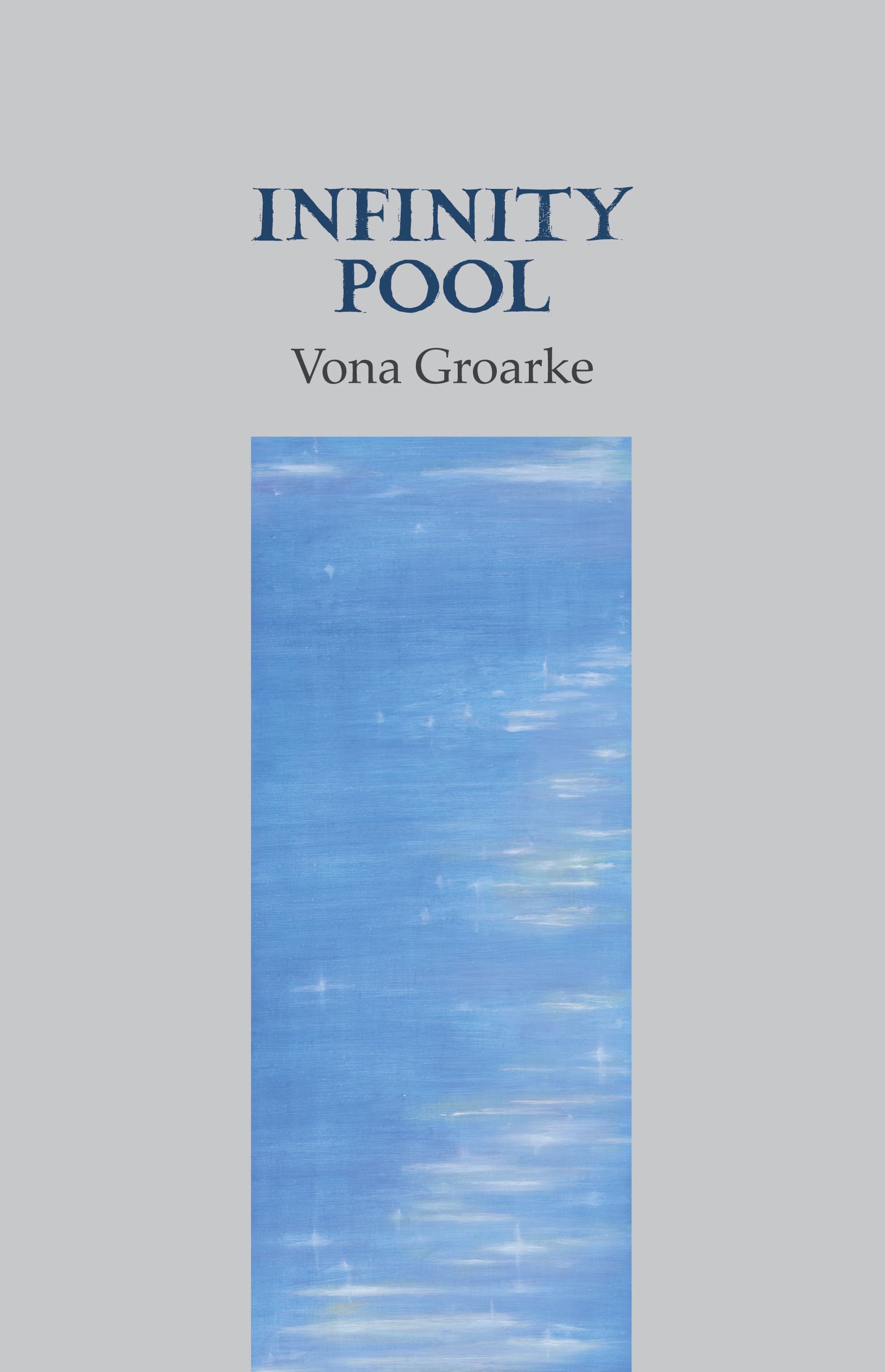
‘Inner Space‘ is from Infinity Pool by Vona Groarke (Gallery Press, 2025) — big thanks to Gallery Press for letting us reproduce it here.
Is there an affinity between poetry and swimming? “I swim in poems / but breathlessly”: in these opening lines of ‘Short Poem About Self-Consciousness’ Vona Groarke combines the underlying subjects explored in Infinity Pool. Water is in the title – although the title poem moves quickly away from what the reader might expect – so let’s start with the obvious water poems. You can’t miss them. Their titles share a common format: ‘Imagine the Atlantic as a …’, eight of them, presented in pairs, carefully placed at turning points within the 35 poems that make up the collection. They act like anchors, or moorings. (Apologies: water imagery is infectious.)
Groarke instructs her readers directly with these titles. ‘Imagine …’. It’s what she has done herself, creating and expanding the comparisons, but you, reader, must join in. Now it’s your job to envisage, to bring these images into your own consciousness. The Atlantic appears, variously, as an actor, mechanic, journalist, chambermaid, film-maker, bartender, artist, and poet. Groarke encounters her own Atlantic on Ireland’s west coast where she can stare out across over two thousand uninterrupted miles, observing its moods, movements, rhythms, patterns. It’s a vast space brought down to the familiar and individual, in poems that are playfully metaphysical, the wit embedded in language and imagery. ‘Imagine the Atlantic as an Actor’ –
running lines. He tries out emphasis
as if dropping stones in a rockpool
(I sink. I sink. I sink.), and plays along
with a smoky grin or countermanding fist.
That shift in inflection echoes the tiny variations in water sounds, mirrors water movements – different stones, different splashes – while the actor hopes for “ripples of applause.” The ‘Mechanic’, meanwhile, knows where every tool hangs in his workshop, the outlines painted on the wall
just as each wreck on the ocean floor sits intact in its mould of water
and every boat drags with it an anchor of shadow, and every vessel,
including the body, slits into the surface a shape it already makes.
That was the second ‘Atlantic’ poem, varying the format by letting longer, looser lines suggest all that huge expanse while also moving the poem into the reader’s space. “Wouldn’t you like to live this way too, every move foreshadowed / by a course determined way back and designed especially for you?” She avoids the word ‘tide’ here – as she does throughout the whole collection – but that’s the shaping force driving the water, and the poem. On the surface sits the mechanic in his orderly workshop, with that pre-planned space for pliers etc. Underneath is the existential question of pre-destination. Not that Groarke would interrupt her poems with such an abstract term: Atlantic and workshop tug against each other like waves, sharing the poem’s space equally. It looks effortless. That’s one of Groarke’s strengths, the way she shifts gear from metaphor into direct engagement with the reader.
The ‘Chambermaid’ shakes a clean sheet “like a breaker spotted out to sea / pulling the thread of itself” while the ‘Bartender’ with “hands like cormorants skeeting and huzzing / over the polished counter or the taps” is a different, calmer sea:
Her job this evening to keep it all smooth
no matter the undertow; to balance
they frisky hen-do in the corner
with the regulars like boulders
on their high stools at the bar.
There’s real water, too, beyond the metaphysical conceits. ‘An Poll Gorm / The Blue Hole’ is a naturally-formed tidal swimming pool on the Sligo coast; the Atlantic “gets to roughhouse and tousle it” before it turns gentler and “I quiet to its quiet”. Salt water swimming, and “licking salt from my forearm”: her words let you share her sensuous pleasure. In ‘The Low Road’ the water is a flooded road in which the poet’s car stalls, leaving her unsure whether to “reverse or plough through”. Then, the lines that are key to the collection:
Here’s my opt-out. Here’s how
I write myself clear.
Writing, and how to write – that’s Groarke’s central subject. It’s the current moving through the whole collection, a poet’s constant negotiation with language as medium: how best to transform the physical world into words on the page, words drawing the reader into the poet’s creative sphere. Of the 35 poems, there are 17 – nearly half – which include “word/s” along with “page”, “line”, “write”. There’s even a poem called ‘My Own Fourth Wall’ where Groarke steps from the stage of the poem to talk to – who, exactly? A friend? A reader? “Dive in, says one of us, who cares who, / and something occurs on foot of the saying / so the page, this page, / is speckled with affect.”
This is a book to hold and scribble in, to relish, and above all to enjoy
It’s not only poets who are influenced by individual words but readers too: the word ‘affect’ struck me because it’s the specific term used by an art critic (Vernon Lee), writing on how her current concerns influenced / affected the way she looked at art works. I’d picked up that book a month ago purely by chance: now it’s a part of my reading of Groarke. The ‘fourth wall’ has already appeared, in ‘Infinity Pool’, a multi-layered poem that defies the reader’s expectations:
I had it in the night, the image,
but lacked the energy or will
to magic my body through
my own fourth wall and lower
myself, spit-spot, into the page.
Not a real pool but the image of one, an image which she attempts to carry into the day – “And I am folding it now, this pool” – with the difficulty of keeping it pristine, able to be worked on, shaped into a poem. If you write – and I suspect that most readers of poetry reviews are also writers – you will recognise this: something visualised in the small hours, absolutely clear, stretching out into layers of meaning supported by language, something you will carry into the day, your best-ever poem. You will also know how the experience ends:
But carrying folded water
isn’t feasible. You know that.
It’s rare in the theatre for an actor to step out of role, turn to the audience, and speak directly. It takes a confident poet to step out and address the reader – but Groarke has earned this right. After all, this is her ninth poetry collection, alongside which runs a substantial public academic career. Yet she can still share her doubts, tussles and uncertainties around finding and placing the right words, and make poems from that thinking. Sometimes it doesn’t quite work: ‘The Future of the Poem’ felt to me a little too close to an outline for a creative writing workshop. Does that matter though? It still fits into the collection’s wide, fluid space of ideas about writing.
The outer space of the Atlantic and the inner space of the creative mind come together in ‘Inner Space’, the poem heading up this review. A “chance remark” sets off a dive into thoughts, “questions / with flotsam answers I can’t quite get a hand / to.” until she’s scooting up to the surface, with a poem. Did you notice her “words / unwords”?
The final poem, an eight-page sequence, ‘Reading Chinese Love Poems in a Borrowed English House’, moves into a new dimension, geographically, as well as a different poetic form: water that’s never at rest, more space to swim.
This is a collection to read backwards and forwards, tracking allusions, deliberate repetitions, play of images, and the author’s fascination with the way the creative mind tugs and worries at how to achieve its end — or catch its fish. Hunt down her books, even if they are hard to locate. Gallery Books don’t feature prominently in UK bookshops, although Groarke’s inclusion on the last T.S. Eliot shortlist might change that. This is a book to hold and scribble in, to relish and, above all, to enjoy.
D.A. Prince lives in Leicestershire and London. Her second collection, Common Ground (HappenStance, 2014), won the East Midlands Book Award 2015. Her most recent collection, The Bigger Picture (also from HappenStance) was published in 2022, and her pamphlet Continuous Present was published by New Walk Editions in 2025 (and reviewed on The Friday Poem here).
As well as browsing our Substack, it’s worth visiting The Friday Poem website where you can browse our Archive of more than 700 posts dating back to early 2021.
Help support The Friday Poem – buy us a coffee to help us stay awake as we strive to bring poetic excellence to your inbox every Friday. If you can’t afford to donate, no worries, we’re going to keep on doing it anyway! Big thanks for everything, you lovely poetry peeps (and especially to our regular donors – you are brilliant).
defintely made me want to read the collection - beautifully done review
Your review has absolutely made me want to read this poet, thank you!