


you start every new day with gunfire as salutation.
just to keep a clear conscience (narratively
speaking). the gun will not go back onto the wall
from which it came. you bankrupt yourself with
the postage and packaging costs of mortar. no
one knows why you put this pressure on yourself.
everyone knows you can’t shoot a false promise
(narratively speaking). no one knows why you are
so attached to narratively speaking. except that it’s
something to do with loose ends. except your chest
tattoo that says for the sake of...
Above is the second piece in On the Subject of Fallen Things by James Kearns (Bad Betty Press, 2025) — big thanks to Bad Betty for letting us reproduce it here.
In all kinds of ways, modern poetry books are trying to escape the strictures of the ‘slim collection’ – that is, the heavily ingrained expectation that any single-author book should comprise a set of independently coherent poems of one-to-three pages in length, only loosely related to one another, totalling between 60 and 100 pages. It’s a format designed to fit a particular notion of the arc of a poet’s career: publishing poems semi-continuously in respectable journals, occasionally stopping to gather these together under an enigmatic title, ultimately arriving at Selected and Collected editions that serve as encapsulations of the artist’s life and soul. Since this is an unlikely road for most poets working today, the format looks more and more like a straitjacket.
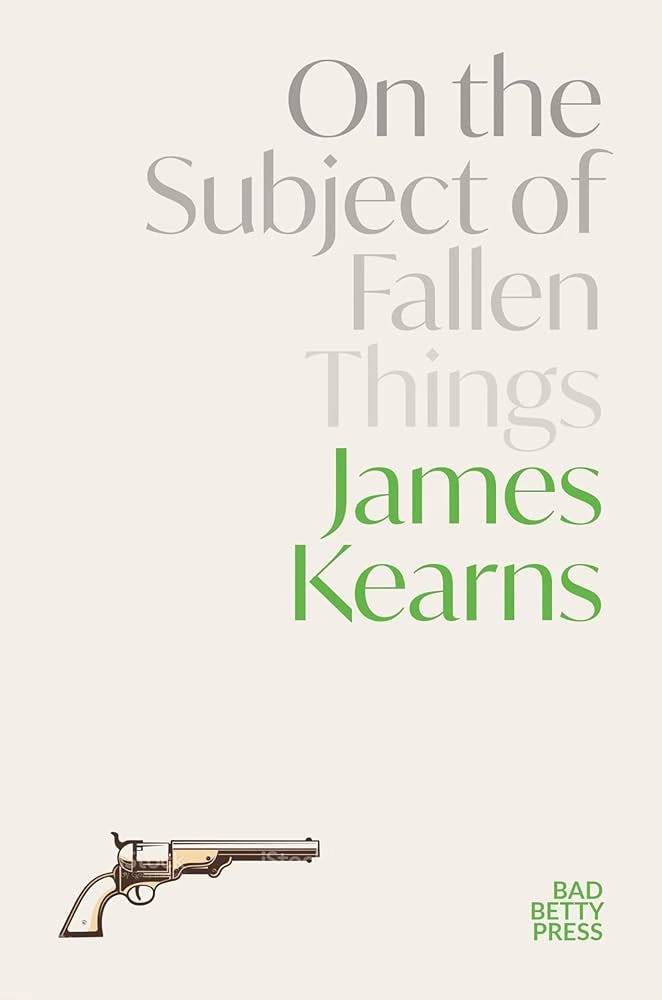
James Kearns’ On the Subject of Fallen Things is, at first glance, a very well-behaved patient: 70 pages of prose poems, most of which fit neatly into half a page or less. On closer inspection, though, it seems a rusty file has been smuggled into the cell. The poems are largely untitled, many of them remarkably similar in form and phrasing. It’s a sequence, then, yes? An iterated pattern? Well … yes and no. I’d say there’s something of the medieval morality play about it.
It opens, like James Sheard’s beautifully lean 2010 collection Dammtor, with a short inventory, a brief list of significant motifs. Except in this case, it’s really a sort of dramatis personae in disguise, since the inventory items return in different guises and combinations throughout the book, interacting with one another not unlike characters coming and going across a stage.
The cape, for instance, foreshadows a recurring fixation with superheroes. In the third poem, one such superhero is a bystander, “on duty” behind the till during a robbery. Later, a poem’s speaker ponders the uncommonness of superheroes: “the number that die out unfullyformed and bedding in their powers is frankly overwhelming”. Cape then reappears as shroud.
The inventory’s parachute, meanwhile, stays safely tucked away until about half way in, when:
the wake that keeps on going swirls parachute thoughts above you; the parachutists guiding them, inconsequential, slumbering.
Another item, the moth, returns in waves, as various kinds of metaphor and approximation. The gun, of course, is the most prominent motif, a villain of the piece that rapidly morphs into ‘Chekhov’ via:
Chekhov’s gun, dropping Chekhov’s bullets on the floor of Chekhov’s petrol station … when Chekhov’s police come bursting in the door past the Rolos and start to open Chekhov’s fire.
On page 28, the inventory itself returns, now “a prop list of whatever act has just come before”, rehearsed at the start of “each memorial service”. Other poems repeat the list form, in an eerie echo of Japanese poet Sei Shōnagon’s scrupulous experiential accountancy: “things of permanence”; “things that do not know their permanence”; an unheaded list of titles a saint might take on, the first nine of which are labelled “taken”. These lists grow increasingly frantic, with one string of commands (“eat the hand eat the wrist eat the above eat the back eat the shoulders”) resuming pages later as an incessantly skipping record (“eat the grief eat the grief eat the grief eat the grief eat the grief”). Several poems read as renunciations of all that has come before, beginning “yet yet yet”, while others seem almost placeholders – white space surrounding the mere suggestion of a poem (“perhaps there is something here about prayers”).
Moving from poem to poem is like waking up repeatedly from a dream, into another part of the same dream
The ambiguity over whether this amounts either to a tessellated lyrical chain (an alien AI’s approximation of the slim collection) or possibly to one long dramatic monologue is skilfully sustained. Moving from poem to poem is like waking up repeatedly from a dream, into another part of the same dream. For a moment, the imagery and tone might seem fresh – a clean break, as in the beguiling piece that begins, on page 44:
just bandanas waving in the wind; you didn’t mean any of it. yet apologies come like licks of an ice cream, quicker to stop the melt. wear summer lightly. trust that insects won’t always be there to plague you through your nights.
But wait – wasn’t that another instance of the moth? And then the ensuing poem bursts through the wall with its “yet yet yet” and the next ends, horrifyingly, with “Chekhov in the mirror”, and you realise you’re approaching another run of poems each of which begins “and what we mean by cannibalism”.
It would be easy to characterise On the Subject of Fallen Things as a long postmodern natter, a transcript of a metaphysicist talking to himself, trying to marshall the ingredients for a single, symbolically dense sonnet. To do so, however, would be to miss the layers of conflict that play out within and between a set of carefully balanced pieces, the zany tussle for meaning that animates the language, and the gradual build toward a climactic confrontation with death.
Jon Stone is a Derbyshire-born, Cambridge-based writer, editor and researcher. He has previously won an Eric Gregory Award, the Poetry London Prize (twice) and the Live Canon International Poetry Prize. As one half of Sidekick Books, he edits the ongoing 10 Poets series with Kirsten Irving. His most recent solo publications are Sandsnarl (The Emma Press, 2021) and Unravelanche (Broken Sleep, 2021). He has also edited an anthology of Dungeons & Dragons writing, Ragged Band of Travellers (Calque, 2025).
As well as browsing our Substack, it’s worth visiting The Friday Poem website where you can browse our Archive of more than 700 posts dating back to early 2021.
Help support The Friday Poem – buy us a coffee to help us stay awake as we strive to bring poetic excellence to your inbox every Friday. If you can’t afford to donate, no worries, we’re going to keep on doing it anyway! Big thanks for everything, you lovely poetry peeps.
Excellent review. Genuinely informative and perceptive, and expressed in such a clear way that I feel like I halfway understand the work already. Jon's fab. P.s. Sounds trippy! I like it.
I particularly enjoyed the description of the 'slim collection'. I'm still meditating on the opening quotation. Especially "narratively speaking".