


These Days
you glimpse her, or her likeness, more; perhaps
driving past — you, stuck at red lights — her,
in profile this time, looking straight ahead.
Or Co-op checkout, standing in the queue,
wire basket on the floor, her gaze
downward, not catching your eye (this time), or
walking a terrier past your house, her back
stiffened, her shoulder blades too sharp, a bag
slung crosswise. Could be anyone, you try to say,
except she’s not. She’s too familiar,
too often. She’s on the last bus, hunched
at the back, no other passengers.
In the waiting room she has a chair
near the receptionist, something complicit
you strain to hear. In the midst of life we are —
you catch the echo trailing off. She’s constant,
tidy, working through a list, slowly
crossing through every person, name by name.
‘These Days’ is from Continuous Present by D.A. Prince (New Walk Editions, 2025) — big thanks to New Walk for letting us reproduce it here.
D.A. Prince has a very nice line in titles. I mention this not because her poems are not so much more – they are – but because it (obviously) all starts with the title and hers do good work. The final poem, for instance, ‘Staying on for the Credits’, manages, to offer the most inauspicious part of any film-going experience as a means of reminding us that our appreciation of art is both collective (“the scrolling names / of all who shared”) and individual (“We take what we need, / draining every word, each in our own language.”) This is a typically understated poem, gloriously subtle, not a word out of place.
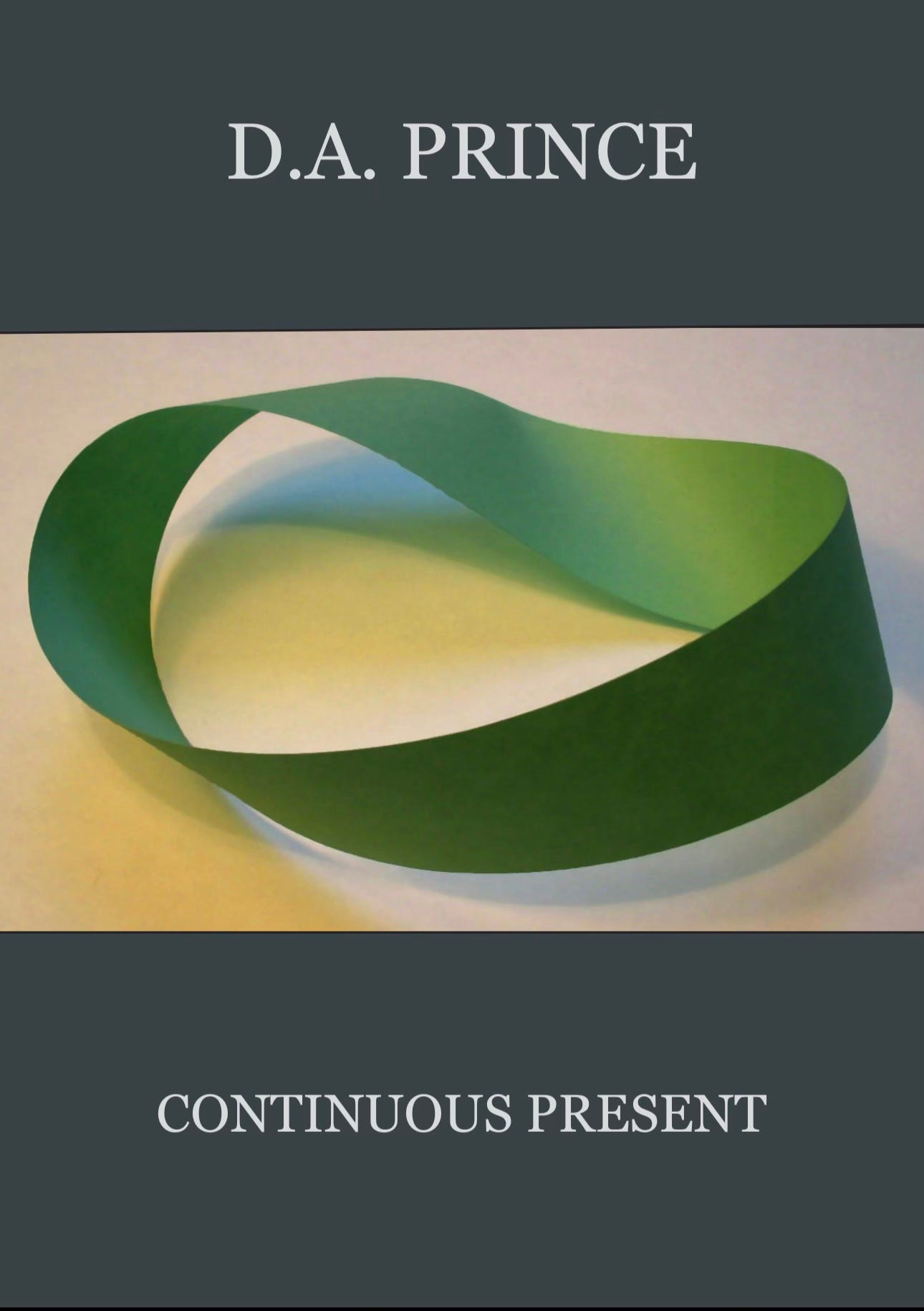
And at the very start of the pamphlet, we are offered a poem whose title – ‘…in my average moments’ (quoting Marianne Moore’s poem, ‘When I Buy Pictures’) – draws attention to itself only in its effort to appear as modest as possible. This poem sets out the spirit underlying this collection. In the opening of its six three-line stanzas, Prince thanks “Miss Moore” for coining the term “in my average moments” that so well suits “the accumulation of present moments” and “the vast indifferent space”. For it is all about time, how it extends “like a stretching cat / engaged only in the furthering of each paw”, and “recognising” and “noticing” and “pointing to” and, in the final stanza, “sparking a search for the exceptional everywhere […] inside the relentless weight of my own hours”.
And this really is the matter of much of the collection, the unforced moment of observation
And this really is the matter of much of the collection, the unforced moment of observation. Poetry, of course has been no stranger to noticing small details, but I do believe there is always room for more. Here’s one example from Continuous Present in its entirety, to make my case:
Through the Train Window
This could be you and any journey:
the way memory holds the momentbetween one nameless station and the next
somewhere in summerwhen an instant of silver light
hums through high grasses,their pool of rippling seed heads
hedged with the weight of elder,green shadows, a dance of willow
before the engine picks up speed.
We might observe that many other poems have been composed under similar circumstances, and that this might even be a brief response to Larkin’s ‘The Whitsun Weddings’ (the final stanza surely), but here it is done with effortless brevity and offers us a graceful recollection of a powerful idea.
Certainly, these are not showy poems and although they feel as though they have come directly from a life lived, they almost always look outwards, look closely at others, noticing pertinent details. In the poem ‘These Days’, it is not even the poetic ‘I’ making the observations, but we the reader, co-opted so that we “glimpse her, or her likeness, more; perhaps / driving past – you, stuck at red lights – her, / in profile this time, looking straight ahead” and later at the Co-op or walking a dog or on the last bus or in a waiting room. By the end, we get the curious sense that we are watching ourselves “working through a list, slowly / crossing through every person, name by name.” So here is a poem made of absolutely nothing any citizen could not have observed in contemporary Britain, with each situation ‘othering’ the subject, and finally alienating our very selves.
Alongside such ordinariness, it is a tonic to see poems inspired by decidedly unordinary folk: Chekhov, John the Baptist (well, his head), Cézanne. Having said that, the Chekhov referred to is a student production of Uncle Vanya, and our focus is as much on the new Assistant Stage Managers “struggling with the tricks / of conjuring shadows from the stylised birches / and, indoors, the background hum of flies” as the play itself. Or rather, it is a poem about how very hard it is to represent the drudgery of an uneventful life lived day in day out. Even portraying such a life through theatre can be terribly boring, as I’m sure Chekhov would have confirmed. And as to Cézanne, the poem in question (‘Cézanne at Tate Modern’) begins:
Too many apples says my friend, dismissing
Cézanne and his stubborn brush working
the canvas over and over, trying
to uncover truth or whatever
lies under the skin
and thereafter concerns itself only with apples, or rather with the necessity for artists to sometimes concern themselves again and again with the same simple subjects and the same fustian materials in an effort to understand the world by observing it intensely. Which is largely what Prince does in Continuous Presence, offering us poems that look again and again at that which is already familiar but quite probably not really ‘seen’.
Jonathan Davidson is a poet, writer and literature activist. He lives in the Midlands but works internationally. His poetry has been widely published and he has also written memoir and criticism. His radio dramas and adaptations have been broadcast by BBC Radios 3 and 4. Much of his work is focussed on how writing – especially poetry – is experienced by readers and listeners. His latest poetry collection is Downland – Paintings by Anna Dillon & Poems by Jonathan Davidson (Two Rivers Press, 2024). Jonathan Davidson’s website is here.
As well as browsing our Substack, it’s worth visiting The Friday Poem website where you can browse our Archive of more than 700 posts dating back to early 2021.
Help support The Friday Poem – buy us a coffee to help us stay awake as we strive to bring poetic excellence to your inbox every Friday. If you can’t afford to donate, no worries, we’re going to keep on doing it anyway! Big thanks for everything, you lovely poetry peeps.
Yes, lovely pertinent review of these poems, their quietism so haunting and far-reaching.
Thank you Jonathan - I’ll be seeing if Deb can stock this at the Poetry Pharmacy.