


Salt, Snow, Earth
Salt bites Snow.
Snow slaps Earth.
Earth pounds Salt.
And so it goes, on and on and on
round and round in every shade of hand
– claw-teeth, hard palm, fist –
Salt, Snow, Earth, Snow, Earth, Salt
Bite, Slap, Pound, Slap, Pound, Bite
A game to get the blood up.
Heart pumping. Skin singing.
No breath or time to ask
Whose bodies are blanketed?
Whose bodies blanked out?
What are the odds white wins?
‘Salt, Snow, Earth’ is from Salt and Snow by Naomi Foyle (Waterloo Press, 2025) — big thanks to Naomi Foyle and Waterloo for letting us reproduce it here. And here’s the film poem, made by Wendy Pye, Razia Aziz and Naomi Foyle.
Salt and Snow, the new collection from British Canadian writer Naomi Foyle, is a disturbing and beautiful collection of elegies – weighty, unapologetically political and profoundly humane.
Foyle’s writing spans essays, drama and science fiction, as well as poetry. In Salt and Snow she writes in multiple forms – sonnets, thwarted sonnets, a shape poem, tercets, couplets, prose and free verse. Throughout, she uses startling imagery and precise language. She’s a Reader in Critical Imaginative Writing at the University of Chichester, with interests that include experimental fiction, Israel-Palestine, eco-literature and diversity. She’s also an activist (she co-founded British Writers in Support of Palestine, a blog site that ran from 2010 to 2018).
Salt and Snow is divided into three parts; Out of Season, Salt and Snow and Sleepless Magpies. This triptych is connected by deaths. Some are the result of illness or linked to abuse, others are associated with trans-generational trauma and injustice. A number of tributes illuminate friendship and love, giving vitality to memories of the dead. The work is set against the current global crises of violence, injustice and ecocide. It's a hard-hitting, deeply affecting book, one to take time over. At the back are notes, pen portraits of the people or circumstances about which the poems are written; these serve almost as ‘headstones’, but contain more than we’d ever read at a graveside or even, perhaps, in a history book.
The first section, Out of Season, includes poems dedicated to the famous and to the author’s friends. These reference orchids, trees, stories of migration, and colonial legacies. Foyle’s work can be prosy and direct at times, but it also skilfully ascends into heady poetics. She reflects on loss, and reminds us that bereavement is universal.
‘Azaleas’ is dedicated to her friend, the poet Judith Kazantzis, whose second marriage was to American author Irving Weinman. Foyle captures the shock and bewilderment she felt at Kazantzis’ death vividly. She writes about the coffin in the crematorium, “all your raging beauty / quiet before the fire”. After the funeral she hides in some azalea bushes, conjuring Shakespearean madness as she comes home “stinking of wild garlic, rent / pink petals in my hair”.
‘The Ballad of Irving Weinman’ is full of life, lyrical, funny and poignant:
One minute bopping
in from the kitchen with cakes on a tray
the next disappearing like a jazz jumpin’ genie
with God’s own lobsters to fry.
The poem rounds off wistfully with the image of Weinman tramping over the Downs, tracking “seeds through blue fields / as your stories sing in the trees”.
A shape poem called ‘Bomb’ follows the two dedicated to Weinman and Kazantzis. Feelings evoked by losing loved ones pass through grief, regret and guilt, then tumble into anguish about Palestine and the partial destruction of the Arctic. Foyle refers to crying “until my eyes were molten pools of lead”, evoking the anguish of King Lear “upon a wheel of fire” where his tears “scald like molten lead”. This sense of fate, of being bound to a wheel of suffering, is also evoked in a later poem, ‘Salt, Snow, Earth’.
… weighty, unapologetically political and profoundly humane
In the second section, Foyle widens her lens to include global suffering, with some poems originating in lockdown. She’s fearlessly political, and the writing brings a quality of necessity (see the article by Valentina Viene below). ‘Salt and Snow’, the title poem, memorialises Arthur Labinjo-Hughes, killed by his stepmother after being poisoned with salt. The expression is staccato, brittle, in short lines and small stanzas. The poet returns to the silence of friends, of community, trying to face the enormous horror of child abuse:
Our silence
is a coverlet
of snowon a looted grave –
white as salt
cut rootsmilk teeth.
The poem is devastating.
Foyle also writes about the trauma of international events witnessed in lockdown. There’s an elegy for George Floyd, whose racist murder by a police officer sparked global protests (‘Lockdown, Week Ten’). She humanises the "complex king” who was the victim of “Amerikkka’s axe” and was "felled / across the path / we all walk together, / until we don’t / anymore”.
Foyle explores some of the injustices of colonialism vividly in, for example, ‘On watching the slaver Edward Colston get dumped into Bristol Harbour'. She writes of a white friend who acknowledges “her fear / of black men on the street at night”, while the ocean, “at our backs” is “licking its blue lips”. But the uncomfortable truth is that it’s actually white supremacy that’s the real terror. Foyle later muses on not getting a research fellowship to look at whiteness in the Greenwich Naval Museum; her poem is a list of objects, including “Elizabeth’s lead mask / lace and pearls” and “an array of Admirals’ trousers” — all white. The shadow of colonialism also creeps into ‘The Dark Earth’, a prose poem where Foyle uses the metaphor of gardening as the backdrop about which plants should live or die “because of their nature”. Gardening here becomes a brutal, graphic metaphor for homophobia.
Several powerful poems turn to Israel and Palestine. ‘Supernova’ explores the Hamas attacks of October 2023 through the harrowing murder of 22-year-old German-Israeli tattoo artist and influencer Shani Louk, who Foyle describes as a “peacenik”, making her death all the more horrific and pointless. The poem feels biblical, mapping the subsequent retribution upon civilians in Palestine. Foyle paints graphic scenes of families trying to dig loved ones out of the dust. ‘Striver’ is a tribute to a young boy called Mujahid who was saved by an American medic working in Gaza, only to be killed, along with his entire extended family, by an Israeli airstrike. In the poem Foyle describes demonstrating outside Parliament holding a long fabric scroll with dead children’s names written on, and “No end in sight”. The image of the floating white shroud in this poem segues into the next, ‘Nowhere is it written love must fail', which is dedicated to Refaat Alareer, Palestinian writer, poet, academic and activist, who was killed by the Israeli army. The poem reminds us how dangerous speaking up can be in oppressive times. Foyle references Alareer’s most famous poem, ‘If I must die’, in which he asks that his death might bring hope and love, like a white kite. Foyle, too, writes of hope, of brave people seeking to, “build bridges / from the wreckage of fences”, who meet above “the abyss” and “look, not down / but at each other”.
Salt and Snow is a highly imaginative tribute to friendship and love, and a cry of protest against violence and injustice
The concluding poem in this section pounds with a relentless beat. It’s a sonnet, and its theme is the eternal cycle of suffering, juxtaposing love against elemental patterns of violence. “Salt bites Snow. / Snow slaps Earth. / Earth pounds Salt.“ Foyle finishes with questions about whose history is told, who is silenced, who wins.
The final section, Sleepless Magpies, pulls away from the global and back to the personal. Foyle chooses the magpie as a motif for the thieving of time. This section contains two long poems dedicated to Irish poet Niall McDevitt and Austrian-born British historian Gwendolyn Leick. Both poems exude love, relating stories of deep friendship and shared life experiences, both in sickness and health. She writes of the pain of witnessing McDevitt’s decline, and how we lose part of ourselves when a loved one dies:
your stoic flair
a salt and dandelion poultice
I press against the axe wound
to my root
‘On Telling Gwendy I’m Autistic’, relays Foyle’s late diagnosis of autism through conversations with her dying friend. It’s a crown of sonnets, and an impressive one. Each individual sonnet is a story in itself, and the whole is an affirmation of her friend’s advice not to lament the unfairness of life but to celebrate all experience, and to do so with friends. Foyle describes the intimacy of the two friends watching TV together, but also searches for ancient truths as Gwendoline faces her own mortality. Foyle evokes Inanna, the ancient Mesopotamian queen of heaven, who visited the underworld and returned. The poem is filled with a sense of legacy, continuity and rebirth. She references the Palestinian maternity thobe which Gwendoline passed to her. In her notes, Foyle promises to return it to Palestine.
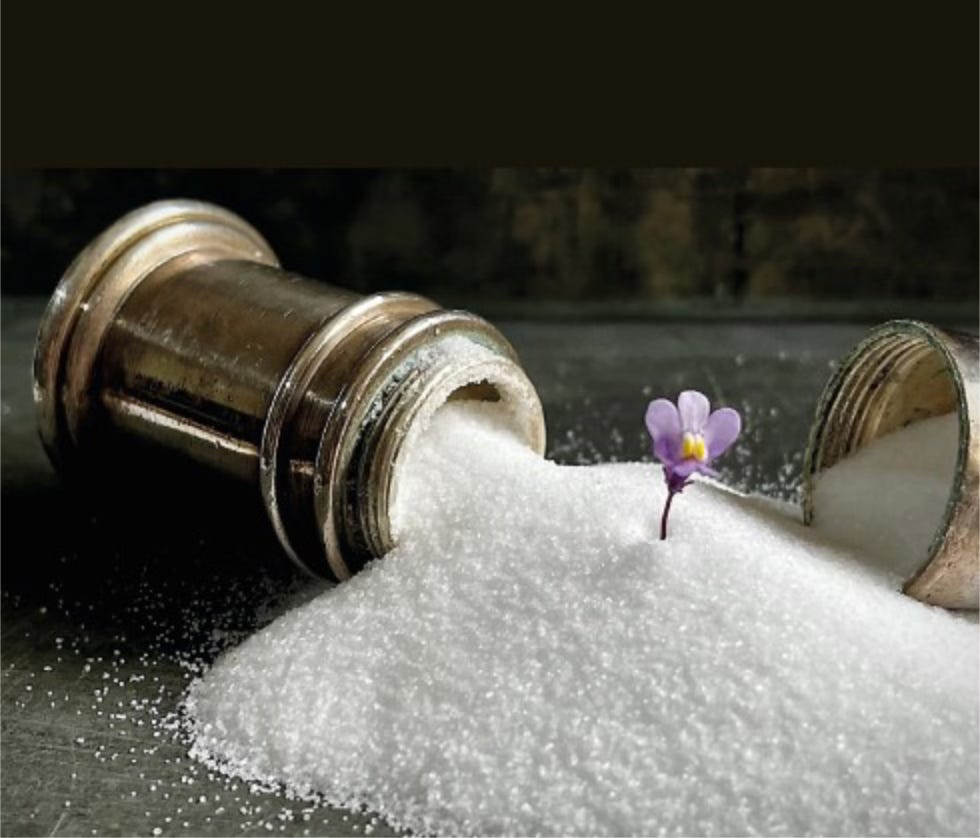
Salt and Snow is a highly imaginative tribute to friendship and love, and a cry of protest against violence and injustice. The abundance of life is transposed onto scenes of grief. Foyle travels between the domestic and global. She ventures into spirit realms, with the witchiness of tarot and ghosts. She covers big themes with skill and fearlessness, weaving the historic both subtly and directly into her work. She speaks to our times with clarity and humanity, and her poetry lingers. The jacket image captures the spirit of this collection: an antique silver salt cellar, tipped and spilling its contents. Salt has powerful resonances; it is a symbol of purity that wards off evil, but it can also be poison. Even more powerful is the small purple toadflax flower daring to grow from the salt mound. It symbolises resilience, protection, hope and continuity, much needed in these troubled times.
Showcasing Poems That Present the Palestinian Narrative: A Conversation with Naomi Foyle by Valentina Viene | World Literature Today
Cover photo 'In Salt' by John Luke Chapman @darklingeye
Khadija Rouf is a clinical psychologist and writer with an interest in the arts and mental wellbeing. She works in the NHS. Her poetry has been published in Orbis, Six Seasons Review, and Sarasvati and included in the NHS poetry anthology These Are The Hands edited by Katie Amiel and Deborah Alma (2020). Her poem ‘Tacet’ won a prize in the health professional’s category of The Hippocrates Prize for Poetry and Medicine, and her pamphlet House Work was published on International Women's Day 2022 by Fair Acre Press. She is also a member of British South Asian writers collective The Whole Kahani and has work in the anthology Tongues and Bellies, published by Linen Press.
As well as browsing our Substack, it’s worth visiting The Friday Poem website where you can browse our Archive of more than 700 posts dating back to early 2021.
Help support The Friday Poem – buy us a coffee to help us stay awake as we strive to bring poetic excellence to your inbox every Friday. If you can't afford to donate, no worries, we’re going to keep on doing it anyway! Big thanks for everything, you lovely poetry peeps.
An excellent review of what looks to be an exquisite collection. The videopoem is very well-made.
Like this! Very sharp and to-the-point. Love the variation on scissor-rock-paper :)