


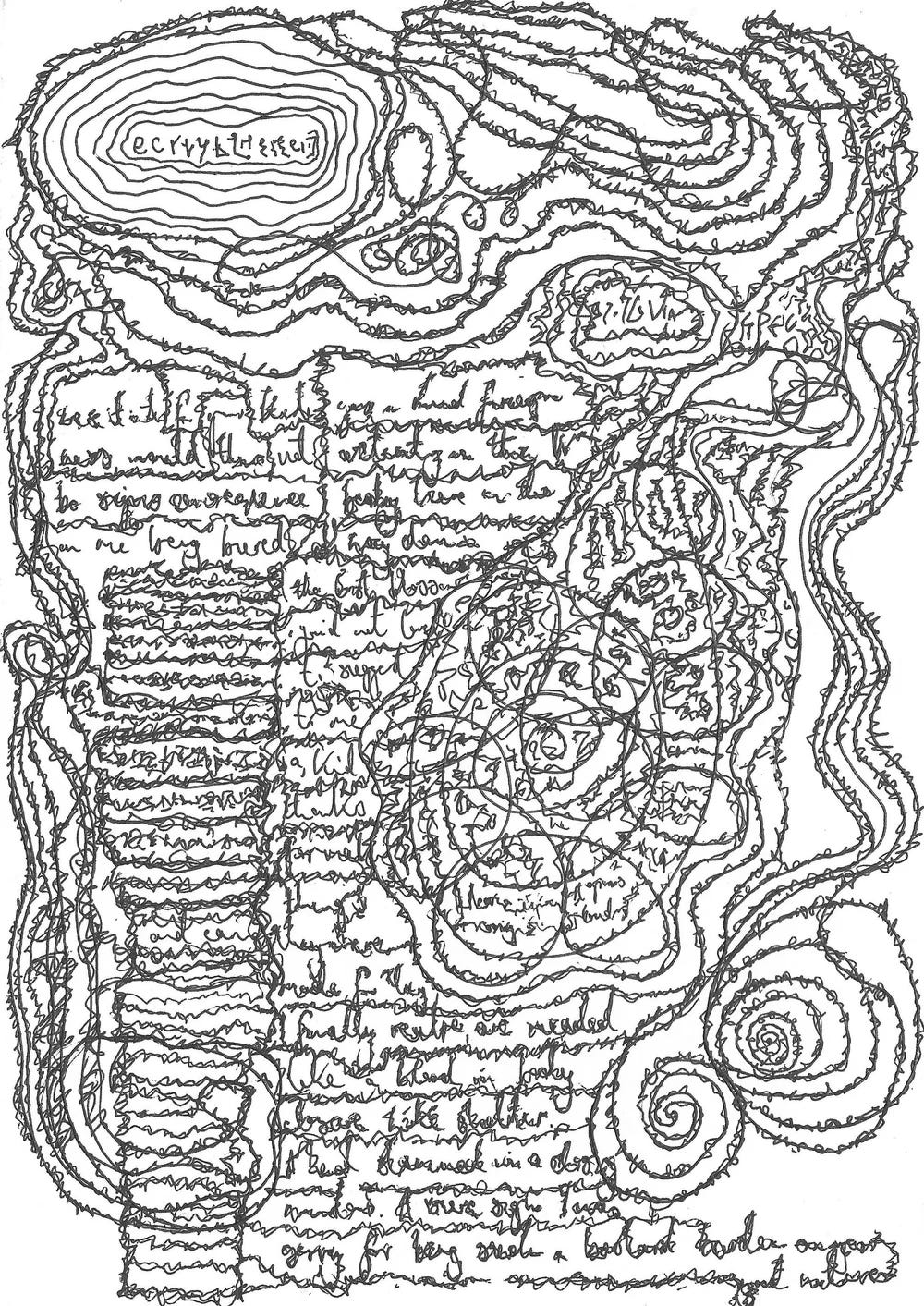
‘It wouldn’t go well’ by S.J. Fowler, from The Selected Scribbling and Scrawling of S.J. Fowler (ZimZalla Press, 2020)
If you write poetry, you’ll know words are not to be trusted – the seductive, promiscuous little beasts! However much you want to embrace them and call them your own dear darlings, you can never be sure where they’ve been or what they’ve been up to when they roll up looking gorgeous but dishevelled at the door of your villanelle or ode or experimental sonnet. You strongly suspect they’ve been in bed with a more skilful word-lover than you. Shakespeare probably … or Dante, or Dickinson, or Plath, or Hughes ... Words are soiled and spoiled. They’ve been used too many times. They come with history.
It’s frustrating and inhibiting. I put the word ‘pearl’ in my poem and immediately think ‘full fathom five’. I write ‘plot’ and think John of Gaunt’s speech. ‘Coffee’ says Prufrock. The more poetry I read the worse it gets. ‘Snow’ reminds me of John Burnside. Carol Ann Duffy has used ‘talent’ at least twice, so I daren’t go near it. I even feel guilty if I use a synonym for a word I regard as another poet’s copyright! Sometimes it’s not a single word but a phrase. I once emailed Mimi Khalvati because a line I was fond of in one of my poems seemed too good and I thought it might be hers. Mimi said it wasn’t, so I went ahead and had the poem published. I still feel queasy about it. I’m not telling you what it was, just in case it was yours … I suppose it’s what’s called influence anxiety, and I fear AI will only exacerbate things for those of us prone to the condition.
Perhaps you’re one of the poets fortunate enough to be free of such scruples. T.S. Eliot was famously unbothered and dropped unattributed quotes in all over the place. When The Wasteland was first published it never occurred to him to mention where the numerous allusions and quotations came from. It was only later that he was prevailed upon to add end notes, and that was because a publisher needed to pad out the page count. Eliot had assumed we’d all recognise his sources and thought it would be vulgar to point out such things.
It may be that my Catholic education makes me particularly susceptible to the nagging voice of influence anxiety. Catholic priest and poet Gerald Manley Hopkins burned all his early poetry and made a seven-year vow of poetic silence, believing he’d been too influenced by classical and romantic poets before him. “Perhaps you should try a seven-year vow of poetic silence too,” I hear you muttering. Well, I would, dear reader, but I’m nearly seventy-six, so …
When [Samuel Beckett] was awarded the 1969 Nobel Prize for Literature, he declined to attend the award ceremony to avoid having to drum up words for a speech
For the mature Samuel Beckett, acutely aware of James Joyce’s influence and distrustful of the naturally ornate verbosity of his own youthful writing, one answer was to write in French. Sometimes he translated the French back into English as he deliberately shrank his style in the direction of the empty page that awaits us all. “Every word is like an unnecessary stain on silence and nothingness”, said Beckett. When he was awarded the 1969 Nobel Prize for Literature, he declined to attend the award ceremony to avoid having to drum up words for a speech.
The above ramblings are my shamelessly wordy introduction to this question: How can a poet cure, or at least get respite from, word-nausea? What can we do when our words sound like we’ve heard them all before … weary flat, stale and unprofitable (as someone once said)? Could the solution lie in something like this?


These graphics are from The Selected Scribbling and Scrawling of S.J. Fowler and are examples of something called ‘asemic writing’. Asemic writing is mark-making that resembles writing to a greater or lesser extent but deliberately avoids legible words, recognisable letters, or any overt semantic meaning (in linguistics, a ‘seme’ is the smallest possible unit of written meaning). It’s a creative practice that has burgeoned in recent years, partly due to the ease of posting online. It can take many forms. It may look wild and messy, like a young child’s scribble or a doodle, or it may appear to mimic an existing or ancient writing system, for example Chinese logographs, Cyrillic writing or runes. Some might say that asemic writing isn’t writing at all, but abstract art, and I’d be inclined to agree. Fowler, however, argues passionately for it as a form of visual poetry – a natural development from ‘concrete’, ‘found’ and ‘surrealist’ poetry, and other postmodern forms. You can see and hear him explaining his ideas here: Asemic Writing, Steven J Fowler.
S. J. Fowler’s biography on The Poetry Archive tells us he’s a poet, artist, martial artist and vanguardist, working in the modernist and avant-garde traditions, across poetry, fiction, sonic art, visual art, installation and performance. He lectures in Creative Writing at Kingston University, has published nine collections of visual poetry and, as the merest glance at his website will tell you, is irrepressibly prolific.
This is raw, instinctual mark-making with little attempt at finesse
In his introduction to The Selected Scribbling and Scrawling of S.J. Fowler he writes: “There is no poetic technique more consistently neglected in the UK than asemic writing.” Acknowledging the influence of Michaux, Cy Twombly, Max Ernst and others in the Dadaist tradition, his book does exactly what it says on the cover. This is raw, instinctual mark-making with little attempt at finesse. If they are poems, they rarely made me want to linger and re-read them, but I was intrigued by the concept that he considered them to be poetry and I was entertained by the titles he gave each piece, e.g. ‘Letter to a Childhood in Jerusalem’; ‘Letter to the Cats of Hampstead’; ‘Treatise on Booklight’. I was also interested in the reflective, entertaining and provocative interviews, articles and explanatory text that were interspersed with the ‘scribbling and scrawling’. Fowler’s background is in philosophy, and his varied literary exploits (of which asemic writing is only one) seem, as much as anything, to be exercises in self-questioning.
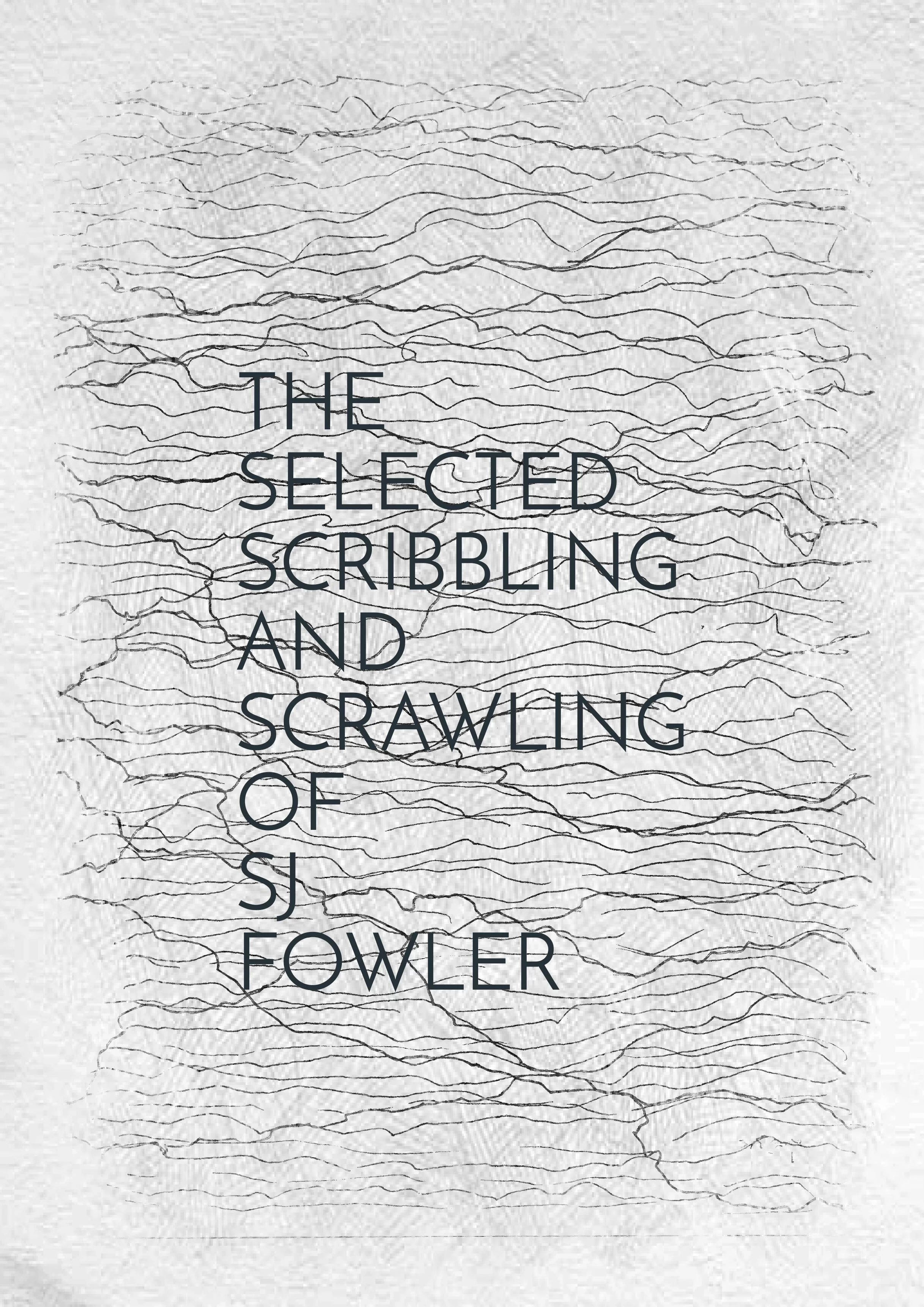
Are his scribblings and scrawlings poetry? I’m not convinced and neither, to be fair, is Fowler, who speaks about his work with an endearing mixture of enthusiasm and self-deprecation. “The poems aren’t meant to be perfect nuggets of cleverness,” he says. Elsewhere he says, “I am fundamentally suspicious about what I’m doing.”
Whether it is indeed ‘poetry’ or not, I can certainly see the practice of asemic writing as potentially therapeutic. I’ve been dabbling myself. Encouraged by Fowler’s ‘anyone can do it’ example and his suggestion in the book that asemic writing deregulates the brain in helpful ways, I spent several days doodling with pens, pencils, charcoal, ink and sticks. I had great fun. It was relaxing and certainly took my mind off words. If I had to label the results, I’d say they were abstract art or word art rather than poetry. Having said that, the word ‘poet’ has its origins in a Greek word meaning ‘maker’ or ‘creator’, so maybe I need to broaden my thinking. Fowler would probably say labels don’t matter.
In fact, Fowler defies categorisation. As the blurb on his book says, he operates “beyond the ragged edge of language”. He seems more interested in process than product; in exploring the materiality and physical gestures involved in written communication – the random lines and dots and squiggles with which children experiment before their writing becomes tied to, and limited by, the conventions of a particular alphabet. Many of his pieces defy ‘asemic writing’ in its strictest sense because they include some vaguely discernible letters and words. These examples actually appealed to me most because the legible bits gave my mind more to go on. The piece at the beginning of this review is one example of his mixed-mode ‘scribbling’. Here are two more:


In the introduction Fowler urges us to: “please be content with my scribbles, knowing there is meaning in them if you just shudder and stare hard enough, and that deep down they are about whatever you like most in your writing." Hmmm. He’s asking for quite a lot of trust here and seems to suggest that the heavy lifting is down to us …
I have, nonetheless, spent significant time with Fowler’s scribbling and scrawling and have also explored his capacious website and numerous YouTube appearances. I came away impressed by his indefatigability, as well as by the huge variety of creative activities with which he is involved here and abroad. He’s a generous, modest and charismatic presence and I liked him as a person. I can’t honestly say I loved his asemic writing or truly experienced it as poetry, but I suspect his response to that would be “Fine!” I’d like to meet him some time and talk about this some more. He’s got me thinking. Which was maybe his intention all along …
LINKS: If you have time to jump down the fascinating and frequently beautiful rabbit-hole that is asemic writing, there’s masses online. You could start with the Face Book page called ‘Asemic Writing: The New Post-Literate’ or follow this link The New Post-literate: A Gallery Of Asemic Writing
Annie Fisher’s background is in primary education, initially as a teacher and later as an English adviser. Now semi-retired she writes poetry for both adults and children and sometimes works as a storyteller in schools. She has had two pamphlets published with HappenStance Press: Infinite in all Perfections (2016) and The Deal(2020), and one recently from Mariscat Press: Missing the Man Next Door(2024). She is a member of Fire River Poets, Taunton.
Vital Statistics: The Friday Poem has 3900-plus subscribers. It’s run by four people – Hilary Menos (Editor), Helena Nelson (Consulting Editor), Bruno Cooke (Spoken Word Editor) and Andy Brodie (Web Editor), with contributions from a team of reviewers and writers.
Until recently we maintained the Friday Poem website (thefridaypoemdotcom) as an archive of 700 posts published between 2021 and 2024 (including most of the original Friday poems) but following a catastrophic hack in late April we made the difficult decision to take this down. We’ll be republishing some of the poems, features and reviews on Substack in the future.
Help support The Friday Poem
Buy us a coffee to help us stay awake as we strive to bring poetic excellence to your inbox every Friday. Heartfelt thanks to everyone who donates, especially to our regular donors. If you can’t afford it, no worries, we’re going to keep on doing it anyway! Big thanks for everything, you lovely poetry peeps.
Enjoyable piece. The early paragraphs about the word-hoard being exhausted or inevitably second-hand are the best bit and not “ramblings” at all!
Nausea? Words may come freighted with a history, but your use of them in a poem tries to push down your meaning supported by that history to the reader and you can/will never know whether the feels the true weight of your lines!