


Rec.
There are days, of course, I don’t know what to say.
Sometimes it’s plain wonder, like this late sun
set over the rec against a full moon –
	       the interplay
of bare trees and our stilt-walking shadows.
More often though, come find me at a loss
as the future flatlines all around us,
	       rolling news
it’s easier to deflect or deflate
with the full range of absent-minded routines
our domesticated comity
	       allows for.
Perhaps that’s why I’m attracted to this
simplified landscape, with its single hill
and the looping path for runners, lovers,
	       and dog-walkers
(occasionally, all three at once),
taking in that sparse wood, a moated isle,
the municipal al fresco gym –
	       but largely
the blank sky and a rippling sheet of grass
fitted to each point of the compass.
The rec is a manageable arena
	       for tired thoughts
and on this ghost of an afternoon
it’s the ghosts I’m mostly thinking of:
how in the middle of my life I find
	       them crowding in.
Moon mirrors sun. Between them, long shadows.
The rec itself is a kind of mirror,
and if confronted with such things we are
	       known to pause,
looking beyond, to scan who else is there,
that’s just what happens when we’ve lived a little
and we have lived a little of what our
	       ghosts did not.
‘Rec.’ is from Summers Are Other by Andrew Neilson (Rack Press, 2025) — big thanks to Andrew Neilson and to Rack Press for letting us reproduce it here.
Andrew Neilson is on record (for Poetry Wales) as quoting his friend and teacher, Michael Donaghy, himself channelling C.K. Williams:
Emotions, particularly those involving grief, are far from clear after all. They can take years to understand, because they require a ‘stringent attentiveness […] if the soul is to do justice to their turbulence and furore’. […] And that is how I try to write poems, with a stringent attentiveness to emotion.
Whatever the implications are for Neilson of that abstract notion and its metaphysical, possibly religious, underpinning, this stringency seems to have extended to restricting his output to two dozen published poems in the last decade. One should bear in mind, perhaps, that he holds a responsible, public-facing job, and that four years ago he co-founded and co-edits (with his wife the poet Kathryn Gray) online journal Bad Lilies. Nonetheless, it is remarkable that this is the first assembly of his poems. I hesitate to say ‘collection’ because this is a thin pamphlet of only nine poems, perhaps designed to showcase his range.
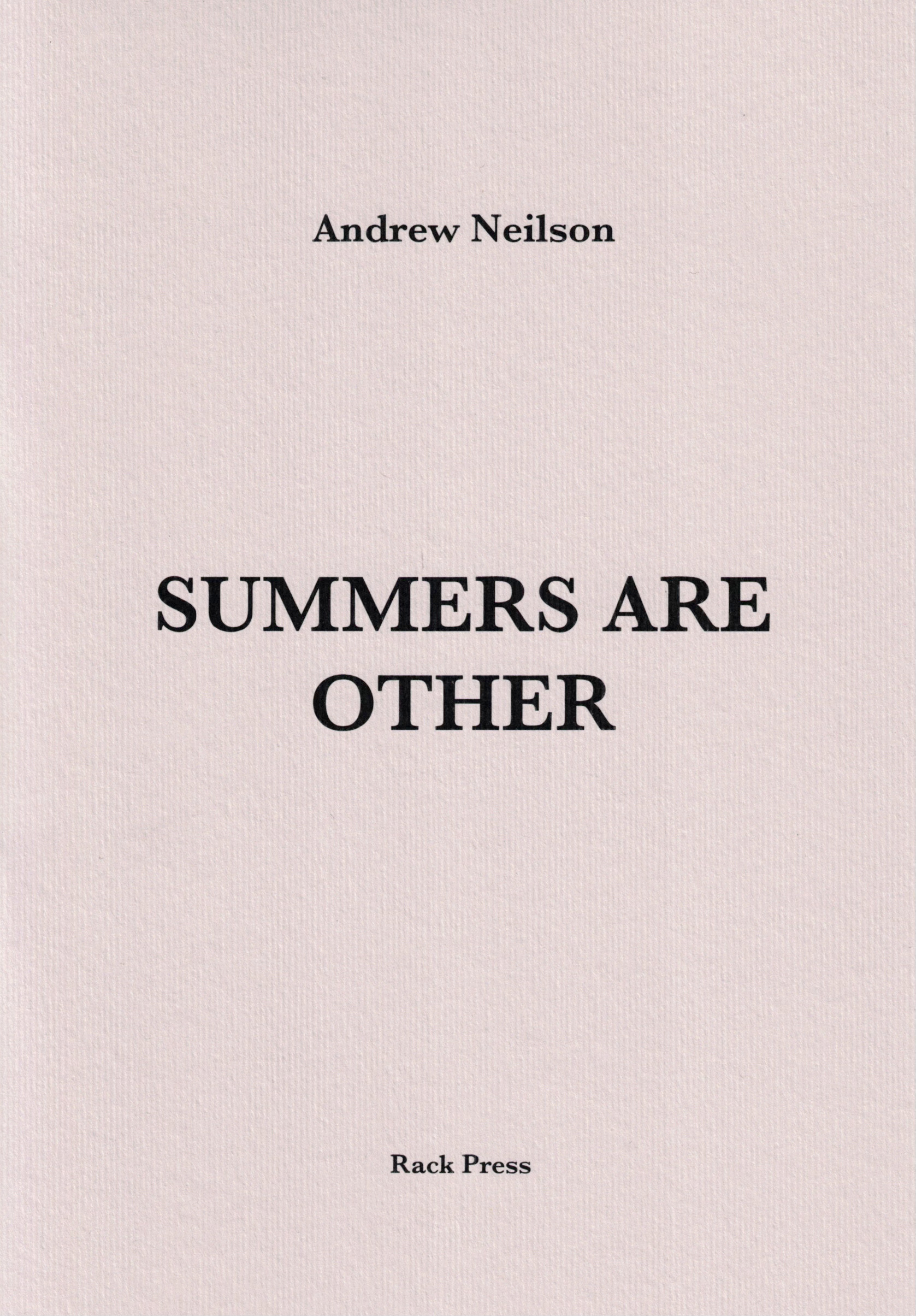
The opening sonnet, ‘Little Griefs’, enumerates, in the octet, a list of sorrows small and not-so-small, beginning with “The hamster buried in the back garden” and ending with “the small child who hugged you tightly”, who “now claims her own world and stretches to it”. Both illustrate instances familiar to parents. The sestet broadens the poem from the mostly personal to the philosophical:
No need to reason, or profess belief,
to know these moments don’t disappear,
but like angels dancing, on their pin,
the little griefs grow great. Then grow again.
Neilson uses commas to slow down the reader and enable them to absorb the full force of each clause and sub-clause, including that reference to the post-Reformation satire of Thomist theology in the penultimate line. His rhymes are often clever: he pairs “garden” with “starred in”, and “eschew it” with “stretches to it”. In fact each pair of rhymes in the poem is full, except, to my English lugs, the half rhymes of the closing couplet, though they may well be full(ish) to Neilson’s Scottish ones.
‘Corrections’ has a title, tone and elegance reminiscent of Donaghy, and consequently the Metaphysical poets and the Formalists (such as Hecht, Merrill and Wilbur) who influenced him. Consider its first stanza:
First came the storm, each strange flurried grasp
followed by those fitful buffetings,
as if the sky was an unfolded sheet
draped over and around, beaten and cracked
by what unfriendly, disembodied hands?
The sentence morphs from the confidence of statement and assertion into the uncertainty of a grand question. The piling-up of adjectives is a technique which today’s workshop orthodoxy might frown on, but these lines would surely be poorer without it. The story-telling in the poem could well be either perfectly true or a tall tale, and the reader gains from not being entirely sure one way or the other. Like ‘Little Griefs’ (and the next poem, ‘Meek’), ‘Corrections’ ends with a short half-line phrase – a technique which, like the clicking into place of a Shakespearean couplet, provides a satisfying and resonant closure.
The piling-up of adjectives is a technique which today’s workshop orthodoxy might frown on, but these lines would surely be poorer without it
‘Meek’ is a portrait in seven couplets of the British pop impresario, Joe Meek. Meek was gay at a time when male homosexuality was still illegal. He died in 1967, aged just 37. His death was violent and self-inflicted, and followed his murder of Violet Shenton, his landlady. But the poem briefly shifts in the fourth and fifth couplets into a brief anecdote whose provenance may, or equally may not, be suspect:
Thirty years later a woman I knew
lived in the flat and we did what you dowhen you’re young and in love, or think you are,
and the sounds you hear don’t come from a star
I would happily quote the whole ending here, but that would be to spoil the prospective reader’s pleasure. The clauses from “we did” to that wry aside “or think you are” are especially Donaghy-esque in their flourish. It’s a poem whose richness becomes more appreciable with every reading. Neilson makes a witty pun on “the same plane”, gives a deftly economical description of the deaths, and name checks the prototype synthesiser which featured so memorably on Meek’s most famous production, the Tornados’ ‘Telstar’, the first British record to reach number one in the USA.
‘The Instrument’ is arguably the most Donaghy-like poem of all. Neilson narrates the unfolding of events delicately, and finds joy in technical terms (“wrest pins and hammers”) and word-play (“Or thought unthought, nearing thought”). He subtly conveys the sense that the narrator may be unreliable, but trusts the reader to go along with the mystery of the poem without a neat denouement. Like Donaghy, Neilson can write abstract assertions which fall beautifully on the reader’s ear and then settle in their mind. ‘The Instrument’ lands with a Scottish note, and also with an element of Surrealism reminiscent of the Peter Lorre film The Beast with Five Fingers:
The way up here is to say nothing of it.
Perhaps it was the nothing of these things
that now made the instrument play.
But while clearly influenced by Donaghy, Neilson isn’t his imitator. With short-lined, ABBA-rhymed quatrains, ‘In Cool Descent’ takes its title and cue from a poem about spiders by E.B. White, author of Charlotte’s Web. It considers, not too seriously, spiders’ web-weaving “those finely sprung radials // as shaped as memories, / the close work / they cannot shirk”, and what lessons they might have for us.
‘Rec.’, like Larkin’s ‘Afternoons’, is set in a recreation ground and has a similarly downbeat, reflective spirit to it. But where Larkin’s narrator turns his gaze on young mothers and children at summer’s end, and rather condescendingly imagines their home lives and the limits of their ambitions, Neilson’s afternoon is in late-autumn and sees him examining the self as much as his surroundings. It opens:
There are days, of course, I don’t know what to say.
Sometimes it’s plain wonder, like this late sun
set over the rec against a full moon –
This is splendidly lyrical poetry, in unpretentious yet still emotionally affecting language. The rhyme-scheme of the first two stanzas is abandoned from the third, almost as if the poet–persona senses that the familiarity of the rec is unworthy of it. But the poem continues in a fairly high register, addressing “this / simplified landscape” with “that sparse wood, a moated isle, / the municipal al fresco gym”. The park is “a manageable arena / for tired thoughts” as Neilson cutely puts it. It’s another poem which demands repeated readings. Neilson’s command of syntax across line- and stanza-breaks is exemplary, and here it’s assisted by his imagery (“our stilt-walking shadows”), a shift into the imperative, and that exquisite “domesticated comity”. The rest of the poem – and its autumnal, Macbethian contemplation of the fleetingness of life – is equally striking.
This is splendidly lyrical poetry, in unpretentious yet still emotionally affecting language
‘The Viaduct’ is a short, short-lined and lovely elegy in four ABBA-rhymed quatrains, dedicated to Neilson’s uncle. The recollection of walking with his uncle is infused with a quiet melancholy, and conveys Neilson’s keenly-felt responsibility to pass on avuncular wisdom to his daughter: “I must teach her the laws / that govern this matter, // how the viaduct’s span / becomes heartsore and steep.” That archaism “heartsore” suits the mood beautifully.
In the tradition of Burns, MacDiarmid, Jamie and other Scottish poets writing in both ‘standard’ English and Scots, Neilson renders Yeats’s 1893 poem ‘Who Goes with Fergus?’ into Scots, as ‘Wha Stows Wi Fergus?’. This, however, is no direct translation. Rather, it’s a curious, irreverent and funny updating, in a voice redolent of the novels of Irvine Welsh, including several contemporary references and giving a name to the anonymous ‘maid’ of Yeats’s original. This exercise could easily have tipped into parody but Neilson avoids that trap, retaining the wording, suitably turned into Scots, of some of Yeats’s lines, while taking greater liberties with others.
The pamphlet closes with ‘Winding River’, a translation of a poem by the great Tang Dynasty poet Du Fu. There are no notes to indicate whether Neilson has a command of 8th century Chinese; I’m presuming he hasn’t. Perhaps this is his attempt at a more concise and more poetic rewriting of one of the many flat and seemingly literal versions available online, (such as Kenneth Rexroth’s flowery, ‘By the Winding River’, in his One Hundred Poems from the Chinese published in 1956). Nice as Neilson’s version is, I’m not sure that it serves much purpose other than to demonstrate the breadth of his interests and ability. It seems to me a somewhat disappointing end to the pamphlet. This apart, Summers Are Other is a richly eclectic treasure box which showcases the poet’s fine technical prowess, ear for lyrical lines and sentences, and ability to marry memorable imagery with thoughtful and unsentimental, yet affecting, phrasing. Stringently attentive, indeed.
Matthew Paul lives in Rotherham and worked as a local government education officer for many years. His first collection, The Evening Entertainment, was published by Eyewear in 2017. His second collection, The Last Corinthians, has just been published by Crooked Spire Press. He is also the author of two haiku collections, The Regulars(2006) and The Lammas Lands (2015), and is co-writer / editor (with John Barlow) of Wing Beats: British Birds in Haiku (2008), all published by Snapshot Press. Matthew Paul’s blog is here.
As well as browsing our Substack, it’s worth visiting The Friday Poem website where you can browse our Archive of more than 700 posts dating back to early 2021.
Help support The Friday Poem – buy us a coffee to help us stay awake as we strive to bring poetic excellence to your inbox every Friday. If you can’t afford to donate, no worries, we’re going to keep on doing it anyway! Big thanks for everything, you lovely poetry peeps.
Thanks for this. Nine poems is almost in micro-pamphlet territory. Any thoughts on the pros and cons of that? On the one hand, pamphlets seem to have been getting longer as full collections have also ballooned and generally speaking I think shorter and more edited is always better -- so many of those 80 page collections should have been 40 pages. So lean and mean can be good -- cut out the filler. On the other hand, nine short-ish poems is really very short. Risks seeming a bit thin or premature? (I appreciate it may also be a press decision -- possibly all the pamphlets from this publisher are equally concise.)
Thanks for this, not a poet I knew but this looks great, just ordered.