


I’ll start with a cliché: you know that if you go to see a film with subtitles, the chances are that it will feature key scenes in which family members sit around a big table, eating and drinking with gusto. If you enjoy the everyday human warmth of such drama and the intergenerational stories which underpin it then I’m certain that you will also relish tucking into Lemonade in the Armenian Quarter. The quality of its poems is astonishing given that Mnatzaganian appears only to have started writing poetry with serious intent after attending an Arvon course in 2015. (That it was run by Ann and Peter Sansom is less surprising: so many poets in the UK and beyond owe a debt to their wisdom and encouragement; one might suggest that they are the poetry equivalent to the influence which John Peel exerted on music.) But as is so often the case with comparative latecomers, what Mnatzaganian possesses is an accumulated, half-century’s-worth of stories which intrigue, entertain and provide the basis for splendid poetry.
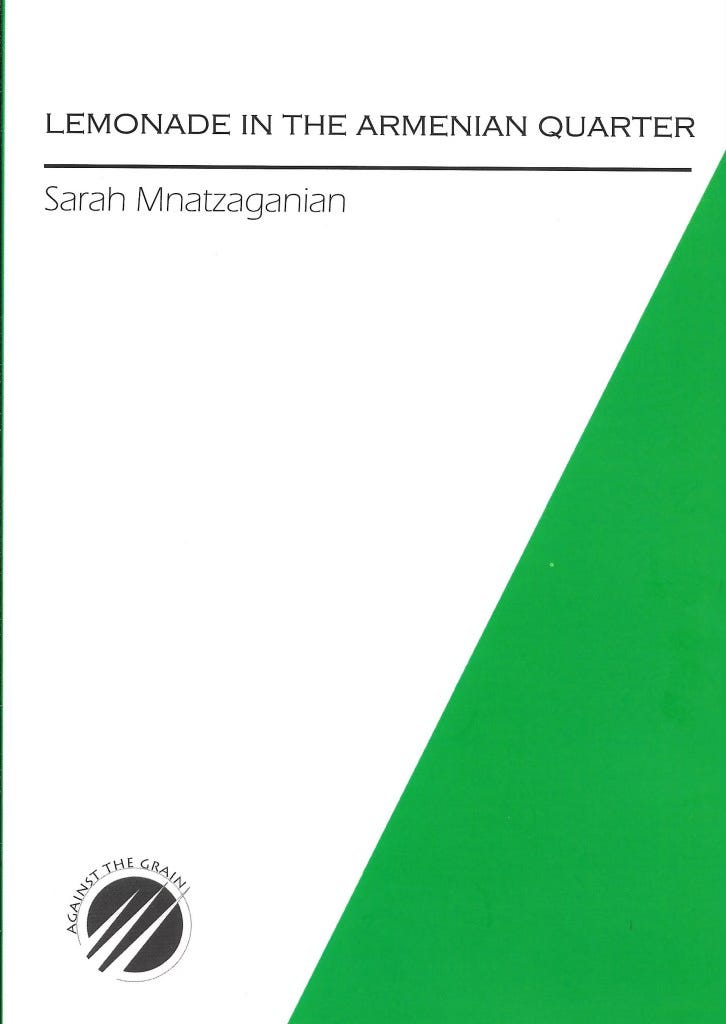
The importance of family is evident right from the off, in ‘Egg Time’, a paean – dedicated to the poet’s Yorkshire mother – to eating a boiled egg:
[…] May this teaspoon
teach my tongue the taste of lunch hour
on a school day when I’m six, hugging
the bump under mum’s dungarees.
Even in this short extract, one can intuit Mnatzaganian’s poetic skill: the unusual but highly effective wish cast by that “May”; the jaunty meter; and the economical and subtle conveying of information to the reader, especially that last, rather lovely image mirroring the shape of the egg. That the dedication reveals that her mother’s name is Madeleine adds to the Proustian nature of the memory.
It is, though, Mnatzaganian’s patrilineal, Jerusalem-Armenian side which imbues the pamphlet with its most intense flavours and memorable lines. ‘My father taught me at night’ recounts how he whispered “love words into the womb”, at first in Armenian and then:
[…] in West Bank Arabic
to darken my hair and make my heart
strong enough to live:Ahlen wasahlen habibti.
May you arrive as one of the family, darling
and tread an easy path on your way.
More languages follow. Mnatzaganian’s mixed heritage yields a diversity of experience which she bestows upon the reader as a gift to be cherished. In ‘Araxi’, one of the pamphlet’s many highlights, we watch her “aunt’s comely neighbours in Jerusalem”:
They spoon spiced coffee into a steaming pan,
watch it bubble, foam and slowly rise three times
and three times stir it back into peace,soothe it with sugar and fill row after row
of tiny cups to warm the mourners of Araxi, 85,
whose house the priests now claim as theirs[…]
The accretion of detail here, augmented by the anaphora of “three times”, is very impressively rendered. The poem ends unforgettably with the majestic image of the priests sitting, “bearded and beautiful, waiting for baklava // bought fresh this morning from the souk / by Araxi’s daughter who leans against a wall, / pale with jetlag and a migrant’s guilt.” It is Mnatzaganian’s ability to say so much with such concision which makes this poem so enjoyable.
Mnatzaganian’s word-choices are suffused with a palpably inherent and generous sense of love, warmth and humanity
The marvellous title-poem is one of three commemorating Mnatzaganian’s Uncle Hagop. It relates, wonderfully, how, years ago, he “planted lemon trees outside his house / where small passionate tortoises collide each spring / with the hollow pock of a distant tennis match” and goes on to depict him, very movingly, as he neared the end of his life. An elegy, in the form of a direct address to Hagop, is equally moving; but it’s the third of the poems, ‘Uncle Hagop in Stratford-upon-Avon’ which is arguably the most remarkable. In it, Hagop tries a spot of wild swimming:
His joy buoys him up like Dead Sea water.
Floating head and shoulders high, he walruses
his favourite lines:Now is the winter of our discontent
Tomorrow and tomorrow and tomorrow
If music be the food of love
He’s in his element, twice.
The natural comedy of this scene is enhanced by that ‘walruses’, an enviably perfect piece of poetic daring.
The women of Mnatzaganian’s family, herself included, are no less heroic and worthy of celebration, as some of the pamphlet’s best poems amply illustrate. The densely-layered praise-poem ‘In Praise of Armenian Cooks’ encompasses the genocide of Armenians undertaken by the Ottomans in 1915 (and which Turkey still refuses to acknowledge) – “I cook in memory of women / who lifted heavy breasts / into the mouths of children / whose fragrant heads / were snatched from their arms / and broken against walls” – and her forebears’ tradition of making dishes which Mnatzaganian continues: “Let’s make lahmajoun, ma’loubeh. / Mince the lamb fine, grind allspice. / […] / Our children are coming home.” Three poems feature Mnatzaganian’s daughter, and three feature Mnatzaganian busying herself in maternal assistance to her son, including ‘Food Run’, which describes her loving compilation of what my own mother used to call ‘a Red Cross parcel’, and the bittersweet loveliness of the couplets in ‘Cake Again’:
When there’s no way to touch
or give anything but wordsit’s time to reach for butter eggs
spice syrup honey nuts apricots,to melt-stir-beat myself into a bowl
and ask what more to add of zestor juice to his tomorrow.
The absence of commas to punctuate the list of ingredients is well-judged, as is the compound verb before that surprising yet vital ‘myself’ – as if she really is putting herself into the cake which, as the poem shows, she goes on to take down to the Post Office for despatch to her son away at university. Lemonade in the Armenian Quarter also poignantly touches, in ‘Intifada Street’, on Israel’s subjugation of the Palestinians; in this, as with the rest of its bountiful poems, Mnatzaganian’s word-choices are suffused with a palpably inherent and generous sense of love, warmth and humanity.
Matthew Paul lives in Rotherham and worked for many years in local authority children’s services. His first collection, The Evening Entertainment, was published by Eyewear in 2017 and his second collection, The Last Corinthians, was published by Crooked Spire Press in 2025. He is also the author of two haiku collections, The Regulars (2006) and The Lammas Lands (2015), and co-writer/editor (with John Barlow) of Wing Beats: British Birds in Haiku (2008), all published by Snapshot Press. Matthew Paul’s blog is here.
Vital Statistics: The Friday Poem is run by four people – Hilary Menos (Editor), Helena Nelson (Consulting Editor), Bruno Cooke (Spoken Word Editor) and Andy Brodie (Web Editor), with contributions from a team of reviewers and writers.
Until recently we maintained the Friday Poem website (thefridaypoemdotcom) as an archive of 700 posts published between 2021 and 2024 (including most of the original Friday poems) but following a hack in late April we decided to take this down. We’ll be republishing some of these posts – Friday Poems, features and reviews – here on Substack.
Help support The Friday Poem
Buy us a coffee to help us stay awake as we strive to bring poetic excellence to your inbox every Friday. Heartfelt thanks to everyone who donates, especially to our regular donors. If you can’t afford it, no worries, we’re going to keep on doing it anyway! Big thanks for everything, you lovely poetry peeps.