


The Experimental Media Forum
As a student I joined an on-campus club called the Experimental Media Forum. Each week, one of us would curate an event for the rest of the group. My input, one week, was to bring in the Flaming Lips’ four-CD album Zaireeka. For the intended aural experience you have to play all four CDs at the same time, while sitting on the floor eating pizza (pizza? Really? — Ed). Between us we had a set of desktop speakers (I had already ripped the album to my laptop’s iTunes library), a CD player, a Do The Right Thing-style boombox, and a Minirig connected to an mp3 player. It was awesome. Another week, someone organised an Andy Warhol retrospective. I remember watching the whites of DeVeren Bookwalter’s eyes flicker in 16 frames per second (shot at 24 frames per second) in Warhol’s 1964 short film Blow Job. The Experimental Media Forum did basically what it said on the tin. So did the film Blow Job.
At the end of the year, the Experimental Media Forum exhibited at the Hundred Years Gallery in Hoxton, East London. For the exhibition, I asked two computer science students in the club to make a program that could read a poem, take each word and run it through a thesaurus, and rewrite it. Or reiterate it. It made semi-nonsense poems one step removed from my original poems. We projected these new ‘poems’ onto a section of wall alongside the originals. They revealed themselves, word by word. It was called ‘Poet my thesaurus’. Other people made other things. We blew our own trumpets.
I don’t remember much about the two computer science students that helped me, but they were studious, in it for the fun of the challenge, and willing to take my silly project seriously. They liked it (I think), and I liked them. And we wouldn’t have met if it weren’t for this club which connected like-minded people on seemingly opposite ends of the art-science spectrum.
The coding took them a couple of weeks. They got stuck on search limits for free users of online thesauruses. ChatGPT could probably write a watertight program in seconds. But that’s not the point. ChatGPT can do lots of things. It can’t find enjoyment in any of them.
More human than human
Who should poets write for? For other poets, for competition judges, for social media followers? For new readers, for old readers? Or for themselves?
In the race to produce poetic content, computers are winning. A year or so ago, Nature reported that AI-generated poetry had become indistinguishable from human-authored poetry. We have overstepped the threshold. “We conducted two experiments with non-expert poetry readers and found that participants performed below chance levels in identifying AI-generated poems,” says the study. This means exactly what you think it means. Researchers Brian Porter and Edouard Machery found participants in their study were “more likely to judge an AI-generated poem to be human-authored than a poem that actually is human-authored”. Others have identified this as the “more human than human” phenomenon. It is now present in the domain of poetry.
AI-generated poems were also rated “more favourably in qualities such as rhythm and beauty”, which led to their mistaken identification as human-written.
Why might readers prefer AI-generated poetry? One reason is that human poetry is complicated. This makes (some) readers misinterpret it as incoherent, like AI slop. Study participants were more likely to use variations of the phrase “doesn’t make sense” to describe human-written poetry than to describe AI-written poetry. This makes AI poetry “more accessible” and … as a result? … preferable, it seems.
There’s a lining, but I’m not sure if it’s silver.
Why might readers prefer AI-generated poetry? One reason is that human poetry is complicated. This makes (some) readers misinterpret it as incoherent, like AI slop
The participants in the study were non-expert readers. They naturally expect to prefer human poetry to AI poetry, but to enjoy a poem, they first need to understand it. They don’t want to pursue a poem; they want the satisfaction of getting it. (Only “expert” poetry readers actively prefer poems they don’t understand, runs the logic. They assume there’s more satisfaction in having to work to understand something original and/or complex than there is in getting something simple immediately. They enjoy the pursuit. Put it another way: they’re bored of clichés.)
Accordingly, the non-expert readers of the study prefer the more accessible AI-generated poetry, which “communicates emotions, ideas, and themes in more direct and easy-to-understand language”. As a result, they “mistakenly interpret their own preference for a poem as evidence that it is human-written”. Happens to the best of us!
These are the poets featured in the study: Geoffrey Chaucer, William Shakespeare, Samuel Butler, Lord Byron, Walt Whitman, Emily Dickinson, T S Eliot, Allen Ginsberg, Sylvia Plath, and Dorothea Lasky. (There’s a whole other essay to be written on this selection.)
Revenge of the humanities
What about the recent history of AI? Well, under Steve Jobs, Apple synergised the liberal art and tech disciplines. Engineers made things that worked, art people made them look pretty. The result was the iPhone, a very pretty thing that worked well.
And what’s the most significant technology of our time? Beer. Sliced bread. LLMs, apparently, or Large Language Models, also called AI chatbots. ChatGPT. Grok. Gemini. Claude. They’re infiltrating workflows, workplaces and work-from-homes like nobody’s business. Tech bros are putting lots of money into them. Competition is fierce.
What makes a chatbot a good one? Well, it has to perform any task instantly and brilliantly, whether that involves troubleshooting a section of coding, suggesting dinner recipes based on what’s in the cupboard, or engaging romantically with its user. That’s not all. There are things it must not do. It must not help people code viruses, or cook meth. It must not induce psychosis. (I wrote about this sort of thing here.) In other words, it needs something resembling a moral compass. And, as LLMs are the interface by which most people interact with AI, they also have to be lifelike, likeable – as easy to talk to as possible. That’s what keeps users hooked. (And they do get hooked, see Neuroscience News, here.)
How do you train a machine to be lifelike and likeable, let alone ethical or creative? Or to recognise originality, bias, nuance, quality? Chinese tech companies are hiring people to train AI in literary and artistic expression. But they aren’t hiring engineers. Successful candidates need diplomas in humanities disciplines – literature, history, philosophy, the arts.
Daniela Amodei, who cofounded Anthropic, maker of the AI chatbot Claude, has a degree in English literature and says “studying the humanities is going to be more important than ever”. “The things that make us human will become much more important instead of much less important,” she told ABC News earlier this year. “And what I mean by that is when we look to hire people at Anthropic today, we look for people who are great communicators, who have excellent [emotional intelligence] and people skills, who are kind and compassionate and curious and want to help other people.”
So, a poet then?
Poets smell when a line dies
On Reddit, I found people discussing the idea that poets could be among those training artificial intelligence language models – specifically to write better, and recognise better writing. “Most of what breaks in LLMs”, one user wrote, “is vibes: subtext, tone shifts, metaphor that isn’t just a dead simile, cultural nuance. Engineers optimise loss; poets smell when a line dies.”
“If we’re talking dataset curation,” wrote another, “I’d rather a room full of editors, poets, translators, and comedians picking texts than scraping everything and praying. Pay them. Credit them. And let them define ‘quality’ beyond correctness. LLMs are already decent at facts; the missing layer is taste. Poets are basically taste engineers.”
I have interacted with Grok. I asked about the relative roles of writers, poets and AI poets. It came up with this:
Writer (prose): “Here is what I mean.”
Human poet: “Here is what it feels like to mean it — because I have lived it.”
LLM poet: “Here is a convincing simulation of what it might feel like to mean it, drawn from everything humanity has ever written about feeling.”
I thought this was quite good. Limited, but succinct. AI can never experience anything; it can only aggregate all the ways human writers have written about their experiences, and produce text based on that.
Here’s journalist Sam Kriss, explaining what he sees as one of AI’s creative writing pitfalls:
Early in To the Lighthouse, Virginia Woolf describes one of her characters looking out over the coast of a Scottish island: ‘The great plateful of blue water was before her.’ I love this image. AI could never have written it. No AI has ever stood over a huge windswept view all laid out for its pleasure, or sat down hungrily to a great heap of food. They will never be able to understand the small, strange way in which these two experiences are the same. Everything they know about the world comes to them through statistical correlations within large quantities of words.
Kriss and Grok agree: the AI cannot draw its own parallel between two experiences, because (of course) it cannot have experiences.
The most human humans
In early 2026, The Observer ran three articles about Zoë Hitzig, a research scientist and “anti-tech bro” who quit her position at OpenAI over the company’s decision to introduce ads to ChatGPT. She feared for the privacy and psychological safety of the chatbot’s 800 million weekly users, and likened the monetisation of ChatGPT conversations to the Pope selling “a trillion confessions”.
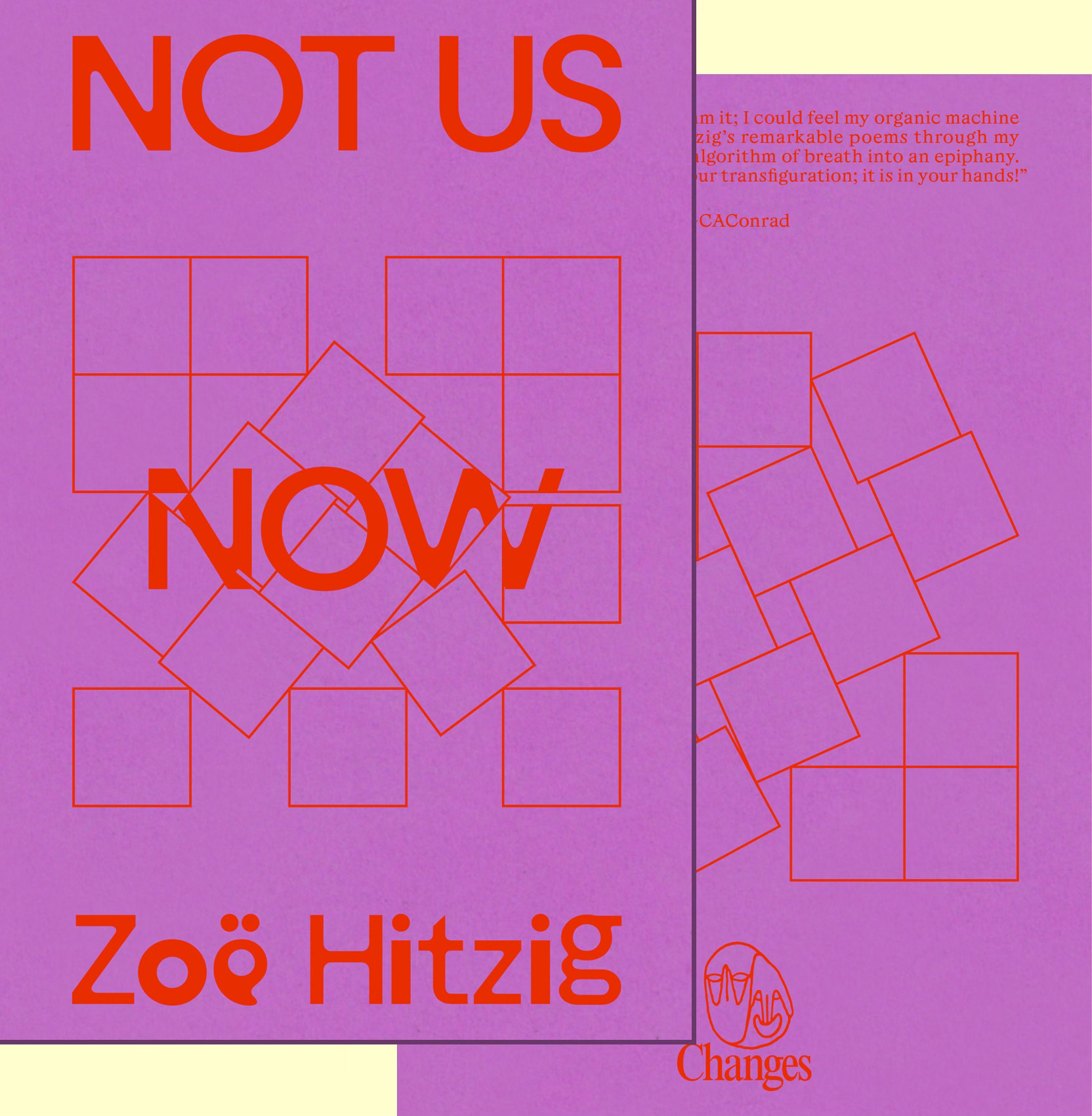
Hitzig is also a poet, and her poetry may well have made her more employable. She has published two collections, Mezzanine (Ecco, 2020) and Not Us Now, winner of the Changes Book Prize (Changes, 2024). Not Us Now is about the future of language. Its “future world” is “remembered in an even further future”, in the words of its blurb. Post-post-human computer entities reminisce about simpler, post-human times. Language is both “survivor” and “cargo”. As such, it “delivers [I would say ‘attempts’] an astonishing act of ventriloquy in reverse”. The book won big – a $10,000 cash prize, international distribution and a launch event in New York.
So, poet: check. Poet writing about computers and language: check. Dual passion for linguistics and technology (and a PhD in economics from Harvard): check, check. What more could OpenAI want? “If you wanted the most human humans training your machine learning,” suggests the Observer’s Melissa Denes, “you might go out and hire a poet.”
Another poet in the AI crossover rabbit hole is Sasha Stiles, from California. Stiles has spent years developing an AI “alter ego” called Technelegy, mostly by uploading data sets of her own poetry to the OpenAI interface. The result is a generative language system trained on her writing, and a book of poetry she describes as “AI-powered”. She frequently collaborates (her word, not mine) with Technelegy. They recently exhibited at MoMA. ‘A Living Poem’ is an “infinite text powered by human imagination and computer algorithms”, which “rewrites and performs itself anew every 60 minutes”.
Ring any bells? It sounds an awful lot like my art project ‘Poet my thesaurus’, which (quite rightly) never made it out of Hoxton.
I like the first entry in Hitzig’s Not Us Now. It’s a lovely William Carlos Williams-esque prologue, and I’ll quote it here:
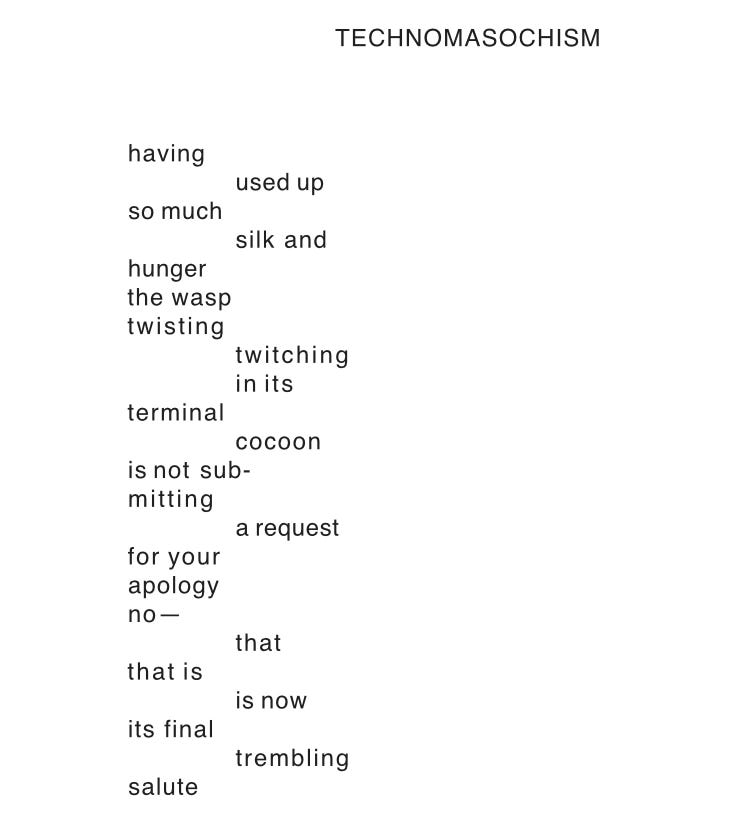
This intro, however, lulls you into a false sense of security. My problem with both Hitzig’s Not Us Now and Stiles’ ‘A Living Poem’ is that they don’t seem to have been written for a human reader. Trudging through Not Us Now I felt neither engaged nor compelled. Page after page, there are obstacles to basic comprehension, let alone enjoyment. It seems to me to be literally designed to discourage a human being from reading it. As for Stiles’ work – I find it almost impenetrable. You can find videos of MoMA visitors sitting on benches amid her exhibits. Most of them are on their phones. It’s almost as if we, as human readers, are more inclined towards poems written by, and for, and even about, humans. As if poems written by – or with – computers are on some level inherently uninteresting to us.
Who would have thunk it?
Bruno Cooke is The Friday Poem’s Spoken Word Poetry Editor. He has lived in China, Sri Lanka and the Philippines, cycled in 50+ countries, and written for several news, opinion and humour websites. Find more of his creative writing on his personal Substack publication called My Special Interest.
Vital Statistics: The Friday Poem has 3600-odd subscribers. It’s run by four people – Hilary Menos (Editor), Helena Nelson (Consulting Editor), Bruno Cooke (Spoken Word Editor) and Andy Brodie (Web Editor), with contributions from a team of reviewers and writers.
Until recently we maintained the Friday Poem website (thefridaypoemdotcom) as an archive of 700 posts published between 2021 and 2024 (including most of the original Friday poems) but following a catastrophic hack in late April we made the difficult decision to take this down. We’ll be republishing some of these posts – Friday poems, features and reviews – here on Substack.
Help support The Friday Poem
Buy us a coffee to help us stay awake as we strive to bring poetic excellence to your inbox every Friday. Heartfelt thanks to everyone who donates, especially to our regular donors. If you can’t afford it, no worries, we’re going to keep on doing it anyway! Big thanks for everything, you lovely poetry peeps.
I’ve often wondered what level of impact blogging (remember blogging?) as well as texting, and insta posts might have on Poetry, especially when some poems might read like plain speech or even directions from a satnav. Also, I see it in creative writing( fiction and nonfiction) the need to tie everything with a ribbon, pretty, punch lines.