


Joal-Fadiouth is a town in Senegal’s Petite Côte, the stretch of coast running south from Dakar to the Gambia river. It is split into two parts. Heading southwards, you first encounter Joal, a market town. The road widens, traffic slows to an amble, and townsfolk mill in and out of the many fruit shops, motorbike garages and general stores.
The colours of Senegal are everywhere. Green stars wink out of yellow-painted concrete. Flags wave in the breeze, hung from wires between telegraph poles. Kids in T-shirts bearing the tricolour giggle over keepy-uppies. Green, spiny soursops mix with yellow bananas in the market stalls while red cashew apples dangle overhead like Christmas baubles. Boys race tyres along the pavement, running helter-skelter past stacks of papayas and lampposts painted green-yellow-red, green-yellow-red. They see you as you pass by and shout, ‘toubab!’ a Wolof word for outsiders.
Then comes Fadiouth, two islands built up over hundreds of years by fisherfolk discarding clam, cockle and/or oyster shells (different sources say different things). Oysters love Senegal’s mangroves, and the Senegalese love oysters. Or cockles, or clams. There are no motorised vehicles in Fadiouth, whose islands are reachable only by long wooden bridges, or by pirogue. (You get a better view of the oysters that way.)
Fishing is controlled. There are catch limits, and periods when fisherfolk are forbidden from catching certain types of molluscs. When Fadiouth became a zone protégée in 2004, the area’s artisanal fishing population argued for more restrictions than the central government had proposed. They understood the ecosystem’s fragility.
Why am I talking about Joal-Fadiouth? Partly because, having recently bicycled through it, I can shoehorn some travel writing into a piece ostensibly about poetry. Partly because it is the birthplace of one of the most important people in modern West African history, a poet whose poetry you may never have read. No, sorry, this isn’t a story about Senegalese footballer Sadio Mané. I’m talking about Léopold Sédar Senghor, Senegal’s first president, and co-theoretician of négritude.
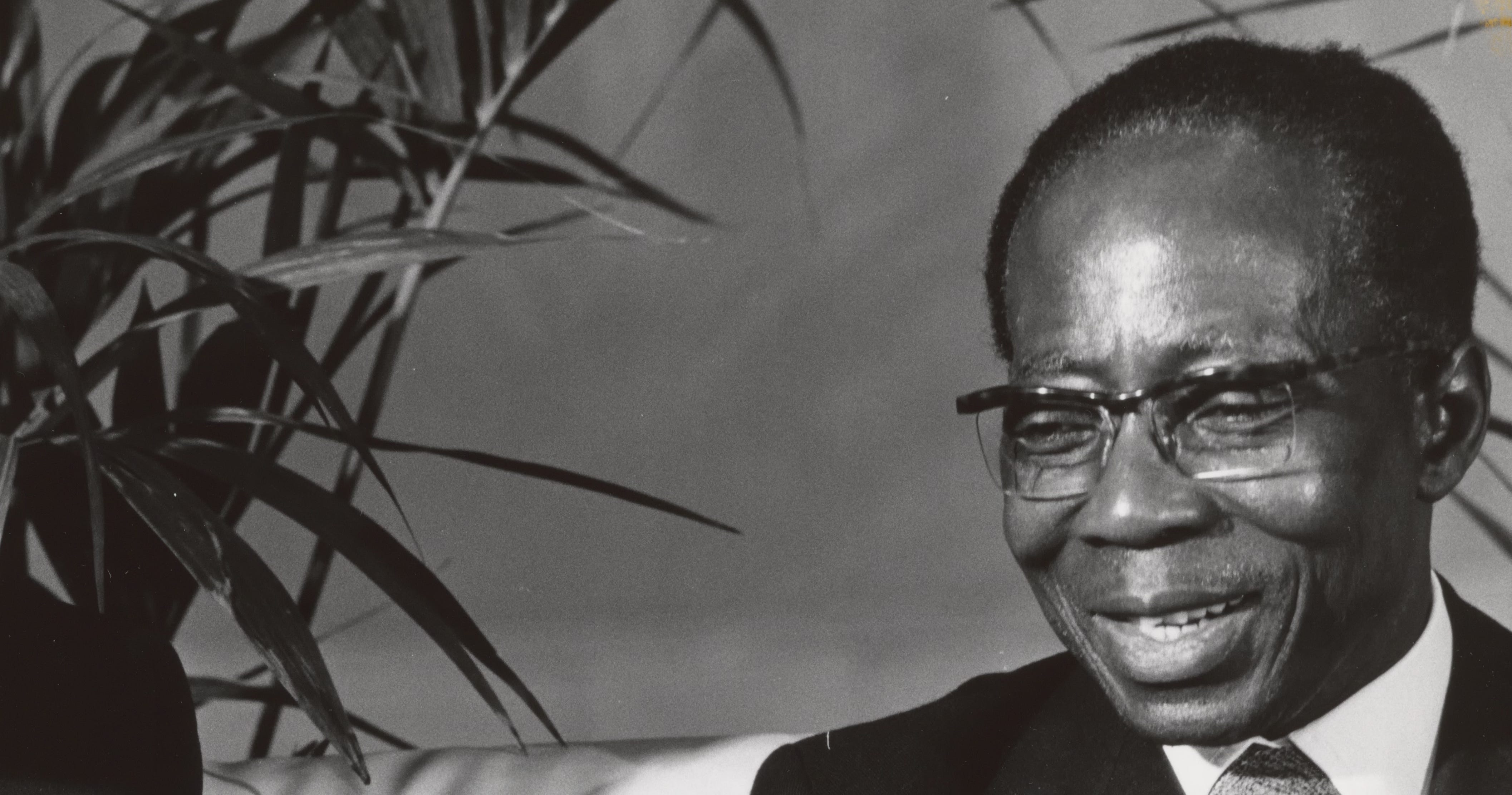
Senghor was a big deal. Born in 1908, he was one of the key figures (along with Martinican poet Aimé Césaire and French Guianese poet Léon Damas) behind the anti-colonial négritude movement, which aimed to define, legitimise and celebrate black consciousness. In so doing, he pivoted Senegal towards independence. He designed its flag and wrote its national anthem. He helped collectivise black identity – in a way that Europeans could understand – received knighthoods from Spain, Italy and the Vatican, and was the first African elected to the illustrious Académie Française, the main authority on French language and publisher of the official French dictionary. With just 40 seats, and lifetime membership (members are known as ‘Immortals’), it is a very exclusive club. Senghor also helped write France’s current constitution.
This is a man whose political and diplomatic achievements cannot be overstated, who went from climbing baobabs in his garden, to studying at a seminary in Dakar, to teaching Latin and Ancient Greek in a French grammar school, to defining Eurafrica in speeches to the Parliamentary Assembly of the Council of Europe as the president of independent Senegal.
So, well done Leo. But the funny thing is that if you Google him, you’ll see that the first word attached to him tends to be … poet.
… the funny thing is that if you Google him, you’ll see that the first word attached to him tends to be … poet
“Poet and former president of Senegal”, “Senegalese poet and statesman”, “Leading poet and intellectual”. Poet this, poet that. This seems like a rare thing. Winston Churchill, Enoch Powell and Jimmy Carter all wrote and published poems, but we don’t call them “Poet and…”. Maybe they wrote bad poetry.
Senghor’s preoccupation with poetry was genuine, and refreshing. Example: he was a prisoner of war for two years during WWII and spent most of his time learning enough German to read Goethe in the original and writing poems he later published as Hosties Noires (1948). He was a fan of Langston Hughes, calling him “the greatest poet of the Negro Renaissance” and the “greatest black American poet”, and of the French poets Rimbaud and Baudelaire. Sartre wrote an introduction to Senghor’s 1948 anthology of black poetry.
On a bicycle trip through Senegal, I visited Senghor’s childhood home. I learned that he was child number 24 … of 41. Dad was a peanut merchant whose middle name, Diogoye, means ‘lion’ in the Serer language. Mum was dad’s third of five wives. My guide referred to the conjugal bedroom, with a big smile, as “the factory”. In the garden at the back of the house is a 500-year-old baobab tree, which Senghor would climb to think. (There are a great many baobabs in Senegal, and a great many goats that feed on them.) In the middle of the hallway ceiling is a six-pointed star. But Senegal is mostly Muslim, has been for a long time. Senghor liked to describe his country as “90% Muslim, 10% Christian, and 100% animist”, his point being that organised religion can only penetrate so far. Anyway, no one in the family was Jewish. So, why the star? Our guide didn’t know.
Senegal’s national football team are the Lions of Teranga – ‘Teranga’ is a Wolof word for the warmth of spirit on which Senegalese people pride themselves. “No animal can better represent the Senegalese people [than the lion], whose cardinal virtues are courage and loyalty”, according to the presidency’s website. And the name of Senegal’s national anthem (lyrics by Senghor) translates to “The Red Lion”. Lions, lions, everywhere.
(Point of interest: ‘Red Lion’ also happens to be the most common pub name in the UK. There are 517 Red Lion pubs in the United Kingdom, as of last summer.)
Question: Why did Senghor write a red lion into his country’s anthem?
The night before we arrived in Joal-Fadiouth, a Senegalese man who had lived in Germany for 22 years – eight years in Munich, 14 years in Stuttgart – told me what a shame it was that so many Senegalese move abroad. “People move to Morocco, Spain, France, Germany from Senegal, live there and then die there, and for what? To die far away from home. Underground, nationality means nothing,” he added. “In the earth, everyone is the same. Blood is always red.”
I’ll be honest, I find Senghor’s poems hard to get into. One or two at a time is enough for me. But I love their boldness, and I can appreciate the impact it must have had on European and African readers of his time. His work is sensual, vibrant and heavily symbolic. It did the necessary work of constructing an African mythos for post-war French-speaking audiences. Its metaphors are vivid and clear. To a contemporary reader they may read as a little overused, or heavy-handed. But in their time, rather than being cheap callbacks to obvious symbols, they were the first building blocks of a poetic tradition that celebrated African-ness rather than denigrating or exoticising it, as outsiders had tended to do. He’s just saying it like it is.
Naked woman, dark woman
Oil that no breath ruffles, calm oil on the
athlete’s flanks, on the flanks of the Princes of Mali
Gazelle limbed in Paradise, pearls are stars on the
night of your skin
Delights of the mind, the glinting of red
gold against your watered skin
Under the shadow of your hair, my care
is lightened by the neighbouring suns of your eyes.
From ‘Black Woman’ at All Poetry
Looking for examples of Senghor’s poetry, I was struck by how hard it is to find – especially (weirdly) in Senegal, even in the original French. From Saint-Louis to Banjul, in The Gambia, it was Senghor’s cultural theory texts that always seemed to pop up. Nonfiction sells better than poetry, I guess. Most poetry websites have the same four or five of his poems. The Internet Archive has a digital copy of Poems of a Black Orpheus (1981, translations by William Oxley), which is worth borrowing for a deeper dive.
A final point about language. Senghor wrote in French, which is complicated. Of course, his early education had been in French – it was a colonial education. At school, he learned about French geography and French politics. The administrators of his lycée in Dakar were French. The literature he studied was French.
But… most Senegalese don’t speak French. It may be the official colonial language, but even now, only one in four are proficient, and most of them only use it when they have to. Most speak Wolof, and there are many Wolof speakers in The Gambia and Mauritania. But Senghor wasn’t writing for West Africans as readers. He was writing on their behalf, for a French, or European, readership. He wanted France, Europe and the world to understand what it meant to be African, to think and breathe and live like an African. And when he started writing poetry, his ability to do so in French meant he could address himself to European audiences. In his case, adopting the language of his oppressor was a necessary sacrifice. It enabled him to elevate his people’s status, and form a literary bridge between two continents.
So, is there a lesson? Maybe it’s that if you want to change the world with your ideas, writing poetry can be a good way to start. Maybe it’s that even if you change the world, your poems may not be remembered. Or maybe it’s simply this: if you want your poetry to endure, write what you need to write, in language your intended reader understands.
Masks! Masks!
Black masks, red masks, you masks black and white –
Masks at all four points from whence the spirit breathes –
In silence I salute you!
And not least of all you, my lion-headed ancestor,
You keeper of holy places forbidden to woman’s laughter and all profane joy.
Breathless air of eternity where I breathe the breath of my forefathers.
Masks of the faceless ones, stripped of each dimple and wrinkle –
You who have painted this picture of my face over an altar of white paper
In your own image … hear me!
Here dies the Africa of Empires – it is the agony of a ruined princess
And of Europe to whose navel we are bound.
From ‘Prayer to the Masks’ (1981, Oxley’s translation)
Bruno Cooke is The Friday Poem’s Spoken Word Poetry Editor. He has lived in China, Sri Lanka and the Philippines, cycled in 50+ countries, and written for several news, opinion and humour websites. Find more of his creative writing on his personal Substack publication called My Special Interest.
Vital Statistics: The Friday Poem is run by four people – Hilary Menos (Editor), Helena Nelson (Consulting Editor), Bruno Cooke (Spoken Word Editor) and Andy Brodie (Web Editor), with contributions from a team of reviewers and writers.
Until recently we maintained the Friday Poem website (thefridaypoemdotcom) as an archive of 700 posts published between 2021 and 2024 (including most of the original Friday poems) but following a catastrophic hack in late April we made the difficult decision to take this down. We’ll be republishing some of these posts here on Substack in the future.
Help support The Friday Poem
Buy us a coffee to help us stay awake as we strive to bring poetic excellence to your inbox every Friday. Heartfelt thanks to everyone who donates, especially to our regular donors. If you can’t afford it, no worries, we’re going to keep on doing it anyway! Big thanks for everything, you lovely poetry peeps.
This is an education (on the morning of my skin)!
Fascinating....
A breath of fresh air - & colours - so desperately needed in this part of the world now - vibrant. Shall explore more. Thank you for gifting us another very special experience this morning ,( for us here ) Senghor might be a beginning