


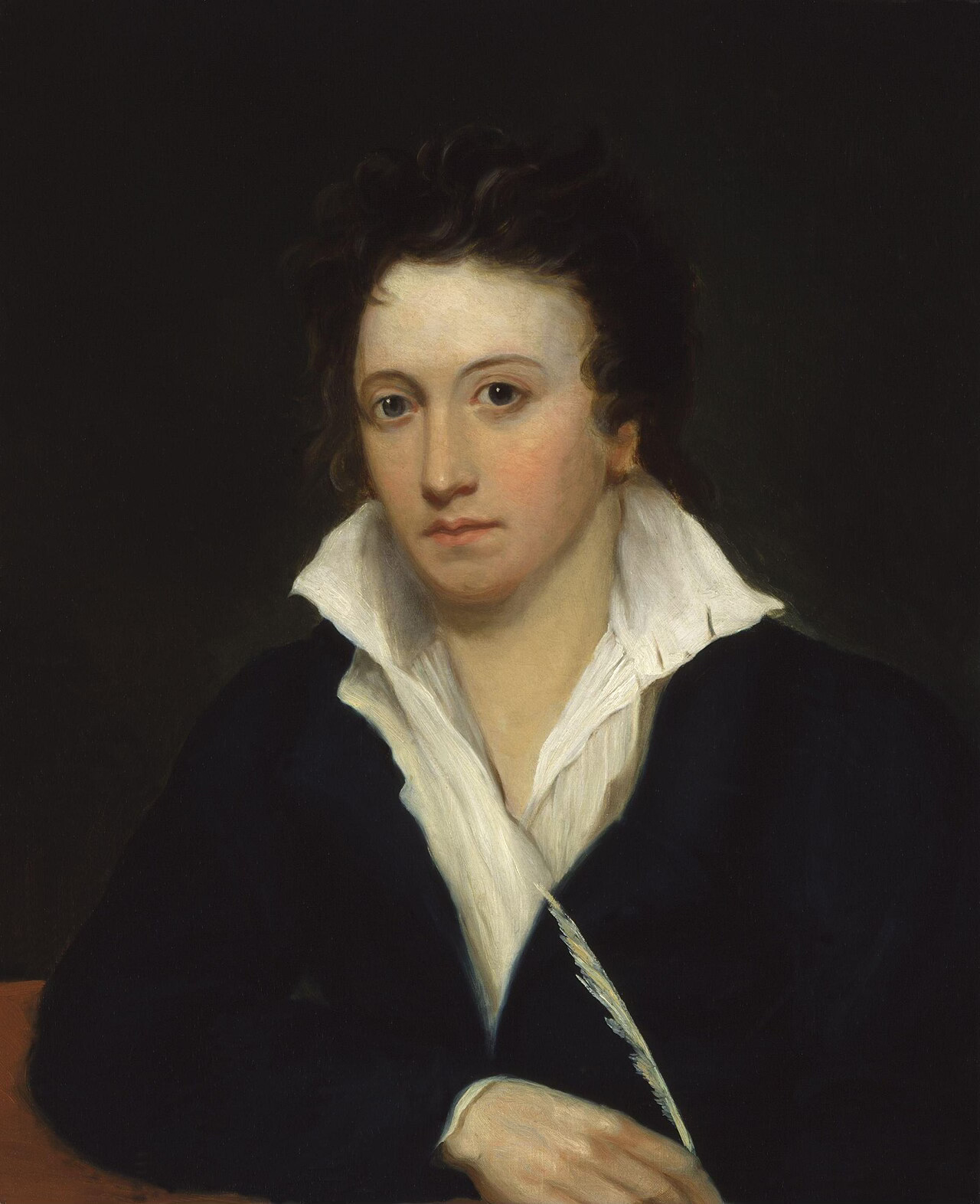
Percy Bysshe Shelley said poets are the unacknowledged legislators of the world. It’s perhaps not exactly true. But they do occasionally get a look in. In fact, Shelley might be the poet whose lines have been most often quoted by British politicians. Shelley was a political radical; he favoured a more equal distribution of income and wealth. He was also a republican, and anti-marriage. He wanted to end aristocratic and clerical privilege. Most scandalous of all, he was a vegetarian – before the word ‘vegetarian’ had even been invented.
Under Jeremy Corbyn, the Labour Party adopted the slogan, ‘For the many, not the few’. Corbyn also co-edited, with Len McCluskey, a poetry anthology titled Poetry for the Many in 2023. One of its contributors, the political strategist Karie Murphy, wrote that its purpose was to “shake off any notion that [poetry] is not something to be read, written, or appreciated by working-class people”. McCluskey wanted it to help change poetry’s image among working-class communities – as in, challenge the notion that it is for “posh people” and/or “softies”.
The line “for the many, not the few” is adapted from the final stanza of ‘The Masque of Anarchy’, which Shelley wrote in 1819 after the Peterloo Massacre. Sabre-wielding cavalry units (operating on behalf of local magistrates) had charged directly at protesters demanding parliamentary reform. Hundreds were injured. 18 died. At the time, 11% of Britain’s male population were allowed to vote. Shelley, despite his aristocratic lineage, wanted to extend suffrage.
Rise like Lions after slumber
In unvanquishable number,
Shake your chains to earth like dew
Which in sleep had fallen on you –
Ye are many – they are few.
Corbyn wasn’t the first to borrow from Shelley. From Tiananmen to Tahrir, and the Poll tax riots of 1989–90, ‘The Masque of Anarchy’ has been used by campaigners all over the world. The Jam quoted it on the back of their 1980 album Sound Affects. The stanza quoted above is engraved on the gravestone of socialist campaigner and investigative journalist Paul Foot. And it featured in the 2023 conference speech of … er … Suella Braverman. She said, without irony, that she was “shamelessly taking [the lines] back from Labour”.


Why do politicians like to borrow from poets? Writing for Culture Matters, Bob Beagrie argues that poetry’s power is in merging the personal and the political into an “articulation of the social”. In other words, it bridges the gap between you and everyone else. It’s also economical, since politicians might not have the time (or talent) for tight, memorable, impassioned wordsmithery. Since it’s outside politics, (good) poetry can solidarise and collectivise without pitting people against each other. Like a shortcut, or cheat code. As Keir Starmer has proved, if you don’t use language to connect with the people you represent, you don’t connect with them at all.
Politicians can also use poetry too much, or in the wrong way. In his application of poetic language – poetic in all senses of the word: heightened, figurative, flowery, verbose – Boris Johnson might be the antithesis of Starmer. It’s no coincidence that Starmer campaigned with a promise of “actions, not words”. Johnson’s mouth was full of words. Big words, long words. Poetic words, on occasion. But the result is the same. Johnson’s version of deploying poetry in a political capacity was to recite Homer in the original Greek. How better to alienate your subjects?
If poetry can move people, bring us together, act as a shortcut to collective feeling and channel nebulous, complex and unpredictable emotions into something positive, then it is also capable of the opposite.
[Famously, as an MP and cabinet member, Johnson was caught mumbling Rudyard Kipling’s ‘Mandalay’ in the presence of local dignitaries during an official visit to Myanmar. “The temple bells they say, come you back you English soldier,” he declared while inside the Shwedagon Pagoda, a sacred Buddhist site. Johnson’s recital so embarrassed the UK ambassador to Myanmar, who was travelling with him, that he leant over to the then foreign secretary and reminded him, “You’re on mic. Probably not a good idea…” “What?” said Johnson distractedly. “‘The Road to Mandalay?’” “No,” said the ambassador. “Not appropriate.” “No?” Johnson replied, burying his head in his mobile phone. “Good stuff.”]
Margaret Thatcher – that well known channeller of nebulous, complex and unpredictable emotions into positive collective feeling – enjoyed the war poets, in particular Rupert Brooke. In a 1987 interview with the BBC, she calls him an “extraordinary poet” with a “straightforward but lovely” eye for language.
She recites, to interviewer Russell Harty, a section of Brooke’s ‘The Great Lover’:
These I have loved:
White plates and cups, clean-gleaming,
Ringed with blue lines; and feathery, faery dust;
Wet roofs, beneath the lamp-light; the strong crust
Of friendly bread; and many-tasting food;
Rainbows; and the blue bitter smoke of wood;
And radiant raindrops couching in cool flowers;
And flowers themselves, that sway through sunny hours,
Dreaming of moths that drink them under the moon;
Then, the cool kindliness of sheets, that soon
Smooth away trouble; and the rough male kiss
Of blankets; grainy wood; live hair that is
Shining and free; blue-massing clouds; the keen
Unpassioned beauty of a great machine;
The benison of hot water; furs to touch;
The good smell of old clothes; and other such —
The comfortable smell of friendly fingers,
Hair’s fragrance, and the musty reek that lingers
About dead leaves and last year’s ferns …
The poem at large is a celebration of things past. This section in particular paints a picture of a Britain Brooke loves and misses – he wrote it in 1914, from Tahiti. It’s a homely poem, exulting in the beauty of everyday natural phenomena and the comforts of prosaic household objects: wet roofs, friendly bread, clean sheets, old clothes. You might expect Thatcher to have opted for a more jingoistic piece, something with a bit more … war. ‘The Great Lover’ flips that expectation on its head, exploring instead the warm, cosy, mundane side of patriotism.
But it’s not all cosy and mundane.
In the historical drama series The Crown, Thatcher fires half of her cabinet because they lack grit, and because they’re too privileged and entitled. Queen Elizabeth tells her she’s playing a “dangerous game”, and in response, Thatcher says she’s “comfortable” having enemies. She then recites the poem ‘No Enemies’, by Scottish poet Charles Mackay. He lived from 1814 to 1889, and was part of the Chartist movement, campaigning for working class people in England to gain suffrage and influence.
In real life, too, Thatcher was fond of this poem. A 2019 BBC documentary (Thatcher: A Very British Revolution) revealed that she kept a copy of it on her desk.
You have no enemies, you say?
Alas! my friend, the boast is poor;
He who has mingled in the fray
Of duty, that the brave endure,
Must have made foes! If you have none,
Small is the work that you have done.
You’ve hit no traitor on the hip,
You’ve dashed no cup from perjured lip,
You’ve never turned the wrong to right,
You’ve been a coward in the fight.
Repetition, exclamation marks, a simple rhyme scheme. And, depending on the context, deeply political. “I like poetry,” Thatcher once told BBC TV presenter Russell Harty. “Some of it is very complicated and you have to study it very deeply, like T.S. Eliot.”
To her credit as a political representative, Thatcher liked more accessible verse than, say, Boris Johnson, who only ever said the wrong poem at the wrong time. However, there are some amusing lines to draw between both politicians and the poet Charles Mackay.
Mackay published ‘No Enemies’ in 1884, five years before his death. Four decades earlier, he had made a splash with the crowd psychology study Extraordinary Popular Delusions and the Madness of Crowds. Now his most famous work, Extraordinary Popular Delusions highlights examples of irrational mass behaviour, debunking things like alchemy, fortune-telling, and the existence of the Drummer of Tedworth poltergeist. In it, Mackay takes aim at economic bubbles, which he calls financial manias. Examples include the South Sea Company bubble of 1711-1720, the Mississippi Company bubble of 1719-1720, and the Dutch tulip mania of the early 1600s.
Mackay was a raconteur with a penchant for overstatement and sensationalism, who never let the truth get in the way of a good story. And a popular one too: Extraordinary Popular Delusions has stood the test of time, and features on Goldman Sachs’ recommended reading list. Take from that what you will. But scholars argue that he was just as delusional as the people he wrote about. He was an opportunist whose “sins of commission were dwarfed by his sins of omission”, writes Polish-American mathematician Andrew Odlyzko. One of the popular delusions he poked fun at was the Railway Mania of the 1840s, a stock market bubble based on over-optimistic speculation. It inflated the cost of Britain’s railway network, enabled larger companies to buy up failed lines, and in the process bankrupted swathes of the middle class. Odlyzko describes Mackay as a “free market and technology enthusiast”, and says he was, in fact, “one of the most ardent cheerleaders for the Railway Mania”, and among those fanning flames of the “extreme investor exuberance” about which he wrote.
We move, at last, to the recital that inspired this piece. Green Party leader Zack Polanski knows how, and when, to utilise the solidarising power of poetry.
Polanski is not an MP, but he has presided over a massive increase to party membership. This is not because of policy changes – his talking points come from the party’s 2024 manifesto. It’s because he knows how to use the tools at his disposal to cut through the noise. He’s active on social media, he builds narratives rather than simply bouncing off of others’, he has his own podcast, and… he knows a thing or two about poetry.
To recap, in early October, Conservative MP Robert Jenrick visited Handsworth, in inner-city Birmingham. A clip of him complaining that during his time there he “didn’t see another white face” was leaked to The Guardian. “It’s as close as I’ve come to a slum in this country,” he told guests during dinner at the Aldridge-Brownhills Conservative Association. Numerous reports emerged in its wake of Handsworth residents calling Jenrick “totally wrong” in his assessment of the area. MPs lambasted Jenrick in news reports, on TV interviews, and on Question Time. By and large, the conversations that followed were predictable and boring.
Zack Polanski did something different. He went to Handsworth, spoke to a handful of residents, and recorded a video of him reciting part of Benjamin Zephaniah’s poem, ‘The British’.
Zephaniah grew up in Handsworth, and called it the Jamaican capital of Europe. ‘The British’, which first appeared in his 2000 collection Wicked World!, doesn’t mention Birmingham specifically, but it celebrates the multi-culturalism and -lingualism of his hometown, while calling for “justice and equality for all”. It’s deeply political, but its format, a recipe, makes it accessible and tonally light. Didactic but not preachy, like myth, or really good political oratory, it communicates something simple, vital and profound without shouting too loudly about it, leaving its lesson at the door rather than waving it in your face.
Mix some hot Chileans, cool Jamaicans, Dominicans,
Trinidadians and Bajans with some Ethiopians, Chinese,
Vietnamese and Sudanese.
Then take a blend of Somalians, Sri Lankans, Nigerians
And Pakistanis,
Combine with some Guyanese
And turn up the heat.
[…]
Leave the ingredients to simmer.
As they mix and blend allow their languages to flourish
Binding them together with English.
Allow time to be cool.
Add some unity, understanding, and respect for the future,
Serve with justice
And enjoy.
– from ‘The British’ by Benjamin Zephaniah
Within a week, Zack Polanski’s video had picked up 60,000 likes. It’s vastly more popular than his usual social media output, which tends to get reactions in the hundreds or low thousands. It resonated with people because it was the right poem at the right time. It was, it seems to me, a good example of poetry “articulating the social”. Benjamin Zephaniah spent decades doing this. But people don’t listen very much to poets. Sometimes it takes a person with a different kind of influence to get a poet’s message across.
During his lifetime, Zephaniah declined an OBE, sought the dis-establishment of the Crown and, like Shelley, was in favour of voting reform. He supported Jeremy Corbyn when, as leader of the Labour Party, Corbyn tried to make the UK’s tax system more redistributive. With a bit of luck, Zephaniah may yet become one of the unacknowledged legislators of the world.
Or, at least, the UK.
Bruno Cooke is The Friday Poem’s Spoken Word Poetry Editor. He has lived in China, Sri Lanka and the Philippines, cycled in 50+ countries, and written for several news, opinion and humour websites. Find more of his creative writing on his personal Substack publication called My Special Interest.
As well as browsing our Substack, it’s worth visiting The Friday Poem website where you can browse our Archive of more than 700 posts dating back to early 2021.
Help support The Friday Poem – buy us a coffee to help us stay awake as we strive to bring poetic excellence to your inbox every Friday. If you can’t afford to donate, no worries, we’re going to keep on doing it anyway! Big thanks for everything, you lovely poetry peeps.
A politician who knows her oats
Is always equipped with useful quotes.
Whatever you say, in speech or letter,
Someone else will have said it better!
Thank you for this fine piece, it raised my spirits. I fear we are sunk, just now, into the most foreboding bits of WBYeats, but the line from the spare, considered, encapsulating language of poetry and the heart and mind of a country is an important one. Poets invest their words with so much consideration and meaning; politicians could learn from the thinking as well as the vocabulary.