


Dark Enough
I found her long black coat
Way back in the closet. Dark enough
To be without dimension, dark enough
To hold nothing but itself in its sleeves.
I’ve lain on the ground in the dark enough
To know what comes crawling out,
So I do not check the pockets, do not
Smash my face in its frangipani and inhale.
The wail I make hardly comes out.
I have an affinity for moths.
I have my own dark enough.
‘Dark Enough’ is from Creature Feature by Dean Young (Copper Canyon, 2026) — big thanks to Copper Canyon for letting us reproduce it here.
Helena: This is a good poem to open with because it’s accessible, emotive and comparatively straightforward. In many ways it’s classic Dean Young (thrives on repetition, great last line, aurally satisfying). In other ways it’s wholly untypical (short, clear, one coherent thought, a consistent, slightly formal register: “I do not … do not”). Strangely, it uses first-word-in-line-capitalisation. Why is this? He doesn’t do it anywhere else, and it places the poem in a curiously formal tradition. It even almost rhymes between coat/out/not/out and moths/enough. It’s definitely Dark Dean – little hope here – but then his elegiac self is never far away. He likes playing the fool, but even in the depths there’s Shakespearian wryness: “I’ve lain on the ground in the dark enough”, “I have an affinity for moths”.
Hilary: What was Dean Young’s “dark”? I guess a lot of it centres on his heart disease. It’s everywhere, manifesting in myriad ways. He had a heart transplant in 2011 and his life ended when the transplanted organ packed up just over a decade later. If the human condition is mortality, he felt it more keenly than most (in an interview with Anthony Tognazzini in BOMB Magazine in 2012 he says he found life “simultaneously utterly poignant and utterly absurd”). Fall Higher (2012) is filled with poems afflicted with literal matters of the heart. In an interview in 2011, he said: “For me, it’s an actual concern because I’ve been living with this diagnosis for over 10 years. My father died when he was 49 of heart problems, so it’s been a sort of shadowy concern for me my whole life”.
Helena: Yes, and Creature Feature’s actually the last of three collections compiled after his heart transplant; we know from the editors’ afterword that he saw them as a trilogy. You and I haven’t read the first two (Shock by Shock, 2015, and Solar Perplexus, 2019), although you have Bender (the 2012 New and Selected) and we both have Fall Higher (2011) and we’ve obviously scoured the web. This is a poet who wrote a great deal. In terms of poetic style, he said he tried to be “as influenced as possible”. Influences included New York School poets (Koch, Ashbery, Tate, Revell etc) and Surrealists like Breton and Apollinaire. He loves wild leaps of illogic, revels in bizarre imagery, and cultivates unexpected shifts of register. He may confuse, but he doesn’t bore. In an interview with the journal Jubilat, he said: “I want to put everything in”. And also: “I think to tie meaning too closely to understanding misses the point.”
He loves wild leaps of illogic, revels in bizarre imagery, and cultivates unexpected shifts of register. He may confuse, but he doesn’t bore.
Hilary: He had poet-friends who wrote great essays about him. Mark Halliday and Tony Hoagland, for example. Halliday (in Living Name, 2025) calls Young’s central theme his “Constant Inescapable Flooding Subject”, namely “the overwhelming baffling exciting maddening confusion of being alive”. Dean Young wants readers to feel this intense confusion as a living experience on the page. Or maybe he just couldn’t edit himself … ?
Helena: Well he was certainly prolific. I’ll never read all of it, although I do enjoy him. And some individual poems seem to me to go on too long. But the technique’s developed and deliberate. I think he could and did self-edit. I just don’t always like his editorial decisions. Periodically he lets a poem get out of control on purpose. To have fun.
Hilary: Yes. He wants to be alive, moving, changing, amorphic. All the same, although he may be demonstrating life’s confusion from the inside, some of us (certainly Mark Halliday) want poems that recognise chaos while considering a way through. Or offering a way to survive it. But Young is a lyric poet too. You can see that in ‘Dark Enough’, the poem we began with. He works towards a high point, he plays on the emotions. Occasionally he makes a startlingly personal assertion, straight from the heart: “I’ve lain on the ground in the dark enough”. That’s not an elaborate mask or persona, and it’s certainly not a joke. It’s him. He’s alive. He’s in there.
Helena: Agreed. He can write wild, he can write silly, he can jumble up registers like no other. But some bits are starkly potent: “dark enough / To hold nothing but itself in its sleeves.” At times I’m stunned. How did he do that? That’s what I find myself thinking.
Hilary: Our main focus is Creature Feature, the posthumous collection that came out in May 2026. Maybe we could look closely at a few of its poems. ‘Dark Enough’ may be the shortest of the lot. Let’s go for something a bit longer. What about ‘Spark Theory’, the opener? He’s good at opening strong, don’t you think?
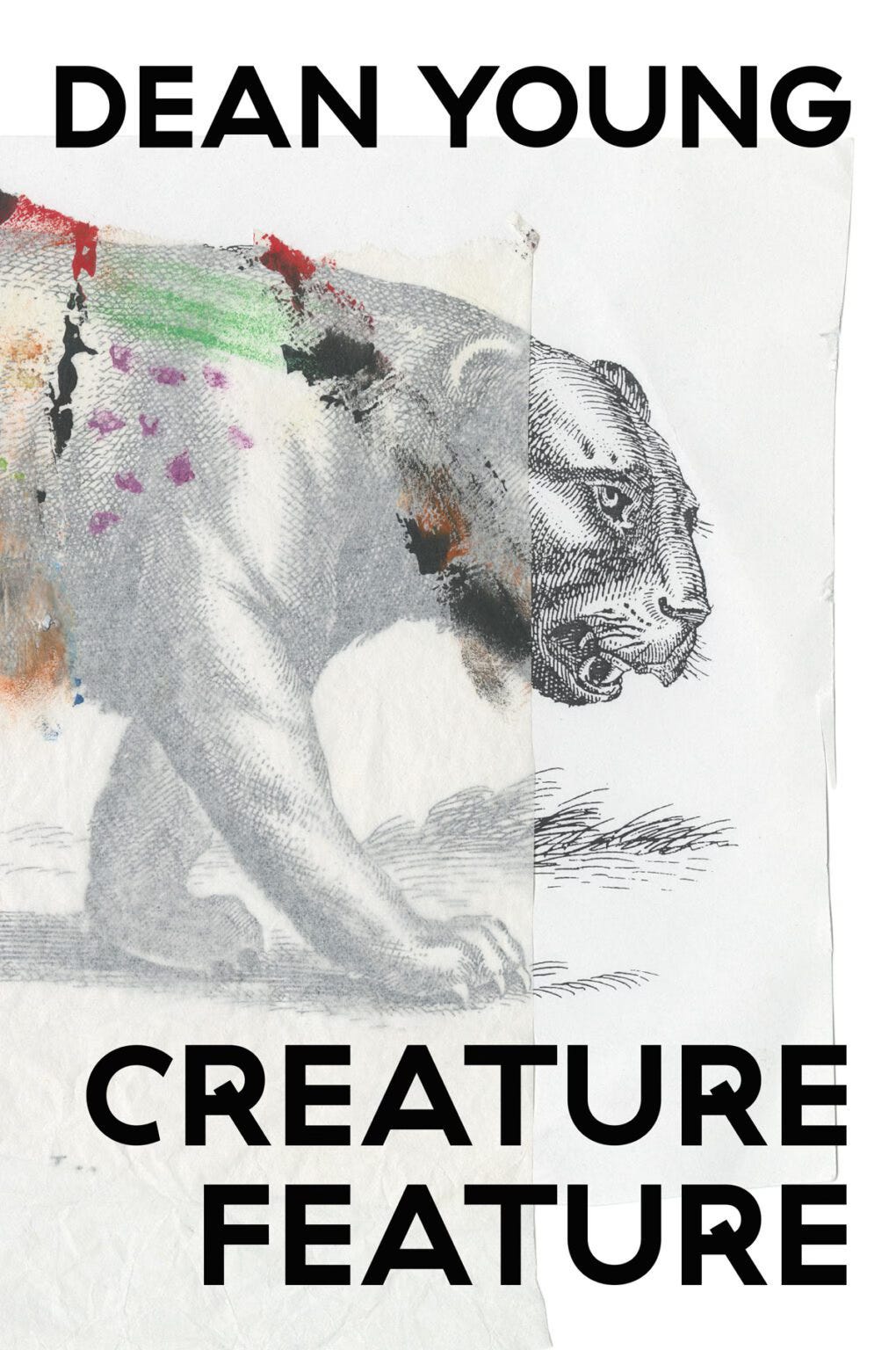
Helena: I do. And I find ‘Spark Theory’ arresting. It’s also fairly brief (in Dean terms) but there’s a bit more oddness about it, more bafflement. Twenty-five lines and the weirdest (but lovely) final image. A good bit of death in here, though anything but morbid.
Hilary: Plenty of death, yes – a hearse in line two and again in lines seven and eight,. Later there are ashes, someone “not being here, / yet being nowhere else”, “occasions for evaporation” and, at the end, a man in pieces. Also lots of references to things that might be associated with danger, burning or cremation. There’s electricity “bouncing off the streets”, spilled gasoline, “perfumes of / incinerated instance”. Link these to the title, ‘Spark Theory’, and you have a heady and combustible mix. I tried to find what Young might be referring to with that title – I found references to various Spark Theories in the fields of data energy, maths, biology, philosophy and psychology, but nothing stood out as being particularly likely. Have you had any joy there?
Helena: He wants the title to sound like a scientific theory, I reckon, but there are at least three kinds of sparks here. Apart from electricity, there’s inspiration and incineration. You can’t cremate a body without sparks. And then what about the sources of poetry? The odd sparks that fire up a poem. Eye-catching things that are curious and odd, or even beautiful. (In ‘Poem Nearly Without Imagination’, he says: “Sometimes it’s exactly like bashing / rocks together to get a spark.”)
Hilary: And ‘Spark Theory’ trips along exhibiting many of Young’s characteristic style mannerisms. Repetition, for example, where he describes a hearse in two seasons (“The hearse a little yellow with pollen. / The hearse almost covered in snow.”) and again with: “Here comes / a strange mailman. Here comes / a Chihuahua with a rubber hand / in her mouth.” And there are surreal elements – plywood making “a peep”, that rubber hand (where we expect rubber band), and “otherness in its flimsy dress”. In any poem, he may leap off at some point into a list of strange and seemingly unconnected things, and here we have exactly that:
[…] A bird flown into
a cotton tree, a love letter crammed
in a plastic mannequin head, what
she said that day by the water
with the ashes making their arabesques.
There’s a link between the hearse and “Some plywood makes a peep”, perhaps, via a cheap coffin, and I see a link between the excess electricity and ‘flow’, which he mentions twice, in the first line and the ninth. But the longer list is an instance, I think, of him wanting to create that sense of “overwhelming baffling exciting maddening confusion”. Life, in all its random strangeness. Part of which is that final image: “a man carried / from his own home in pieces, / like a harp.” Somehow that harp conveys an anatomical quality. It’s all angles and curves, it’s large, it’s unwieldy. For me, a harp heralds angels, or choral music; something ethereal and ritualistic.
Helena: A Scottish harp, a clarsach, isn’t big. But logically this final image shouldn’t work at all. If the man’s in pieces, isn’t the harp too? But I think the harp’s intact. I think it’s a fragile instrument that has to be carried with enormous care, perhaps even shouldered. Just think what comes out of it. Music itself. Isn’t a harp a sort of lyre? Doesn’t it represent the poet himself? I find the end of ‘Spark Theory’ moving. Heart-breaking actually.
Hilary: Oh yes, endings. We should say something about his genius/knack for ending a poem. Over the past few weeks we’ve fired various Dean-Young endings at each other, haven’t we? (Approvingly.) ‘The Burning Laboratory’, for example: “Does anyone / really expect these restraints will hold?” And remember the last two stanzas of ‘Estate Planning for a Snowflake’:
I’m just trying to enjoy the cortege,
the lambs out front garlanded with bells,
the look over the edge, the dogs
trotting by with human limbs in their jawsas if that’s how to tell what’s dreamed
from the genuine aggregate of indeterminate
quanta. It’s all in the mind anyway.
Just probably not mine.
That’s a typical Dean Young ending, isn’t it? Droll, wry, funny, self-deprecating – and tragic, to a greater or lesser degree.
Helena: Absolutely. But back to ‘Spark Theory’. What about the sonic play stitching parts of the poem together? “Flow” is a key word – he amplifies it with “yellow”, “snow”, “flow” (again), “rowboats”, “rainbows” and (later) “flown”. Then there’s “peep” and “streets”. He has fun with “insufficiency of electricity” and “incinerated instance”. The poem’s confident, at ease with itself. Crazy but linguistically skilful.
Hilary: As well as being jam-packed with death. Not just the hearse references but also “ashes making ... arabesques”. Where did the ashes come from if not from one of the “occasions / for evaporation”, an “incinerated instance” i.e. a cremation? As for “Simultaneously not being here, / yet being nowhere else” – surely that must be the guy in the coffin?
Helena: Yes, I think so. ‘Spark Theory’ is about death, as well as the sparks that generate poems, and the electric effect and brilliance of life, and the inevitability of cremation, and fragility of humankind. It’s a vision.
Hilary: And yet the sentences are easy to get hold of. Here are the first three lines, for example:
Things flow one into another.
A hearse pulls up and idles.
Some plywood makes a peep.
No fewer than five out of the first eight lines are end-stopped statements. He does this a lot in this book, more than in earlier collections, so far as I can see. You might get lost in his allusions and his imagery but not in the syntax. I welcome that.
Helena: So what happens when he does use more complex sentence structures? Let’s take a look at ‘So You Want to Write a Poem’. I know it ends with snappy units, but most stanzas are enjambed, and just look how it starts:
Compose yourself with a cat in your lap
like a stopped escalator. The cat’s there
for connection to the living creatures of this planet,
the simile connection to everything else,
the very thing your mother warned you about
but you’re going to have to do most of the heavy lifting yourself
and in that way it is like falling in love
and other maladies.
The opening simile, broken across the line, enacts one of his main tenets, doesn’t it? The cat in your lap is not like a stopped escalator, which is the point. He wants disruptive images, although absolutely any simile will invoke some oblique way in which two things are like each other. It’s not impossible to make the case for a cat and an escalator. But this isn’t poetry of consolation or comfort. The cat in your lap is a joke, as is “compose yourself”. The line about your mother’s a bit of fun too, and the image about the “heavy lifting”, the hard work of poetry, makes sense (to me, at least). However, “in that way” i.e. the heavy-lifting way, writing a poem is not, so far as I can see, like falling in love, though falling in love could be seen to be like other maladies. But is the syntax helping or hindering the meaning? Or am I tying meaning too closely to understanding and missing the point?
Hilary: I think the person is the “stopped escalator”, not the cat. I see someone sitting, side on, so bent at the hips and knees and ankles. You adopt the zig-zag shape of stairs when you sit (and are also stopped from moving by the cat sitting on your lap).
Helena: Oh wow. That never occurred to me. Maybe you have a point.
Hilary: However, the comparison between writing poetry and falling in love is, yes, a bit of a challenge. He’s suggesting for both of these things that we do most of the emotional work ourselves. So falling in love isn’t something that descends on us from outside, like a gift. It requires internal slog. And the following (glorious) few lines support this and and continue in the same vein:
[…] Reports vary but everyone
is squished by at least 800,000 kilos of earthly burden
like the squinched face at the bottom of the totem pole
when what you want is to be on top,
wings coming from your forehead, upright
worm that you are, quite a view.
It’s passages like this that make me adore this poet and want to try to write like him (I’ve tried; I can’t). His imagery’s spot on – that lovely shift from a totem pole, revered holder of history and lineage, to “upright worm” with the implication of something lowly with slightly risible aspirations. His tone ranges from newsreader to colloquial, from intimate and wistful to humorous and self-mocking. Although I’m less convinced by the ending here than usual; I find it a bit obvious. In the final stanza, he seems to be telling his readers how to write a poem for real:
You may have to take yourself apart.
Really get some dirt in your nose.
Now stork-like lift one foot.
Balance. Let the mind assert its blank.
Don’t quit. Now lift the other.
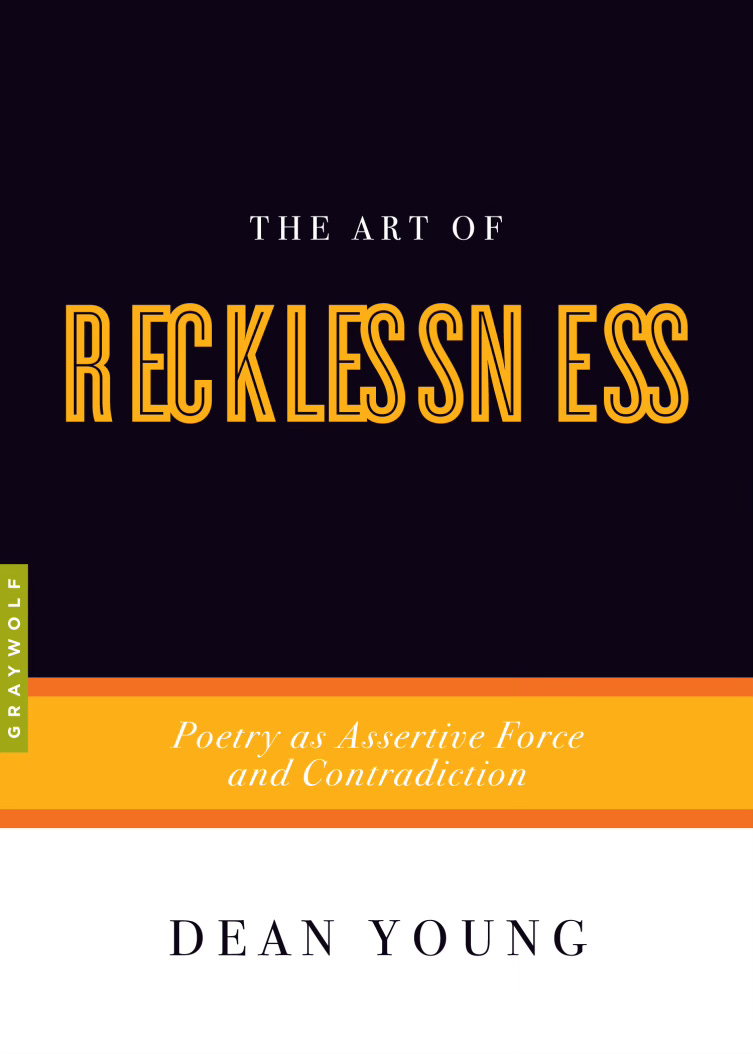
Helena: Oh but I love the last line, and its absurdity. How did you see it as obvious? I was totally wrong-footed by the step-by-step instruction that left me hanging. But in The Art of Recklessness, his 2010 prose book about poetry (which we haven’t talked about yet), he says: “One of the powers of poetry is to bring us up to the unutterable and then go on speaking. […] The poet is like one of those cartoon characters who has stepped off the cliff only to remain suspended.” Is that what’s happening at the end – stepping off the cliff? Even if the ending fails for you, Young says failure’s a necessary factor, I seem to remember, like cultivating uncertainty. If you’re going to risk everything, you’ve got to be prepared to shipwreck your reader at times. Which he does, doesn’t he?
Hilary: When he says “lift one foot” I half expect him to say “lift the other”. And he does. It’s not a failure, for me – just less surprising than some of his other endings. For example, in the poem you found online, ‘The Late Work of Pinkham Ryder’ (included in Shock by Shock, 2015), the poet’s had a “procedure” – possibly a surgical reference – and a friend drops by to see how he’s doing. He’s “arranged all the green rocks / of my collection, mostly fluorite, / at one end of the table” and he’s “winding up the robots at the other.” In ensuing stanzas he goes off on one, in inimitable Dean Young fashion, but eventually comes back to his friend, who he describes as:
[…] one of those people
who think it’s an emergency when you pee
purple or your head’s even a tiny bit
on fire or you’re talking in your sleep
which, by the way, I’m doing now
not that that inhibits my field command.
Robots, attack!
Howzat! I love the way he loops back to the robots. Everything feels like a table-top game – toy soldiers, wind-up robots – and the poet is either a child or crazy. It’s a mad mad mad mad world, but there’s fun to be had.
Helena: It’s unusually coherent, that Pinkham Ryder poem. A thread runs right through. Not a shipwreck in sight. Even a joke at the end.
Hilary: But back to The Art of Recklessness. The title’s taken from a John Ashbery quote: “Most reckless things are beautiful in some way, and recklessness is what makes experimental art beautiful”. The book has been lauded and panned in pretty much equal measure, and from what Dean Young says in interviews it sounds as if he rather cobbled it together from previous essays. It’s certainly more of a polemical anti-rule manifesto than any sort of manual on craft. Near the end he says: “I was hoping that at some point I would figure out what this book is about – maybe you are too.”
Helena: Some of it’s great reading, though, don’t you think? Cheerfully provocative.
Hilary: I was interested in the part about the return to the primitive in Western culture. He says “artists turned from mastery of illusion and technique to a more unmitigated, raw relationship with the basic materials of the medium”, moving back to “barer, harsher, more directly expressive modes”. This struck me as important to understanding his own work. He’s placing himself in a kind of tradition, isn’t he – even if it’s also anti-tradition. He distinguishes between a communicative state and an expressive state i.e. “There’s the fire: we must leave the building,” versus “Yikes!”. Poetry, he says, is in perpetual negotiation between these two states. “These are the two forces that form must come to terms with.” I’d say he himself goes deep into ‘Yikes!’ (the expressive state that recreates the intense sensation of being alive in a startling, baffling world). Is that what you mean by “shipwrecks” the reader?
… this poet doesn’t aim to satisfy our expectations: that’s far too predictable.
Helena: No. I meant the reader gets lost. Lost enough at times to throw in the towel. But I’m still thinking about Ashbery on recklessness. I don’t think it’s even true that most reckless things are beautiful in some way. Most things are beautiful in some way; recklessness is the least of it. Doesn’t ‘reckless’ suggest wild, careless, out of control? Recklessness is risky; it attracts admiration, maybe. But that doesn’t mean it’s beautiful. Recklessness can be awful. It can be fatal. I can’t agree that “recklessness is what makes experimental art beautiful”. Good experimental art isn’t always beautiful, nor trying to be. Me, I’d rather it was interesting. I know the Ashbery quotation is out of context – but I hate grand poetic assertions. At least when Dean Young makes them, he immediately contradicts himself. I guess that’s the “permanent negotiation” you spoke about. I liked lots of The Art of Recklessness – liked it, more than found it useful. I think (like all books about poetry) it’s really the poet explaining his own methodology. I mean, how do you “get better at not knowing what” you’re doing?
Hilary: Maybe it’s like Keats. The negative capability thing. But what about those reader shipwrecks in Dean Young? Give me an example.
Helena: I can pick out poems in Creature Feature where he loses me, though they also have good bits. As you pointed out earlier, he often goes in for listing things. A list poem’s supposed to accumulate towards a pay-off. But this poet doesn’t aim to satisfy our expectations: that’s far too predictable. All the same, the poetry reader is needy. There has to be something in it for them. It has to be more than a random poet hurling great phrases. But that’s sometimes how it feels. For example, ‘island Life’ sets out as a Because poem:
Because my little dog knows me
Because of idiot backward calliope longing
The Z of it
How gladly I’d cut myself out of the photographs
Because after a heart transplant I have a right to stagger
Because of swimming under a sign saying not to
Jupiter in Cancer
Righty tighty, lefty goosey
An unlawful display of fireworks
Because this heart has had more car wrecks than the rest of me
I threw up the whole whale watch
We know how a Because Poem is meant to work. The missing half of the Because – even if never stated – is supposed to be inferable, eventually. In ‘Island Life’, equipped with your previous Because-Poem experience, you start the deduction process. You get nowhere. “I threw up the whole whale watch” looks like a promising precursor to “Because my little dog knows me”. But it doesn’t seem to mean anything. So you look at “The Z of it”, even though it’s not even a sentence. I’m guessing it meant something to the poet (maybe a TV reference?). For me it’s a ‘duh’ clause, as is “Jupiter in Cancer”. Two or three more of those and I’m offski. Perhaps I could make a case for what the poem might be telling me but … life is short. Still, ‘Island Life’ doesn’t lose me as fatally as ‘Welcome to the Neighbourhood’, which sets off being playfully random and then goes on … and on … and on. “There’s nothing worse than a poem that doesn’t stop” as he says himself in The Art of Recklessness. This is the poem that includes the lines: “I’m sure I’m not the first to think / I’ve discovered a way to put everything in”. Blimey. This poet-fiend is proud of the thing that’s driving me nuts! Who on earth wants a poem about everything?
Hilary: Dean Young, apparently. I’m not sure whether the urge is inclusive or arrogant. There’s a couple of lines in ‘Ever the Night, Ever Sunrise’ which seem to call in ‘everything’ all at once:
An ocean rushing through a pinprick,
the whole universe tear-dropping from an eye
Is Dean Young the pinprick through which the whole ocean rushes? Is his the eye that cries (for) the whole universe?
Helena: I don’t think so. In this romantically titled poem he’s experiencing the pinprick (whatever that might be) so intensely that an ocean rushes in. Similarly, just one tear affects him so intensely that it’s “the whole universe”, or at least it’s that quality of sensation he’s trying to communicate (cf Keats – from whom Young is not so very far – “Oh for a life of sensations rather than thought”).
Hilary: But he swings from wild intensity (“I broke my fingertips. I broke my tongue”) to self-deprecating (the pinprick – he’d like that, he’d find that funny, and “but really was it all so terrible?”) and even relatably pathetic (“It’s not that we all don’t try”). Again, the poem is a crazy jumble of stuff, made to provide us with the experience of living in the world of Dean Young.
Helena: Crazy it may be, but more than just a jumble. Things are not as reckless as they look. Isn’t ‘Ever the Night, Ever Sunrise’ mostly about dedicating your life to poetry – “really was it all so terrible?” He compares writing to being one of many, another tiny being, like a tadpole aiming for the light above the surface and mostly merely scratching the underside. “Gasping like lightning in a lake with a rope swing”, I admit, is jumbled, perhaps the confusion of mortal risk and nearly-there-ness and never-quite-making-it. But can’t any poet relate to this? And it’s sensory, it’s close, it’s intimate. Taste and touch: “I broke my finger-tips. I broke my tongue.” But the peak experiences include that ocean “rushing through a pin-prick”, and grief telescoped into a tear-drop. The grief is devastating. You can’t write it if you don’t feel it. The “smaller and smaller” birds are the whole crowd of us, all the wouldbe poets, and they’ve consumed even smaller insects/stars until we’re almost entirely made of sky. But still we try. We keep trying. We try so HARD. The word ‘try’ is all over the place in this book. The strivers create mountains of failed poems, shiny bits of value gleaming here and there.
Hilary: What about another one of the ‘ever’ list: “Ever the scarecrow with bees in its head”? We’ve met that scarecrow before in ‘Scarecrow on Fire’.
Helena: Yes, there are two poems by that title in Fall Higher. It’s an image of Dean himself, I think, here with poetry bees in his bonnet. The poet’s glove reaches clumsily for the roses (born to blush unseen & waste their sweetness etc), and here and there out of the mire some lauded bard or other rises up, at the same time as a revered creation is rubbished and destroyed. Meanwhile human love endlessly exerts its attraction and its devastating loss. Perhaps you can muster a wolf (all your strength, all your poetic skill) to fight on but that’s only the half of it. Doesn’t mean you’ll make it.
Hilary: If this reading’s right, there’s only one way to do poetry. Risk all you have. Feel the pain and do it anyway. “Always put your best foot in the fire.” Here we go with another spectacular and wholly unexpected ending. After a while, I feel you can spot the ‘typical’ Dean Young poem when you see it. Some lose me in the middle (OK, maybe I get shipwrecked) but when he’s good, he’s very good indeed.
Helena: Yes, always the anticipation of flashes of brilliance, some of which illuminate understanding. And in between – well, I like his voice. He’s not smug or cocky or supercilious. He’s congenial. Sometimes he makes me laugh. Even when I get lost, I don’t feel ignored. Or stupid. It’s like he’s a human being reaching out from a place of vulnerability. He knows nothing but experiences everything, which is a kind of vivid insight. I wouldn’t have missed reading Creature Feature. Not for anything. Which poems will you remember from this collection?
Hilary: One of my favourites is ‘If Anyone Asks’, Creature Feature’s final salvo. I particularly like the ending, which I don’t think we should give away. The first line continues the title – if anyone asks, then
tell them just because they can’t hear the moon
doesn’t mean it’s not screaming.
Tell them it’s just like being attacked
by a murderous lunatic in your own bathroom mirror
or by your own jewelry or toothbrush or taco
or panthers, entirely in-the-mind panthers.
That’s a fabulous series of images, each one both frightening and ludicrous, especially the “entirely in-the-mind panthers”. It’s as if he’s catastrophising, his mind spiralling out of control, leaping from one scenario to the next, each more awful than the previous one, but at the same time being held in check by his own self-deprecating, feet-on-the-ground humility. Two opposing forces.
Helena: Yes, but “if anyone asks” … what? Typically, he never says. He tells you, many times, what it’s like, but not what ‘it’ is. However, by line 11 he observes:
Anyone who’s tried to write a poem gets exposed
to some mighty whichway winds.
So I think it’s reasonable to infer that ‘If Anyone Asks’, like many in this collection, is about the whole art of writing poems. But also more than that. It’s about the business of existing inside a poem. I suspect inside a poem was the only place Dean Young felt fully alive (“I dare you to find a river any other way”). A dangerous place, but the only place to be.
Hilary: In the afterword, Dobby Gibson and Matt Hart say: “The entire point of a Dean Young poem is that it preserves the spontaneous energy and idiosyncratic mechanisms of its own invention.” Doesn’t this poem demonstrate that?
Helena: Certainly, and the editorial comment is true, though nowhere near as good as reading the poems themselves. This last poem is a favourite of mine too, although I think it gets a bit rambly in the middle where he’s not only exemplifying but also commenting on himself doing it. I mean, he gives three types of ‘moods’ and then says, “Here, I made a list.”
Hilary: But the jokey bit about the “ant farm of consciousness” and his mother makes me laugh, and I love the way he drops vertiginously from that into six serious lines aimed directly (and personally) at the individual reader. You wouldn’t forget this ending.
Helena: Nor the neat way the whole poem links back to ‘Spark Theory’. In that opening poem: “it’s not an insufficiency of electricity / that we need to worry about”, and in the closing piece: “Sometimes pressure creates electricity / but we always risk dust”.
Hilary: Yes, many things here look random at first but are interconnected, a skilful feature of the whole. It’s not half so reckless as it first appears. We think people should read this book, don’t we?
Helena: We do. We definitely do.
Helena Nelson is a poet, critic, and publisher, founding editor of HappenStance Press and Sphinx Review, and Consulting Editor at The Friday Poem. Her first collection, Starlight on Water (Rialto, 2003), was a Jerwood / Aldeburgh First Collection winner. Her second was Plot and Counterplot (Shoestring, 2010). She also writes and publishes light verse, including Down With Poetry! (HappenStance, 2016) and Branded (Red Squirrel, 2019). Her most recent collection is PEARLS: The Complete Mr & Mrs Philpott Poems (HappenStance, 2022).
Hilary Menos is a poet, editor and reviewer. Her latest pamphlets are Vox Wah-Wah (New Walk Editions, 2026) and Fear of Forks (HappenStance, 2022). Her first collection, Berg (Seren, 2009), won the Forward Prize for Best First Collection 2010. Her second collection is Red Devon (Seren, 2013). Her pamphlet, Human Tissue (Smith|Doorstop, 2020), was a winner in The Poetry Business Book & Pamphlet Competition 2019/20. She is editor of The Friday Poem.
Vital Statistics: The Friday Poem has 3700-plus subscribers. It’s run by four people – Hilary Menos (Editor), Helena Nelson (Consulting Editor), Bruno Cooke (Spoken Word Editor) and Andy Brodie (Web Editor), with contributions from a team of reviewers and writers.
Until recently we maintained the Friday Poem website (thefridaypoemdotcom) as an archive of 700 posts published between 2021 and 2024 (including most of the original Friday poems) but following a catastrophic hack in late April we made the difficult decision to take this down. We’ll be republishing some of the poems, features and reviews on Substack in the future.
Help support The Friday Poem
Buy us a coffee to help us stay awake as we strive to bring poetic excellence to your inbox every Friday. Heartfelt thanks to everyone who donates, especially to our regular donors. If you can’t afford it, no worries, we’re going to keep on doing it anyway! Big thanks for everything, you lovely poetry peeps.
I'd never heard of Dean Young before, but now I want to read him. Thanks for this.
Wow. Good read, and thanks for introducing me to this writer.