


Foundling
None of us can remember him arriving,
brought to us perhaps in a heavy rain shower.
There was a phone call I think,
then the doorbell rang.
He had had quite the time of it:
three days on MDMA. The ketamine chaser
had left him lost from himself.
His face had beautiful angles.
I knew at once I wanted to keep him,
brought fresh orange juice,
a blue duvet and told him
everything was alright now.
It seemed okay to stroke his hair
even though he had no back story,
and couldn’t remember his own name.
I left him sleeping and busied myself
with planning our future.
Checked in on him around midday,
cup of tea in hand, a KitKat,
a DVD we could watch together.
The duvet was crumpled
his spot on the sofa still warm.
’Foundling’ is the first of ‘Three poems about Felix Hirst, visitor to the homeless hostel in York’, from Missing Person by Zoë Walkington (Smith|Doorstop, 2026) — big thanks to Smith|Doorstop for letting us reproduce it here.
The very structure of Missing Person, Zoë Walkington’s second pamphlet, sets it up as something rather different from the average themed collection. Briefly, it’s a detective story told through poems of various forms. But more than that, we’re offered a ‘storyboard’ that includes a cast list, a back-story and an epilogue, and poems concerning the suspects, the witnesses and the investigating team. Armed with a great deal of information, readers encounter the investigation itself in the latter half of the pamphlet. We’re invited to solve a mystery. A ten-year old boy has disappeared in contemporary York. Who took him? This certainly encourages careful reading.
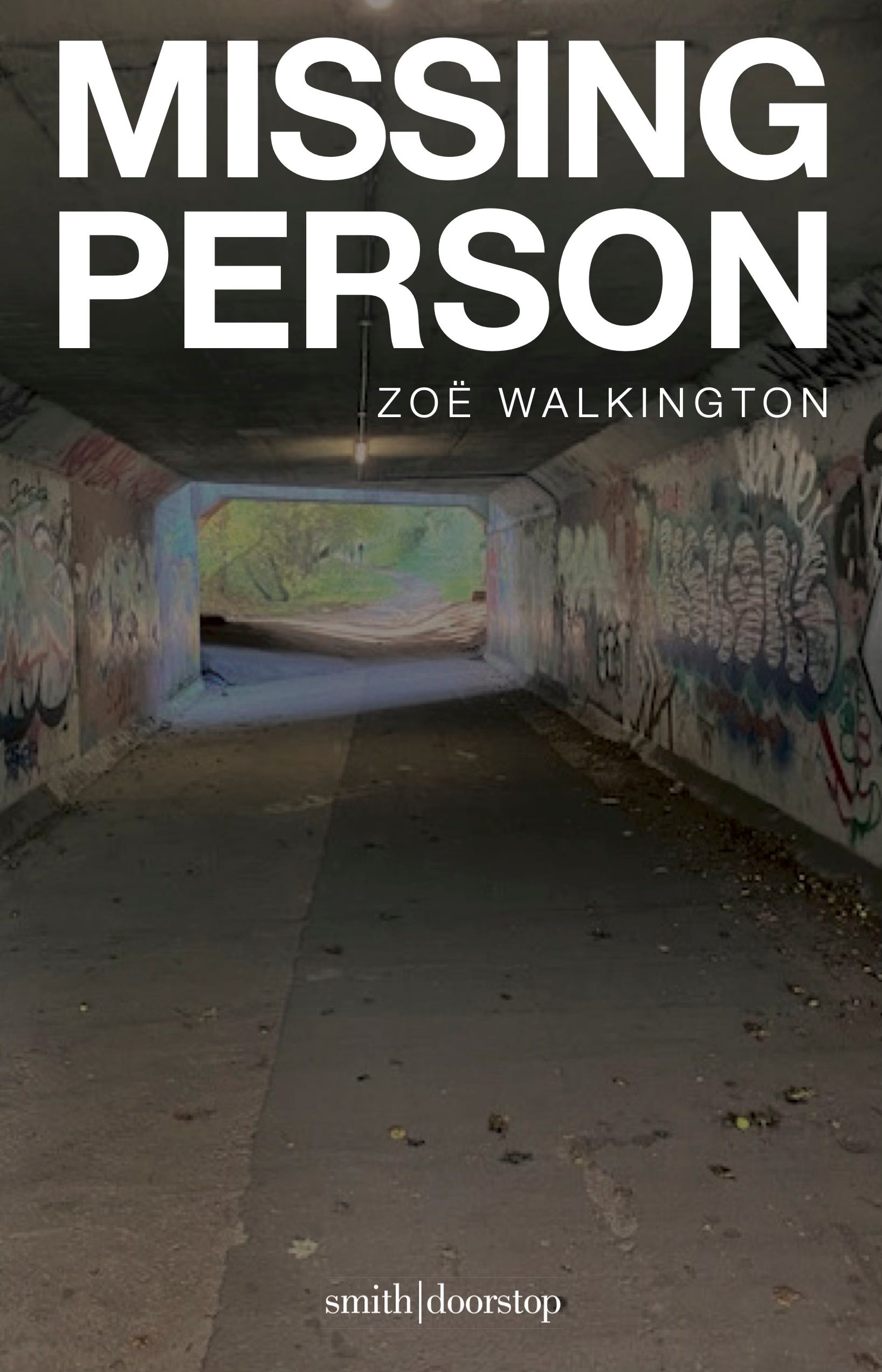
So Missing Person isn’t a typical poetry pamphlet, and the experience of reading it isn’t typical either. While pamphlets occasionally demand more interrogation than we might wish to get at their meaning, here’s one that’s created expressly to encourage us to puzzle over it and make notes as we read. And then to go back and read again, applying whatever powers of deduction we can muster. “The collection is solvable”, the author tells us in the brief introduction. But if my experience is anything to go by, this mystery won’t be solved with a skim read. Repeated readings are required!
Here’s a short poem from the opening section (‘History’):
Babies
I’ll show you the way
decisions get made.
Like the naming of a son,
part by the parents
and part by the town.
In Hebden Bridge, he’s Felix,
in Huddersfield he’s James
and whatever they are named
their mums sucked hard
on gas and air, just the same.They might be left-handed.
It will be possible, in time
to hide your disappointment.
All that smudged ink.
When Felix is in Emmerdale
and James is Head of Finance
no-one will know, because
who needs to hold a pen these days?
Not actors. Not Heads of Finance.
That’s who.
Having read this poem three times while preparing my review, and now having carefully typed it out, I’ve got a growing list of ‘things that might be useful to the investigation’. I seem to remember something later in the collection about Felix not getting into RADA, but did he manage a bit-part in Emmerdale (that popular Yorkshire-based TV soap opera)? And the bit about being left-handed, with the resulting “smudged ink” – that’s got to be important. And was James a Head of Finance? I’m not sure.
… it is fun to flick back and forth from poem to poem, piecing together what each might offer to our uncovering of the truth
Many of the poems provoke similar questions. I’ll share no more of my thoughts for fear of spoiling your fun. And, reader, it is fun to flick back and forth from poem to poem, piecing together what each might offer to the uncovering of the truth. And isn’t uncovering the truth one of the things that poetry often aspires to? Here, of course, we know what truth we’re after – who took the boy. But like the best detective stories, we come away with more than just an answer, and the poet’s leaps of imagination make this a really arresting (no pun intended) read.
As an example, here’s a short poem in the voice of ‘THE GRAFFITI ON THE WALL OF THE SUBURBAN UNDERPASS, YORK’:
Sevenling (What the graffiti saw)
What the graffiti saw was young lads booting
a ball, a coke can, each other.
The vixen who stopped to snout through twitch grasswhich crept underground through rhizomes,
that held secrets, lost language, and hope.
Impassive and cool she loped onwardher mind already turned towards prey.
That term, “rhizomes”, is important – perhaps. It simply means (according to the dictionary) horizontal underground plant stems, but these help plants ‘survive unfavourable conditions’, and this perhaps tells us more about the environment in which our investigation takes place. And every poem in this sequence, in whatever form, offers us a little more, not just to help solve the mystery but to create a remarkably complete portrait of a place and a time. The entire setting is portrayed in such detail and through so many points of view that even the urban underpass – the scene of the crime – is alive with meaning.
The entire setting is portrayed in such detail and through so many points of view that even the urban underpass – the scene of the crime – is alive with meaning.
After repeated readings, I’m still not sure if I’ve solved the mystery – or whether that even matters. But what I am sure about is that this is a fascinating exercise in putting poetry to good and unusual use. It would be fascinating to know how Zoë Walkington approached the whole project. Did the mystery develop as the pieces were written? Did she use one of those pin boards we see on detective shows, full of photos and statements linked by bits of string? And what about the boy? Will no one think of the boy? Goddamn it! Who took him? And is he OK?
There’s no doubt in my mind that Missing Person is a satisfying and unusual read (and re-read), whether you solve the mystery or not.
[If you have worked out who took the boy, please message The Friday Poem —Ed.]
Jonathan Davidson is a poet, writer and literature activist, living in the English Midlands. His poetry has been widely published, and he has also written memoir and criticism. His radio dramas and adaptations have been broadcast by BBC Radios 3 and 4. Much of his work is focussed on how writing – especially poetry – is experienced by readers and listeners. His latest poetry collection is Downland – Paintings by Anna Dillon & Poems by Jonathan Davidson (Two Rivers Press, 2024). Jonathan Davidson’s website is here.
Vital Statistics: The Friday Poem has 3700-plus subscribers. It’s run by four people – Hilary Menos (Editor), Helena Nelson (Consulting Editor), Bruno Cooke (Spoken Word Editor) and Andy Brodie (Web Editor), with contributions from a team of reviewers and writers.
Until recently we maintained the Friday Poem website (thefridaypoemdotcom) as an archive of 700 posts published between 2021 and 2024 (including most of the original Friday poems) but following a catastrophic hack in late April we made the difficult decision to take this down. We’ll be republishing some of the poems, features and reviews on Substack in the future.
Help support The Friday Poem
Buy us a coffee to help us stay awake as we strive to bring poetic excellence to your inbox every Friday. Heartfelt thanks to everyone who donates, especially to our regular donors. If you can’t afford it, no worries, we’re going to keep on doing it anyway! Big thanks for everything, you lovely poetry peeps.