


Used & Vintage
His first was a Fender Squier made in Japan
which he part-ex’d at Mansons in Exeter for an Epiphone
which he traded for a pretty little Rickenbacker Jetglo
which he swapped for half a car and a Gibson Les Paul Studio
which he lost to the drummer in a late-night drunken bet
so had to sell his half car, at a loss, to buy the Gretsch
which he kept for decades until one night on Instagram
he saw, fell in love with, and bought the blue Dan Dunham
which he ditched last year for the blonde Tele here in his lap —
ash body, maple neck, just starting to open up
the way tone woods do, like sycamore, spruce, mahogany,
the grain settling in sweeter patterns the more you play
so with use and age comes depth and resonance
and I look at him and think, yes.
‘Used & Vintage’ is from Vox Wah-Wah (New Walk Editions, 2026) — buy Vox Wah-Wah from New Walk or if you are in the EU email Hilary for a copy.
Vox Wah-Wah will be launched online on Thursday 28th May at 7pm UK time (8pm French time) — here’s the link to click if you’d like to register.
The Professor of Transformation by Elaine Ewart will be launched at the same time.
https://us06web.zoom.us/webinar/register/WN_eBz7YjsFSKyqHPz8Uc6R4A
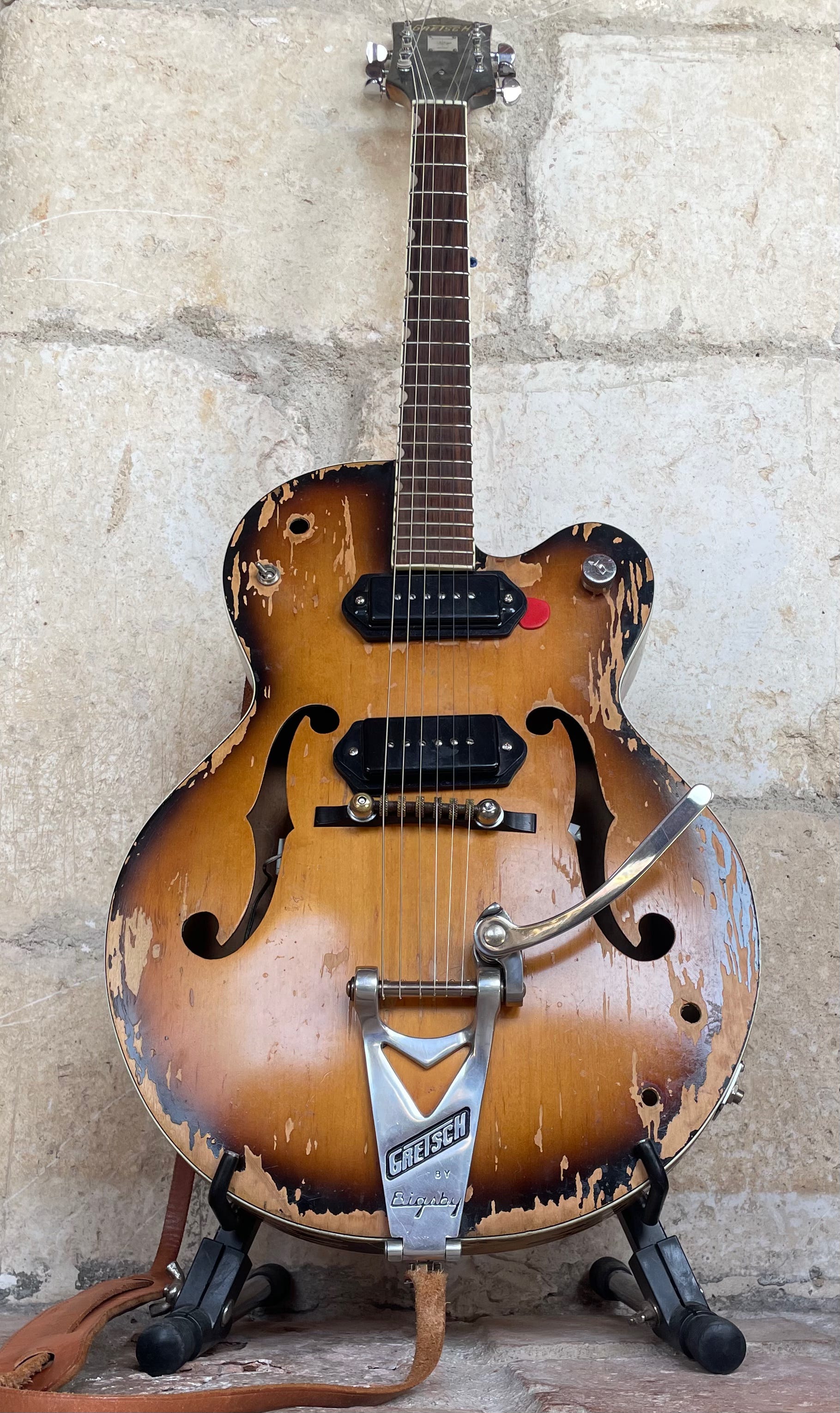
It all started with the Gretsch. A 1967 Gretsch Double Anniversary – Sunburst, to be precise. Beaten up, scratched, scarred, bare wood round the edges, empty holes where knobs had once been. Look at the picture. That guitar has lived.
Back in 2003 I was running poetry and music cabaret One Night Stanza in an upstairs room in the Kingsbridge Inn in Totnes with artist and comedian Stephen Park. Compèring was terrifying, but I wanted to get better at dealing with an audience. Stephen, on the other hand, was in his element. He liked nothing more than grating a cucumber and watching the male members of the audience squirm, or performing his absurd poems, one of which went something like this:
Lamb of God
Soup of the Day
Cream of Mushroom
To improve my microphone technique, I joined a stand-up comedy workshop with Tony Allen, the “godfather of alternative comedy”. There I met a funny guy called Jerri Hart. He played trumpet in jazzabilly showband The Rhythm Doctors. Jerri said it was the best band in Cornwall. So I booked them for One Night Stanza.
One Night Stanza had an audience of about fifty locals, and some very memorable performances. ONS co-founders Matt Harvey (‘Empath Man’) and Rose Cook (of the Dangerous Cardigans) were regulars, and ’Your Dad’, the late, great Ian Marchant, brought the house down on more than one occasion. None, however, were quite as memorable as The Rhythm Doctors.
The band was booked to go on in the final slot at about ten pm. The four musicians looked pretty down-at-heel squatting in the corridor in their scruffy dinner suits. Jerri held his trumpet in one hand and a spliff in the other; the drummer had drumsticks poking out of his top pocket and a mad twinkle in his eye; the double bassist had decorated his instrument to look like a Mondrian painting and the guitarist had a guitar that looked … well, what can I say? My heart sank when I saw it. The state it was in. I had no idea what to expect. Was this even a proper band?
My heart sank when I saw it. … Was this even a proper band?
Five minutes later, as they launched into a fiercely fabulous version of ‘Minnie the Moocher’, I had no fears and no regrets. They were tight, professional, and eminently watchable. In minutes the audience was up on its feet. Soon all the customers drinking in the bar downstairs had joined us, cramming into the small room and craning their necks to see what was making the noise. Then someone tugged at my arm. It was the landlady. She had come up to complain, but she – and all the rest of bar staff – stayed for the rest of the set, and the encore, and congratulated us on a fabulous (and free) show. And the Gretsch? The Gretsch sounded awesome.
Which brings me to the blurb for Vox Wah-Wah:
When Hilary Menos got together with guitarist Andy Brodie she found herself sharing space with a 1967 Gretsch Double Anniversary, a 1962 Vox AC30 and an array of guitar pedals with names like Dr Scientist Reverberator, Nocturne Dyno Brain and Rozz Super Baby Flanger. Soon she could tell a Tele from a Strat and a humbucker from a P90; and in the eternal conversation about where rock’n’roll came from and who did it best, she got game!
Frank Sinatra said rock’n’roll was ‘the most brutal, ugly, desperate, vicious form of expression it has been my misfortune to hear.’ Frank is between these covers, as are Jimi Hendrix, Elvis Presley, Karen Carpenter and Etta James, among others. But this is not just a celebration of rock’n’roll greats. Menos explores the stories behind iconic moments in rock history, the impact of sound on the body and the joy of reckless abandon. The poems in Vox Wah-Wah suggest how to live, how to love and (with a bit of help from Elvis) how to leave this world.
The Gretsch – bless her pitted rosewood fingerboard – was also instrumental in the making of this pamphlet. Sound is generated by the interaction of instrument and player, and how can anyone not frame this as a kind of relationship. Most guitarists name their guitars and many call them by a woman’s name; B.B. King‘s was called Lucille, George Harrison’s and Albert King’s were both called Lucy, and Jimi Hendrix’s last guitar was called Izabella. It’s hard not to anthropomorphize. Andy calls the Gretsch ‘the old lady’, and over time I developed a feeling of kinship with her. But when she was supplanted in his affections, first by ‘the Blue’ and then by ‘the Blonde’, I chose to imagine myself, instead, as his 1964 Butterscotch Blonde Fender Telecaster.
I’m customisable, from headstock to chromed brass strap button.
For versatility and ruggedness I can’t (and won’t) be beaten.I’m jazzy clean, but rock’n’roll when you add a little gain,
I can do a country twang and that mournful sustain;in fact I can do anything, and still steer and paddle a canoe.
I’m the one that every single model on show comes second to.
(from ‘Self-Portrait’)
Andy is defiantly old school; he plays through valve amps (a 1962 Vox AC30 or a 1963 Ampeg Reverberocket) rather than newer solid-state amps, and he plays loud in order to feel the sound vibrate through his body. Turn one of these old amps up high and the valve-driven sound starts to take a kind of shape. “You need to feel the squish,” he says, “the sag.” That’s when the fun starts. Hence ‘Wall of Sound’:
For the gig tonight, at the audio guy’s insistence,
he’s using in-ears and a wireless guitar system.
I watch him play, his prosaic solos and fixed smile
indicative. I know what he needs to do: junk the in-ears,
plug in a foldback wedge and crank up the Fender Twin
until the tubes crunch and glow and the air moves
(physical, elastic) […]
Like most guitarists, Andy is obsessed by tone, which has led to many conversations about exactly what he’s searching for, and to poems in the pamphlet like ‘Roy and Nancy’, about Roy Buchanan, one of the finest guitarists of the blues rock genre. Roy’s Telecaster (‘Nancy’) had a tone all of her own which musicians have been trying to emulate (and explain) ever since. Trying to work out what it is about a pickup that creates a particular tone led me to write ‘The Queen of Tone’. It’s about Abigail Ybarra, the woman who hand-wound the pick-ups on Fender guitars at the Fullerton factory through the 1950s and ‘60s:
[…] winding in just enough air,
her hands shaping the resonance of every Fender guitar
with consistent inconsistency
Ybarra and her team (of mostly Latina women) were at least in part responsible for the awesome tone that Jimi Hendrix achieved with his Olympic White Fender Stratocaster.
Connie Francis once said, “A girl can’t sing rock’n’roll. It’s basically too savage for a girl singer to handle.” Thanks, Connie
I’ve long been fascinated by the role and status of women in rock’n’roll. Connie Francis once said, “A girl can’t sing rock’n’roll. It’s basically too savage for a girl singer to handle.” Thanks, Connie. But the music industry was – maybe still is – a pretty harsh place for women, as evidenced by so many tragic stories. Karen Carpenter, for instance, died aged 33 from anorexia (and the drugs she took to stay thin).
When they found her on the floor, her heart beat
once every ten seconds. Six times a minute.
(from ‘Superstar: The Karen Carpenter Story’)
Of course Vox Wah-Wah couln’t have happened without New Walk Editions, and in particular my editor Nick. New Walk founders and editors Nick Everett and Rory Waterman are, in my opinion, among the best in the business. They have compiled (I’m trying to avoid saying ‘curated’, ugh) an varied and interesting list and have a solid commitment to finding new voices, as well as publishing good new work by established poets. They produce pamphlets (and occasionally books) that are beautiful to handle; TFP reviewed one of these, ‘Continuous Present’ by D.A. Prince, last year. Working with Nick was a delightful process; he’s everything one might want in an editor — precise, informed and exacting, as well as lots of fun.
I could say more about how Vox Wah-Wah explores the things we do – to ourselves and to others – in the name of ‘Art’; how music is like poetry in that it’s all about tension and release; how guitars really are like people, and people really are like guitars (“with use and age comes depth and resonance”). But I’ll leave further comment to Steven Lovatt who will review Vox Wah-Wah on The Friday Poem in a few weeks time. Steven called Unexhausted Time by Emily Berry (then editor of Poetry Review) a “difficult book to admire”, and detected “an excess of Eliotesque riddling and intoning” in Leaves by Matthew Hollis (then poetry editor at Faber), so I don’t expect him to pull any punches.
If you’d like to hear me read some of the poems, come to the Zoom launch at 7pm on 28th May (next Thursday). If you want a sneak preview, we made a film-poem of ‘The King of Porthcawl’ – watch it below.
Buy Vox Wah-Wah from New Walk or if you are in the EU email Hilary for a copy.
Oh, and there’s a Spotify playlist too, just flash the QR code with your phone camera. Enjoy!

Hilary Menos won the Forward Prize for Best First Collection 2010 with Berg (Seren, 2009) and is a two-time winner of The Poetry Business Book & Pamphlet Competition with Human Tissue (2020) and Extra Maths (2004). Wheelbarrow Farm (Templar, 2010) was a winner in The Templar Book & Pamphlet Competition 2010. Her second collection is Red Devon (Seren, 2013), and in 2022 HappenStance published a pamphlet, Fear of Forks. She is Editor of The Friday Poem.
Vital Statistics
The Friday Poem is run by four people – Hilary Menos (Editor), Helena Nelson (Consulting Editor), Bruno Cooke (Spoken Word Editor) and Andy Brodie (Web Editor), with contributions from a team of reviewers and writers.
Until recently we maintained the Friday Poem website (thefridaypoemdotcom) as an archive of 700 posts published between 2021 and 2024 (including most of the original Friday poems) but following a catastrophic hack in late April we made the difficult decision to take this down. We’ll be republishing some of these posts here on Substack in the future.
Help support The Friday Poem
Buy us a coffee to help us stay awake as we strive to bring poetic excellence to your inbox every Friday. Heartfelt thanks to everyone who donates, especially to our regular donors. If you can’t afford it, no worries, we’re going to keep on doing it anyway! Big thanks for everything, you lovely poetry peeps.
This is the Telecaster positive collection I’ve been waiting for. Congrats, Hilary.
The film-poem is astonishing. Elvis Herselvis rises from the page!