


In the Middle of Things
[…]
ii
The apples in heaven upstairs are all felted
The green door at the end of the hallway too
with the light from a small gin right-angled
around the doorframe
Lined up on the window ledges of the attic bedroom
the scullery maids are little bottles of poison
Surrounded by slaughter
the fox on the landing is breathing in its still life
The stair rods are coming loose
the stair carpet unstitching
your breath unleavens the bread
part red sea part read left field
right field a fern unfurling a swallow
at the back of the mouth
A broken jar of horseradish leads
to the outdoor lavatory where a stone
at the back of my tongue drops down
the well as I rise up in the opposite direction
bolt upright in a bucket of water
Swallows saliva solvitur ambulando
breathing very carefully
The ambulance is driving too slowly
over the golf course amongst the swallows
towards the one I can’t put together
‘In the Middle of Things: ii’ is from Fourth & Walnut by Jeremy Over (Carcanet, 2025) — many thanks to Carcanet for letting us reproduce it here.
Let's start in the middle of things with ‘In The Middle of Things’, page 39, perhaps as close to a conventional poem as anything here. It is in two numbered parts. Part I is a five-paragraph prose poem (part II is quoted at the start of this review). The first three paragraphs are separated from the remaining two by an indented tilde and apparent change of subject. Here’s the beginning:
He walks carefree towards the cliff edge looking up into the sky. Over his right shoulder, tied to the end of a staff, he carries his worldly belongings in a small satchel.
For me, this paints a picture familiar from children’s books. Dick Whittington, perhaps. The first paragraph continues to describe the walker’s playful white dog, and a backdrop of icy peaks.
The second paragraph opens with a shift of style: “The Fool is Zero. All potential.” It then transitions to more relaxed prose, somewhat academic in tone:
[…] He isn’t taking a leap of faith so much as just one more stop, in faith that the ground or something or someone will be there still to support him. He has no need to look down. What he is looking for is in the sky.
Beyond the tilde, a dramatic contrast is introduced:
And here’s a photo of my father taken the day before he died. Standing in a field a long way from any cliffs or icy mountains. Not stepping out, but posing for a photo. Burdened by the paraphernalia of picnics.
The next and final paragraph completes the connection between the two parts:
[…] He is not at the start of a new journey. Nor at the end of one. He is in the middle of things. In a field. Where happiness lies. And a picnic lunch.
This poet evidently has a tender eye for the off-whack, and a keenness to take an experimental approach to form and sequence in order to address emotively charged content. I appreciate his approach in this poem. The slight oddness seems to add, charmingly, to the emotional valence.
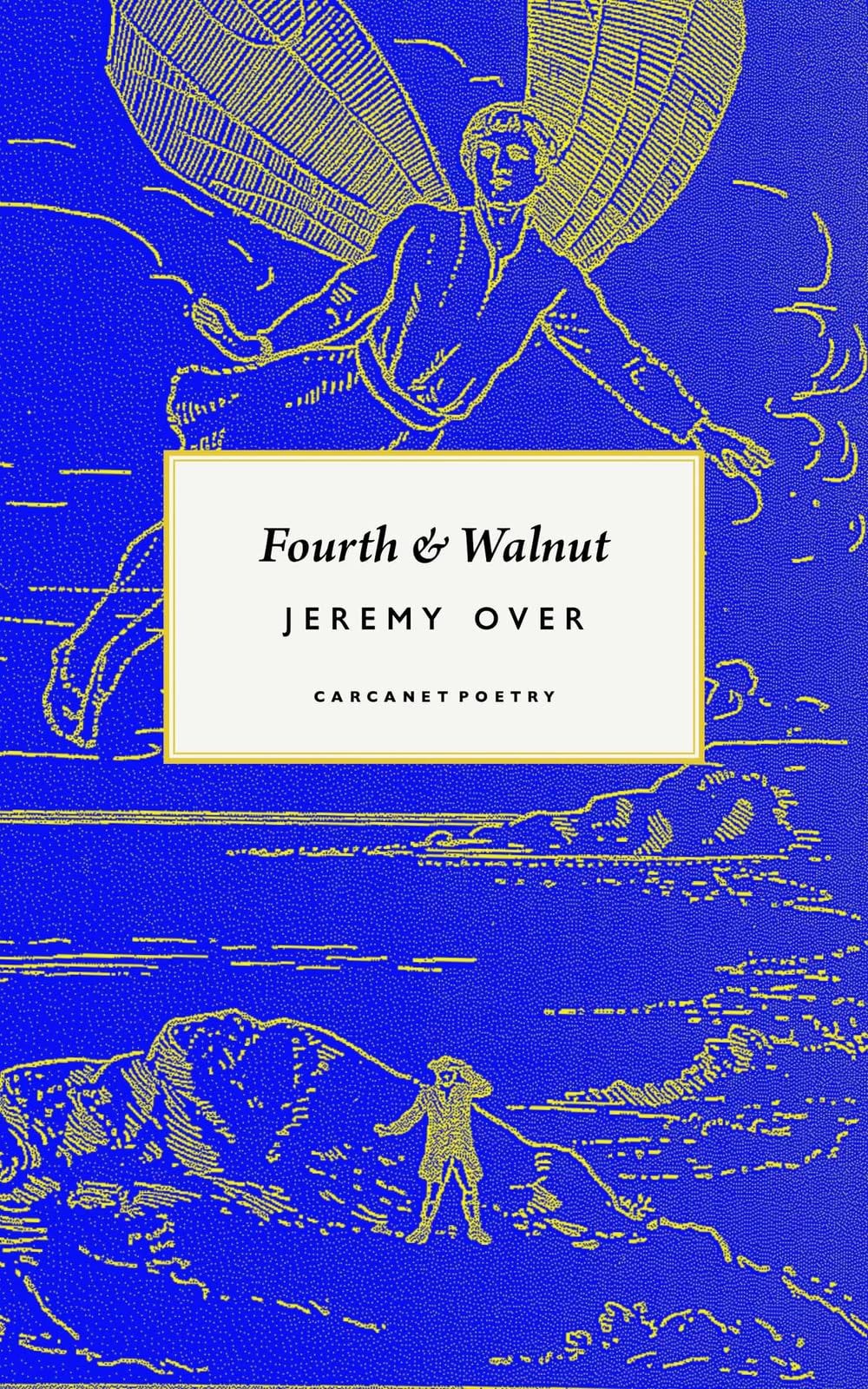
Now let's move to the end of the collection, the final poem, ‘Yes and Yes’. (Depending on how you count, this is perhaps the fifth or seventh poem. The Contents lists five separate pieces, two of which have two parts, but some of these have further independent subdivisions). In this piece, Over’s experimental inclinations are more to the fore.
The title ‘Yes and Yes (or the art of seeing)’ is an erasure of ‘Eyes and No Eyes: or the Art of Seeing’ which, according to the notes, is “one of W. T. Stead’s morally improving one penny ‘Books for Bairns’”: a picture book published in 1897. The poem reproduces the first 27 pages of the picture book (presumably the whole book) but with many more than half the original words erased — appearing as if snopaked before being photographed.


Everybody knows that, in poetry, what is not said matters as much as what is said. I take it that Erasure, as a technique, explores this principle, in that the erased words, or at least the document from which the words are erased, are intended to somehow colour the meaning of the words that have been retained. This mechanism is arguably altered when the source is a picture book, with the original illustrations preserved. As a reader, I found that my primary orientation to this piece was to make guesses about the original book.


And a strange book it seemed: most of the line drawings seem to depict a public schoolboy (jacket and tie, straw boater) in a rural setting. We see the boy gazing at a sunset, and the scattered text reads: “our house, just as crimson and yellow as the apparent enlargement of reason”. We see sand-martins flitting around a sandbank and the text reads: “a great many in and out of holes situation”. Sometimes the text gets even more elliptical: “flock of flying fancy spoke as if one was broken and often over-shoes”. At this point my sense of nonsense-humour feels stretched too far, though I'm sure different readers will have different elastic limits.
At this point my sense of nonsense-humour feels stretched too far, though I'm sure different readers will have different elastic limits
I think the nonsense verse of Carroll or Lear is one of the important literary touchstones for Fourth & Walnut, though this connection is never made explicit, despite a large number of influences being name-checked, cited or quoted. Over is certainly not intending to sound very serious; in the Carcanet Meet the Author video on YouTube (see below) he says, “the main approach of the book is a childishly silly one, resisting seriousness and fixedness, playing around with words and ideas and the sounds they make for no good reason at all”.
‘Reading in the Rain: An Essay’ has an extended epigraph from an academic text on the psychology of reading by Frank Smith. The thrust of the epigraph is that prediction based on a world model is a key aspect of reading, which view is indeed very influential in contemporary psychology. Smith illustrates his point by inserting the word ‘rhinoceros’ into a sentence and suggesting that it surprises the reader because it upsets their predictions. Personally, I’m not sure this argument holds – it seems to imply a very large number of negative predictions. This is hardly Over’s problem, so I digress (obviously) but my excuse is that digression seems to me one of Over’s signature moves, including in this piece, which begins:
A rhinoceros has notoriously poor eyesight which is not just surprising but disturbing. Something that big and dangerous somehow shouldn’t have such tiny eyes.
I think Over is free-associating, aiming to continue the surprise in the name of amusement. This strategy leads to a whimsical disquisition on the rhinoceros and its connection to surprise, which informs us that “A rhinoceros can run at 30mph which is faster than, at 28 mph, the fastest human” and “The rhinoceros is, almost by definition, unexpectedness itself – that which you didn’t see coming. Strange that it didn’t see us coming either”, and ends with the contentious claim: “The opposite of a rhinoceros is when snow drops”. Certainly a snowdrop is different from a rhinoceros, although quite surprising itself in this context. Its mention motivates a couple of short, short-lined, lyrical poems about snowdrops, which form part of the same ‘Essay’. Here’s how the second one titled ‘Snowdrops’ starts:
Lots of them
I decide I will count every one in this garden
as a kind of meditationBut there are more than I thought
I've been trying to extract some of Over's motives as well as his strategies. But having read the book several times, I suspect this an unhelpful orientation. Instead, I think the reader has to let the fragments flow over them, ready to be amused, willing to jump between ideas without being troubled by seeming non sequiturs.
I think the reader has to let the fragments flow over them, ready to be amused, willing to jump between ideas without being troubled by seeming non sequiturs
‘Equinox in a Box’, for example, is a kind of time-stamped verbal protocol of everything that occurs to the author while he spends a day in a James Turrell skyspace (a shed-sized artwork with a hole in the roof, if I’ve understood correctly). I was reminded of David Markson’s This is not a Novel. Again there are plentiful citations and quotations, but also some charming interjections when the author’s gaze looks outward and “A dot on the horizon / becomes a man and his reflection.”
‘Advice to a Young Poet’ has an epigraph from Rilke’s famous letters which it immediately undercuts with advice of its own:
Dear Small Ones,
Be careful with Rilke.
After which it offers a kind of reading list: ‘listen instead to James Broughton ... Then to Gaston Bachelard … Gertrude Stein … Henry Miller ... William Blake” before closing with a mention of Thomas Merton, “at the corner of Fourth and Walnut”, which explains where the title comes from, if not exactly why it was chosen. The back jacket blurb offers more, and mentions an overarching ambition: “Beyond the whimsy, what the book seeks are the precise coordinates of heaven, which Thomas Merton found in Louisville, on the corner of Fourth & Walnut.”
Make of that what you will.
Meet the Author: Jeremy Over Discusses Fourth & Walnut on YouTube, here:
Watch the launch of Fourth & Walnut on YouTube, here:
Stephen Payne is Professor Emeritus at the University of Bath, where until September 2020 he taught and conducted research in Cognitive Science. He lives in Penarth in the Vale of Glamorgan. His first full-length poetry collection, Pattern Beyond Chance, was published by HappenStance Press in 2015 and shortlisted for Wales Book of the Year. His second collection, The Windmill Proof (2021), and a pamphlet The Wax Argument & Other Thought Experiments (2022) were published by the same press. Stephen Payne’s website is here, and he blogs here.
As well as browsing our Substack, it’s worth visiting The Friday Poem website where you can browse our Archive of more than 700 posts dating back to early 2021.
Help support The Friday Poem – buy us a coffee to help us stay awake as we strive to bring poetic excellence to your inbox every Friday. If you can't afford to donate, no worries, we’re going to keep on doing it anyway! Big thanks for everything, you lovely poetry peeps.