


The Butchers of Hull
The butchers of Hull, that summer day, did more than they knew.
Their lock-up shops were like Catholic shrines, like Walsingham.
I stopped on their streaming forecourts, all across the town.
I read their ‘beast heart’, and felt my own heart fill.
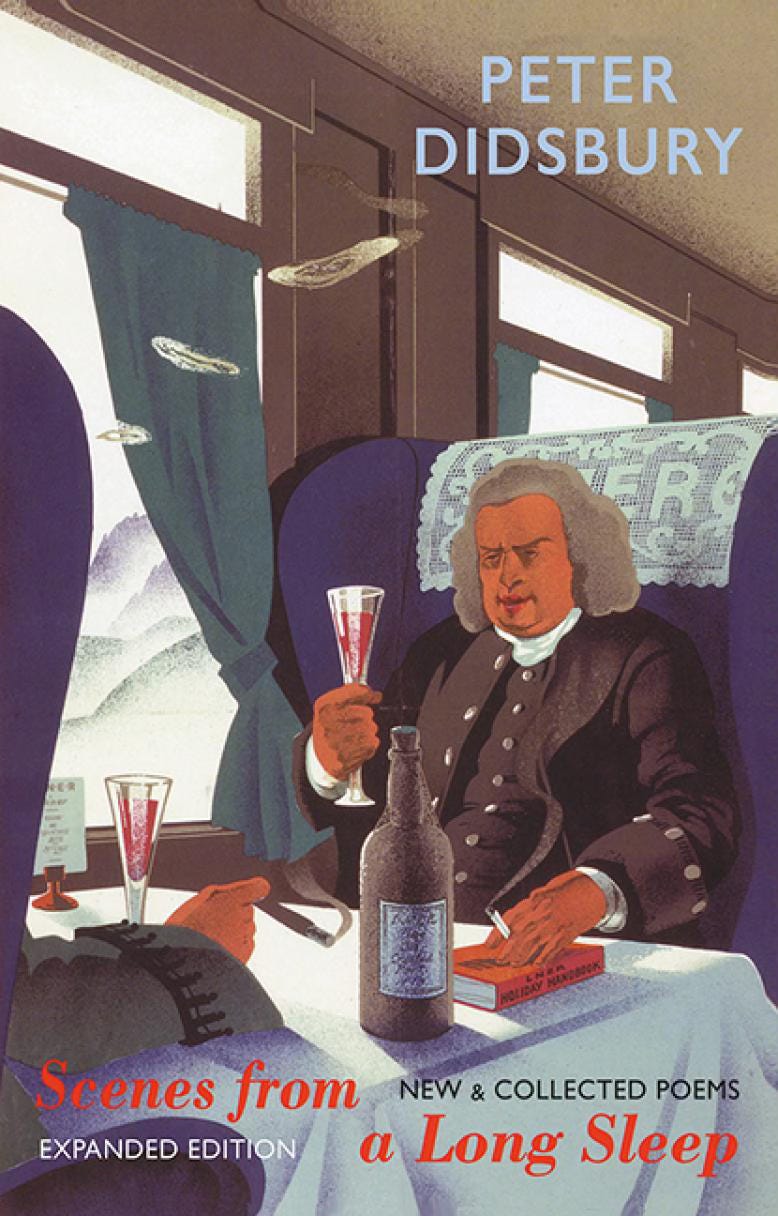
‘The Butchers of Hull’ is from Scenes from a Long Sleep, New & Collected Poems: expanded edition by Peter Didsbury (Bloodaxe Books, 2026)
I wasn’t reading much contemporary poetry at the time Peter Didsbury was making his biggest splashes. When I began to read more, I soon became aware of Didsbury’s presence as some kind of poets’ poet, often celebrated with adjectives such as eccentric, unpredictable and subversive (to choose three that appear on the back-cover of this edition). I liked the sound of this, but I never got around to reading him properly, until it occurred to me that I might offer to review this extended edition, from the perspective of a new reader of his work.
My first, and lasting impression of Didsbury’s poems is how unusual they are. Here are three sentences, from three different collections.
A grainy autumn day, and all that it means to you:
street slung under the beam of the wind,
sun stranded at one end, just holding its own.
— from ’The Autumn’, from The Butchers of Hull (Bloodaxe 1982)
Wake up, my heart, get out of bed
and put your scarlet shirt back on and leave,
for Sunday is coming down the chimney
with its feet in little socks,
and I need a space in which to write my sermon.
— from ’A Priest in the Sabbath Dawn Addresses his Somnolent Mistress’, from The Classical Farm (Bloodaxe 1987)
An answer had almost suggested itself
when terrific commotion in process of being let loose
directly outside his room
made him open his door to find that somehow or other
a large wet dog had entered from the street
and was gaily disturbing with its wagging extremity
the contents of the hall umbrella stand.
— from ’At North Villa’ from That Old-Time Religion (Bloodaxe 1994)
None of these three examples contain the sort of sentences you would find in most contemporary poetry. They’re quite complex in terms of syntax, occasionally somewhat old-fashioned in terms of diction. They’re the opposite of earnest, the opposite of flat. They perhaps enact a kind of parody, a mismatch between the surface of the language and its meaning. Despite these complexities, the individual poems are generally clear, statement by statement, although their overall intent is less so, at least to me.
Well over 200 poems are included in this ‘New and Collected’, making any kind of summary a challenge. I will focus on three short ones that I can puzzle over, prompting individual responses that I hope do justice to some of this poet’s methods.
Let’s begin with the four-line title poem of Didsbury’s first full collection, ‘The Butchers of Hull’, quoted in full at the top of this review. Here we find the author, on a summer’s day, visiting the butchers’ shops of his hometown. He sees his journey as a kind of pilgrimage, as if to Catholic shrines. I suppose he means that the butchers play a central role in the everyday commercial culture of the town and the broader economic culture of the society, a place for shoppers to acknowledge their part in grander schemes and to exchange greetings that affirm their interdependencies and togetherness. Of course, this is Didsbury’s idea (if I’m right), not the butchers’, and perhaps that’s all that is meant by the first sentence?
Even in four short statements and end-stopped lines, however, there are numerous surprising component details. Do butchers have forecourts? The only relevant photograph that Google found for me is Mr Butcher’s forecourt, and, unfortunately for us all, Mr Butcher wasn’t a butcher. Because of the more common usages, I find my mental image combining a high-street butcher’s shop with a side-street garage – stuff lying around, corpses/chassis with strewn innards. Why is ‘beast heart’ singular, and why is it in quotes? Am I missing a biblical or literary allusion? (Google, again, is no help.) The very last clause is a good example, it seems to me, of imprecision or ambiguity upping the emotional ante for the reader, despite leaving the writer’s precise emotion unidentified. There are lots of ways for a heart to ‘fill’.
The very last clause is a good example, it seems to me, of imprecision or ambiguity working to up the emotional ante for the reader despite leaving the writer’s precise emotion unidentified
I don’t suppose the butchers of Hull are much different from the butchers of Neasden, or Cardiff, but Hull certainly has a special place in English poetry, and Didsbury is often described as a Hull poet, along with a number of other illustrious names (Philip Larkin, Douglas Dunn, Stevie Smith, Andrew Motion – even Andrew Marvell). The only direct acknowledgement I have noticed of this is in the first new poem in this collection, dated 2026, in which the setting is not urban but rather, well-tended suburban. ‘Blue Plaque’ begins:
One of his high windows
was open as I passed,
allowing in
the autumn afternoon
The “high windows” are clearly a reference to Philip Larkin’s final, and perhaps best-known, collection. And this time the web helps me deduce that in the poem Didsbury was walking in the area of Newland Park, Hull, where Larkin lived from 1974. When Didsbury retraces his steps past what was evidently once the poet’s house, he finds the window closed, and wonders about what he might have witnessed, if he’d been outside at the time:
a long arm, perhaps,
or heard the dull sound
of something being pulled shut
among the glistening trees
Like several other poems here, this poem is in sentences that begin with a capital but have no closing full stop and extend over several lines (as in the quotations above). I’m not always sure this has any particular significance, but here it seems apposite, because something that has ended in one way (the poet is dead), really hasn’t in others (his influence, his presence in the culture remains). Isn’t the “long arm” closing the window a brilliant repurposing of an idiom for this purpose? The long arm (reach) of the law. The long arm (reach) of the poet, adept at closing, as well as opening, high windows.
The final poem I will discuss is ‘Revisited’, from Didsbury’s last full collection, A Natural History (2003). This poem illustrates what I now think of as one of Didsbury’s main modes. He allows his immediate physical environment to prompt a memory or a thought, willy nilly. And then he reflects on his own imagination, how it might have caught him off-guard, surprised and then mystified him in some way, by its contents and its omissions.
In ‘Revisited’, the prompting scene is minimal, and barely separable from the memory:
Dawn, and the rain just stopping.
In the yard behind the house
an old-fashioned mop bucket
dreams of going to Heaven,
its god a frog with a seventeen-syllable name.[...]
It must be twenty years ago, all this.
Then comes the imaginative, introspective turn: “I think I shall add one more unit / to these emblems of gathered silence, / quite possibly a cat”. I suppose you could read this as Didsbury recursively accounting for the creation of his poem, but I prefer to think that he’s primarily interested in the stream of his associative thoughts, and that the poem is quite literally an after-thought. The rest of the piece (in total 21 shortish lines) describes this additional “unit […] / quite possibly a cat”, and concludes with a description of the animal:
her front paws raised on the cold brimming margin
of a sacred pool known to her and her alone.
The “sacred pool” is in fact the contents of Didsbury’s bucket, but the full meaning of its “sacred” rainwater is beyond the mundane, and unknowable even to the poet who has chosen, or has felt compelled, to mention it.
Stephen Payne is Professor Emeritus at the University of Bath, where until September 2020 he taught and conducted research in Cognitive Science. He lives in Penarth in the Vale of Glamorgan. His first full-length poetry collection, Pattern Beyond Chance, was published by HappenStance Press in 2015 and shortlisted for Wales Book of the Year. His second collection, The Windmill Proof (2021), and a pamphlet The Wax Argument & Other Thought Experiments (2022) were published by the same press. A collection of prose poems, The Late Guest, was published by Parthian Books in October 2026. Stephen Payne’s website is here, and he blogs here.
Vital Statistics: The Friday Poem has 3900-plus subscribers. It’s run by four people – Hilary Menos (Editor), Helena Nelson (Consulting Editor), Bruno Cooke (Spoken Word Editor) and Andy Brodie (Web Editor), with contributions from a team of reviewers and writers.
Until recently we maintained the Friday Poem website (thefridaypoemdotcom) as an archive of 700 posts published between 2021 and 2024 (including most of the original Friday poems) but following a catastrophic hack in late April we made the difficult decision to take this down. We’ll be republishing some of the poems, features and reviews on Substack in the future.
Help support The Friday Poem
Buy us a coffee to help us stay awake as we strive to bring poetic excellence to your inbox every Friday. Heartfelt thanks to everyone who donates, especially to our regular donors. If you can’t afford it, no worries, we’re going to keep on doing it anyway! Big thanks for everything, you lovely poetry peeps.