


Robert Jorat
This morning Robert
I polished my black boots
to be correct and neat
for your adieu
Your coffin was small
and one of your granddaughters
lit the candles
for its four corners
You taught me
the dying art
of sharpening a scythe
with a hammer
At your grave side
I see your thumb nail
testing the blade
thin as foil
With the years you grew frailer
and I tapped
to draw the steel
each year thinner
Yet afterwards
you always took the blade
and with a short hammer
corrected my ineptitudes
Next June
I must sharpen the scythe alone
and for you I will try Robert
to make it sharper than my grief
‘Robert Jorat’ by John Berger is from his Collected Poems (Smokestack Books, 2014) — thanks to Smokestack for letting us reproduce it here.
Yesterday (November 5th) marked the centenary of the birth – in Stoke Newington, London – of John Berger: artist, art critic and teacher, champion of the oppressed, film-maker, innovative radio and television broadcaster, internationalist, political thinker and, above all, a multidisciplinary, globally-renowned writer of the highest calibre. The word ‘polymath’ is bandied about willy-nilly these days, but if it applies to anyone then it most assuredly does to him.
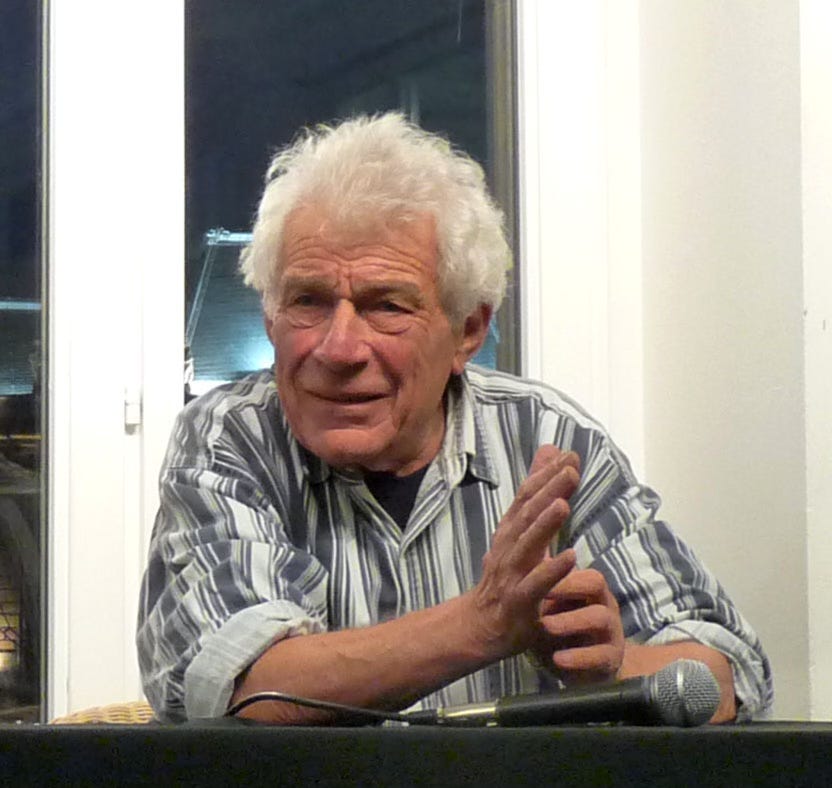
Berger‘s father, Stanley, was a Hungarian émigré and infantry officer who won the Military Cross for his service on the Western Front during World War I. His mother, Miriam, was a working-class Londoner – a vegetarian, a pacifist, and a former suffragette. They sent John to boarding school from the age of six. Called up at 18 in 1944, Berger himself refused a commission and served for two years as a lance corporal in Ballykelly in Co. Derry; the experience of living and working alongside men of less privileged backgrounds was crucial later in the development of his thought.
After studying at Chelsea School of Art and the Central School of Art and Design, he made his name in the 1950s as a combative, fiercely intelligent, Marxist art critic for Tribune, then the New Statesman. His theories on the gaze of painters – the male gaze especially – crystallised in his influential, direct-to-camera 1972 TV series and accompanying book, Ways of Seeing. This remains arguably his best-known work, a collaboration with Mike Dibb, though other collaborations (particularly those with the photographer Jean Mohr, among them 1967’s A Fortunate Man, concerning the rounds of a Forest of Dean GP) are also justly revered.
Among his many prose writings – essays, novels, plays, reviews – it is the stories Berger tells which stand out. He was, and considered himself to be, above all, a story-teller. His fourth, picaresque novel, G (1972), won both the James Tait Memorial Prize and the Booker. He famously donated half the prize money of the latter to the Black Panthers and bought a farmhouse in the Alps of the Haute-Savoie with the other half. He’d been in voluntary exile from England since 1962 and settled into the life of a Pan-European (his paternal grandfather was a Jew from the cosmopolitan city of Trieste) and an engaged citizen at large in the world, always willing to support the causes of those denied full human rights, not least the Palestinian people. His trilogy, Into Their Labours (collected in 1991), is perhaps his most impressive creative achievement; three searingly-memorable novels of rural life. Throughout his life, almost up to his death aged 90 in 2017, he continued to write on an array of subjects. Not since Orwell had a British writer produced such a politically-charged yet eminently readable and erudite body of work.
Among his many prose writings – essays, novels, plays, reviews – it is the stories Berger tells which stand out
Berger regularly included his short poems directly in his prose works rather than publishing them separately. In 1994 he published Pages of the Wound, a collection of poems, photographs, and drawings, and also recorded a special audio cassette supplement for Audio Arts of readings of the poems, subtitled ‘Poems Drawings Photographs 1956-94’. In the sleeve-notes, Berger wrote:
Since I was about twelve years old I have been an avid reader of poetry. I took poems with me wherever I went, and I read them in the rain, on buses, in bed, in despair, on river banks. Not, mostly, the poetry one is obliged to study to pass exams, but the exiled poetry, which crosses frontiers: Hikmet, Lorca, Mayakovsky, Weores, Akhmatova, Vallego, Cavafy, MacDiarmid, Ritsos, Adonis, Darwish … the list doesn’t end.
In 2014 Smokestack Books published his Collected Poems. Smokestack’s founder-editor Andy Croft recalls:
I first corresponded with John when I was writing my biography of the poet Randall Swingler; John knew Swingler after the War and was very helpful to my researches. A few years later, noticing how many poems John had slipped into the many titles of his on my shelves, I asked if he would be interested in my making a book of them. Incredibly – but with typical generosity – he agreed to give the book to unfunded, provincial, shoestring, one-man Smokestack.
Berger arranged his Collected Poems thematically, in five sections: ‘Words’, ‘History’, ‘Emigration’, ‘Places’ and ‘My Love’. Spanning almost sixty years of his abundantly creative life, they encompass the same range of themes as his fiction and non-fiction.
The poems in the ‘Words’ section focus on the power of what is said and what is not, and how it can be cut off. In the short lyric ‘Words II’, the tongue itself is metamorphosed into four different living things. Firstly: “the spine’s fist leaf / forests of language surround it” and lastly, “tethered and alone in its mouth”. There is a case for saying that Berger’s poems are at their most potent when he adopts a tone seemingly influenced not by Anglophone poetry but the more dream-like and folkloric poetries of the eastern Mediterranean and the Middle East. Only rarely does the English-language poetry tradition surface, though one example is an early poem, ‘Leavings’, where he uses short lines and off-kilter half-rhyme reminiscent of Wilfred Owen in a lovely lyric:
Brightest guests have gone
Green furnishings are down,
Shadeless light condones
Black frost on window panes.Where loves and grasses
Spent their seeds
Over iron crevices
Ice now makes the beds.
(Minimal and inconsistent punctuation was to remain a constant in Berger’s poetry.)
‘A Dream Which I Inscribed Verbatim’ written in 1960, also contains rhyme but less obtrusively and all the more effectively as a result. It’s Berger at his most lyrical, form matching content to make a sort of folk tale: “Not the horse run wild / nor the men on their feet dismounted / could lead her through the wood to believe / that he had truly died. // O bite the lobe of his ear, they said, / And draw the bolt of his life. I’ll leave it for the reader to discover the poem’s beautiful, tragic ending.
As a famous writer, Berger received large amounts of correspondence, which built up to be uncontainable. One poem, ‘The Unsaid’, poignantly evokes this: “Among the post unanswered / two letters / from sloe friends. / The handwritings, one fat and one thin, / not easy to decipher, / yet over the years / I had read them avidly / finding encouragement.” This too has a heartrending ending.
The ‘History’ section poems remain topical. At a time when the world’s most powerful nation’s government has threatened to livestream a capital punishment, Berger’s poem ‘16.45h The Firing Squad’ reminds us that execution is abhorrent: “Under the stars the bereaved / imagine they hear / a dog howling too / on the edge of the world.” In these poems Berger stands squarely with the dispossessed and stricken, and with those who champion their cause. A stand-out poem is ‘Orlando Letelier 1932–1976’, an elegy for a key member of Allende’s government who was assassinated in Washington by Pinochet’s thugs, with CIA connivance:
Before the fortress of injustice
be brought many together
with the delicacy of reason
and spoke there
of what must be done
not by giants
but by women and men
It’s far from easy to write political poetry that doesn’t look and sound like sloganeering or trite statements of the obvious – as Harold Pinter’s banal efforts attested – but it seems to me that Berger’s deep compassion enabled him to do so.
In these poems Berger stands squarely with the dispossessed and stricken, and with those who champion their cause
Three poems set in his home in the small alpine hamlet of Quincy, in the Haute-Savoie near the French–Swiss border – ‘History’, ‘Jura Mountains’ and ‘Alpine Spring’ – are testament to his powers of observation and thinking, as if he’s rooting back into prehistory:
the upside-down-turtle-heads of two birds
turning as slowly as history
refusing motion
predatory
in the canopyless sky of moments lived
of millennia powdered into blue
‘Trilling’ finds him at his most pleasingly oblique and elusive:
The canary sings inside the eagle
and is mad.
The canary sings inside the cage
of the eagle’s breast.
There is an engaging riddle-like ambience to this poem, in keeping with the spirit of his 1980s novels, the narratives of which were less laden with overt messaging than his essays and other non-fiction studies.
Unsurprisingly, the terrible shadow of the First World War, in which his father fought, loomed large in Berger’s life. Fifty-two years after its end, he imagines his own beginnings within its carnage:
It seems now that I was so near to that war.
I was born eight years after it ended
When the General Strike had been defeated.Yet I was born by Very Light and shrapnel
On duck boards
Among limbs without bodies.[…]
Before I could see
Before I could cry out
Before I could go hungryI was the world for heroes to live in.
If there is one group of people for whom Berger is especially known as a partisan, it is the migrants of the world. Not just those fleeing war or hunger but also those in search of work and a better standard of living, as illuminated in his classic collaboration with Jean Mohr, A Seventh Man (1975), a study of the hopes, dreams and reality of Turkish Gastarbeiter in West Germany. Migration caused by economic inequality was a major theme in Berger’s prose work so naturally it occurs in his poetry too. In all this, he was ahead of his time and still speaks to those in our contemporary society who seek to denigrate (and worse) the migrants among us. The ‘Emigration’ section includes several poems written in the persona of emigrants, most notably in the fragmentary 1980s sequence ‘Eight Poems of Emigration’, apparently in the voice of a Serb:
I try to sleep
my country
is a hide nailed to woodthe wind of my soul rushes
out of horizons
I make a hammockin sleep
I suck birth village
touch my river’s curve
The other highlight of this section, ‘Separation’ (1984/85), is written in the collective first person and contains all the sadness of the emigrant’s life:
We carry poetry
as the cattle trucks of the world
carry cattle.
Soon in the sidings
they will sluice them down.
The poems in the ‘Places’ section cover a wide variety of towns, cities and terrains yet none seem as deeply-felt as those set in and around Quincy. ‘Alpage’, for example, opens with delicate observation: “Murmuring river / clasps the mist / for a moment more. / The peaks are signing on / the sky. / Stop and hear the milking machines / designed to suck like calves.” There are poems of quiet, rural living, such as ‘Ladle’, with its lovely ending: “pour soup for our days pour sleep for the night / pour years for my children”). Then there’s ‘Ladder’, which starts simply and existentially: “The uprights are pine / the rungs are ash’). Lastly ‘Death of La Nan M.’ tells a story:
When she could no longer
prepare mash for the chickens
or peel potatoes
for the soup
she lost her appetite
even for bread
and scarcely ate
The poem continues with Berger’s trademark deft economy. Short lines serve to accentuate line-breaks and add the weight of finality to end-line words. At his most concise, Berger verges on haiku, as in the opening tercet of ‘Sunset’: “Like a trout / our mountain basks / in the setting sun”.
The book’s final section, ‘My Love’, is equally diverse, with much to delight the reader, especially (again) in small details of unpretentious domesticity: “[…] three pebbles / I brought from Dieppe” which “interrupt the trains of my thought” (‘From Dieppe’) or “The hay / smelt of how / the sky loved the earth” (‘Old Love Poem’). My favourite is ‘And our faces’:
When I open my wallet
to show my papers
pay money
or check the time of a train
I look at your face.
Neither a formalist nor a bold explorer of the possibilities of free verse, Berger largely used poetry as a vehicle for short observations and tales, and restrained but heartfelt emotional responses, the nearest verbal equivalents to his pencil and charcoal sketches. His principal concerns were not routinely written about by other Anglophone poets of his time. He was an outlier, both literally and creatively, and found most of his kindred writers and other artists elsewhere in the globe. His influence on other writers, filmmakers and artists, such as Geoff Dyer and Tilda Swinton, continues to be felt, although few contemporary poets seem obviously influenced by him.
The back-cover blurb assertion that this book “reveals its author to be a major poet of our time” borders on hyperbole – Berger was no Hardy or Lawrence, equally adept in prose and poetry, and seems to have regarded poetry as another string to his bow rather than a principal medium for his work. But this comparatively slim collection includes some fine poems and is more than just an adjunct to Berger’s lasting body of fiction and non-fiction.
Matthew Paul lives in Rotherham and worked for many years in local authority children’s services. His first collection, The Evening Entertainment, was published by Eyewear in 2017 and his second collection, The Last Corinthians, was published by Crooked Spire Press in 2025. He is also the author of two haiku collections, The Regulars (2006) and The Lammas Lands (2015), and co-writer/editor (with John Barlow) of Wing Beats: British Birds in Haiku (2008), all published by Snapshot Press. Matthew Paul’s blog is here.
Vital Statistics: The Friday Poem has more than 3900 subscribers. It’s run by four people – Hilary Menos (Editor), Helena Nelson (Consulting Editor), Bruno Cooke (Spoken Word Editor) and Andy Brodie (Web Editor), with contributions from a team of reviewers and writers.
Until recently we maintained the Friday Poem website (thefridaypoemdotcom) as an archive of 700 posts published between 2021 and 2024 (including most of the original Friday poems) but following a catastrophic hack in late April we made the difficult decision to take this down. We’ll be republishing some of these posts – poems, features and reviews – on Substack in the future.
Help support The Friday Poem
Buy us a coffee to help us stay awake as we strive to bring poetic excellence to your inbox every Friday. Heartfelt thanks to everyone who donates, especially to our regular donors. If you can’t afford it, no worries, we’re going to keep on doing it anyway! Big thanks for everything, you lovely poetry peeps.
A really interesting insight into the poetry side of Berger, as well as a welcome overview of his entire achievement. Thank you!
Thank you Mathew, I can relate strongly to Helena’s comments above.
What a fascinating person John Berger was and one to be greatly admired. I so appreciated learning more about him and previously knew nothing of his poetry or of Smokestack.
I feel it is a privilege to read The Friday Poem each week. I wish the world was led by people like John Berger and those behind the Friday Poem. I find you uplifting and must support you, which I have singularly failed to do so far. Thank you for furthering my education and for your generosity.