


By the Time You Read This
By the time you read this I’ll be gone
for a newspaper and quart of milk
never to return, a half-mowed lawn
leading to me as a scroll of silk
once led to the mulberry silkworm.
By the time you read this I’ll be gone
AWOL in spite of the fact, in terms
of domesticity, I’ve outshone
even the heedful trumpeter swan
that spends five weeks constructing a nest.
By the time you read this I’ll be gone
less because of some profound unrest
than my fascination with the Cree
and the sandhills of Saskatchewan
into which windswept immensity,
by the time you read this, I’ll be long gone.
‘By the time you read this’ is from Joy in Service on Rue Tagore by Paul Muldoon (Faber, 2025)
At 73, Paul Muldoon’s productivity is almost overwhelming. Rather than following the Larkin route of producing one slim volume every decade, Muldoon has published three books since 2019, each well over 100 pages, as well as editing a monumental volume of Paul McCartney’s lyrics, all while fronting the poetic rock group Rogue Oliphant. And he has lost none of his ability to tangle history, art and recent global events within a laundry-list of poetic forms.
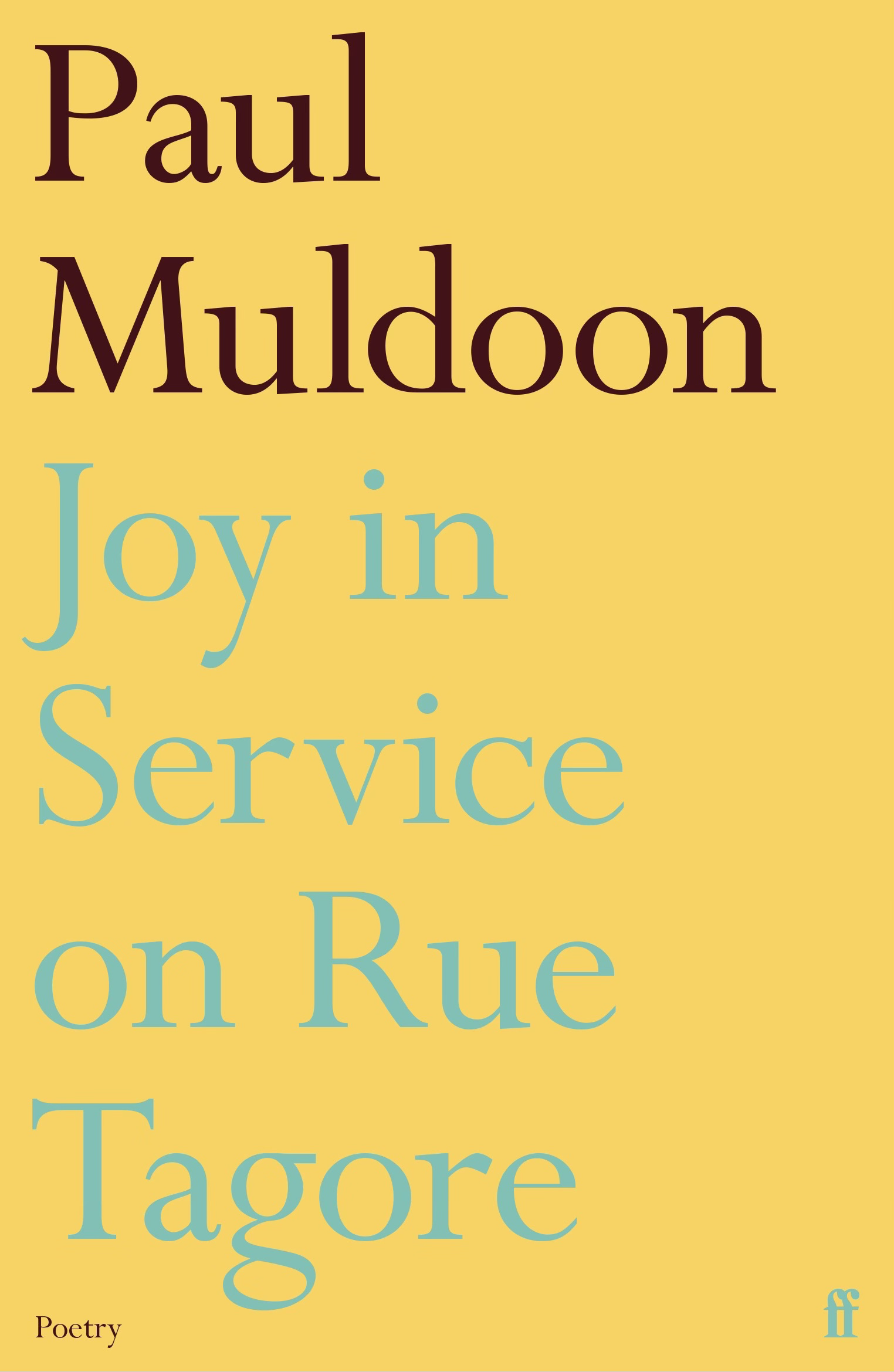
Joy in Service on Rue Tagore probably won’t win over new readers to Muldoon’s sometimes bewildering verse. There is the usual feeling of overwhelm and frustration at your own limited vocabulary and general knowledge as you try to make sense of poems which absorb everything, from Roman chariot races to the Italian invasion of Libya, to Frankie Vallis’s version of ‘Ghost Riders in the Sky’, and the time a horse was brought onstage during a 2010 production of Boris Godunov at the Met.
There is also little of the identifiable ‘self’ to moor us that we come to expect from modern poetry, a clear personality to ‘relate to’ or easily identify with. On your first go, reading these poems can instead seem like skimming through a rhymed encyclopaedia. As always, there is a conversational, easy-going tone, but the subject matter seems to veer wildly off course with almost every line, as in ’The Rain’, where a hand held out to check for rain is rebuffed, prompting diversions into Joan of Arc, a hailstorm in France, a swarm of bees waiting for the opera to start, and how a “fleet // of chariots” may be launched “by way of the scene shop”, until it returns to its initial image in the final stanza. The poem seems to embody notions of art and transformation via its own discombobulating transformations, using the surprising tenderness of its opening and closing image to suggest ways that the imagination might interact with reality. It’s a poem that wholeheartedly employs what Muldoon called, in ‘They That Wash on Sunday’, his preference for the “the off-, the under-, the sleight-of-hand”, and may be beguiling or overly clever, depending on your patience for sussing out the connections.
On your first go, reading these poems can instead seem like skimming through a rhymed encyclopaedia
One stark exception to this within the book, however, is ’Near Izium’. It is Muldoon’s response to the Russia-Ukraine war, and might be one of the best war poems from this century. Muldoon probably isn’t the first poet you’d reach for to make sense of a recent conflict. Although his poetry has been steeped in the violence of the Troubles in his native Northern Ireland, his responses to that conflict have always been elliptical, preferring sideways glances and ambiguity over direct confrontation (as Heaney put it, "his lever for the Troubles has never been less than the proverbial forty-foot pole"). And his poetry has only become more free-associative over the years, sometimes seeming to be more concerned with language itself than subject matter. Perhaps a layer of distance has allowed him to write this unequivocal, rageful condemnation of Putin’s war, written in the voice of a Ukrainian soldier waiting in a bunker “deep, set far back in the Soviet era”, eager to see Putin “strung up for his crimes”. In the 21st century, rhyme might seem out of place in a poem about war, but Muldoon’s use of uneven couplets renders the speaker’s anger all the more insistent, suggestive of the choral chant of a battalion:
[…] It’s not only over Donbas all hell
will break loose. Whosoever leaves a body in a hole
and leaves one hand
sticking out must high five it on the witness stand.
Rhyme does bring an element of humour; but this is the kind of humour that makes it possible to keep going, rather than merely to make light of something. And there is a pleasurable immediacy to Muldoon’s language, describing faces that “glow with gun oil / and blood,” and less of the irony and arcane references that can create distance in the rest of his verse. There is the usual obsession with words and etymology, but here it helps him to add heft to his putdown when he jokes that Putin’s name “means both / “path” and “psychopath.””
While we seem to learn little about Muldoon himself in these poems, there are moments in which the vulnerabilities of late middle age come to the fore. The title poem, for example, imagines a retired undercover agent entering a doctor’s office and reminiscing about a past “chained to a briefcase”, planting fingerprints with the hand of a cadaver. Bereft of these former excitements, the speaker must find joy instead in the small graces of a “fleeting smile,” or even “the blood test / proving negative”.
While we seem to learn little about Muldoon himself in these poems, there are moments in which the vulnerabilities of late middle age come to the fore
‘The MRI’ similarly touches on mortality, using the claustrophobic image of lying down for a scan as a jumping-off point for imagining the history of humanity, from the “stone / sarcophagus we once believed to “eat flesh,”” to lying down to watch “the planets wheel // and wheel / about us”, until we reach the present moment, in which a “stone-faced doctor has the heart / to give it to us straight from the shoulder.” On initial reading, the movement from line to line can feel destabilising, each image apparently linked by the constraint of the sestina form rather than sense. However, after some time with the poem, I ultimately found the way Muldoon explodes a specific experience of vulnerability into a larger, collective history both moving and mind-expanding in equal measure.
At times, Muldoon can sound a bit too much like himself; in ‘Welcome to the Irish Alps’, for example, various theories of the meaning of the word ‘Gallic’ are enumerated. This kind of discursiveness for its own sake recalls one of his much earlier poems, 'History', which begins with the line "Where and when exactly did we first have sex?", a question which only generates further questions, until the speaker eventually finds themself casting doubt on the origins of Louis MacNeice's poem 'Snow'. But even if 'Welcome to the Alps' is unsurprising in light of the rest of Muldoon's poetry, it is still deft and musical, and puts words and meaning under the microscope, as any good poem should do.
Muldoon does Muldoon more memorably in ‘By the Time You Read This’, a sequel of sorts to another earlier poem, ‘Why Brownlee Left'. In the new poem, the speaker’s leaving note explains why their leaving can’t really be explained: it is less because “of some profound unrest // than my fascination with the Cree / and the Sandhills of the Sakatchewan, / into which windswept immensity, / by the time you read this, I’ll be long gone.” This playful non-explanation sums up Muldoon’s poetics: the eternal allure of proper names and unusual words, and the sense that such names contain a depth of strangeness that makes them worth holding up to the light, even if analysis only yields further doubt, further bewilderment. That sense of bewilderment is a positive thing, however. It acts as a reminder of our own limited understanding, which in turn becomes a prompt to look closer, to take apart the assumptions we make about the world.
Will Snelling is a writer from Hastings. His work has featured in New Critique and Ink Sweat and Tears, and in 2022 he completed an MPhil on Elizabeth Bishop at Bristol University.
Paul Muldoon is an Irish poet. He has published more than thirty collections and won a Pulitzer Prize for Poetry and the T. S. Eliot Prize. At Princeton University he has been both the Howard G. B. Clark '21 University Professor in the Humanities and Founding Chair of the Lewis Center for the Arts.[ He held the post of Oxford Professor of Poetry from 1999 to 2004 and has also served as president of the Poetry Society (UK) and poetry editor at The New Yorker.
As well as browsing our Substack, it’s worth visiting The Friday Poem website where you can browse our Archive of more than 700 posts dating back to early 2021. If you like Will Snelling’s writing, try his review of God Complex by Rachael Allen (Faber, 2024).
Help support The Friday Poem – buy us a coffee to help us stay awake as we strive to bring poetic excellence to your inbox every Friday. If you can't afford to donate, no worries, we’re going to keep on doing it anyway! Big thanks for everything, you lovely poetry peeps.
A very good review. It articulated my feelings and thoughts when reading this collection. Thank you.
Thanks for that. Brought back to me why I love Muldoon's poetry. While giving me new insights, I mean.