


is, thinks Pearl by Julia Bird (The Emma Press, 2021)
Pearl is different. Pearl goes shopping in the Christmas shop in June. Pearl’s notable school skill is the sorting of similar items. Pearl checks out the same white bear from the toy library for three fortnights in a row.
Execution, repetition
modulation thinks Pearl
when tasked with any type
of regular activity.
(from ‘Yellow-Pink Pearl’)
is, thinks Pearl follows Pearl as she knocks about her faded seaside town – for a day, for a lifetime – doing everyday stuff. She has her hair done, she goes swimming, she plays in the recreation ground. But Pearl sees things differently, and we see things differently through Pearl’s eyes; when we are lodged in Pearl’s head the ordinary, the quotidian, the expected, become surreal, vivid, meaningful.
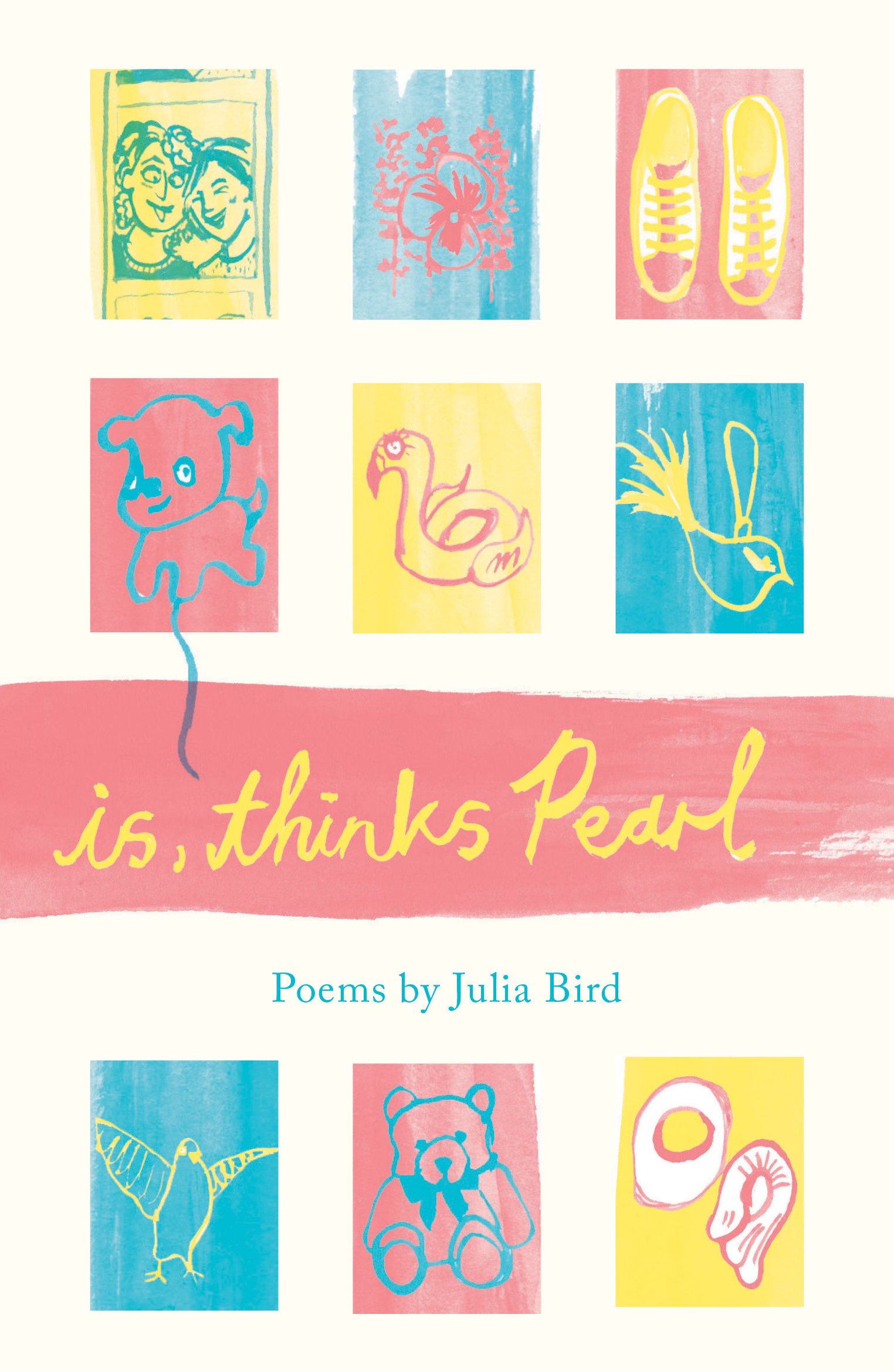
Pearl sees similarities between things where we probably wouldn’t; it’s her reward for paying close attention, and she offers it to us. In ‘Tactical Pearl’, “Pearl scoops / the egg from the boiling water and drops it / into its cup. The curve of the teaspoon / and the curve of the shell.” And the boundaries between Pearl and the things she pays attention to become thin and blurred. “Pearl / is a soldier; Pearl, the soft set sun.”
There are moments when we are fully involved in Pearl’s experience while at the same time able to see Pearl from the outside, though Julia Bird is careful not to give us information about Pearl so we have no idea how old she is or what she looks like. We bring our own selves to Pearl. In ‘Oxblood Pearl’,
Here she stands now
at the top of the giant slide, the point
from which there are only two ways down:
the metal steps or the polished swoop.
The arc of the sun is a coin-toss, slowed.
When Pearl goes swimming in the lido, she takes a pink blow-up flamingo and sculls up and down (using her “non-best-seller hand”):
From the tile pool edge,
the life-guard scans the liquid turquoise field,
the pink flamingo, Pearl’s buttercup suit:
the three split tones of the sun.
Pearl drifts on. From her own breath
she has raised a throne.
(from ‘Liquid Pearl’)
The imagery is rich, brilliantly colourful and startling, with such neat use of rhyme and half-rhyme – sun / on / throne – and a delightful conceit, in the last line, of the throne made from her own breath.
Bird, by her own admission, is obsessed with light. In ‘Violette Pearl’, Pearl goes to a night club wearing a dress covered in sequins, and encounters a mirror ball “stuck all over / with square-inch glimpses” of the goings on in the night club. Light seems to shatter and bounce around the poem, fractured through the optics, splintered by the mirror ball. Through Pearl’s eyes we see this as a sort of violence, reinforced by the plosives in the language – “hooks / and drops and luxe and breaks / and fights and pills and skin.” Pearl’s response could only be Pearl’s – when she goes back to the night club she wears the same dress, but “plucked / of every shiny sequin, / their cotton threads / left nervous in the air.” The cotton threads are like trembling filigree antennae, like Pearl’s hyper responsive senses.
In ‘is, thinks Pearl‘, Bird has created a kind of alternative heroine, and one to be championed
Bird is particularly good at seeing from a child’s point of view. In ‘Oxblood Pearl’, a boy is “poleaxed by the green shield bug which / landed on then took off from his arm: / the violation and the loss.” In ‘Flash Pearl’, Pearl thinks about the photo booth and remembers most of all the booth stool on its screw leg, and “the crank it took to make it pirouette”. I can see her now, unselfconsciously turning and turning the stool round to make it twirl.
is, thinks Pearl celebrates the alternative view, the sideways approach, the focus on something other than the obvious. It honours plurality, difference, diversity, people who buck the trend, refuseniks. It’s a plea for gentle sort of subversiveness. When staying in a hotel, it is Pearl who phones Room Service to see if there’s anything she can get for them (‘Foaming Pearl’). It’s an appeal for second chances. In ‘Tactical Pearl’ Pearl thinks,
There should be streamers and choruses
of Auld Lang Syne at every breakfast
when yesterdays, with their noisy campaigns
and tactical endeavours, cease.
Each Full English should bring a resolution –
the baked beans of I will, the bacon of I won’t.
Another chance to get it right should spread
like marmalade on toast.
And it’s also a plea for communication between people – it is Pearl who sorts out the row between two magicians when they get themselves “trick-stuck in competition” pulling rabbits out of hats, and it is Pearl who, as a waitress in a sea-food restaurant, places a basket of condiments on a table so far out of reach of the two silent customers that “to season their supper with acid, / mineral or herb, one of the pair / was going to have to, surely, crack.” So it’s surely also a kind of defence of poetry, of seeing things anew, or slant, and finding the language to communicate this. Of making a throne out of your own breath, perhaps.
In is, thinks Pearl Bird has created an assured and confident pamphlet. It is beautifully crafted, compassionate and hopeful. She has also created a kind of alternative heroine, and one to be championed.
Buy is, thinks Pearl from The Emma Press here.
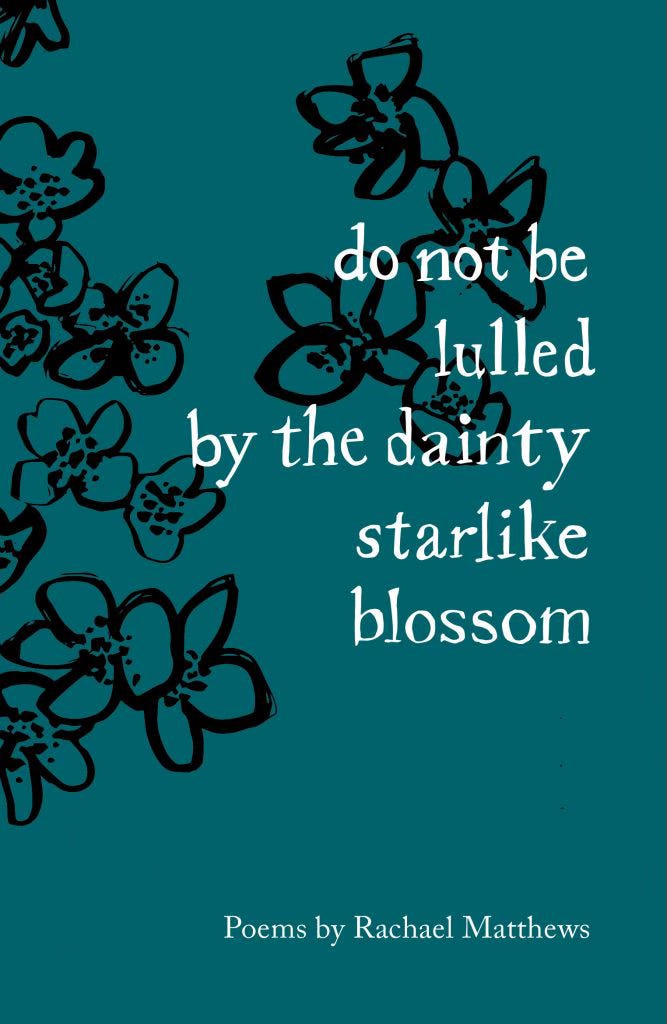
do not be lulled by the dainty starlike blossom by Rachael Matthews (The Emma Press, 2021)
The title of Rachael Matthews’ pamphlet do not be lulled by the dainty starlike blossom issues a threat we would do well to heed. It opens daintily enough, in the title poem, at the radiance tea house on 55th, where two lovers watch jasmine tea pearls unfold in their cups,
meatylabialaroused
aaand immediately there’s a lot more going on than we expected. There’s shame and there’s rage, and there are parents who deny food as a punishment, so the girl gets “no dinner for a week / after i mention liking girls”. In order to get food cooked – unlike at home – “quickly & without any shouting or crying” she steals money and cycles to the local Chinese chippy, but has so internalised the need for punishment that when the owner brings her food
her thank you sounded like fuck you
The poem ends, back at home, after she has been tricked into accepting second helpings of a meal by her parents, with,
“and what do you say to your father?”
my fuck you sounded like thank you
It’s a delicious turnaround, transgressive and to the point.
Matthews’ poems often have a neat payoff at the end. Her poem (it is loosely a ghazal), ’Ghazal: the sea’, starts,
I was raised by the ocean but never swam because
my mother couldn’t stand the sea
The fucking sea, she would say, cold and grey and endless,
meaning her marriage not the sea.
This is pretty good in itself, but in the final stanza Matthews decodes her own poem, saying,
Start again. Go all the way back. Re-name. Say
having a child every time you hear: the sea
This makes you go back and re-read the poem again in a whole different light. When one’s parents are inconsistent and un-straightforward, things come to stand in for other things: food for love, the sea for having a child. Matthews is a psychoanalytic psychotherapist, so she knows a bit about this. Her ancestors were steel workers and circus performers, so she knows a bit about circuses. too. In ‘family circus’ the two strands come together to paint a frightening picture of a dysfunctional family, with clowns and lion tamers and jugglers,
and me the sword swallower
keeping everything down
forever thinking to myself
this shouldn’t go on indoors
This pamphlet is neatly crafted, stringing together a narrative of a difficult childhood with difficult parents, and the journey to a place where being able to become a mother oneself is a possibility, and more. The poems are dark, intelligent, and often funny. ‘Mrs Arnolfini’s interior’ after the famous marriage portrait by Jan Van Eyke of the Italian merchant Giovanni di Nicolao Arnolfini, in a large black plaited straw hat, and his wife with the funny horned headdress, is what it says on the tin – the internal monologue of the wife musing on her husband, his oranges, his fine drapery and fur. It ends “I’ve never liked him or his hats.”
This pamphlet is neatly crafted, stringing together a narrative of a difficult childhood with difficult parents, and the journey to a place where being able to become a mother oneself is a possibility, and more
And in ‘chicken’ she writes about the father who would “often drive us towards oncoming traffic”, and who “threw / our pet bird against a wall”. It’s blackly funny and beautifully negotiated and has this reader wincing and smiling at the same time.
There is hope here, though it is hard won. In ‘recovery’ Matthews uses medical language to describe her partner and their lovemaking;
you always want me like surgery
several quick procedures
then a long complex interventionI’ve learned to do triage
attend selectively
make most of your body wait
and in ‘settled’ Matthews abandons many of her tricks to write plainly and movingly about her partner.
makes me wonder why
I ever settled
for anything less
And then, after all, there is the possibility of a child. In ‘Daffodils’ the worry is whether “they” will or will not bloom. But it’s not about daffodils, it’s about becoming “ready for mothering myself”, with both meanings implied, and the process of becoming pregnant. And the penultimate poem ‘ultrasound / ego gravida’ ends with a message of hope, of commitment to survival, and a nod to struggling mothers everywhere:
you were no oil painting, says my mother
recalling my newborn look and i realise
motherhood is about surviving our own
deadness, others’ aliveness, and vice versa.
Buy do not be lulled by the dainty starlike blossom from The Emma Press here.
Crucifox by Geraldine Clarkson (Verve, 2021)
I take issue with Kathryn Maris when she says, at the front of Crucifox, “Geraldine Clarkson is – quietly, attentively, humbly – writing some of the best poems of our time.” Clarkson herself might be quiet, attentive and humble, I don’t know. But her poems aren’t. These poems are smart, surreal, knowing, sometimes whimsical, sometimes impenetrable, always confident. I’d like to take her out for a pint. On the basis of the poems in this, her fourth pamphlet, I think she’d be great company.

For example, ‘After ‘IF—’. Only a brave woman would take Rudyard Kipling on, and Clarkson knocks it out of the park. She starts,
If you can loose your heart from headlock,
and touch it, puggish and stubborn
as it is, stunted fist, and keep its company,
and learn its tongue, half-mute, unbuckled
from its bridle—
and she does indeed unbuckle her tongue and is off on a crazy merry-go-round, pastiching the old colonial, spitting heartfelt denunciations of supposed virtues, people-pleasers, ersatz prophets and,
those who placed the rules in metal struts
across your mental shoulder blades, before you knew what rules
were—old rules—and yet knew—
It’s such a joy to read, with Clarkson’s sheer pleasure in sound evident. In just these first eight lines we get loose / mute / struts / rules / knew, we get heart / half / mute / mental / metallic, we get stubborn / stunted / company / tongue. The sound and the sense move in tandem, and we can feel the poet digging in to her craft for pleasure, ours and her own.
She’s great at surreal imagery too. In ‘The Fainting Room’, the eponymous room is “set aside for the more friable ladies”. In ‘Christmas Surgery’ she meets a “beige-faced nurse” wielding “something like a melon-baller” for surgery that sounds more like an exorcism, and says,
My old grey spirit, under the influence
of medication, folded its limbs beneath
itself, trembling.
But even after tablets, belly prodding and the removal of “a green streamer of pus / festive as muck” the poem remains punchy to the end:
‘We’ll have
devils on horseback,’ she said, ‘before we
have our crackers. Hold tight.’
I’m less convinced by her prose poems, of which there are maybe six, most of which are a page or so long in solid justified text. Partly because I think she puts too many adjectives in, and not always useful or fresh ones. In ‘Apple Snow’, she has “sour crab apples” (are they ever anything but?) and in ‘Compliments of the Patron’ the assistant “fixed me with an almond eye” which feels clichéd. ‘In Old Mr Spence’s Kitchen’ pretty much every item comes with its attendant adjective (weasel light, frayed rattan blinds, dotty fruit flies, whiny vase, itchy nose, latex wrist) – of course adjectives convey information, paint a picture, give colour and so on, but the use of so many seems to weigh the writing down like too much fruit on a branch. The prose poems also don’t have quite the same dash, the bravado, the dense celebration of sound of her other poems.
These poems are smart, surreal, knowing, sometimes whimsical, sometimes impenetrable, always confident
But I love what she’s trying out in the four Fox poems, Fox, the Prisoner; Fox, the Prisoner II; FOX NEWS : CREATRIX and CROSSFOX : CROSSBOX. One poem is in the shape of a crossword, one is the clues for the crossword, the others riff on the nature of a fox. The pamphlet’s dedication is a quote by Marianne Moore, “a fox sees all that there is to be seen, And from all sides”. Which is what Clarkson is doing here, circling her subjects – which are, in the words of the blurb, “rebellion, emergence from disappointment and fasting, new beginnings, recreation following destruction; soulwork; inspiration and the act of writing itself” – and seeing them from all sides.
And there are poems here where she goes for it big time and really pulls off something powerful. In ‘On a Hill” she writes about how, and where she might encounter God:
Maybe via an angel, masquerading
as a stranger. Or in the bath,
public or private—it’s not unheard of.
But her encounter – if that’s what it is – comes through the writing of poetry. Granted, the poem is ballasted with a quote from Genesis, and uses weighty, biblical language, but even if she’s using borrowed tools, she’s making her own thing with them, and it’s great.
Clarkson doesn’t do neat lyric poems with a carefully curated small insight at the end. She ranges, she riffs, she has sprawl, in the Les Murray sense of the word. Her poems finish with a swagger, a wink, or (occasionally) a shot in the dark. Sometimes I have no idea what is going on, but I’ll take this over delicate restraint and tidy closure any day. Clarkson is a breath of fresh air.
Buy Crucifox by Geraldine Clarkson from Verve here.
Hilary Menos is editor of The Friday Poem. She won the Forward Prize for Best First Collection 2010 with Berg (Seren, 2009). Her second collection is Red Devon (Seren, 2013). Her pamphlet, Human Tissue (Smith|Doorstop, 2020), won The Poetry Business International Book & Pamphlet Competition 2019. Her newest pamphlet is Fear of Forks (HappenStance, 2022).
As well as browsing our Substack, it’s worth visiting The Friday Poem website where you can browse our Archive of more than 700 posts dating back to early 2021.
Help support The Friday Poem – buy us a coffee to help us stay awake as we strive to bring poetic excellence to your inbox every Friday. If you can't afford to donate, no worries, we’re going to keep on doing it anyway! Big thanks for everything, you lovely poetry peeps.