


To Gasp at the Cold
Crocs, easier to slip on with my flat arches,
to sneers of being ‘Old Bloke’s Slippers’,
worn in a damp November to pick late
raspberries from drooping canes, to make
our muesli more relevant. Brown leaves in
chilled fingers, I fail to notice one shoe slip-off,
before I put a sock-foot down, not feeling cold
at first, but warm to my unsuspecting reptile
brain, till it seeps through to the ankle bone
and time’s big swamp bubbles burst forth into
another time when he was younger,
my hand on his tummy, asking –
does it hurt where dinner lives,
or where your pudding goes? A gravel shore
to dip my toe and hold his hand, to shocked
recoil at the bitter cold, though some urge too,
to wade in deeper, and to remind him
of how he leapt in the Arctic Ocean
on the Lyngen peninsula, north of Tromsø,
and stayed in a whole minute, fifty seconds
longer than the nobodies there, to slide out,
slick as bladderwrack, but for the boreal sand
in his hair, from where he’d touched polar
night, at the bottom.
‘To Gasp at the Cold’ is from A Full-On Basso Profundo by Ken Evans (Salt, 2025) — big thanks to Salt for letting us publish it.
Most poetry collections these days open with an epigraph or two, usually something profound, esoteric, inscrutable or just really cool. The aim is to set the tone of the collection, or shed a little light on the contents or, you know, just to sound really cool. A Full-On Basso Profundo opens with a couple of particularly arresting quotes. The first comes from ‘Tumbling Down’ by Steve Harley and Cockney Rebel, best known for their biggest hit Make Me Smile (Come Up and See Me), a UK number one in early 1975:
‘Gee, but it’s hard when one lowers one’s guard to the vultures
Now me, I regard it a tortuous hardship that smoulders
Like a peppermint eaten away
Will I fight? Will I swagger or sway?’
STEVE HARLEY AND COCKNEY REBEL,
‘Tumbling Down’ (1975)
The second quote is from Be Mine, the 2023 novel by American author Richard Ford, the fourth in his ‘Bascombe' series:
‘She just stopped her car on the Heart of America
bridge and jumped in the Missouri River, leaving
behind a note that said. ‘If you get out of life with
one friend left, you’re probably a kiss-ass.’
RICHARD FORD, ‘Be Mine’ (2023)
Not Proust or Prynne or Pound but a mid-seventies English rock band and a contemporary U.S. novelist. The choice is refreshing. And both quotes serve as clear signposts to the heart of this collection. In the first, Evans nods to the creeping anxiety most poets face before publication – the fear of being misunderstood, of offering up something carefully made and deeply felt to the “vultures” (that’s us readers). In the second, perhaps he’s alluding to that bravado poets also (sometimes) feel, the thing that drives them to write what needs to be written, whatever it might take, however hard it might be to stand by it. And perhaps more. In his review of Be Mine in the Guardian in June 2023, Kevin Power says Richard Ford’s Bascombe series is about “happiness as a project of conscious denial”. The protagonist, Frank Bascombe, says “The ability to feel good when there’s almost no good to feel is a talent right up there with surviving loss.” Is this what Ken Evans is also saying in A Full-On Basso Profundo? Let’s see.
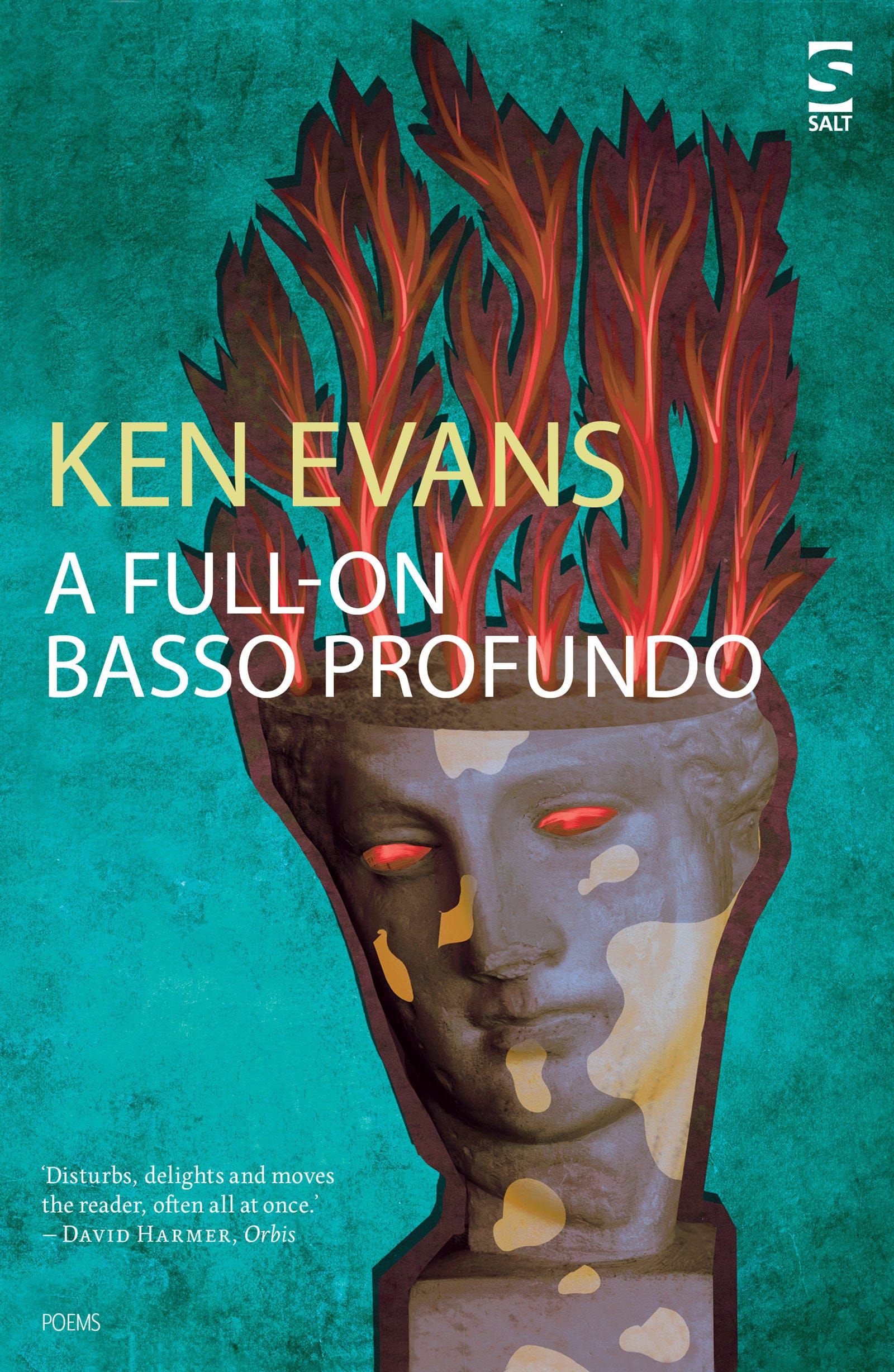
Disclosure: I have personal reasons for interest in this book. Like Ken Evans, I donated a kidney to a family member. So I turned first to the poems dealing with Evans’s donation, ten years ago, to his sister, who has the chronic auto-immune disease lupus. ‘An Unfamiliar Calling’ is set in the Chaplaincy Office of the department of Spiritual & Pastoral Care at Hammersmith Hospital, where the poet hides because he needs “a place, / fast, to let the blood calm between my ears now / I know the op. is on for Monday”. The narrator isn't alone, there’s also a woman praying “in the pew behind”, but they are “two stilled strangers”. The tone is urgent, the narrator’s panic palpable.
’Legit.’ is subtitled ‘The kidney donor has a temporary loss of courage’ and oh yes, I relate to that too. The word ‘legit.’ is used throughout, initially to refer to the mark made on the body to show which kidney to remove. It opens, “It’s OK to say ‘No’, on the trolley to theatre, the surgeon says”, then cycles through various alternatives to the surgery, until the poet remembers “you, sister, lying there, // waiting on your own knife, saying nothing”. It’s a powerful piece, made more so by the flash of amusement I got when I realised that there was another way of reading ‘Legit”.
These kidney donation poems sit centrally in the first and largest section of the collection, titled ‘The Oikosphere’ (Greek – oikos – family, household). Here we meet Mum, Dad, an older sister with a death-ray stare, childhood friends pogo-ing to The Stranglers at Tiffany’s nightclub in 1977, an older, alcoholic friend found dead by the landlord of his local, and Aunt E. who wears a “mauve fascinator” to “J’s Zoom wedding”. Evans ranges far and wide in terms of subject matter, setting and form. His style is eclectic, snappy and busy, combining references to contemporary and other cultures with a fair dollop of humour.
‘And the Blithe Shall Eat a Horse’, for example, opens with Polynesian seafarers who “navigate by the sway / and bob of their testicles, sitting cross-legged / on the bottom of vegetable-matter boats.” While we “won’t mute a parking sensor on our bumper with a wide berth to reverse into”, the Polynesians “sail a quarter of Earth’s surface.” Equally, in ‘All Our Fathers are a Dark Religion’, his father’s deliberate mishearing of pop lyrics is amusing: “We can be herons, just for one day.” And in ‘To Gasp at the Cold’, the poet steps on a chilly floor when picking raspberries in order to “make / our muesli more relevant”. A sensation of coldness transports the poet and the reader straight to the Arctic Ocean “on the Lyngen peninsula, north of Tromsø”, into which the poet’s young son leapt and stayed “a whole minute, fifty seconds / longer than the nobodies there”. It’s smart and funny, but there’s also tenderness and a sense of wonder. This tenderness comes to the fore in ‘Purple Iris’, which describes a daughter lost, we assume, to stillbirth:
I think you would be tall and long-limbed,
like your swimming brothers who followed,
a bit sporty and awkward maybe, in your teens.
The poem describes “blue pockets of sky to help with what’s / uncopable, the illusion of any ‘up’” — I’m reminded of Frank Bascombe’s “ability to feel good when there’s almost no good to feel” — and ends in “the chapel of rest where I held you / ten minutes without the midwife, / putting off letting you go.” It’s beautifully done, and undoubtedly moving.
Evans’s style is eclectic, snappy, busy, with references to contemporary and other cultures and a fair dollop of humour
There are eight pieces in the second section, ‘The Anersphere (Greek – ‘aner’ – male), the best of which, to my mind, is ‘Pineapple Rings and Dostoyevsky’, a poem that addresses the kind of conversations men have with each other:
Two men walk away from the chippy,
[…]
One man stops, says to the trees,
‘It’s my heart, mate.’
Evans has a talent for delivering the unexpected. Here, the speaker gets little in the way of sympathy from his mate, who’s more interested in whether or not he’s finished with his battered pineapple rings, “sticky and salty and sweet”. It’s real, and it’s poignant.
There’s also the long poem, ‘An Invisible Fury' (six pages of tercets, plus a page of notes), which gives the book its title. This is a tricky one – it’s clearly an important piece for Evans. For the reader, it requires time and thought. It’s broken into four parts. The first three are fairly straightforward: ‘The Action’ (five stone bridges in Derbyshire are blown up), ‘The Actor’ (Rachel, who lives in a cave and is transitioning to ‘They’), and ‘Reaction’, which is (very broadly speaking) about climate change, and includes the stanza:
These caves, a shadow-face of the shining moon, alter ego
of tundra and rainforest, spark new grief for places
we never knew and surely now, never will.
The final, more complicated section is ‘There’s No Postscript to Apocalypse’. This demonstrates how the hypothetical dystopian future plays out: lawsuits, storms, species extinction, floods and other climate-based disasters, culminating in a bellow from ‘They’, who (following the application of testosterone patches) now shouts with a “full-on basso profundo” (the lowest bass voice type). The piece is a roller-coaster ride but if you read carefully it’s rewarding – neat, imaginative and funny, with a solidly eco-political message.
Evans brings curiosity, wit and energy to his work
The third section of the book is ‘Americanicity’, with poems that reference a school shooting, SpongeBob Squarepants, Ella Fitzgerald, Butch Cassidy, Oprah Winfrey’s notion of #Livingmybestlife, both the Navajo and the Atacama deserts, and private space travel, the T&Cs of which make it clear exactly who will be able to experience this (dubious) pleasure:
You can sit strapped in your seat for up to 90
minutes, if there’s a launch delay, without access to
a lavatory; you are relaxed with 5 other people, with
the hatch closed – the capsule – the width of two
roulette tables or your walk-in wardrobe.
‘Genius at Wrok’ also shows Evans’s funny side, but is more disturbing. The ‘genius’ is a gas station attendant somewhere in Southern Utah, where nuptials last as long as “gelato in a power outage”. He perseveres in his sunny outlook, though we get the feeling he’s misguided; “Gas station doors swing behind him like he’s a croupier / exiting with the house winnings when he’s only making the rent / like the rest of us”. He warns of high temperatures on the way “but hey at least we’re not in El Paso”. There’s always somewhere worse to be, or someone else worse off. Look on the bright side. Feel good when there’s almost no good to feel. It could almost be Frank Bascombe speaking.
Evans brings curiosity, wit and energy to his work. He’s observant, and translates his observations into neat imagery. In ‘The Great Escape on the River Leen, Nottingham city centre‘, for example, caddis-fly have “black, noise-cancelling headphones for eyes”. He’s alert to contemporary issues of war, climate change and gender politics, but also playful with language – witness what he does with rhyme and half-rhyme in ‘Real Diamond Lederhosen’, where skin is described as a “body glove we shine in […] no stein or red wine can stain.” Occasionally he can be a little prolific with commas, and occasionally he’s a little too clever for his own syntax, but these are small quibbles.
And beneath all this humour and play, A Full-On Basso Profundo displays real compassion for human vulnerability, and even offers us a sort of prescription for survival. In ‘The Optimum Principle’ Evans emphasises the positive: “babies still / get pulled from rubble, sometimes”. The poem ends:
[…] March sun still draws strength
from pale daffodils, and rabbits eat
my lettuces in summers now, as
always, and home remains a flicker
of a kitchen light, radio on, some song.
Hilary Menos is editor of The Friday Poem.
Ken Evans is featured in Broken Sleep’s Masculinity anthology and won the 2018 Kent and Sussex Poetry Competition. He has been published widely in magazines including Acumen, Magma, Poetry Scotland, The Alchemy Spoon, Frogmore Papers. He began to write poetry ten years ago after donating a kidney to his sister who has lupus.
As well as browsing our Substack, it’s worth visiting The Friday Poem website where you can browse our Archive of more than 700 posts dating back to early 2021. If you like Hilary’s writing, well, you can’t bloody avoid it, frankly, on The Friday Poem. If you’d like to read some of her poetry, try one (or both) of her two collections, Berg (Seren, 2009), which won the Forward Prize for Best First Collection in 2010, or Red Devon (Seren, 2013). If a full collection feels a bit daunting try one of her recent pamphlets. Human Tissue (Smith|Doorstop, 2020) is a bit of a downer, while Fear of Forks (HappenStance, 2022) is more cheerful. For poetry, that is.
Help support The Friday Poem – buy us a coffee to help us stay awake as we strive to bring poetic excellence to your inbox every Friday. If you can't afford to donate, no worries, we’re going to keep on doing it anyway! Big thanks for everything, you lovely poetry peeps.