


My husband waits for pain to go
I find you in the dark and you explain,
looking weary on a chair, not defeated,
but paying it respect, when pain
visits. You sit and listen to its heated
argument in your skin, having paused here
before. You can’t move to the other side
of hurt, until your body shifts each gear
without a thought and time’s a happy ride.
Let’s talk straight. Sail through the operation,
restored to yourself, and me – I’ll take
what I get: wounded husband, slow motion
recovery towards another spring. Let’s make
more years together, however they run,
two men holding tight in this winter sun.
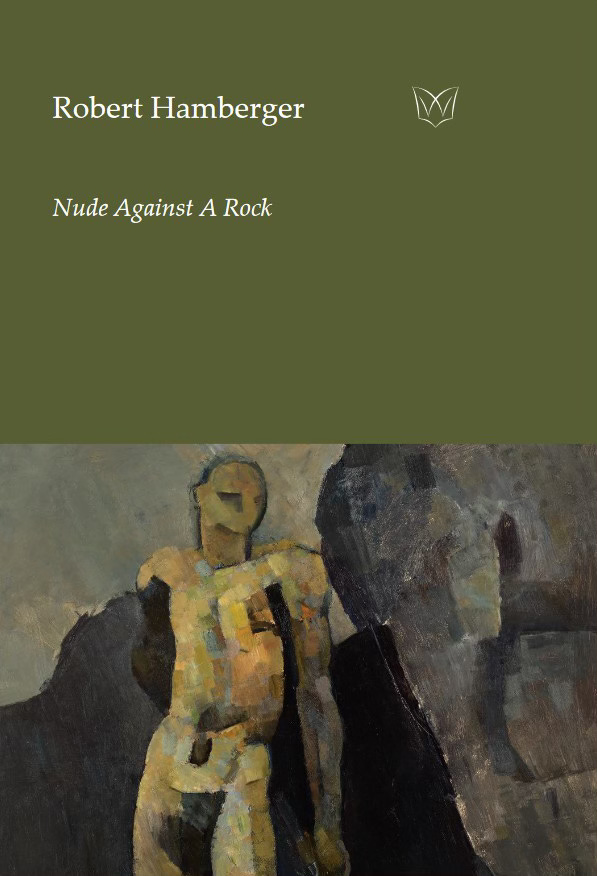
‘My husband waits for pain to go’ is from Nude Against A Rock by Robert Hamberger (Waterloo Press, 2024) — big thanks to Robert Hamberger and Waterloo Press for letting us publish it.
To read Robert Hamberger’s latest (his fifth) collection is to feast on love. Nude Against A Rock is a profoundly humane and compassionate work in which humans and other animals, fields and trees, the known and the unknown, the inanimate as well as the animate, are all shown in their infinite variety to be equally worthy of love and respect in the face of menace and threat.
Lines towards the end of ‘Playing Love Hangover while washing up’ illustrate this consistent wish to embrace the world, combined with a sense of immediacy:
How can I hold them all in my hands
without overflowing, while a cat laps
urgently at water and rain tonight
wrestles away from the sea?
Spirited generosity sits at the heart of Hamberger’s work and underpins his clear-eyed consideration of the many different loves he celebrates in this collection. It takes a courageous heart to present together the different kinds of love: for a partner, for parents, aunts, friends, strangers, all of life and the world, including the self.
In ‘The house of my body’ the speaker takes a long look at himself: “There’s a hole in the roof where pigeons / roost with rain. I ache in my rafters”, and “In the bed of my breath / friends who died thirty years ago / speak large as life”, and “I garden the suck and shovel / of my dirt, grub through soil”. The poem ends triumphantly with “Celebrate my blossom, / achieve my grass, give steadfast / permission to my worms.” I admire the impassioned tolerance here, the love of the here and now – and this stance is typical of the entire book.
Spirited generosity sits at the heart of Hamberger’s work
But this acceptance of self (or rather perhaps of the speaker’s persona in the now) reaches much further. Many of the poems – even those that appear to be classic love poems, such as the seventeen pieces in the beautiful opening section My Husband Sings – seem also to be grounded in explorations of the relationship between artist and artistic practice. The ones that result from Hamberger’s journeying into a love affair with creativity are among those I consider the most poignant and affecting in the collection. The poet looks at love as creativity and creative practice as a potent form of love.
For instance in ‘Blue’ – the second poem of the opening section – the beloved partner, sleeping, becomes a notion to be recreated, even painted:
[…] What shadows can I see
if our duvet slips down and you shiver?
You might even turn over to face me
if your private dream allows, but for now
here’s the cobalt-blue slope of your shoulder,
dark hillock of your shoulder-blade, furrow
along your spine, its cleft of lavender.
The final section of the book, which carries the collection’s title, allows the fullest expression of this interrogation of the creative process. All the poems here relate to the gay British painter Keith Vaughan. Hamberger probes and interprets Vaughan’s life, loves and creative motivation through the twin lenses of the artist’s own journals and his paintings. This is done with characteristic compassion and the result is an intensely moving sequence that speaks eloquently of the persistence of art and literature as a way of living and witnessing.
These lines, taken from close to the end of the final poem of the Vaughan sequence ‘Elegaic landscape’, become a vivid manifesto for lifelong creativity:
I’m raw sienna – rose madder – renaissance gold.
My bathers and wrestlers, my naked men
gather like silence beside me.Watch me sift towards unfinished brushstrokes
This is a truly fine collection from a poet who is always working to extend his range. I will return often to the poems for many reasons, but perhaps most of all for Hamberger’s honest observation of real life and his gift for thinking deeply into his subjects with love and tolerance. In doing so, he shows that he is not afraid to dwell with uncertainty and ambiguity. Instead, these ineluctable features of life become matter at the heart of his creativity. Hamberger takes enormous care with craft, with form, and so his poems invite his readers to take time in the reading, which in the hurry and heat of this world is like being given a long cool glass of water, and then another.
Clare Best has published a memoir, The Missing List, three full collections of poetry, and several pamphlets and collaborative works. Her latest publications are End of Season / Fine di stagione (Frogmore Press, 2022) and Beyond the Gate (Worple Press, 2023). In 2020-21 she was a Fellow at Guildhall School of Music & Drama. Currently she is working with composer Michael Bascom on a setting of her long poem ‘Salting’ and with composer Abel M.G.E. on an audio documentary piece based on love letters during World War Two. Clare Best’s website is here.
Robert Hamberger has published five poetry collections, including Warpaint Angel (Blackwater Press, 1997), The Smug Bridegroom (Five Leaves Press, 2002), Torso (Redbeck Press, 2007), and Blue Wallpaper (Waterloo Press, 2019), which was shortlisted for the 2020 Polari Prize. His pamphlet, The Rule of Earth, was a winner in The Poetry Business Book & Pamphlet Competition in 2000. In A Length of Road (JM Originals, 2021) Hamberger retraces John Clare’s epic journey from the Epping Forest asylum to his home in Northamptonshire
As well as browsing our Substack, it’s worth visiting The Friday Poem website where you can browse our Archive of more than 700 posts dating back to early 2021. For example, if you like Clare Best’s reviews, try her review of Time by Etel Adnan, or her review of Kate Hendry’s Mariscat pamphlet MX SIMP. If you want to know more about Clare Best’s experiences of collaborative artistic work try her two picture features here and here, and if you’d like to know more about her poetry read her Friday poem ‘beyond the gate’, or Charlotte Gann’s review of her Worple collection, Beyond the Gate.
Help support The Friday Poem — buy us a coffee to help us stay awake as we strive to bring poetic excellence to your inbox every Friday. If you can't afford to donate, no worries, we’re going to keep on doing it anyway! Big thanks for everything, you lovely poetry peeps.
I thought this was a wonderful poem. Thanks so much.
Marilyn Longstaff
Gorgeous xx