


Sag Harbor, Long Island
after Ray Johnson
soles touch water,
waves lap at pale ankles
and I am
a happy meal
with its smile removed
salt water up to my waist,
thighs shake
and I am
a bruised sternum,
making a wish
leaning forward,
body buoyant
and I am
a boiled egg,
left unwanted in the saucepan
muscles arc,
tender is the flesh
and I am
a motorway,
made only of hard shoulders
soft hands propel me,
swimming out to sea
and I am
a Barbie girl
in an Oppenheimer world
lying backward,
held by the swell
and I am
free, here
I am
floating.
‘Sag Harbor, Long Island’ is from Back to the Fuchsia by T. S. Idiot (Palavro, 2024) — thanks to Tom Stockley (T.S. Idiot) for letting us include it here.
A prism of colours
When I wrote about Tom Stockley for The Friday Poem in 2022 he was working on a play, a film, a drag act and a zine. He’d lived in Bristol for a few years. He was “in love, but open to seeing other people”. We talked about queerness, cabaret, the DIY ethos of punk and community theatre, and his favourite colour.
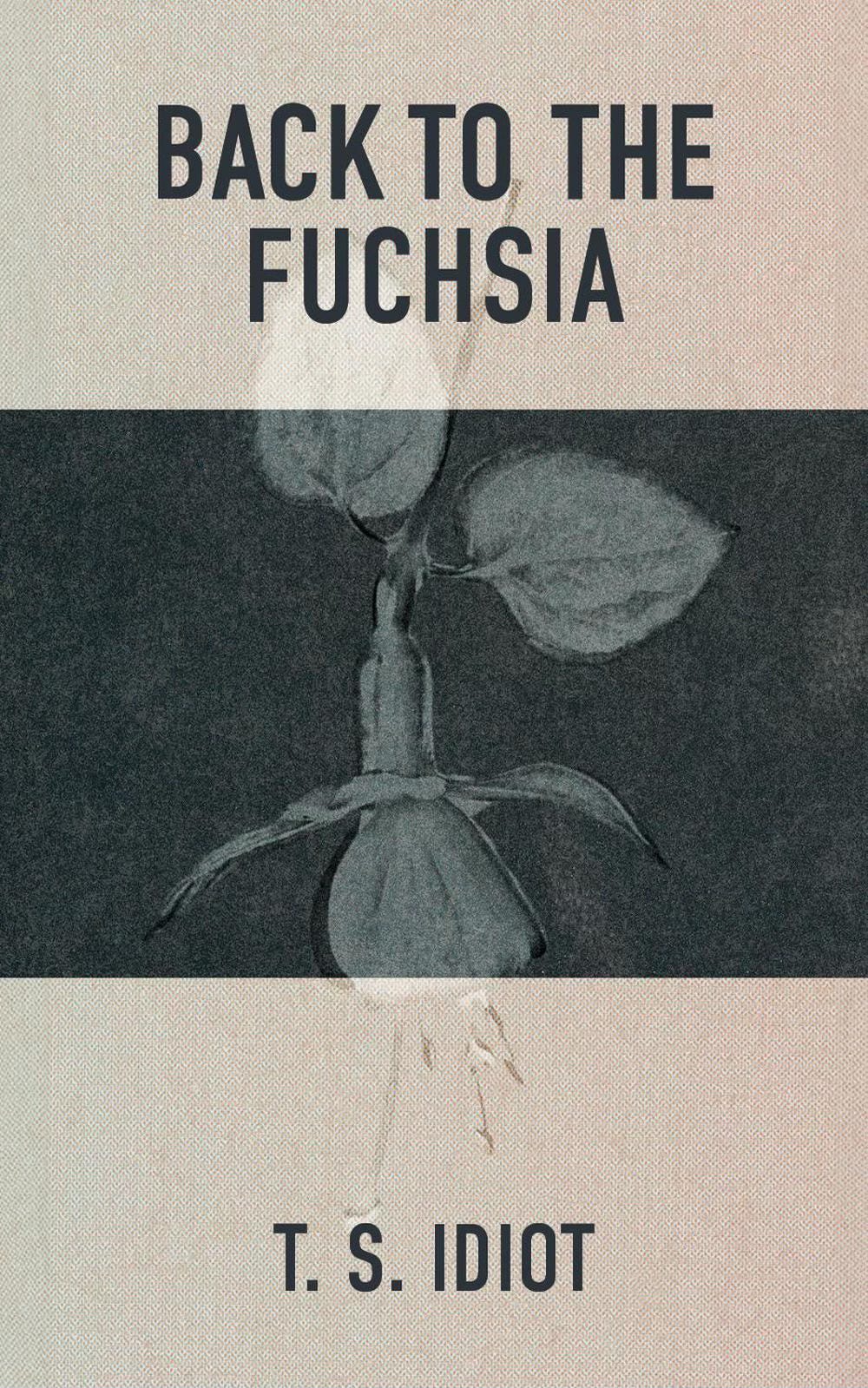
Sadly, at the time, Tom was experiencing some turbulence. In his words, between 2019 and 2024, “when the world fell apart, so did I”. He eventually left Bristol, and spent the latter part of 2024 touring his debut collection, Back to the Fuchsia, out now (under the pseudonym T.S. Idiot) with Palavro, an imprint of the Arkbound Foundation, a UK literature charity. I caught up with him at a beer and home-brew shop in Brockley.
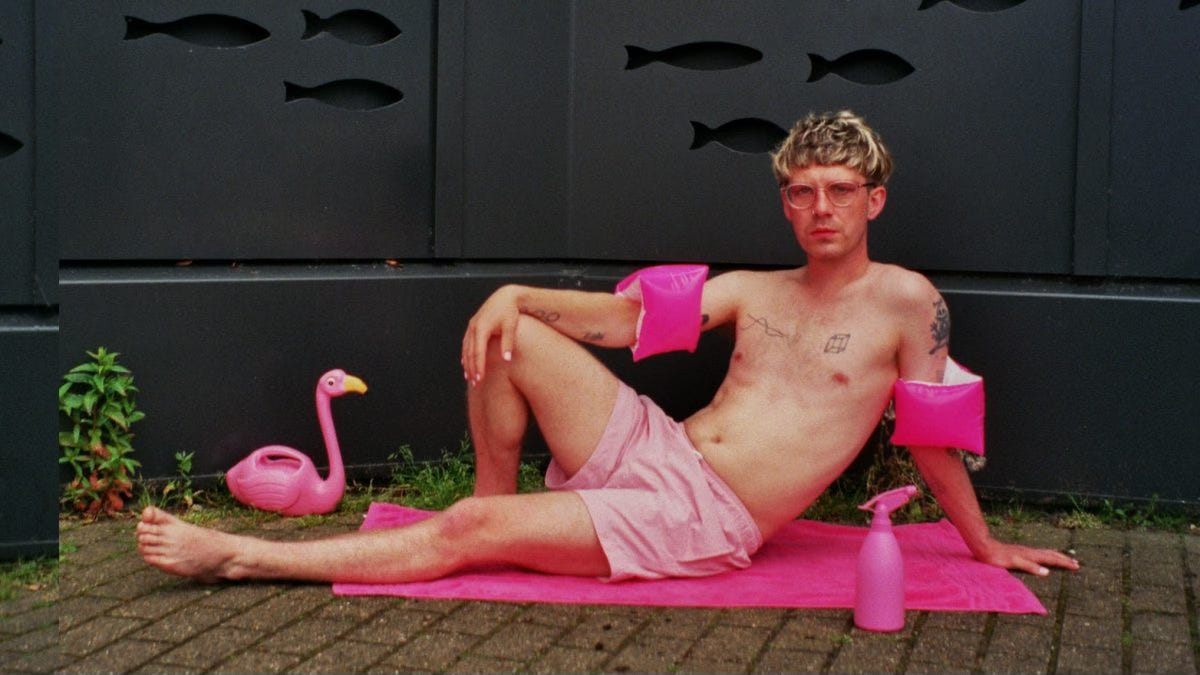
Tom writes in the book’s introduction that people mostly know him for his “loud, fast and (subjectively) funny punk poetry”. His performances often involve bizarre headpieces. They’re original, informal and weird. Unpretentious and, yes, definitely funny. There’s something about his aesthetic and semantic choices that reminds me of The Mighty Boosh. Comedy and tragedy go arm in arm. Sadness has a silver, sequinned lining. And pink is more than just a colour.
Tom turns tears into laughter while wearing a tea-cosy-cum-balaclava and a Lidl-branded hoodie. Recently, he’s been working on musical accompaniments. He has a network of artist friends – poets, performance artists, singers and musicians – who, from the outside looking in, seem to embody the same DIY spirit that drives him. They help each other out, perform at each other’s shows, support one another. A kindly thread connects them.
Back to the Fuchsia holds onto some of the deliberate oddness that suffuses Tom’s live performances. But it’s also deeply personal and unabashedly earnest. It contains “muddy reflections on class, queerness and community from someone who’s doing their best”. It finds diamonds in the rough and “mirror-splintered luminescence” among dead cats and corner shops. And it takes us on a journey through the “council estates, cityscapes, and crumbling coastlines” of Bristol, Falmouth and Torquay, between noon and midnight on an unspecified day.
More than anything, Back to the Fuchsia might be an exercise in finding ways to locate, feel or embody love. This is easy when writing about a dog that has died – “you are / a benevolent shadow // you are endless devotion / and a wet smell” (‘Dog Poem’). Ditto a dead cat: “You are the good stuff. / You are strong defences / and a soft touch” (from ‘Eulogy for a Dead Cat’, which is pieced together using words from “a packet of cat food she’ll never eat”). Less easy when writing about, for example, a life experienced as meaningless or an attempted suicide.
‘Mine / Yours’ is one of the few poems to make direct reference to the culmination of Tom’s mental health struggles, mentioned above. It describes Bristol as a former mining town, where houses were “warmed by coal, / black gold from chiselled wounds” and notes: “men have died here / and I have tried too”. But it doesn’t labour the point to manufacture emotional gravitas. Instead, it turns it on its head:
now the mines are flooded with hot water from below geothermal energy that heats these homes once more.it is possible to harness heat, and find hope, from your scars.
[from ‘Mine / Yours’]
Another is ‘Notes on a Broken Shower’, which wryly likens the action of turning the faucet “off and on again” to “attempting / to do the same for myself”. But ‘Notes’ doesn’t play for poetic clout by plumbing the depths of a period of emotional turmoil. It begins: “naked, I was met / with a lack of enthusiasm”. The narrator finds “proof of life (or something like it)” in the steam rising from his limbs, describes preparations to “manifest / a destiny of wet socks and panic”, and adopts a sacred lexicon to evoke the image of another patient’s pubic hairs “congregat[ing] in the drain”.
More than anything, ‘Back to the Fuchsia’ might be an exercise in finding ways to locate, feel or embody love
In ‘Plastic Bag’, Tom writes that an eco-friendly carrier bag takes a week to break down, and adds, “—I wish I could last that long / without decomposing”. Elsewhere, he describes the fear of disturbing a bouquet he left on himself when he thought that he’d stopped breathing, and writes, “No one can kick me down further / than I have bought myself / but still I rise; / Icarus in ripped jeans” (‘Icarus in Ripped Jeans’). I don’t find these references to personal difficulty heavy-handed. They treat the subject with humanity and wit in a way that elicits compassion and empathy, even a breakout smile. A lesser, less original poet couldn’t achieve this.
After the bleakness and struggle of ‘Frontierland’, ‘Hopscotch to Nowhere’ and ‘Wet Fag, Futile Gestures’, in which the poet finds himself “glaring in the tiny screens / of the self-service checkout” in Asda, eats the worst sandwich of his life, and notes, after rolling a cigarette in the rain, that “the taste of consequence in my mouth / is nothing new”, finally we alight in wonderland. ‘Disco Boyfriend’ is an ode. At last, unfettered love.
o, disco boyfriend,
glitter clad and sweat drenched
you shimmer, cheap prosecco
tremors on the dancefloor
mirror-splintered luminescence
moonlit gay boy magic;
even the way you vomit
is tender and considered.

I would walk you home
in any weather.
[from ‘Disco Boyfriend’]
And there’s a change in pace: in ‘Last Twink on Earth’, the poet wades through “rivers of effluent, / greeting traffic cones and condom wrappers” and snorting crushed-up medication. Anaphora ensures a steady rhythm. ‘Godless Place’ recounts a drunken encounter with a 45-year-old man on Grindr. And ‘Sag Harbor, Long Island’ calls back to ‘Last Twink …’ with an epistrophe echoing its anaphora. It’s totally T.S. Idiot. The narrator is standing in the sea. First, the waves lap at his ankles. Then the water’s up to his waist. Soft hands propel him – to what? And meanwhile, he is fishing for a metaphor to describe himself. He’s a happy meal “with its smile removed”, a bruised sternum “making a wish”, a “boiled egg, / left unwanted in the saucepan”. Barbie energy meets Oppenheimer energy. It laughs, it cries. It holds the tragic at a distance, and insists on pink.

If Back to the Fuchsia had a mood board, it would feature bad sandwiches, Asda self-checkouts, bottles of Apple Sourz, the styrofoam cups of AA meetings, cigarettes, hopscotch grids, and lots of pink and neon. Lots of pink and neon.
In between the streaks of vomit, in the dark corners of the salty flats and behind the hospital doors, there are trails of light
Against an aesthetic of mundanity, T.S. Idiot takes us on a stumbling, nicotine-filled, definitely-tipsy journey through sorrow, heartache and darkness. But in between the streaks of vomit, in the dark corners of the salty flats and behind the hospital doors, there are trails of light. Fuchsia is neither epic nor grandiose. It doesn’t have much technical razzle-dazzle, nor does it claim to be a rallying cry or to get to the bottom of the human experience. But it travels from A to B, it’s delicate and earnest, and it finds sweetness where sweetness is seldom found. With any luck, there’ll be more to follow.
there will be a world
where people pray
in the wake of our pink dust
where we make lipstick traces
and dance like Ian Curtis
where we hold our own hands
and love like no one hurt us
we’ll dig dirt beneath the fuchsia flowers
where somewhere else is always here
I promise you, queer darlings,
we will find our way back here.
[from ‘Back to the Fuchsia’].
Bruno Cooke is The Friday Poem’s Spoken Word Poetry Editor. He’s written one novel (Reveries, available from You Know Where), four plays and two feature screenplays. He has worked as a freelance journalist since 2019. He has lived in France, China, Sri Lanka and the Philippines, working as a writer, educator and occasional chef. In 2023, Bruno set off on a round-the-world cycle; receive updates via his Instagram page.
Tom Stockley (T. S. Idiot) is a queer post-punk poet. He has been writing and performing across the UK since 2013, and has produced work for BBC Arts, UNESCO and The Tate. In 2023 his short film Salt In The Wounds was shortlisted for the Outspoken Prize for Poetry in Film, and his short play All The Things I Said was shortlisted for the Pomegranate Theatre Prize.
As well as browsing our Substack, it’s worth visiting The Friday Poem website where you can browse our Archive of more than 700 posts dating back to early 2021. If you like Bruno Cooke’s writing, try his piece on the joy of cycling, his profile of Filipino poet, journalist and activist Santo Niña, or his review of Orlam by PJ Harvey (Picador, 2022).
Help support The Friday Poem — buy us a coffee to help us stay awake as we strive to bring poetic excellence to your inbox every Friday. If you can't afford to donate, no worries, we’re going to keep on doing it anyway! Big thanks for everything, you lovely poetry peeps.
I saw T.S. Idiot at an evening at the Poetry House in Ledbury and was expecting bonkers knockabout fun. Instead Tom gave us an at times heartbreaking and quietly reflective reading that left most of us on the verge of tears. I bought the book - it is wonderful as Bruno so deftly reveals, tender, heartfelt and beautiful. It made me think, laugh and cry. I loved it. And the Dog poem was so spot on - quite perfect.
My one reservation was the name. Poetry as deep and revealing as this deserves to go out under Tom's real name not hide behind an amusing pseudonym that raises expectations of something light, silly and frothy. This collection is too good for that.
"But it travels from A to B, it’s delicate and earnest, and it finds sweetness where sweetness is seldom found." I really like the sound of this!