


The Hill We Climb
Ever since Los Angeles chose her for its first ever youth poet laureate in 2014, Amanda Gorman’s trajectory has pointed upward. She published her first book of poetry, The One for Whom Food Is Not Enough, in 2015 – age 17. And in the ten years since, she has racked up an extraordinary and unique combination of achievements, from performances at the Super Bowl, on MTV and at the Library of Congress, to earning Hillary Clinton’s support for a hypothetical presidential campaign in 2036.
Gorman is an interesting figure in the world of poetry, partly because she's so much more than a poet. She is the complete package: activist, model, author. Genius, if you ask media company OZY, which gave her $10,000 in 2017 to pursue her "outstanding ideas and envisioned innovations". Complete packages are rare in the poetry world because poets tend to be bad at selling themselves and their work. What page poets do is write, and write is what they do. Meanwhile, on all fronts, Amanda Gorman is rock solid. She packages herself.
She’s earnest, unabashed. Poet with a capital P. In the Q&A at the end of the collection reviewed here, she says its most important message is: "You are not alone. We are in this together. There are many mountains we must hike, but the hills worth climbing are always those we trek as one." There is professionalism here. Like a light, she’s always on, and she writes about her poetry in a way that probably brings anyone teaching it to a class of 12-year-olds a huge sigh of relief.
She looks the part, too, and not by accident. "Fashion brings a distinct visual aesthetic to language," she told Vogue in 2019:
When I’m performing onstage, I’m not just thinking about my clothing, but what my Wakanda Forever T-shirt and yellow skirt is saying about my identity as a poet. When I became US Youth Poet Laureate, my mom and I actually talked a lot about my clothing because I act as my own stylist and makeup artist.
How does she want to come across? "Regal, youthful but mature." Everything in balance. Like a president-in-waiting, Hillary Clinton might say. Or a model citizen of 21st century (pre-Trump) America. She embodies her identity seamlessly, with a kind of scripted professionalism.
Wakanda Forever is the sequel to Black Panther, which one critic praised as "afro-futuristic and Blackity-black as hell". Gorman forefronts her Blackness and regularly contributes meaningfully to racial discourse in the US. That she’s on the right side of history did not go unnoticed by Joe Biden, who capitalised on it when he chose her to read at his inauguration in 2020. For the reasons outlined above, she’s the ideal poet for the job. Her aesthetic is refined. She writes about issues facing US society. And she doesn’t offend anyone (well, anyone vaguely liberal) in the process.
Unfortunately, while there were many things that qualified her for the role of inaugural poet, writing original or technically impressive poetry was not one of them.
In a nutshell, Call Us What We Carry is a tricky and at times rewarding read. Its scope is ambitious, but it is too long, and many of its poems have substantial weaknesses. A critique of this work, put together by a young poet near the start of her career, takes as much aim at those publishing it as it does to the one writing it. Therefore, please consider this a review of Gorman’s editors, sub-editors and publishers as much as it is of her as a poet.
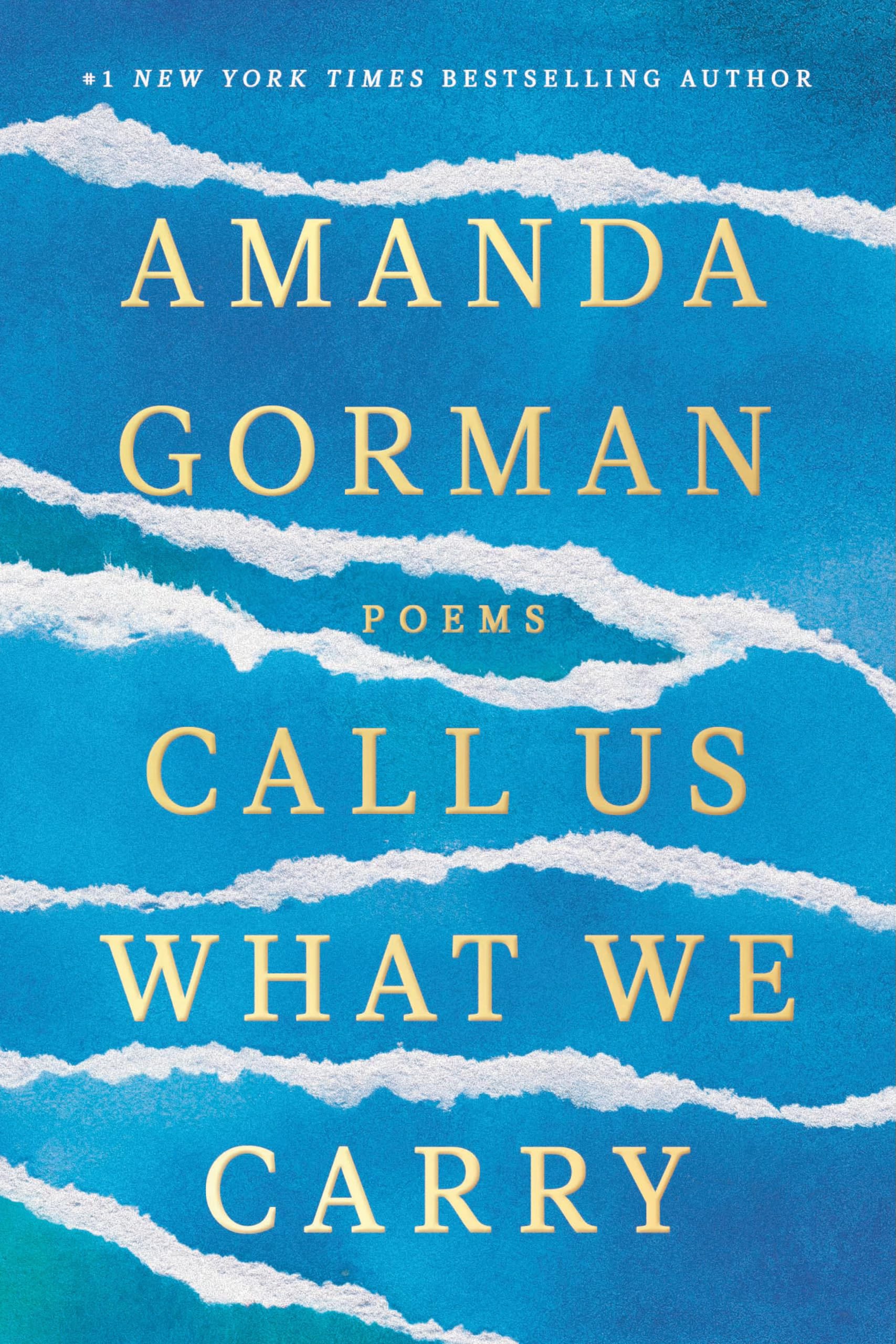
Call Us What We Carry comprises 211 pages of poems split into seven sections. At the end there's a notes section, which lends the book an academic air; a gratitude section, in which Gorman thanks, among others, God, her ancestors, and her readers for “being willing to carry these words”; an interview with the poet, which kicks off with the interviewer describing the book as a “masterpiece” (!); and a discussion guide. The guide encourages us to consider the relationship between form and content in some of the less traditionally structured poems. We certainly will.
The sections have headings like Requiem, Memoria, Fury & Faith, and Atonement. Words that indicate Big Themes. Statements of theme, even, rather than mere indicators. Epic words that presage epic content. They do not prevaricate. We will be reading about: the Covid-19 pandemic, racism, slavery, Black Lives Matter, identity, grief and trauma. And language – Gorman is interested in etymology and the moveability of meaning, and regularly translates that interest onto the page. In other words, Call Us What We Carry punches high.
Unfortunately, while there were many things that qualified her for the role of inaugural poet, writing original or technically impressive poetry was not one of them
Certain stylistic features make this collection look distinctive from the start. Every line begins with a capital letter. Gorman uses ampersands in place of the word ‘and’, even when it means editing an erasure poem’s source material. And she frequently – though not invariably – separates stanzas with a run of three asterisks, rather than a space. Some poems have simple paragraph breaks. Others are separated by trios of asterisks. Some have both. (It would be good to discern a reason for this choice but I couldn't.) Nor is it clear (to me) why she opts for ampersands.
Key to understanding some of Gorman’s choices is that she comes to page poetry from performance poetry. As a rule, poets geared to spoken word think more about pace, rhythm, and how words sound. They also get to make decisions about pace, rhythm, etc when they perform their work. Stripped of their input as a performer, the text can feel lacking. For me, this is often true of the present collection.
Her status as voice poet writing for the page is noted by literary critic Kate Kellaway, who writes in her review of Call Us in The Guardian that Gorman "cannot resist words that echo one another". She lists some examples in her review. But oh, there are more. “In all these times/ I Unprecedented & unpresidented” (‘At First’); “We wept the year away, / Frayed & afraid” (‘Fugue’); “we are perishable / But prevailing, living & livid” (‘Hephaestus’); “Absolutely abulic, / incessantly incensed” (‘Captive’); “We now / appreciate that Pandora’s box was a jar / left ajar” (‘Pan’). Kellaway concedes that Gorman’s "hallmark is also, at times, her weakness". She nevertheless finds "a sense of exalted wordplay".
Identifying homophones and words that echo each other is straight out of the spoken word poet’s wheelhouse. One of the perks of leaning into how things sound, rather than what they mean, is that you get unusual word combinations, and these can be thought-provoking. For a transcribed spoken word poem to work, the reader must meet it halfway by agreeing to read it aloud. But even when we do this, these wordy titbits sound laboured, like neat tricks rather than meaningful word combinations.
Incidentally, it is not impossible for a spoken word poet to make the transition to the page without compromising on meaning or auditory punch. Joelle Taylor is one example. Her page poetry retains the sound of her voice while also taking advantage of what the page has to offer. You can read my profile of Joelle Taylor for The Friday Poem here, and my review of her 2021 collection C+nto & Othered Poems here.
Another signifier of Gorman’s spoken-wordiness is her soft spot for alliteration. ‘Another Nautical’ contains the lines:
That is to say, words
Are how we are moored & unmarred.
Let us rouse & roar
Like the ancient beasts we are.
It’s a passage about how words are capable both of anchoring us in reality and facilitating a connection with our animal nature. The words ‘rouse’ and ‘roar’ work together in this context. Rhetoric rouses; beasts roar. Words moor us. But do they ‘unmar’ us? Unmarred means "not altered from an original or pristine state", according to Merriam-Webster. In other words, it's our invention, the technology of language, that keeps us in our natural, pristine state. Meanwhile, elsewhere in the poem, we're told about something “only words can do— / Prod us toward something new”. So, language encourages us to progress while also preventing us from changing from our original, pristine state. Personally, I get – er – unmoored here, unsure of what the poet’s trying to say.
So: habitually homophonic and abundantly alliterative. Then there's Gorman’s experimentation with form. Call Us What We Carry contains concrete poems, erasure poems, poems in the shape of a game of Hangman, poems written into the American flag, as questionnaires, movie treatments and timelines. It's a beguiling array which, if executed well, might be stimulating. But the execution is confusing. There are weird and non-weird inconsistencies regarding the criteria of certain forms, as well as inexplicable decisions to sidestep formal conventions in a way that makes many of the poems feel unedited. Experimenting with form also instructs us to regard these as page poems, rather than transcribed spoken-word poems, which mixes the messaging.
Experimenting with form also instructs us to regard these as page poems, rather than transcribed spoken-word poems, which mixes the messaging
In the study notes at the end of the book, we’re encouraged to critically consider the poet’s choice of form and how it relates to the content. Well, let’s.
‘VALE OF THE SHADOW OF DEATH or EXTRA! EXTRA! READ ALL ABOUT IT!’ takes the form, as its name suggests, of a newspaper article. It begins, “We promise to write the truth. / Stay with us till the end.” Intriguing. We're on board. The narrator explains that the Spanish influenza “did not / originate in Spain. In fact ...” and so on. We're reading a journalist’s attempt to dispel myths about the origin of the so-called Spanish flu. They tell us about the 1882 Chinese Exclusion Act. The tone is vaguely journalistic; myths are being dispelled; content is following form. We are urged, again, to “Follow along” while the narrator informs us of the various possible translations of the Spanish word 'vale', the flu’s arrival in Chicago, and its impact on Black people in America. “Stay.” we’re told again. “We promise, we are going / somewhere, okay?” And these entreaties are starting to sound like the poet herself urging us to keep on trucking. We read one US authority’s view that the bubonic plague was an “Oriental / disease, peculiar to rice eaters”, after which follows a bizarre passage:
As if we are what we eat & not
also who we cheat, what we
tweet.
He was dead.
What we mean is he was dead
Wrong.
We can only fully understand
language by what doesn’t sur-
vive it.
A commitment to justified text, including using hyphens when a word runs over two lines, shows some degree of deference to the form of a newspaper column. But all other signs are absent. The syntax has melted away into … something else. Why start writing to a particular form and not continue in it?
The fifth section, ‘Atonement’, contains several erasure poems. Gorman explains that the “key to constructive—& not / destructive—erasure is to create an extension instead of / an extract”, to find new meaning. The difficulty I have – and this may be a personal snag – is that the documents from which they have been “plucked” have been entirely erased. This means they do not exist to provide context. Nor are the words on the page in the same positions as they are in the original texts – Gorman has re-formatted and, at times, re-punctuated her found texts in order to make them make grammatical sense, and be easier to read. But the point of an erasure poem is that you can see the format and shape of the original text, isn’t it? See its shape, discern from its appearance something about its intended meaning, juxtapose the resulting poem with its source material.
‘DC PUTSCH’ goes one step further. It's an erasure piece in the shape of the White House’s rotunda. An erasure poem, which gleans much of its meaning from its relationship to its original form, moulded into an entirely new form, where non-sequiturs are no longer explained by words not being physically next to each other. It reads like a concrete poem that simply does not make sense.
‘The Soldiers (or Plummer)’ is an interesting poem. It takes the diary of an African American soldier who fought in World War I, snips it up and inserts several haikus. By and large, the haikus have the conventional number of syllables on each line. But many of them lack the essential transition that is supposed to take place between lines two and three, the kireji (cutting word) and the kigo (seasonal reference).
Action is joining
The weaponry of our hands.
Ready, aim higher.
If haikus are a numbers game, this is a haiku. But does it feel like a haiku?
I’m torn on ‘REPORT ON MIGRATION OF ROES’. It takes a real-life survey from a 1922 report titled The Negro in Chicago, which is of stunning sociological interest. It erases parts of it and replaces the proper nouns (“Chicago” and “the South”) with allegory indicators (“Panpax”, “Pandem”). This renders the survey respondents as abstract migrants and thereby allegorises, or generalises, the Black experience in the North of America. It’s interesting, but sadly not as interesting as the source material itself. Making a specifically interesting thing generic doesn’t in and of itself add value to the source material, or make for engaging poetry. Still, I’m glad I read it.
‘Monomyth’ promises us a poem-as-movie treatment, but then doesn’t follow the form. It could have been really fun if the whole thing had stuck to its guns. ‘CODA IN CODE’ takes the form of a series of phrases, all in capitals, from business ads Gorman spotted in summer 2021. There is a line drawing of a gallows at the end. Several letters are missing from the phrases, replaced by underscores, to indicate the unguessed letters in a game of Hangman. At first, I didn’t get why some of the guessed letters hadn’t been filled in. When I did get it, however, there was no sound of cogs clicking into place, no revelation, only a little sigh.
‘At First’ takes the form of a conversation over an instant messaging platform, but there's no discernible difference in voice between the two interlocutors. Also, the poem is not laid out on the page in a way that properly represents a conversation on an instant-messaging service. There are staggered line breaks, all the emojis are aligned to the centre, and the screen-bubbles are not treated in a consistent manner. ‘Arborescent I’ and ‘Arborescent II’ are arranged to resemble trees. But the alternating lines that constitute them are aligned left so every other branch is exactly the same length. Why not centre the text so that every odd-numbered branch isn’t uniform? Simple editorial decisions could make these concrete poems look more like the forms they represent.
With fewer words and more space on each page, semantic and editorial decisions deserve more scrutiny
Reader, if it sounds like I’m being picky, it’s because I am. This is poetry we’re talking about. With fewer words and more space on each page, semantic and editorial decisions deserve more scrutiny.
One more bugbear, before finally hanging up the hatchet. Questions. Does a question need a question mark in order to be a question? I sort of think it does. The question mark makes you go up at the end of the sentence. It changes the pace – you come across it and suddenly, there's an enquiry. It invites you to think. A question without a question mark is a very different thing. It makes a statement, closes the thought. Numerous examples of question-mark-less questions sit uncomfortably with me. For example, in 'Lighthouse', "When has horror not been our heirloom." In ‘Compass’, "How could we not be altered." There are more.
But there is another reason I’m being picky.
The list of literary institutions throwing their weight behind Amanda Gorman is so nearly exhaustive that it stretches credulity. The New York Times, Glamour magazine, Urban Word, Barnes & Noble, Penguin Random House. And that’s just the bookish ones. CBS This Morning has commissioned her to write and perform multiple times. Nike chose her to write the manifesto for its Black History Month campaign in 2020, cementing her status as an authority on race relations. She founded a youth writing and leadership nonprofit when she was 18. The position of National Youth Poet Laureate was invented for her. She was the (youngest ever) poet to perform at an incoming US president’s inauguration, making hers one of the best-known faces (and voices) in Anglophone poetry. A president likes her. She spoke to him, had his ear. The XQ Institute. Viking Children’s Books. MTV. She went to Harvard. Her fans include Barack Obama, songwriter and librettist Lin-Manuel Miranda, Al Gore, and Pakistani education activist Malala Yousafzai. Hillary Clinton wants her to run for president in 2036. Time. Vogue. When she was 20, a New York City library and museum displayed one of her poems alongside an Elizabeth Bishop exhibit. She’s an Estée Lauder ‘Global Changemaker’. Met Gala co-host. Democratic National Convention speaker. The list. Goes. On.
One would be forgiven, looking at her list of achievements, for thinking Amanda Gorman is among the best poets ever. This is a problem for three reasons.
First, because the poetry is not very good.
Second, because it affects the way Jo Bloggs perceives the work. Poetry is not like music, where the vast majority of people are confident in saying what they like and don’t like. If a literary authority proclaims, “this poetry is good”, Jo is pretty likely to accept it as true. I don’t have stats to back this up. It’s a hunch. But between the way it’s taught in school and the fact that only a tiny minority of people regularly, voluntarily read poetry, I think it’s fair to assume that, if (s)he reads something deemed ‘officially’ good and doesn’t like it, Jo may well write off poetry altogether.
Third, because of the effect it has on the writer herself. Imagine suspecting that your work is being elevated by the literary establishment, not for its literary merit but because you’re so easily marketable. Imagine all this happening before you reach the age of twenty-four, when your ego is most fragile; as a person of colour, who must already contend with the idea that the way you look might dictate your access to opportunity; and as a woman, to whom institutions built under patriarchy are known to condescend by extending short-lived invitations to the party. Imagine what it’s like to have won the acclaim of just about every literary authority you can think of – by your mid-twenties. Imagine you start to believe it. Your work is revolutionary. What then? Stay in lane and accept your most original work is behind you? Experiment, and reconcile yourself to your most successful work being behind you? It’s easy to forget that praise doesn’t make us better. Nor does criticism make us worse.
Gatekeepers should not find consensus. They shouldn't speak as one. It feels disingenuous. Disagreement is what makes art interesting
Gorman’s accolades give the impression that she's a once-in-a-generation talent. Someone we can all get behind. It makes me sceptical. Why are so many major voices championing the work of one poet? Gatekeepers should not find consensus. They shouldn't speak as one. It feels disingenuous. Disagreement is what makes art interesting. So what do the literary institutions, or the individuals who work for them, really think of her work? Do they genuinely love it? Or are they jumping on a safe-bet bandwagon? If Biden digs a poet, she’ll sell. The marketing is already done. Alternatively, do we need to consider the possibility that numerous literary authorities have bad taste?
Just as the T.S. Eliot prize winner reveals something about the direction the seneschals of the British literary establishment want the rest of us to face, the recipients of such honours as the Poets & Writers Barnes & Noble Writers for Writers Award (which itself wins the award for clumsiest name) or OZY Media’s Genius Grant (it’s literally called a genius grant) are in some way indicative of how the American literary establishment wants writers to proceed.
All of which is to say that a critique of her work is an indirect criticism of the bodies that have foregrounded it. Gorman’s pedestal is remarkably tall, and someone else built it. Kate Kellaway describes Gorman as a “secular preacher”. Whither does one go after preaching?
My read is this: Call Us What We Carry was published because it would sell, and it was possibly fast-tracked through the editorial process. It sold because of a wave of popularity surrounding its author following her reading at Joe Biden’s inauguration. And now, looking back, it reads like a generic mishmash of missed opportunities, rather than a career-defining opus. By publishing it as it is, Viking (and later Chatto & Windus, then Penguin Random House via its Vintage imprint) took advantage of a young, talented writer because of her marketability. This did Amanda Gorman a disservice. But we never do our best writing in our early 20s (unless we’re Nick Drake, Amy Winehouse, John Keats or Arthur Rimbaud). How will Gorman manage the burden of celebrity and the glory of laureateship? She is clearly an extraordinary character. We'd do well to keep a weather eye on her.
Bruno Cooke is Spoken Word Editor of The Friday Poem. He recently launched a Substack publication called My Special Interest, and has written one novel (Reveries, available from You Know Where), four plays and two feature screenplays. Besides writing about poetry for The Friday Poem, Bruno writes poetry of his own and runs On Our Bicycles, a repository of bicycle touring guides. He has lived in China, Sri Lanka and the Philippines, and cycled in 50+ countries. In April 2023, Bruno set off round the world; receive updates via his personal blog.
Amanda Gorman is an American poet, activist, and model. Her work focuses on issues of oppression, feminism, race and marginalization, as well as the African diaspora. Gorman was the first person to be named National Youth Poet Laureate. She rose to fame in 2021 for writing and delivering her poem ‘The Hill We Climb’ at the inauguration of Joe Biden. She is the author of The Hill We Climb (2021), Call Us What We Carry (2024) and The One for Whom Food Is Not Enough (2015), and the children's’ picture books Something, Someday (2023) and Change Sings (2021) illustrated by Loren Long. A graduate of Harvard University, she lives in Los Angeles.
As well as browsing our Substack, it’s worth visiting The Friday Poem website where you can browse our Archive of more than 700 posts dating back to early 2021. If you like Bruno Cooke’s writing, try his piece on Million’s Poet, a reality television show in the United Arab Emirates with massive cash prizes, his profile of spoken word performer Kae Tempest, or his review of Slug by Hollie McNish (Little, Brown, 2021).
Help support The Friday Poem — buy us a coffee to help us stay awake as we strive to bring poetic excellence to your inbox every Friday. If you can't afford to donate, no worries, we’re going to keep on doing it anyway! Big thanks for everything, you lovely poetry peeps.
Brilliant essay articulating the reservations and anxieties so many lovers of good poetry feel about so much of what now passes as ‘poetry’ in the glossy upper echelons of the public space. Thank you Friday Poem for posting this.
Bruno, you are the complete package!