


So What
I like my coffee sweet so what,
Four sugars to the cup.
I like tea sandwiches at Claridge’s,
A plate of perfect with the crust trimmed off.
I like to look out on Brook Street
From rooms on the Brook Street side.
From there I walk to my nearby tailor
And my nearby shotgun maker.
Face the truth.
Poetry doesn’t matter in the least.
But, as to poetry, a fabulous new Purdey
28-Bore Over & Under
Shotgun shoots quail with delicate puffs of thunder
While singing always beautiful
Springtime Christmas carols
Through its beautiful London barrels.
There’s nothing on earth as beautiful as a Purdey
Over & Under, or as urbane, or as insane,
Except Volodymyr Zelenskyy,
The incredible president of Ukraine.
Moonlight is falling straight down on Manhattan.
The streets tonight so what
Are smooth as satin.
I like to there and touch it here.
[…]
Read the rest of ‘So What’ in Granta, archived here.
Hilary: Frederick Seidel has a child’s fascination with the transgressive. He wants to shock. And he has shocked. His first collection won the Young Men’s and Young Women’s Hebrew Association Poetry Prize in 1962. The winner was promised publication by Atheneum Press, but Atheneum had qualms. They thought the tone was anti-Catholic and anti-Semitic. There was a suggestion of libel too. Then there was the title, Final Solutions. Was this Jewish poet having a laugh?
Atheneum asked for textual changes. Seidel refused. Atheneum refused to publish. All three judges resigned. Eventually the book was picked up by Random House. And Seidel’s justification for that awful title? In a review in the New York Review of Books (June 1963), Anthony Hecht said that though Seidel knew his title would conjure Hitler’s “final solution to the Jewish problem”, it didn't pursue this association explicitly.
Are we convinced? I’m not. I think Seidel worked out early on that he wanted to be a enfant terrible, that no publicity was bad publicity, and that poems about sex – particularly about the female body – sold. His 1980 collection, Sunrise, has a poem called ‘Fucking’ in it, which contains the memorable lines: “I can remember her sex / And how the clitoris was set”. Even now, in his ninth decade, he’s still banging away (forgive the pun). The poem ‘To Baudelaire’ (So What, 2024) contains the lines:
You see a Subaru
Parking in the mirror under skies of blue
When she bends down to touch her toes for you
Because she wants you to enjoy the view
Of her woke flower singing teardrops of dew
Which reheating makes only better, like a stew!
Petals and stamen, clitoris …
I’m not sure which offends me more, the comparison of the female vulva to stew, or the clunking full end rhyme.
Helena: Or frankly the whole thing. Those lines are truly AWFUL. Unrepentantly so. Fame is a terrible thing for poets. Can this be he who wrote in Sunrise (1980) the lovely quatrain of 'Years Have Passed':
Seeing you again.
Your glide, your gaze.
Your very quiet voice.
Your terror. Your quiet eyes.
I know people of judgement who rate Seidel, so let's take a look at something less easy to shred. I suggest 'Fog'. It's widely quoted, and it appeared in Ooga Booga, which was shortlisted for the Griffin in 2007. No mean feat, that – the Griffin shortlist. So what do you think of 'Fog'?
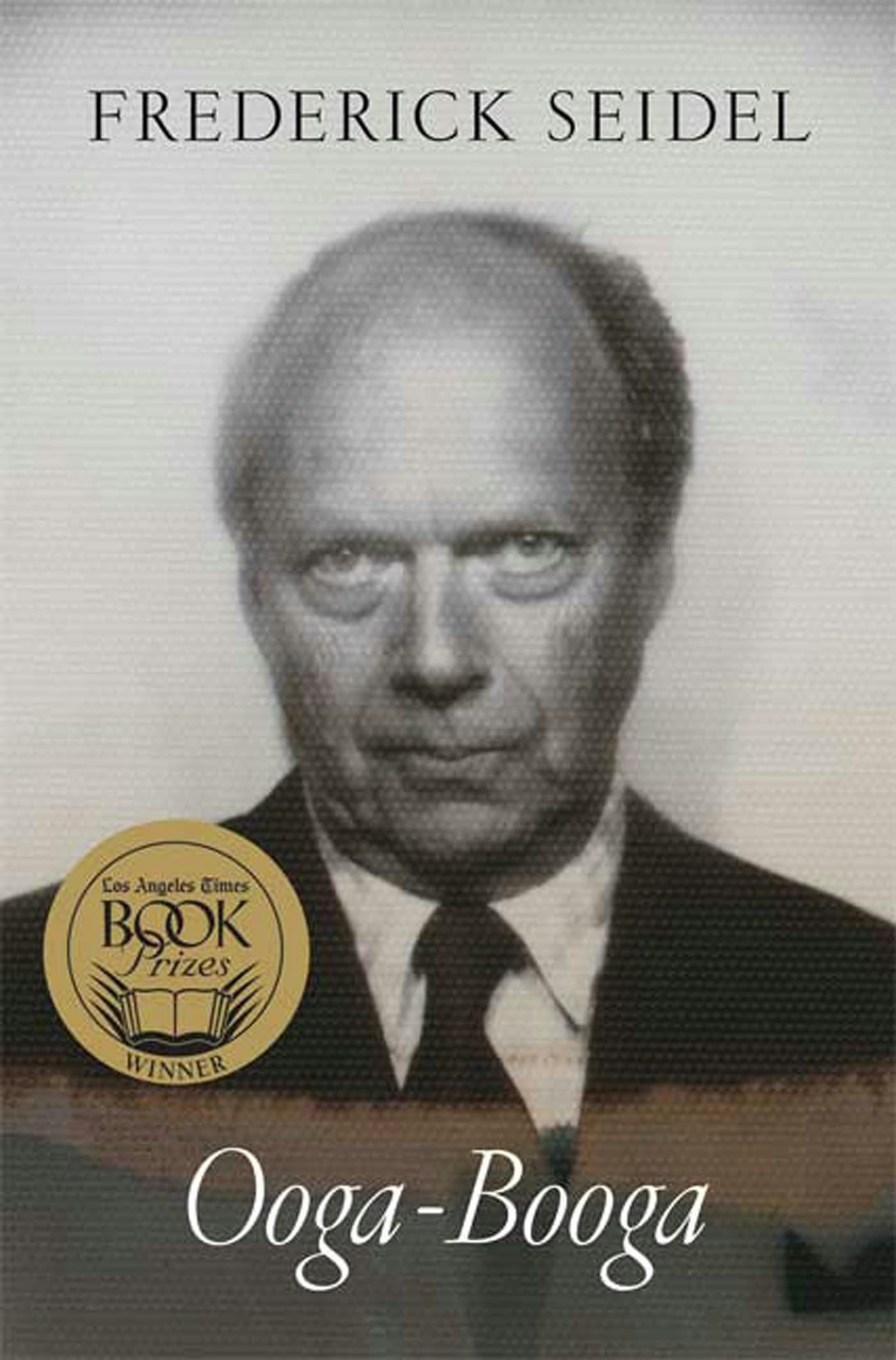
Hilary: We’ve done conversations like this on Peter Gizzi and Victoria Chang and both times we exchanged poems ‘in the style of’ our subject. I read ‘Fog’ before I read your email properly and assumed it was Seidel-pastiche. I’m still not sure you aren’t pulling my leg. That first stanza covers pretty much all of Seidel’s bases: living, dying, motorbikes, sex, and a certain degree of apparent self-knowledge.
I spend most of my time not dying.
That’s what living is for.
I climb on a motorcycle.
I climb on a cloud and rain.
I climb on a woman I love.
I repeat my themes.
In the following four stanzas, he does a quick tour of Italian beauty spots (Bologna, Milan, Florence), makes it clear what he values ("The Lord is my shepherd and the Director of Superbike Racing. / He buzzes me through three layers of security”), and makes a not-particularly-oblique reference to his penis (“Basically, it sticks out of me”). Perhaps this poet deliberately pastiches himself?
Helena : That’s certainly a possibility, although I don’t believe it’s what the Griffin Prize judges thought. In any case, I think it’s a double bluff. He overplays his own most characteristic verse technique (repetition, often ‘I’ statements). He daubs an archly ironic tone into the picture. He ladles dollops of apparent self-awareness. Tricky, but scarcely admirable. There’s got to be more than that, surely?
Hilary : There is more. It isn’t dull. It is accessible. It addresses its themes in an unconventional way. I haven’t read anything quite like it before. Billy Collins says Seidel “does what every exciting poet must do: avoid writing what everyone thinks of as ‘poetry’.” And yes, he does that, though whether he does it in a GOOD way is debatable.
Helena : Themes? What are the themes of ‘Fog’? Death, apparently? Except I’m not convinced it’s about death at all. More like self-magnification. Some kind of apotheosis into godhead, maybe. He’s doing things that add up to not dying, he says. Things like biking, flying, having sex, possibly writing magnificent poems. As you do. Rich old man pastimes. He zips round Italian cities. He manifests self-centred wealth. He gets a bike built for him. He pontificates. He expects to die when he finally sees this wonder bike. His closing image is like a twentieth-century Fox still: a man in a fog (I see it as a cloud) digitally photographing a personally-commissioned bike on an altar (is the altar naughtily iconoclastic?). So what is the theme? I don’t object to the style. It is, as you said, accessible. It has bounce. But no way I’m taking this to a desert island with me.
I don’t object to the style. It is, as you said, accessible. It has bounce. But no way I’m taking this to a desert island with me
Hilary: But it feels contemporary. I like the sense that Seidel’s engaged with current events and the real world. Ernest Hilbert, reviewing Ooga Booga in the Contemporary Poetry Review in 2007, says: “One could read many thriving American poets and not know that there is a world outside the daily suburban routine of the poet, much less one in which war and deprivation define the lives of whole populations. In this respect, Seidel, as glib as he might seem in any given line, is more engaged with the state of the world than most American poets.” Seidel writes about the war in Ukraine. He writes about Nick Cave’s grief (read the poem, and Nick Cave’s response to it, here), the Covid pandemic, cancer. He writes about Trump (read ‘Trump for President! in the LRB, and ‘Trump’ in the New York Review of Books) and it’s occasionally glorious. For example, the last stanza of the poem ‘Malkovich recites Seneca’s Thyestes’ in So What reads:
The mob bulges down Pennsylvania Avenue
Toward the Capitol.
The bullying bulk of President Donald Trump—
Nero of Mar-a-Lago—
Fucks them from behind like a dog.
Helena: Glorious??
Hilary : I’m not saying this is good poetry. I suppose I like it because I agree with the anti-Trump sentiment, and nobody else says quite like this. Which puts me in a quandary, because it seems I like Seidel’s transgressive attitude when it’s directed at Trump, but not when it’s directed at women.
Helena: But he’s merely using Trump for an easy win, isn’t he? Throwing in names, rather than social comment? A way to demonstrate his own daring habits. In any case, I’m not convinced that what a poet writes about matters as much as how. I think it’s the meld of material, theme, method, form, insight. And I guess I want to feel moved. In the case of Seidel, I’m not even stirred by his Nick Cave piece. The truth is I don’t trust Seidel. His arrogance – even if it’s a persona – is alienating. On the other hand, I nearly like the way he writes lightly about dying when he’s approaching 90. Too old for riding motorbikes. And much else.
But you raised the issue of transgression and women. What about ‘Hymn to Aphrodite’, which Carol Rumens selected from Peaches Goes It Alone in 2021. She didn’t find its female references offensive, although her personal feelings are masked. I do find this poem interesting, and I like parts of it. Rumens, like you, credits Seidel with being contemporary and urban, and she seems to admire his “rangy swagger”, but form-wise she says he’s a traditionalist. I think ‘Hymn to Aphrodite’ might be about love. But maybe it’s only lust, or maybe it doesn’t matter so long as the poet actually feels something here. I sense vulnerability beneath the swagger. The opening stanza is sharp and arresting. Isn’t this good writing?
I gather you were in the lobby
Minutes before.
Terrifying to almost see you again.
I smelled the shockwave, the burning air.
Hilary: Yes, it’s compelling, it’s immersive, and it’s clever. There’s a delightful mismatch between “I gather”, which is reserved and non-committal and slightly old-fashioned, and words like “terrifying” and “shockwave”, which are unambiguous, extreme, and contemporary. It indicates a fundamental difference between the two ex-lovers, and allows us to speculate on their relationship, and how it ended. She must have been some woman. And this is some opening stanza. The second stanza also has a certain authenticity of feeling. Love and lust combine – the exalted heights of Mount Olympus are infused with the sensuality of the jungle.
Then come the clichés (that inescapable moon), the heavy rhyme, the repetition, the usual self-aggrandisement (here mixed with a dash of vulnerability), and the inevitable focus on the female anatomy. Some say Seidel is a worshipper of women, but he only seems to worship specific parts of them – breasts, buttocks, genitals. Here it’s pubic hair. Repeated three times. I can’t find a poem of his that praises a woman without mentioning her body. Over and over again he celebrates sensuality and youth, and denounces age. In ‘Broadway Melody’ he says, "A naked woman my age is a total nightmare. / A woman my age naked is a nightmare.” Well, fuck you, Fred. Seidel might claim to be reflecting the values of America, so we can understand, analyse and counter them, but frankly he’s only compounding the problem.
Some say Seidel is a worshipper of women, but he only seems to worship specific parts of them – breasts, buttocks, genitals
Helena: It's a popular confusion, I think, to assume writing about women's bodies is the same as adoring women. But I thought the lines "A naked woman my age is a total nightmare. / A woman my age naked is a nightmare” were mocking him, not a woman. The statements are ambiguous, aren't they? For a man of 89, a naked woman is a nightmare. But a woman of 89 is a nightmare for him too. A joke. Probably.
Hilary: So Seidel can write witty (for some), arresting, readable and smart poetry, but he can’t keep it up. He sets up something interesting and smart, then ruins it with “I chose not to come out / On stage and tell them what a poem is about.”
Helena: I agree. He's writing well and then he spoils it. For me, he spoiled it in 'Hymn to Aphrodite' two lines earlier. I'd say he crashes with: "I wasn’t, but I could have been, / A god I was living in." The syntax is painful. He "could have" been a god, which at least makes sense in this context, but no. Instead, he could have been "a god I was living in"? That's as inept as the Beatles' "the world in which we live in".
Hilary: He goes some way to pulling it back with the sixth stanza:
You look like a field of flowers.
You look like flowers in a vase.
You look like brains and breasts.
You are life stabbing death to death.
Here, his use of repetition works well (though also starts to wear a bit thin). The movement from flowers in a field (natural, beautiful) to flowers in a vase (tamed, collected) to brains and breasts (getting weird and scary) to “life stabbing death to death” (what an image!) is magnificent. The ex-lover is portrayed as something elemental, all-encompassing, capable of overwhelming death itself. Compared to her, he's a tiny hermit crab wearing borrowed protection. It’s breathtaking.
Helena: Are you serious?? This is marmite territory. I absolutely don't get the movement from a field of flowers (fair enough for Aphrodite) to flowers in a vase. Aphrodite is not and never will be flowers in a vase. Brains and breasts is too anatomical, and in any case, she owns these features; she doesn't resemble them. It isn't clever; it's just assertion. And as for "life stabbing death to death", oh please. How do flowers in a vase kill death?
Hilary: Isn’t it just the progression of his thought? For me, the poem takes a woman who is as beautiful as a field of flowers and dresses her in a vase; I had the image of an hour-glass shaped vase, like a woman wearing a tight bodycon dress (perhaps this was something his ex-lover did?). Admittedly the leap to brains and breasts is a bit far, but I think he’s doing what he always does, reducing things to their baser elements, loading the poem up with viscera and sex, to shock. Breasts evokes beasts, and from there it’s not too far to life and death. He probably liked that fourth line, and wanted to find a suitably macabre way to get there.
But what about:
I was like a god or
I was like the tiny hermit crab
Who walks around inside a borrowed empty shell
Bigger than he is for protection.
Surely that is the vulnerability you mentioned earlier? Are his expressions of vulnerability and his feeling of insignificance honest and authentic? I’d like to think so. Those moments where he recognises human frailty – which occur more often in his poetry as he ages – can be quite touching.
Helena: Well, yes. When he gets to "I was like a god" and the bit about the hermit crab, he's writing better. The trouble is, he already did the god comparison earlier. Still, he's getting more interesting. "I'm packing heat. That's a poem." I'm not sure, but I think he's comparing sexual heat (as inspired by the goddess) with the fire of poetry. "Peaches goes it alone" is possibly solo sex, but also maybe poetry performance: "I do what I do". That is to say, he makes another poem. He repeats his themes. And yet he's wearing a "borrowed empty shell", the shell of a poet. He's off down that shore with his trousers rolled, "ready to be found out". A moment of self-awareness? Ah sadly no. When he visualises his exposure, it's lubricious: he's going to be "eaten / Naked." The man can't resist his own deliciousness.
Hilary: Let’s look at that seventh stanza in more detail, because I think it’s telling.
I’m packing heat. That’s a poem. My concealed
Carry permit is revealed.
I do what I do.
Peaches goes it alone.
Do we think “packing heat” is an erection? If so, his erection is a poem (!), and it’s also a gun. Gun, erection, poem – they’re all the same, and going it alone is either masturbation or writing poems, which in his case seem to amount to the same thing. Paradoxically, while he seems to look outwards to current events, Seidel is primarily concerned with himself, and specifically what’s inside his (expensively tailored) pants.
Helena: And yet, the whole poem is a 'Hymn to Aphrodite'. Maybe it's not about sex at all. You took the opening to be an address to a real person, and I agree it feels personal. But maybe it's not. Or it is and it isn't. Maybe all this fuss is about poetry itself. The Muse. He takes poetry seriously, as one book after another demonstrates. And the end of the poem is truly weird. What do you make of it? And what do you think of the form, chopping the poem into neat (though irregular) four-line boxes?
Hilary: If stanzas are individual containers for a thought (verse paragraphs), I’d say his were broadly doing the job. The short, terse lines generate a feeling of control – perhaps the poet's need to control his response to his ex. But I suspect he’s doing this consciously, in order to look like a formalist. Or to look as though there's a method in the madness. Carol Rumens says he is essentially a traditionalist, but she doesn’t really explain why. I’m not sure I agree.
Helena: Well, he's no innovator. So in that sense, he’s traditionalist. He divides almost all his poems into regular-sized chunks. He capitalises the first letter in every line. His punctuation is conventional. His line breaks are mainly at the end of phrases, with the occasional enjambement to make a point ("I chose not to come out / On stage"). He loves repetition: he uses the old techniques of anaphora and (as Carol Rumens points out) anadiplosis (I had to look that one up). Different kinds of repetition anyway. And repetition still works, even when it's mechanical. It's something readers 'get'. Then there's rhyme (another kind of traditional repetition) to hammer home high points ("Walks through my front door / And knocks me to the floor"). All of that stamps him as essentially retro, although the wild variation in line length is more deviant. Still, he does keep following the same method, doesn't he? Including in So What, the forthcoming collection?
Hilary: The problem with discussing So What is that it isn't available in the UK until well into August 2025. But we've managed to track down three poems online. So let's take a look at how traditionalist, or otherwise, Seidel looks right now. There's '1937', which we found on LitHub, the title poem 'So What' which we found behind a paywall on Granta but which is archived here, and there's 'Moxifloxacin', shared in the notes on a Steve Donoghue YouTube discussion (video below). All three are chunked into even-sized stanzas. All three have elements of erratic rhyme.
Helena: '1937' is hardly contemporary: lots of name-dropping of 1930s poets. 'Moxifloxacin' seems to be a feverish ramble, composed during an episode of pneumonia. I think the title poem, 'So What' is the most interesting. In fact, I think it might be a signature piece for Seidel, the man who can declare anything, no matter how absurd or offensive, and brush it off. He simply doesn't care.
Hilary: I think you’re right. That’s why we put an extract at the start of this discussion, as well as a link to the whole thing in Granta. It’s the title piece, it opens the new book, and it’s one of the longer poems – ten eight-line stanzas. The phrase “So what” appears five times here, and it also forms the coda. Seidel is according this poem – and that particular phrase – high status, and we should take notice of it. So what’s he doing?
First off, he locates himself in a moneyed world – Claridges Hotel, Brook Street, bespoke tailoring, Purdey shotguns. So far so Seidel. He segues – well, it’s more of a “left at the lights” leap actually – into the war in Ukraine and while he’s there he draws a parallel between his shotgun and Volodymyr Zelenskyy, “the incredible president of Ukraine”. He’s starting to sound a bit like Trump. Is this intentional? There are references to shooting quail, shooting pigeons, and, at the end, shooting rabbits, all of which are characterised as sport or fun. For extra ballast, there’s a stanza where he name-drops well-known Russian writers actively wreaking destruction: Tolstoy and Turgenev, Pushkin and Pasternak, Mandelstam and Babel, Tsvetaeva and Akhmatova. Also Tchaikovsky and Death with a capital D want "to defeat Ukraine".
The poem meanders along with his thought processes. Some of it makes little sense, and parts of it seem to be led by rhyme. For example, in the second stanza his shotgun:
[…] shoots quail with delicate puffs of thunder
While singing always beautiful
Springtime Christmas carolsThrough its beautiful London barrels.
Surely “carols” is only there to rhyme with barrels? ‘Springtime Christmas carols’ is an absurdity.
Helena: Yes, it's absurd. Intentionally absurd, and that's something he often uses rhyme for: to throw everything out of kilter. It might be entertaining at times but here it's too grim for that.
Hilary: There's some sonic play which some might find entertaining, such as: “You lift a hundred-thousand-dollar Purdey Trigger Plate / Over-and-Under wonder to your shoulder and levitate”, but as a display of poetic technique it’s a bit gauche.
Helena: But I think that's the point. His poetic technique almost always appears clumsy because he's never trying to be technically skilful. He can sound like William McGonagall. But Seidel is certainly doing something deliberate. It's all about voice. That particular Seidel voice, the poetry-persona with its alienating and cocksure expression, its stance of not giving a f***. He's been working on this voice for decades. I suddenly realised how much it isn't his ordinary writing/speaking voice when I read him writing about motorcyles in Harper's Magazine (2009). Without the bizarre rhyme and rhythms, the hyperbole, the death, the guns, the repetition, the sex, the moon, you find someone who sounds ... quite ordinary:
The bike really was stunning. Collins started it up and I climbed aboard behind him and rode as a passenger over the river to the derelict industrial area in Queens where I was going to receive my lesson. Greco followed in his car. I knew what to do on a motorcycle. I knew what lever did what. I knew how to start it and how to stop it. I set off and when I wanted to slow to a stop I accelerated instead and couldn’t remember where the brakes were until quite a ways down the road.
Hilary: But back to So What and its title poem. Whatever voice he's using, he clearly has something to say about poetry doesn't he? It’s “useless” and “a disgrace”, meaning, I think, that poetry can’t halt war. Is this the extent of his transgression now – to declare that poetry makes nothing happen? Surely we’ve heard this somewhere before? He says: “Poetry doesn’t matter in the least. / But as to Purdey poetry …” So we’re back to guns as poetry (though not so much sex).
‘So What' is full of emphatic, significant-sounding statements. “Face the truth”, he says. “Birdsong is serious”. Then he undercuts this with trivialities and absurdities. “The problem of homelessness in the subways— / Having nowhere to undress—”. That’s the problem with homelessness? Having nowhere to undress? It’s as if Seidel has set out to write a Big Poem about War, but decides to cheapen it at every turn.
Helena: I don't think it's a Big Poem about War. I think it's apocalyptic theatre. Theatre of the absurd. He's hurling in a whole lot of stuff, some of it cute, some of it appalling. It doesn't belong together. It doesn't make sense (which is the point). The symbol of beauty (a gun) strikes me as obscene, deliberately so. But look at the whole poem as a vast Dali-esque collage. A photo of Zelensky, moonlight on Manhattan, a plate of crustless sandwiches, the staircase in Claridge's, a giant advert for a Purdey 28-bore shortgun, a film loop of crumbling skyscrapers on a screen, a man with live pigeons in a huge plastic bag like a balloon, a giant face of Mandelstam in the sky, a million white rabbits about to be slaughtered, a signpost reading THIS WAY TO WORLD WAR III. It's all about juxtaposition. These are obviously the end days and (in this context) poetry is useless and meaningless. The poem isn't entertaining. It's horrible. And its voice is horrible. But it's also art. And maybe it sums up what Seidel himself struggles with.
By the way, I find it interesting that the rabbits are white and don't know what colour they are. Nor do his white readers. There are people of colour, and there are the others – the white ones. And here they're about to be slaughtered. And so what? Are "you" the guy with the gun, or are you one of the rabbits? World War III? This time the white rabbits get it. And poetry won't save them.
Hilary: But that's a big claim, that it's 'art'. Art should be a rewarding experience, I think, whether it’s through emotive power, conceptual ideas, technical proficiency, or beauty. Well, beauty this ain’t. And there’s not much technical proficiency here, though I suppose one could argue that in the same way that Les Dawson was an able pianist, Seidel must be skilled in poetic techniques in order to do them so badly. Does this poem contain or evoke emotional power? I’d argue not, or not much, or not for me – anything Seidel starts to build up, he pulls down pretty swiftly, with his trademark dodgy syntax, heavy end-stopped rhyme, sexual or grisly imagery and relentless repetition.
So we’re left with some sort of conceptual idea. I think Seidel is all about subverting our expectations, choosing not to deliver on the standard contract between poet and reader of poetry. He’s taking the piss. At the end of it all, he walks away from us, back to his bespoke life, shrugging his shoulders. So what? He’s got nothing for us. In another poem, ‘St. Louis Blues’, he writes, “I’d like to mix in nonsense / While there’s time left”. It’s almost as if he’s taunting us.
Why do people like this poetry? Does anyone really like this? Because lots of reviewers seem to. And lots of editors. Only recently the New York Times described him as “one of our best contemporary poets”. I’d agree he’s got something, but after I’ve read a few of his poems, I start to feel cheap and dirty, and not in a good way.
Helena: It interests me that 99% of the jacket blurb comments on Seidel are by male critics. Why should that be, I wonder? And few people, male or female, can be found trashing him, though Paul Bachelor does his best in the New Statesman (behind a paywall but first article free). Anyone casually Googling would get the impression that this poet is universally regarded with awe. You and I don't share this opinion, although he has succeeded in needling both of us, which was certainly his intention. But would we choose to buy the next book by him? Or even the previous three?
Hilary: Nope. Sam Riviere in the Quietus says, of Seidel, “all I can say is that I am seduced and I am repelled”. I’m not seduced. I’ll grant him an occasional half-smile, but I won’t go back for more.
Helena: Agreed. So What is sufficient Seidel for a long time. It's horrible. So is watching the television news. The title poem is like watching the television news: "atrocities in Ukraine are not far away, / And World War III not so far away". The deliberately bland, underwhelming expression lingers nastily. Please can we find something more uplifting to talk about next?
Helena Nelson is a poet, critic, publisher and the founding editor of HappenStancePress and Sphinx Review. Her first collection, Starlight on Water (Rialto, 2003), was a Jerwood / Aldeburgh First Collection winner. Her second was Plot and Counterplot(Shoestring, 2010). She also writes and publishes light verse, including Down With Poetry! (HappenStance, 2016) and Branded (Red Squirrel, 2019). Her most recent collection is PEARLS: The Complete Mr & Mrs Philpott Poems (HappenStance, 2022). She is Consulting Editor of The Friday Poem.
Hilary Menos won the Forward Prize for Best First Collection 2010 with Berg (Seren, 2009). Her second collection is Red Devon (Seren, 2013). Her pamphlet, Human Tissue (Smith|Doorstop, 2020), won The Poetry Business International Book & Pamphlet Competition 2019. Her newest pamphlet is Fear of Forks (HappenStance, 2022). She has worked as a student union organiser, journalist, food reviewer, arts critic, organic farmer, script overseer and dramaturge. She is editor of The Friday Poem.
Frederick Seidel is an American poet. He was born in 1936, in St. Louis, Missouri. He earned an undergraduate degree at Harvard University in 1957. He is the author of numerous collections of poetry, including So What (Farrar, Straus and Giroux, 2024); Peaches Goes It Alone (Farrar, Straus and Giroux, 2018); Nice Weather (Farrar, Straus and Giroux, 2012); Poems: 1959–2009 (Farrar, Straus and Giroux, 2010); Ooga-Booga (Farrar, Straus and Giroux, 2006), a finalist for the National Book Critics Circle Award; Going Fast (Farrar, Straus and Giroux, 1998), a finalist for the 1999 Pulitzer Prize in Poetry; and Poems: 1959–1979 (Alfred A. Knopf, 1989). His awards include a Lamont Poetry Prize and a PEN/Voelcker Award.
As well as browsing our Substack, it’s worth visiting The Friday Poem website where you can browse our Archive of more than 700 posts dating back to early 2021.
Help support The Friday Poem – buy us a coffee to help us stay awake as we strive to bring poetic excellence to your inbox every Friday. If you can't afford to donate, no worries, we’re going to keep on doing it anyway! Big thanks for everything, you lovely poetry peeps.
I didn't know Seidel's work, there's a lot I don't know, but very much enjoyed your to and fro about this latest collection and other work by him. Despite your only occasional smile in his direction and your mutual repulsion, your comments have induced me to want to buy a copy, just to see for myself. So thanks for that. Best, EB
I think you have his number here. Ten years ago I thought Seidel was important and exciting. He was always in the LRB, which was the kind of thing I cared about: that dynamic partly explains why you don't find anyone criticising him, people want to seem 'in the know'. I still think he sometimes pulls it off, when he's vulnerable or really commits to an image. I enjoy the way he breaks form, but sometimes it's just ugly. And yes that constant need to shock gets tiring and usually ruins the poems. I don't have any desire to read them anymore.