


Tribute
There goes the wind and nowhere
to shelter, hedgerow a mere myth.
Peet, the last bird in this flattened world,
makes her way towards the temple
called Lonely Oak, picks between the shrine
of brightly painted stones. Peet,
pinned in an endless lunar turntable.
The field has no border and the crucible turbine
is always so unsure of its delineation.
Each speckled egg, she visualizes, is a trinket
dangling from a blue thread; each lung
a thumbprint of cloud in the darkening sky.
I am always about to lose my way.
And in the distance, Lapwing. In the near distance,
Lapwing. Nearest, Lapwing. Same old,
same old, life as thin as contact paper.
‘Tribute’ is from Lapwing by Hannah Copley (Liverpool University Press, 2024) – thanks to Hannah Copley and Liverpool University Press for letting us publish it.
Nothing wholly anarchic
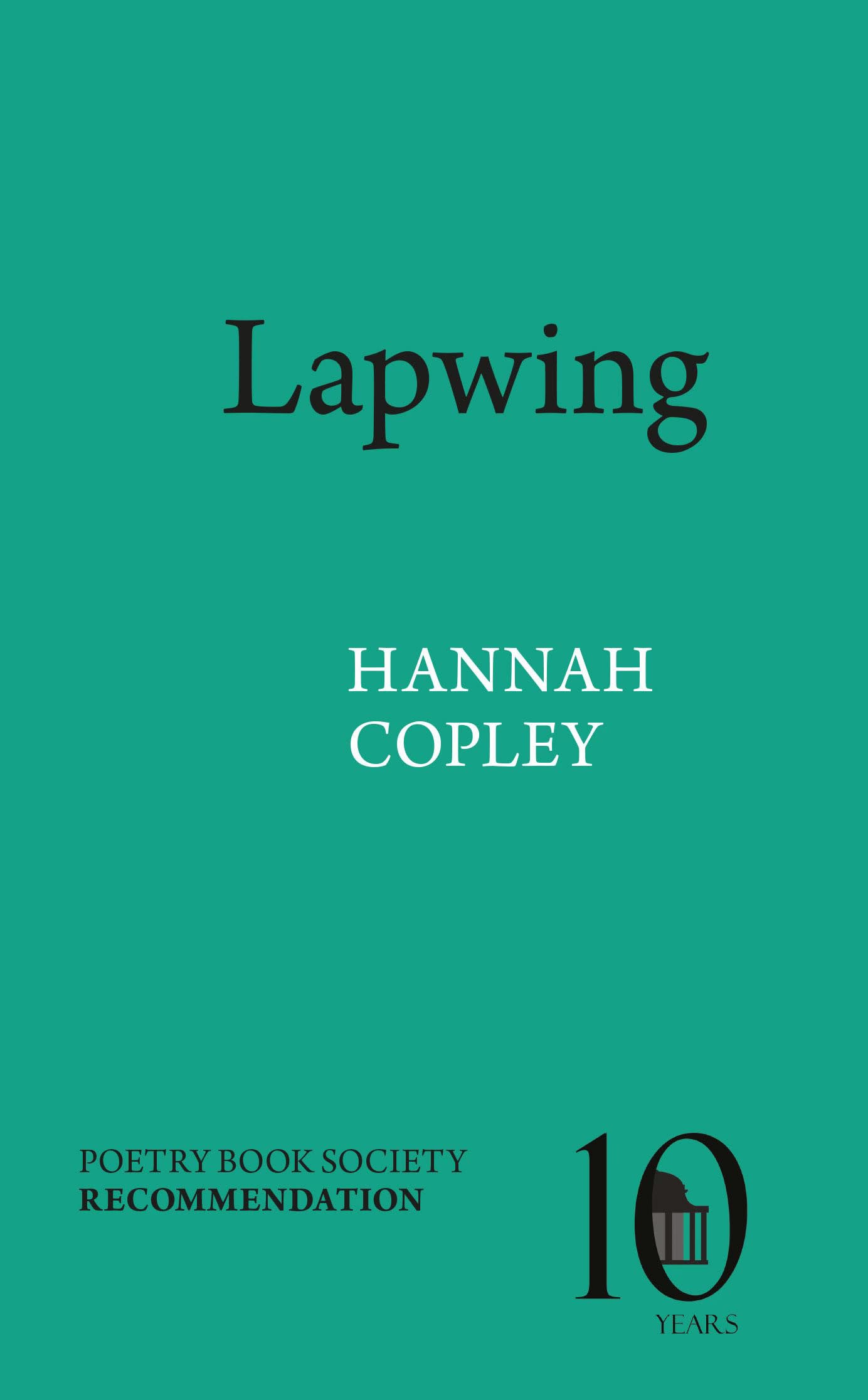
If, on opening Hannah Copley’s second collection, Lapwing, you were expecting a female counterpart to Ted Hughes’ Crow (Faber, 1970), you’d not be too far from the mark. Both Copley and Hughes use birds as ways to reflect on life – or some lives – on our corner of this planet. However, while Hughes anthropomorphised corvids into mythical figures, tricksters at the heart of creation myths, the sequence of poems which makes up Copley’s book is more rooted in the mundane struggle for existence in Britain, both recently and now.
In Birds Britannica (Chatto & Windus, 2005), the magisterial compendium of British birds and their place in folklore and everyday lives, Mark Cocker and Richard Mabey note about the (Northern) Lapwing that, “Few birds have created as large a cultural legacy in Britain as the most beautiful of our plovers”. But that beauty – not just of its plumage, its crest, and its call (which gives it its most common alternative name, ‘peewit’) but also of its acrobatic courtship display flight – has been the species’s downfall throughout the centuries. It has, of course, also been hunted for food – both the bird itself and its eggs. The British Trust for Ornithology estimates the reduction in the bird’s breeding population between 1967 and 2002 as a whopping and tragic 67%. No wonder, then, that the species is on the Red List for birds of the highest conservation concern.
Cocker and Mabey also note: “Direct persecution may have ended, but unfortunately lapwings have not prospered in the modern farming environment. The population has undergone a dramatic slump”. This wording is echoed by Copley in one of her most prose-like pieces, ‘XX’:
With numbers in such sharp decline, with the state of
agriculture as it is, with the increased conversion of
arable land to pasture, with the use of increasingly
large machinery, with the sale of land to developers,
with the melting of the ice caps, with rising sea levels […]
The poem continues in this vein of (rightly) decrying habitat and bird-number loss and the impact of climate change; it could easily be read as a critique of Defra and the NFU. Perhaps the influence of Claudia Rankine’s Citizen: An American Lyric (Graywolf / Penguin, 2014) can be detected in the deliberate flatness of the writing. But it moves seamlessly into Copley’s imagined world of lapwing characters eking out subsistence:
[…] Having no solicitor, tew-it, otherwise
known as peet-peet-peet, otherwise known as Vanellus
vanellus of the family Charadriidae, acts as his own
executor, draws up his estate: twig, feather, fluff, dried shit,
corn husk, dried grass, clod, some calcified, some not. Tew-it,
otherwise known as Lapwing, otherwise known as progenitor,
cries out the names of his surviving issue: Peet-Peet-Peet.
The technique of anaphora – repeating the phrase ‘otherwise known as’ here, and in nearly every poem in the sequence – is brave; there’s a thin line between the incantatory spell of repetition and the risk of tedium. For the most part, Copley uses it with wit and an admirable sense of defiance. Repetition works as a unifying device, albeit a rather heavy-handed one. It also functions as a reminder that the lapwing, under its various names, whether its Linnaean classification or dialect alternatives, is a shapeshifting creature that won’t be tamed or beaten into extinction, despite human actions.
The bird’s nesting and other habits are squirrelled into the poems rather than elbowed in; Copley’s background reading was evidently wide-ranging, and gives the work a solid grounding. Surprisingly, however, she doesn’t cite any sources in her acknowledgements. Lapwing is, of course, a creative enterprise, not a scientific treatise, but that omission seems remiss.
Lapwing, though, has a higher, altogether more ambitious aim than simply offering a reckoning of species and habitat loss in modern Britain
Lapwing, though, has a higher, altogether more ambitious aim than simply offering a reckoning of species and habitat loss in modern Britain, important though that is. The back cover blurb insists, in rather confusing syntax, that: “At the heart of the book are the shifting figures of Lapwing and Peet, two creatures whose overlapping narratives echo the double note of the bird's cry. In Lapwing, known by countless names, migratory, and slowly disappearing beneath addiction, Copley examines a life in a slow tumble, as we are transported into a world shaped by real and imagined predators. Running alongside Lapwing is the searching voice of Peet, a daughter left to understand her father’s vanishing while trying to make a life in a habitat no longer fit for survival”.
There are few unambiguous traces of this intention. There are references to a bar and a couple of website addresses in the acknowledgements for those living with alcohol addiction and their supporters. There’s also a photo of (presumably) the author as a young girl, with her father. Finally, there are occasional glimpses of birds-as-humans, such as:
Eyes glassy in Fitzwilliam Street, standing at his full height between a swan and a European woodpecker. Lapwing inserted into a family tableau, mounted as the loving father of three dead chicks.
(from ‘[SIGHTING, Cambridge 2021’)
However, while Lapwing and Peet do at times offer different perspectives, I feel their characters are not always well differentiated. Regarding Copley’s intention, I’m reminded of the descriptions encountered in galleries alongside artworks, the full ‘meaning’ of which could not be discerned without the texts. Without the blurb on the back jacket, I very much doubt I would have picked up on it. In places, one does intuit that the depiction of the Lapwing character may allude to the father’s unhappy situation:
Nothing muscular enough. Nothing
wholly anarchic. Lapwing simply wishes
violence upon the whole of Birdworld.
Upon the whole of himself.
(from ‘XVII’)
But there’s no overt metaphor-making in the manner of, say, Pascale Petit, who has recounted and transformed childhood trauma through various inhabitants of the natural world. Whatever emotional release it provides for the author, Copley’s use of the bird characters as metaphors is more subliminal, perhaps growing apparent after multiple re-readings.
The sequencing of the poems in Lapwing doesn’t bestow a perceptible narrative either. The dated ‘[SIGHTING’ pieces are not placed in strict chronological order, although towards the end, the reader might sense some semblance of a playfully expressed denouement:
Otherwise known as no reply. As silent heron,
silent hookwink, silent coot. A clear Peet-Peet
shrilled alone in a fallow field, otherwise known
as devoid. Knowledge felt as drained pond,
louring sky, slaked grass, flushed clutch, as
otherworld. Lapwing, transmuted, remains
unmoved.
(from ‘XXVI’)
Here, the sentences begin with nouns without articles, making the whole into a list-poem whose cumulative power derives as much from the brevity of the clauses as from their sounds and rhythms. And there’s much to savour in the sound patterns of Copley’s lyrically alliterative and plangent poetry–song:
Otherwise known as Peet-Peet-Peet. Plumage
primped and plucked to perfection, each bright
tail up like a rake, breast down, peck,
crown, otherwise known as hollow-man,
as bust-up, wing smacking the green fool that even
thinks to try his luck in these parts.
(from ‘IV’)
Inside such sonic richness, it would be easy to overlook the assortment of poetic forms. Copley favours the unrhymed truncated sonnet, also sometimes uses the short form of Geoffrey Hill’s Mercian Hymns (but without his indents), and occasionally the prose poem, especially where it can be made to resemble an extended nature note:
Loitering near the military base in October. Flushed at sixty metres. As he became airborne uttered a sharp call. Pigeon-like size, dark plumage, large paddle-shaped wings, and crest identified him unmistakably. Last seen circling a bar in Northern Europe, last seen nesting in Mongolia. […]
(from ‘[SIGHTING, Shemya, Alaska, 2006’)
Most often, Copley uses blocks. Sometimes her poems are numbered. Less often, they are titled. Some are neither numbered nor titled. She also deploys extended spaces between words at times. Such formal variety might be helpful in a collection of thematically dissimilar texts. Here though, despite demonstrating that the poet is able to adjust form to suit content, it seems to me to militate against the book’s unity. This is a minor quibble, however, as is the fact that Liverpool University Press poetry books (they’ve dropped the ‘Pavilion Poetry’ name but kept the logo) are just a little too small for my taste, with a font-size that makes me squint.
One can’t help but admire Copley’s ambition. The execution of her aims may seem less than fully coherent, but this also applies to the avian (and implicitly human) lifecycles of survival which her poems portray. Quirkily and intriguingly, Copley’s final poem, ‘bloated appendix’ is placed after the acknowledgements page at the very back of the book. Its eight sinuous and sensory couplets and three single lines, might very well be the sequence’s stand-out:
Tremble equates to flutter to a shrill catch
of air against the beak. Svalbard sounds like a trainscratching its track, like wind screwing its way
through a loose rivet. Barely a feather, barely a curledfoot left of him and still throwing his voice down
the converted mine shaft.
Matthew Paul lives in Rotherham and worked as a local government education officer for many years. His first collection, The Evening Entertainment, was published by Eyewear in 2017. He is also the author of two haiku collections, The Regulars (2006) and The Lammas Lands (2015), and is co-writer / editor (with John Barlow) of Wing Beats: British Birds in Haiku (2008), all published by Snapshot Press. His second collection will be published in June by Crooked Spire Press. His blog is here.
Hannah Copley is a writer, editor and academic based in south-east England. Her work has appeared in POETRY, The London Magazine, Poetry Birmingham, Stand, Under the Radar, Bath Magg, and other publications and anthologies. Her first collection, Speculum, was published by Broken Sleep Books in 2021. She is a senior lecturer in creative writing at the University of Westminster and a poetry editor at Stand magazine.
As well as browsing our Substack, it’s worth visiting The Friday Poem website where you can browse our Archive of more than 700 posts dating back to early 2021. If you like Matthew Paul’s writing, try his review of Instead of an Alibi by Geoff Hattersley (Broken Sleep Books, 2023), STRIKE by Sarah Wimbush (Stairwell Books, 2024) or The Ayrshire Nestling by Gerry Cambridge (Tringa Press, 2024).
Help support The Friday Poem — buy us a coffee to help us stay awake as we strive to bring poetic excellence to your inbox every Friday. If you can't afford to donate, no worries, we’re going to keep on doing it anyway! Big thanks for everything, you lovely poetry peeps.
Well, I didn't know anything about Hannah Copley, but I do now know I'm going to buy that collection. Amazing poems. Great review by Matthew Paul, too.
Thank you for this.