


Summer in Baldoyle
Two centuries back, Samuel Lewis
in his Topographical Dictionary of Ireland
recorded 12 children attending a hedge school
in Baldoyle. Maybe in the ruins at Grange
or nearer to the holy well of Donaghmede,
or somewhere in the then wild lands of Mayne.
Now that I try to see them in my mind’s eye,
in truth I spy them everywhere: in every clutch and clique,
every clot, as we used to call it back home in Portlaoise
when we met up to hang around and watch
the world go by — outside the Applegreen,
beside the Racecourse chip shop, along the low wall
of St Laurence’s Church: the hedge schools
are in session. Even now, information is being swapped
and news passed on. There is not a hedge, my Liege,
in the entire Barony of Coolock, or in all the land —
no stand of trees or reeds or weeds without
its heedless, nay rebellious summer song.
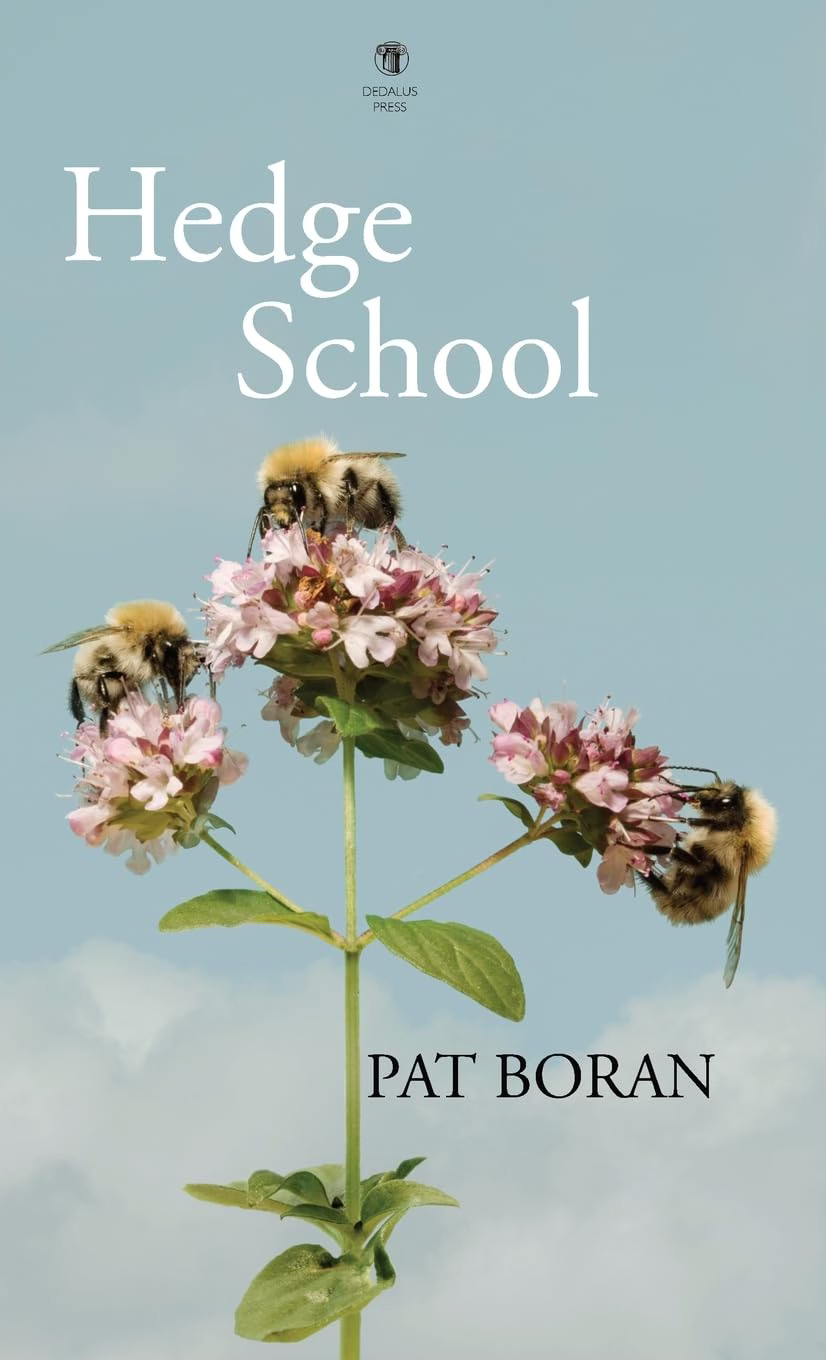
‘Summer in Baldoyle’ is from Hedge School by Pat Boran (Dedalus Press, 2024) — thanks to Pat Boran and Dedalus Press for letting us use it.
‘Hedge schools’ in colonized eighteenth-century Ireland were illegal Catholic primary schools, and the political dimension of the term is present in a number of poems in this, the eighth collection from Irish poet Pat Boran. Not obviously, however, in the first and title poem, which uses both lineation and a mosaic of phonetic effects to great effect to describe a bird:
What’s she at
       out back
that little bag
       of chirps
small beak
       hole-poking
feather-stroking
       nitpicking
stick-amassing
       her tail flashing
stitching nothing
       to nothing more
than empty air
This could serve as a signature poem for many in the collection, not only because of its rhythmic musicality but also because there are several other similarly accomplished bird pieces. ‘Starlings’, for example, conveys how something routine can nevertheless excite through its sportive liveliness. It does this by comparing the actions of the birds to pre-performance musical practices: “Like the warm-up notes / of the orchestra, / the frills and thrills, / the two-step stop / and return / to start again”. ‘Kingfisher’ deftly plays with the word ‘king’ in describing the bird’s typical posture – “sat on a throne / at a self-imposed distance from the action”.
‘Bird Song’ is a simple, yet moving, rhyming poem which illustrates well how rhyme is “a tension, and a provocation to attention and memory, and it can produce a small electrical charge in the language, a charge that often brings with it some degree of illumination” [Boran in the Afterword to waveforms: Bull Island Haiku, Orange Crate Books, 2015]. Even if birdsong is directed to rival birds, “the singing has a second thread / that finds the heart before the head,” and this other thread invites us to (italics in original):
[…] Stop, look — blue sky, red rose.These bright things do not last for long, God knows.
The strong admonition is followed by a simultaneous appreciation and poetic preservation of brightness. The lines impress by coining a fresh proverbial expression out of basic material. While the risk of using such elemental language pays off in this case, Boran’s nature poetry typically showcases his visceral relationship with natural phenomena in greater detail. ‘Greater Stitchwort’, for example, is his paean to a flower (“so pale, so perfect, / so fragile and uncertain / it can only be the future”). The poem opens with a tactile description of what lies above it:
Blackthorn and white-, hornbeam and elm,
a staff or two of silver birch,
higher up the longer-fingered
chestnut leaves, the somewhat aquatic
curve of the leaf of the oak,
the giant handprints-on-sky
that is the sycamore
In ‘Building the Ark’, the text of one of Boran’s poetry films, it is “not that Noah / saves the animals but that the animals, / as ever, save the man”. In developing this theme of learning from nature, the poet plays with the ‘hedge school’ nomenclature by including in his imagery instances of hedges, hedgerows, and even hedgehogs. In ‘Haggard of Sparrows’ a hedge is described as:
                                          […] that neighbour
of difference, of otherness, that place
where town meets country, here
meets elsewhere, where outside peers in
in the dead of night
This idea recurs in ‘Beyond the Hedge’, which designates territory beyond the flowering garden hedge as “the wild lands”. Hedge is border, yet at the same time, “nothing’s more peripheral than a hedge” (‘Rose’).
“Make no mistake”, this poem declares, “the world is cruel and beautiful in equal part”
The rose hips in the perimeter hedge of the poet’s primary school were the source of the “itching powder” used to torment classmates and also illustrated “the truth about limits: // that suffering together is not the same / as suffering alone” (‘Itching Powder’). A different kind of itch, the “itch of poetry”, features in ‘Boundary’, in which the poet confesses to still not being over the mindless vandalism that uprooted and destroyed “that first hedge we planted”:
So, likely, I am the last one left
still dwelling on this, still trying to make sense
of a senseless act, the done-and-dusted story
neither history nor memoir, but the itch of poetry.
Irish hedge schools feature in ‘Penal Laws’, which compares them with the closure of girls’ schools by the Taliban. Nature’s darker side appears in ‘New Homes’, which contrasts those nests that will be built by birds in places like “garden hedgerows” and “rotten fencing” with homes destroyed by the 2023 Turkey-Syria earthquakes: “Make no mistake”, this poem declares, “the world is cruel and beautiful in equal part”.
Boran’s work is grounded in the tangible, but whereas his previous collection, Then Again (Dedalus Press, 2019), focused on found and treasured objects, here autobiography and the natural world provide most of the ‘triggering’ material. ‘Seal’, for example, recounts repeated failed attempts to spot a seal from “the same grey / landlocked bank of stones” but the failure is relative because, in addition to a head cold and sore backside, he ends up with, “on my own old skin, / only this fleeting / if somewhat otherworldly glow”.
‘Zoom’ is a poignant poem, in which the settled author feels “awkward as a zoo visitor briefly looking in / to some unlabelled cage” when he has a video call with an old single friend living in a “cluttered man cave” with “so many empty bottles / that it’s like the morning-after aftermath / of the far too many parties we gatecrashed / a lifetime back in a barely recognisable world”. A typical morning after such parties is described in ‘Hedgehog’, a funny, evocative poem about a group of hungover youngsters watching a hedgehog lap milk “with a tongue like a small pink postage stamp”. ‘Driving South’ has similarly striking imagery when the music from the car radio is loud but so, too, is the “flag of wind / flapping wildly in the rolled-down windows”.
Boran’s tone and style are often conversational and there’s a constant sense of movement and flow. In ‘Summer in Baldoyle’, for example, there are hedge schools in session everywhere – “Even now, information is being swapped / and news passed on” – while ‘Changing of the Guard’ contrasts early morning urban foxes “slipping home in ones and two” across Brixton rooftops with the “rising populace” heading to work below, “entirely oblivious to their presence”.
Hedge School is a substantial and noteworthy addition to the tradition of Irish nature poetry
‘Scythe’ meditates on death in masterly fashion with repetitive, scythe-like sibilance and eerie onomatopoeia:
where the scythe blade now simply swept
all in its path, all with a sound
like a summoning up of silence,
the summer’s summary, but soft as breath.
The collection retains a strong sense of interconnection. Strands such as the hedge and the bird imagery are interwoven with memories and ideas about childhood, youth, education, home, boundaries, modernity, and the environment. ‘New Homes’ describes a pattern in the author’s creativity that will be familiar to many – “I write and give up writing, / and write again and again give up”. Thankfully in Boran’s case, the “itch of poetry” that features in ‘Boundary’ continues to win out. Hedge School is a substantial and noteworthy addition to the tradition of Irish nature poetry.
Tim Murphy is an Irish writer based in Spain. He is the author of four pamphlets, including There Are Twelve Sides to Every Circle (If a Leaf Falls Press, 2021) and Young in the Night Grass (Beir Bua Press, 2022). His first full-length collection is Mouth of Shadows (SurVision Books, 2022) reviewed by Richie McCaffery here.
Pat Boran is an Irish poet, writer and editor, and maker of short poetry films. He is a former editor of Poetry Ireland Review and the current editor and publisher of Dedalus Press. He has published more than a dozen books of poetry and prose. He was born in Portlaoise in the Irish midlands and lives in Dublin.
As well as browsing our Substack, it’s worth visiting The Friday Poem website where you can browse our Archive of more than 700 posts dating back to early 2021. If you like Tim Murphy’s reviews, read his review of A to Z of Superstitions by Ian Harker (Yaffle Press, 2023), or his review of The Shark Nursery by Mary O’Malley (Carcanet, 2024). If you want to know more about his writing, read Richie McCaffery’s review of his first full-length collection, Mouth of Shadows (SurVision Books, 2022)
Help support The Friday Poem — buy us a coffee to help us stay awake as we strive to bring poetic excellence to your inbox every Friday. If you can't afford to donate, no worries, we’re going to keep on doing it anyway! Big thanks for everything, you lovely poetry peeps.