


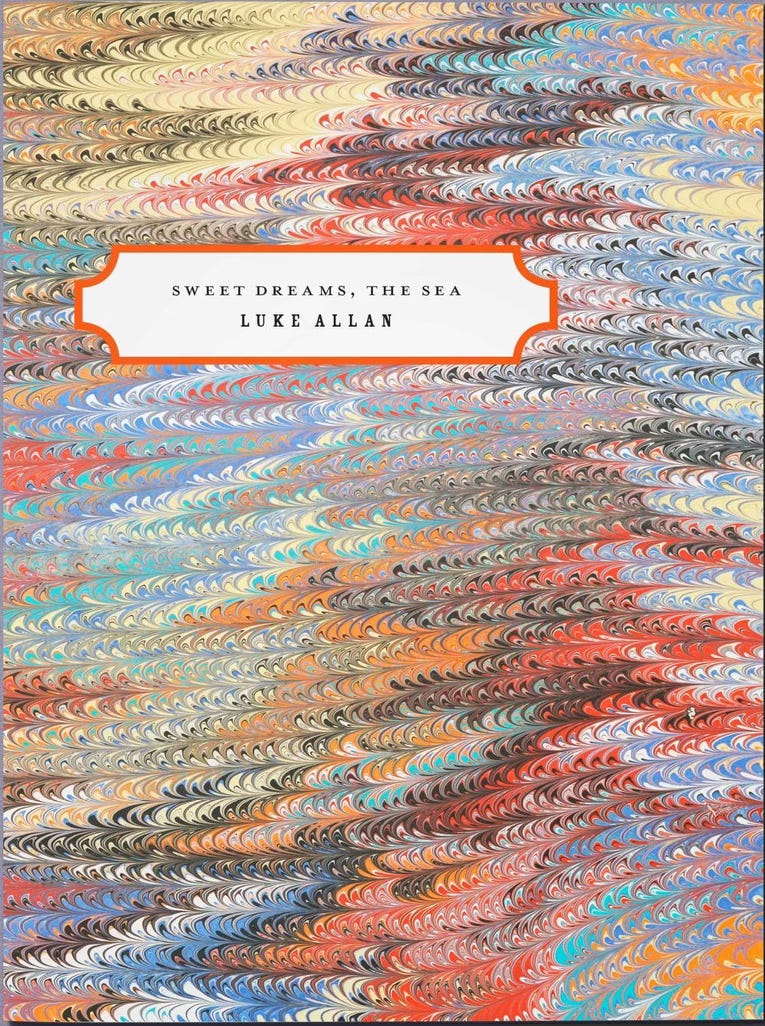
Selected by Ishion Hutchison as winner of the 2023 Poetry Society of America Chapbook Fellowship Award, Sweet Dreams, the Sea is a self-portrait of a man’s life following the suicide of his mother. This intimately personal story is dignified by revelations of vulnerability. The speaker is adrift in a world of loss. With luminous particularity, he seeks connection in a world reconfigured by grief, yet without the expectation of liberation from it.
In ‘Horoscope’ the lost mother is imagined back to life:
I said, it hurts the most in bed at night.
I said, we could have helped you.
She laughed and said the wind is a beautiful crystal
spread infinitely thin, and eventually
the snow kept falling.
The poet’s language is direct and unflinching. The untethered word ‘eventually’ at the break of the line, lingers in the reader’s mind. The snow continues to do what snow does, covering everything that came before and making a blank canvas of the world. Recurring references to snow are metaphors for the inner landscape of the bereaved; soft, relentlessly cold and silent. In the collection’s opening piece ‘Something to show for it’, Allan says:
It’s why I say snow to refer to
what is snowing in me.
In the same poem, his mother’s death is announced bluntly followed by the remark, “You never know what a person is going / to do next”. Here, light-heartedness hauls the narrative away from a dark truth – namely that some human beings inflict unfathomable acts of violence upon themselves and by such acts others are harmed.
This intimately personal story is dignified by revelations of vulnerability
In ‘When you look at the moon you are taking part in the sea’, the science of moon and tide is announced awry, almost as if spoken by a child, the orphaned man returned to his boy-self. ‘The world is mean and won’t make everything okay’ gestures towards anger, an emotion mostly notable for the speaker’s desire to suppress it, maintaining rather than interrupting the reader’s emotional engagement. In ‘The world isn’t wide, just very near’, the child-voice rescues the exhausted adult by offering the solace of his inner world:
I don’t want to feel this anger towards you
for the rest of my life. I want god to eat it
like a horse eating an aubergine, right from
my hand.
Tender feeling dignifies the lost mother and her kindness is memorialised by “a small pebble” that props open the window “so that the room isn’t poisonous by the time / someone finds her”; even her final actions are loving and remarkable for their thoughtfulness.
This is open-hearted, honest writing
Allan pays attention to the finest details, infusing the quotidian with gravitas; drawing his speaker away from the anguish of unanswerable questions. The tension between these two polarities is a driving force of the collection. In ‘Marseille’ a man cooks onions in his truck:
First he lifts them
with the holey spatula, then he tips them back over.[…]
To fail to tell a person you love them
is to take away something that belongs to them.
Strange syntactical arrangements embody the speaker’s confusion and isolation, and this reader shared his bewilderment. An unconventional simplicity of speech recurs throughout, creating phrases that embody the speaker as child and augment a sense of his loneliness. For example, “The birds are singing to the dancing the wind is.” As if he were a child, comfort is sought in the imagined permanence of the natural world, the eye drawn skywards towards the organising metaphors of birds, the wind, and the moon. “The world is mean / and won’t make everything okay.” The boy who grounds himself frequently in the material reality of his surroundings does so as if only in the naming of ordinary things can he begin to make his predicament comprehensible. In ‘First Winter in Iceland’:
Half a pizza
is sleeping in an open box in the car park,
topped with shimmering slices of rain.
Allan’s writing is characterised by gentle humour that resists sorrow and repeatedly, briefly, frees his narratives from the pain of loss:
The name sprayed on the wall of the bakery
is my stepdadad’s, but it seems so unlike him
to assemble his ashes back into a body
and be ready to start over.
In its final pages, the collection has a section dedicated to the poet’s wife, whose steady presence is presented mostly in glimpses. In ‘First Winter in Iceland’:
sometimes
you come in to brush your teeth and I feel
love. A woman is brushing her teeth and
is my wife, I think.
The entire third poem, ‘A taut line between night and morning’, in the section One-word poems (for Vala) reads:
stay
The word ‘stay’ hovers poignantly in a field of white space. “Mourning”, the silent homophone of “morning”, invites the reader into an unstable landscape encompassing both hope (of a new day) and the truth of grief where the speaker acknowledges the irrevocable fact of loss, addressing the lost person with a plea to she who has gone and cannot be resurrected. Also implicit is the effect of light; its illumination and how one might interpret its absence. By the employment of an extremely pared-back lyric within the four poems in this section, Allan reaches for simplistic understanding in the aftermath of a profound personal tragedy. This conveys the central theme of the collection: the endless confusing complexity of suicide.
Sweet Dreams the Sea is a meditation upon loss. With eloquent simplicity, the poem ‘What counts as light’ acknowledges the limitations of what can be conveyed linguistically. “I am learning to say no longer with us. / I am learning to say took her own life.” In the final piece, ‘Snow Nights’, Allan and his wife discuss leaving Iceland, “its big dumb moon / its unkind beauty”, for an unnamed destination. No longer alone, thoughts of ‘moving on’ are assigned to the couple. Their togetherness is ordinary and complete. They talk to each other in whispers and eat “tubs of sweet meaningless” ice cream in the car with the radio on. The speaker circumambulates grief in the presence of his wife. “And in the end we were only human”, he says. This is open-hearted, honest writing.
Vanessa Lampert is an acupuncturist, editor and teacher. She writes poems slowly and is widely published. Poems from her first collection Say it With Me (Seren, 2023) were selected for The Forward Prizes anthology 2024, The Telegraph poem of the week and The National Poetry Competition anthology 2020.
As well as browsing our Substack, it’s worth visiting The Friday Poem website where you can browse our Archive of more than 700 posts dating back to early 2021.
Help support The Friday Poem – buy us a coffee to help us stay awake as we strive to bring poetic excellence to your inbox every Friday. If you can't afford to donate, no worries, we’re going to keep on doing it anyway! Big thanks for everything, you lovely poetry peeps.