


The Watcher
I am a watcher; and the things I watch
Are birds and love.
Not the more common sorts of either kind.
Not sparrows, nor
Young couples. Such successful breeds are blessed
By church and state,
Surviving in huge quantities. I like
The rare Welsh kite,
Clinging to life in the far Radnor hills;
The tiny wren,
Too small for winter; and the nightingale,
Chased from her home
By bulldozers and speculating men.
In human terms,
The love I watch is rare, its habitat
Concealed and strange.
The very old, the mad, the failures. These
Have secret shares
Of loving and of being loved. I can’t
Lure them with food,
Stare at them through binoculars, or join
Societies
That will preserve them. Birds are easier
To do things for.
But love is so persistent, it survives
With no one’s help.
Like starlings in Trafalgar Square, cut off
By many miles
From life-supporting trees, finding their homes
On dirty roofs,
So these quiet lovers, miles from wedding bells,
Cherish their odd
And beastly dears with furtive, fondling hands
And shamefaced looks,
Finding their nesting-place in hospitals
And prison cells.
’The Watcher’ is from Not My Best Side, Selected Poems by U.A. Fanthorpe, edited by John Greening, with a preface by A.E. Stallings (Baylor University Press, 2024) — big thanks to Baylor University Press for letting us reproduce it here.
I’d been meaning to read U.A. Fanthorpe (1929-2009) ‘properly’ for a long time. Her widely anthologised poem ‘Atlas’, about the ‘sensible’ side of love has been a favourite of mine for years, and Christmas wouldn’t be Christmas without quirky festive poems by U.A.F. popping up all over the place online. So, when I saw that John Greening had edited a new Selected, I decided that the time had come to get to know her better. I’d been attracted by her humour, her warmth and her unpretentious ‘grounded’ quality. Greening’s selection confirmed the best of my expectations, and took me deeper.
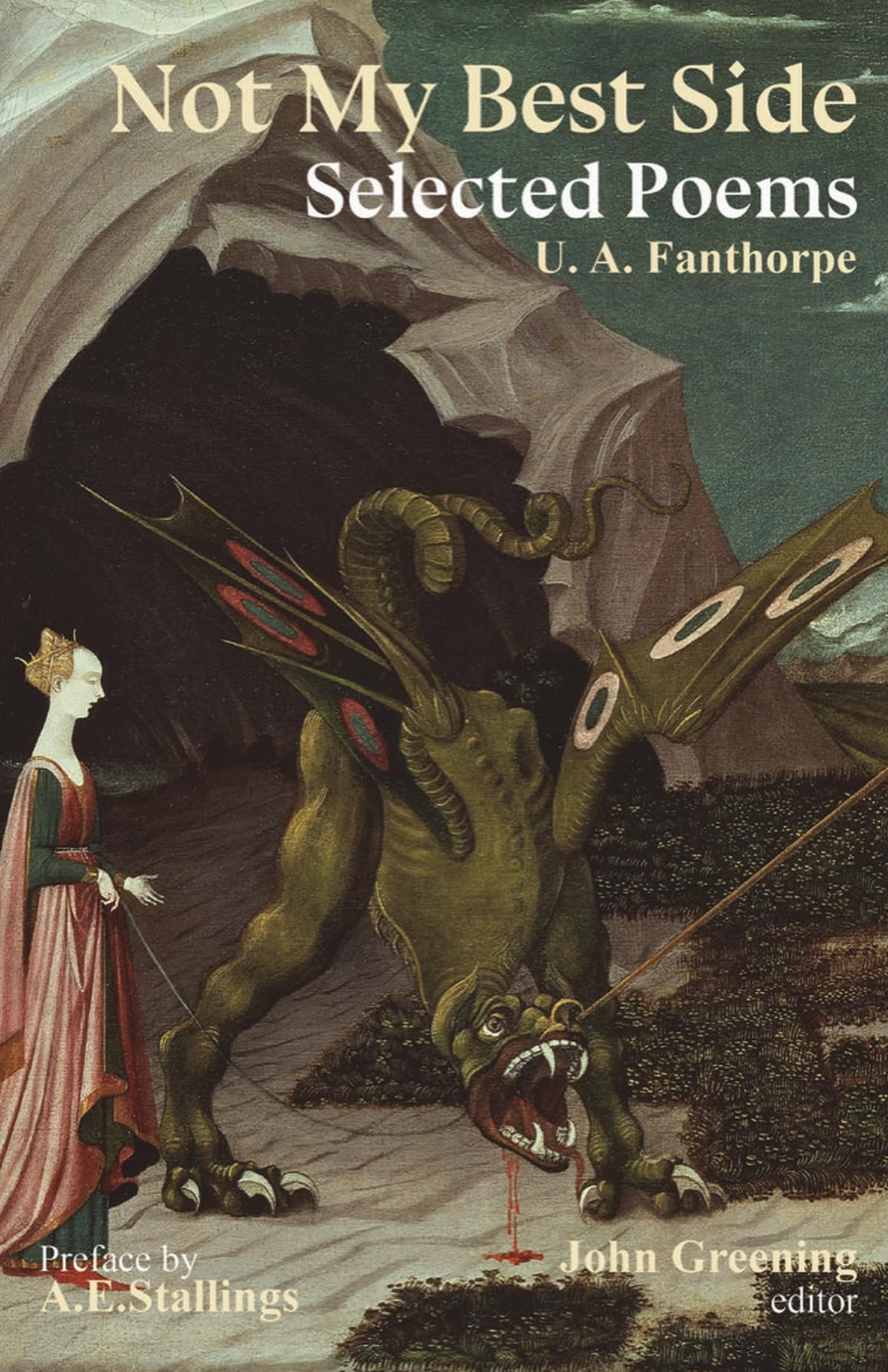
For anyone who doesn’t know Ursula Fanthorpe’s poetry (I’ll mostly refer to her as U.A.), Not My Best Side would be a good place to start. The book is published in the USA with an American audience in mind but, as an English reader, I found it suited my ‘getting-to-know-you’ purposes very well. There’s a substantial and informative preface by the American poet A. E. Stallings; a foreword from U.A. herself, taken from an earlier collection, plus a sensitively written editor’s introduction and a biography. I felt as if I’d had a tutorial from some top-notch dons before I started on the actual poems. Greening also provides generous notes to many of the poems, designed partly to help American readers with specific references (Ovaltine, Hovis, the Giro; abbreviations like QC and MP; events from English history etc.) but the notes go much further than this. I found them useful, and often educational. Greening has organised the poems alphabetically by title, a method which he says was favoured by U.A. herself. The chronological and thematic randomness of this approach allows for interesting juxtapositioning and does, I think, loosen the editorial ‘grip’, allowing the poems to speak to each other in fresh ways which neither the editor nor the poet might have expected. It works well.
For anyone interested in further reading, Greening provides a reference next to each of the 126 titles on the contents pages, allowing the reader to find the source. There is also a full list of titles and the collections they come from at the back. At £15.99, it’s not cheap, but the production values are excellent. It’s a thoughtfully compiled book, aesthetically pleasing to handle and to read.
So, what of U.A. herself? And what of the poems Greening has chosen to include?
Ursula Askham Fanthorpe was born in Kent in 1929, read English at Oxford, then trained as a teacher. She was Head of English at Cheltenham Ladies’ College until her mid-forties when she left the college to become a receptionist in a neurological hospital. This freed her up to write poetry which she began publishing at the age of 49. A practising Quaker, she was the first woman to be nominated for the post of Professor of Poetry at Oxford. She was awarded the CBE in 2001 and the Queen’s Gold Medal for Poetry in 2003. She died in 2009, leaving behind her long-term partner and fellow poet, Rosie Bailey.
Fanthorpe was prolific, publishing thirteen volumes in her lifetime. Her poems encompass the many things her lively mind knew about and loved – history, art, education, mythology, language and literature, old churches, the Bible, English heritage, and above all, people. Her poems are eminently readable, full of wit and infused with a quality of gratitude and generosity. It’s noticeable that many poems are dedicated to friends and quite a few are written to be read by two voices. She and Rosie Bailey would often perform the poems as a double act.
Her poems are eminently readable, full of wit and infused with a quality of gratitude and generosity
It’s significant that Fanthorpe didn’t write poetry until she’d left the (presumably rarified) environment of Cheltenham Ladies’ College to take up much lower-paid work in a hospital. It was watching the lives, joys and suffering of patients and staff (as Stallings says, “the humble and the unsung”) that inspired her. She felt compassion for them, identified with them and wanted to give them a voice. As she says in her poem, ‘The Watcher’, which prefaces this review:
The love I watch is rare, its habitat
concealed and strange.The very old, the mad, the failures. These
Have secret shares
Of loving and of being loved.
Fanthorpe lived at a time when to be a gay woman was, if not actually illegal, something to be ‘concealed’. It can’t have been easy, but I suspect it deepened her capacity to empathise with the marginalised.
In his introduction, Greening says, “If I have given this selection any ‘spin’, then it is to present more of U.A. Fanthorpe’s spiritually inclined poems.” It’s not surprising that Greening might lean in such a way, given his commitment to Christianity, but I have to say the selection didn’t strike me as particularly skewed. This could be because I too am drawn to ‘spiritually inclined’ poems. But it might also be because there’s nothing ‘in your face’ about U.A.’s faith. Quakerism’s inclusive, non-dogmatic style suited her temperament, and her religious poems are often gently humorous and sometimes mischievously irreverent. They also leave plenty of room for doubt and discomfort. Her subtle, multi-layered poem, ‘Daffodil Ministry’, is a good example. The setting is a Quaker meeting where someone is “daffodilling on” about the solace of seeing daffodils on her morning walk:
O yes, of course the world is harsh,
And suffering, O yes—and yet
This morning, as I walked along
And saw the daffodils, I thought—
The triteness (as with Wordsworth’s famous poem, once learnt by rote in every classroom) is, at first, embarrassing:
And yettishness: a state of mind.
[…]
Easier not to meet each other’s eyes.
But in the subsequent silence, the poet goes on to reflect on how daffodils do indeed sprout everywhere, offering their tawdry consolation (“Long-legged, gape-mouthed”), proliferating alongside the miseries of “Homelessness, poverty / Injustice, executions, arms trade, war”. “The stillness isn’t easy with itself,” she says, “And yet; and yet.” U.A.’s spirituality is a corporeal, compassionate spirituality. As Stallings says in the preface, Fanthorpe is more in tune with Beatitudes than the Commandments.
In a poignantly tender poem, ‘Christmas Presents’, we find Fanthorpe in hospital (for cancer surgery) being visited by her partner. The poem starts jauntily:
Christmas, very, have a merry very
A very merry Christmas, trilled the cards.
In gynae wards that means: There is a future.
Later in the poem, she notices that the people visiting a terminal patient in the next bed to hers are staring at her and Rosie. Far from resenting the apparent rudeness, she decides that they:
Stared at us out of tact, no doubt,
Somewhere to rest their smarting eyes, but also
(I like to think) because we were,
Of all things, human;Human, of all things.
U.A.’s poems get under the skin of what it means to be human because she feels deeply and has experienced suffering herself. Some poems touch on her struggles with depression. In ‘A Minor Role’, she writes:
[…] in the street you may see me
Walking fast in case anyone stops:
O, getting on, getting better my formula
For well-meant intrusiveness.[…]
Thinking ahead: Bed? A good idea!
(Bed solves a lot); answer the phone,
Be wary what I say to it, but grateful always;[…]
Cancel things, tidy things; pretend all’s well,
Admit it’s not.
But this same poem ends with the line: “I am here to make you believe in life.”
U.A. is a life-affirming poet and there is far more light than darkness in the poems. The randomness of alphabetical ordering allows the humour to shine through between the more sombre pieces. I found myself smiling often and sometimes laughing out loud.
The randomness of alphabetical ordering allows the humour to shine through between the more sombre pieces
Both Stallings and Greening comment on Fanthorpe’s Englishness. “Englishness is a difficult concept for the English these days,” says Greening (carefully sidestepping the minefield a more political statement might ignite), “but I suspect that most readers of this volume will be untroubled by questions of what it means.” I, for one, wasn’t troubled. U.A.’s Englishness has nothing do with xenophobia or bigotry, but everything to do with her love of England’s history and geography, its idiosyncrasies and its language. The poem, ‘Earthed’ reads like an ode:
In serious Cotswold uplands, where
Limestone confines the verges like yellow teeth,
And trees look sideways.[…]
Or Somerset belfries, so highly
Parochial that Gloucestershire has none, or
Literate thrushes,Conscientiously practising the
Phrases Browning liked, the attitude Hughes noticed,
Or supermarketsWhere the cashiers’ rudeness is native
To the district, though the bread’s not
Would American readers appreciate this poem, I wondered? Dyed in the wool anglophiles might, but, as with many Fanthorpe poems, the cultural specificity (despite Greening’s excellent notes) could be a problem.
From a personal point of view, my only disappointment with John Greening’s choice of poems is that he omitted ‘Atlas’ – the poem that brought U.A. to my attention in the first place and which many poet friends also love. No matter – personal selections can’t please everyone. However, I found his overall choice very enjoyable; he's inspired me to read more, and I’ve now bought a handsome second-hand edition of the posthumously published (now out of print) New and Collected Poems. It contains nearly five hundred poems, including ‘Atlas’ so I shall be busy for a while now, hunting out other gems he might have missed!
I loved that Not My Best Side ends with a sharply humorous piece. “You will be hearing from us shortly” satirises the modus operandi of interview panels. In the poem, we hear the patronising voice of the panel, but are left to fill in the interviewee’s answers for ourselves:
And now a delicate matter: your looks.
You do appreciate this work involves
Contact with the actual public? Might they,
Perhaps, find your appearance
Disturbing?[…]
And your accent. That is the way
You have always spoken, is it? What
Of your education? Were
You educated? We mean, of course,
Where were you educated?
And how
Much of a handicap is that to you,
Would you say?
U.A. Fanthorpe won’t be to everyone’s taste. As Greening says, “It’s inevitable that some readers coming to Fanthorpe’s work will feel that the poetry is too much of its time, that it has dated.” I didn’t mind this (perhaps because I’m old!) although I did find the stereotyping of characters jarred occasionally. Listen, for example, to ‘The Cleaner’:
I’ve seen it all, you know. Men.
Well, I’ve been married for thirty-two years,
I can do without them.
I know what they’re after.[…]
But these post-grads are older,
They take advantage. These girls, mind,
They’re not all as innocent as you’d think.
Twenty stubs in the ashtray.I can tell a lot from that.
But then Fanthorpe speaks to us from a world before emails and mobile phones, when attitudes to many things were different. The poem above may well be quoting verbatim from something overheard.
Elsewhere Fanthorpe delights in challenging the status quo. Her poem ‘Either/Or’ struck me as very contemporary-sounding:
If you’re not rich, you’re poor; if you’re not gay, you’re straight;
If you’re not North, you’re South; you’re skinny, or overweight.
If you’re not Bartok, you’re Blur; if you’re not black, you’re white;
Don’t spoil your voting paper. We’ve no programme for sometimes, or quite.[..]
These, they say, are your choices. Just tick the relevant box.
But what if it so happens we don’t want to be orthodox?
If we wear our rue with a difference, don’t fancy this or that,
If we choose to sport a whole hatstand of different kinds of hat
U. A. Fanthorpe is a one-off. She’s that rare treasure, a poet who’s both highly intelligent and accessible. She’s also endearingly modest. As Stallings says, “Her work is consistently unpretentious, wearing its considerable learning lightly, and is plainspoken but not affectless.” Whether this selection of poems will speak to American readers, I can’t say. But I hope it does.
Annie Fisher's background is in primary education, initially as a teacher and later as an English adviser. Now semi-retired she writes poetry for both adults and children and sometimes works as a storyteller in schools. Her most recent publication is Missing the Man Next Door (2024) from Mariscat Press. Two previous pamphlets were published with HappenStance Press: Infinite in all Perfections (2016) and The Deal (2020). She is a member of Fire River Poets, Taunton.
U.A. Fanthorpe (1929 – 2009) spent her earliest years in Kent. She attended St Anne’s College, Oxford, afterwards becoming a teacher and ultimately Head of English at Cheltenham Ladies’ College. She only began writing when she turned her back on her teaching career to become a receptionist at a psychiatric hospital where her observation of the “strange specialness” of the patients provided the inspiration for her first book, Side Effects. Since that relatively late start, Fanthorpe was prolific, producing nine full-length collections, including the Forward Prize-nominated Safe as Houses and the Poetry Book Society Recommendation Consequences. She was awarded a CBE in 2001 and the Queen’s Gold Medal for Poetry in 2003.
As well as browsing our Substack, it’s worth visiting The Friday Poem website where you can browse our Archive of more than 700 posts dating back to early 2021. If you like Annie Fisher’s writing, try her review of The Wind and the Rain by Anthony Wilson (Blue Diode Press, 2023) or her features on poetry books and poetry anthologies for children. If you want to know more about her poetry, read Jane Routh on Missing the Man Next Door by Annie Fisher (Mariscat, 2024).
Help support The Friday Poem – buy us a coffee to help us stay awake as we strive to bring poetic excellence to your inbox every Friday. If you can't afford to donate, no worries, we’re going to keep on doing it anyway! Big thanks for everything, you lovely poetry peeps.
Absolutely love UA Fanthorpe, for all the reasons you give. I'm tempted to buy the book, even though I have the original Selected Poems and quite a few individual collections, but the shipping from the USA is a bit off-putting!
I’ve been posting a daily poem.