


"To find myself in thou": Peter Gizzi, a poet's poet?
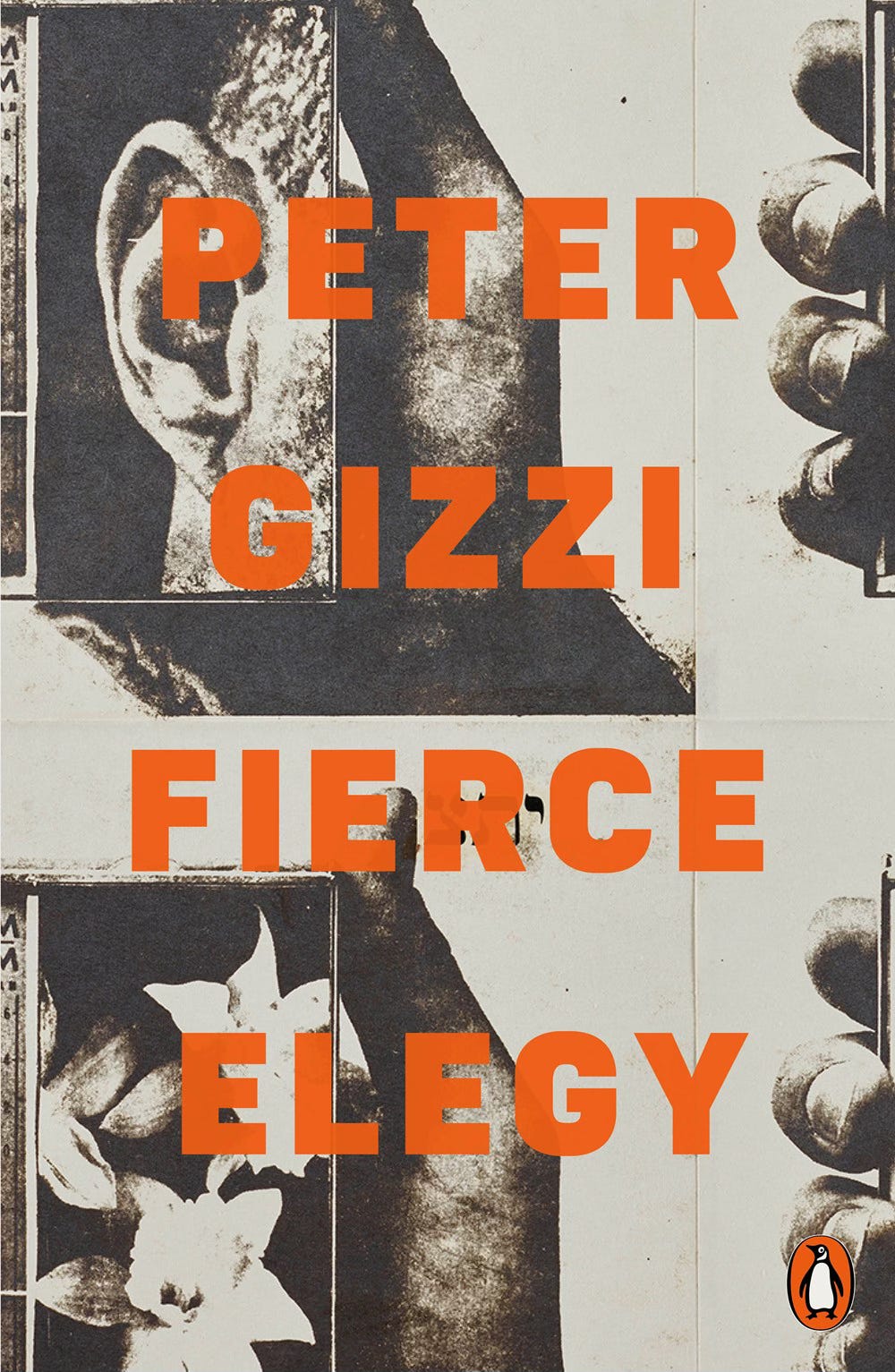
Nell: The T.S. Eliot prize is the UK biggie, no question. So there are always loads of people who disagree with the choice of winner. The question is, shall we join them, or do we think Peter Gizzi is the bizz? Fierce Elegy isn't a long book, so you can read it fast. Which I did. And then again. For me, it was like doing a jigsaw puzzle with a thousand pieces and a picture on the lid of nature and grief. I assembled quite a lot that were obviously bits of grief, and some more seemed to be about poetry (the business of making it). A few of them joined together and looked promising. But there were far, far more that meant absolutely nothing. Endless bits of sky. The only phrase I can remember now is “to find myself in thou” because it's weird, and weirdly biblical, and because it didn't say “to find myself in thee”.
Hilary: Interesting, isn't it, how these archaic pronouns sometimes pop up? Thee, thou, thy and thine – not used these days apart from in some regional dialects, in religion, and (it seems) in poetry. To me they sound sound odd, old-fashioned and anachronistic. Especially so in Fierce Elegy, where Gizzi teams them with some slangy, down-with-the-kids expressions. "Thus spoke the silvered asphodel” and "to find myself in thou" inhabit the same poem as "It was kinda real, and kinda not.” Such different registers – it was the first thing that struck me. What’s Gizzi trying to do here?
[You and I, Nell, have had a small private conversation about Gizzi’s use of the phrase “to find myself in thou”. From it I have learned two things. One is that thou is subject and thee object, as in, "Shall I compare thee to a summer’s day? Thou art more lovely and more temperate”. Also that you are (thou art) a kinder person than I am. Or maybe just more circumspect. You gently suggest that his phrase is weird (not necessarily a bad thing), but this makes it memorable for you (probably a good thing) and you then (kindly) try to justify it as a pronoun shift. I just think he got it wrong.]
Nell: What’s he doing? I’m not sure, but it's one of his recurring features, the mingling of registers. Draws reader attention, I guess. Post-modern shenanigans.
Hilary: The second thing that struck me was the overall lack of affect, the flatness. Apparently, the whole book is a kind of elegy for Gizzi’s two brothers (one died in 2010 and the other in 2018). The blurb creates daunting expectations. My heart sinks when I’m called on to read “poems of loss; of love; of the strangeness of being a self amid the fury of the world; and of our ongoing closeness with the dead”. Poems that are "soaring yet grounded, vulnerable and brave”. Too much, too much. But this sort of puffery does mean I open the book anticipating some really heavy stuff; a rending of garments and a howling at the stars, or at least a bit of unmediated keening. Grief, pain, emotion – these have become the currency of contemporary poetry, and they demand an open vein. Not here. I read right through and got to the end unmoved. I couldn't decide whether I felt relief or disappointment.
Nell: I thought I would realise who the subject of the elegy was, like Tennyson's 'In Memoriam’ or Dylan Thomas's ‘Do not go gentle into that good night’. But after two readings I had no idea. So knowing about those brothers is useful, although I don't think it's going to help my jigsaw. Which raises another issue for me. According to the puff quotes, someone in the New Yorker said: "He identifies the thing we're all searching for", which I took to mean solace for universal grief. But I never found the "thing" he had identified, though I usually like elegiac modes. We all respect grief, don't we? We know that thing.
By the way, the book currently ranks fifth on The Amazon 'Erotic Poetry' best seller list. Yesterday it was first. It's only ninety-eighth in the ranking for 'Death and Bereavement'. I guess this must be something to do with an A.I. trawling for key phrases – which shows the kind of sense machines make of essentially abstract literature. Did you find any particular poems that stood out for you, perhaps as interesting, if not moving?
Hilary: I have found one poem of Gizzi’s that I really like. Unfortunately it’s not in this book (it’s on the Poetry Foundation, here).
Nell: Oh yes. I like that very much too! If only there were more like this. This is a man who (in various interviews) makes a big thing of 'syntax', although he uses that word differently from me. Often, it seems to me he uses it almost synonymously with 'language'. In any case, in 'In Defense of Nothing' (which seems to be at least ten years old) he is using ordinary, logical syntax. By 'syntax' I mean putting words and phrases together to communicate meaning through grammatical structures. In that short poem you tracked down, each sentence has an active verb, so it's easy to follow the thinking. Only the final sentence is verbless, but it's following the pattern of earlier statements, so the verb is implied.
In Fierce Elegy, the sentence forms are different. In an interview with Jennifer Chang after the 2023 publication of Fierce Elegy in the USA (which for some reason didn't disqualify the Penguin edition from the Eliots the following year), he says: "What’s nice about being a poet [...] is that I get to build my own syntax. And that’s a huge thing. It’s a great marvel and a great life experience to just keep on building a syntax, because syntax connects us to the world." But it seems to me that his syntax disconnects more than it connects. It's often fractured and puzzling. Someone at a bus stop in Glasgow would have no idea what he was talking about. Imagine if he approached them with the opening lines of 'Findspot':
Thus far we have spoken
only the codes,
a litany of survival.
Thus spoke the silvered asphodel
next to the factory ruin.
Sound carries on water.
My subject is the wind.
To take umbrage at what a tree can do,
watching one single birch
become lightning stunning the sky.
Language is a made thing,
to see the mind seeing itself.
To see thought, a wing
in night, a long brooding.
Take it, listen, the night is orchestral
when the power's on.
Everything disporting.
A furred wand upon nothingness.
They wouldn't let him on the bus! A whole set of statements and non-statements with no conjunctions. No ands or buts or becauses. Some lines have no active verbs, and the last sentence has no verb at all. What's the silvered asphodel doing with a litany? What codes? Why is he sounding like the Prayer Book? What on earth is a "furred wand"? Is language a 'made thing' or is it a medium for making things with? What does all this mean?
Hilary: Furred wand, fnarr fnarr.
Nell: Oh please.
Hilary: Sorry. Back to meaning. In Fierce Elegy, I struggle to find much to hang meaning on, and if I read it without listening for meaning, I don’t find it particularly enjoyable on the ear. I particularly don’t like the long thin form, which he uses in poems such as as ‘Nimbus’. Here’s a bit of it:
it’s so random
becoming a self
the secret
to my own
piece of sky
behaving as
clouds do
another day
a macular blue
white, steel
I react to this with the same sort of bewilderment that Gizzi says he writes out of. Perhaps that’s his point. And I seem to be almost alone in my bewilderment, which only bewilders me more! Apart from Tristram Fane Saunders, who mounts an extraordinary take-down of the T S Eliot prize award choice (you’ll need a way to bypass the paywall) in the Daily Telegraph, and Graeme Richardson in The Times (also paywalled), who calls Fierce Elegy “tedious and flatulent” and says its win “reflects that weakness of critical culture”, I can find very little criticism of Gizzi anywhere. He is pretty much universally lauded.
Nell: I dislike ‘Nimbus’ too The short lines force you to read in snatches. It goes on for ever. To get through EIGHT pages of this, you have to believe there's a pay-off. I don’t see one.
Hilary: I don’t even like the only poem from Fierce Elegy that Fane Saunders rates highly: ‘Of the Air’ takes the form of eight small blocks of fully-justified text, one per page, each two to seven lines long. Here’s one block (we can’t reproduce it as justified text on Substack, unfortunately, unless we use a pdf, which is not good for screen readers, so you’ll have to use your imagination):
April or little signs. Shall survive. I do not think.
Will take place. I have had. What does ever. A little
effort. Rushing things. I am less given. Still have
my fits. Be on guard. Be sure crying. In a state.
Spoil everything.
Saunders calls it a "piercing prose sequence with shades of Beckett” and says it’s the book’s highlight: “hard, spare, real”. What did you think of it, Nell?
Nell: Hm. It's like one of those poetry games where someone cuts up a poem into dozen of phrases and then you're invited to put them together again. But I went back to the Fane Saunders' write-up. He actually says: "Still, Gizzi’s a real poet: his poems always strive to achieve things only possible in poetry, even when they’re prose. Listen, only, to the staccato gasps of 'Of the Air' [ ... ]" So he's suggesting listen to it, don't read it. If I do that, with the idea in mind that the speaker's wrestling with grief, then I begin to feel something, yes. On the other hand, I think Fane Saunders has swung into over-praise to offset his earlier slating. But what amused me most was his fridge-poetry comment.
Hilary: Fridge poetry?
Nell: He says Gizzi "leans hard on the fridge-poetry nouns (song, life, light, dark, death, sky, cloud, echo, shadow). [...] It’s abstracted rather than abstract – pulling the woolliness over our eyes, or over the author’s own." I like fridge poetry, as a matter of fact. But the issue of abstraction also interests me, the way Gizzi often favours nouns you can't visualise. I mean, you can see the asphodel, the factory, the birch tree. But not the mind, language, or "a long brooding". I can't 'see' a "furred wand" either, unless it's a fluffy shotgun microphone – probably the wrong idea (though perhaps blessedly different from your image).
And if you look at the section you quoted earlier from 'Of The Air', not one actual object features. Everything's left to your imagination, all evocation, nothing tangible. In 'Dissociadelic', he invents an abstract word for the title, and inside the text you get sentences like: “To have crossed over into ink / and to loiter and bleed out / on the occasion of the universe." Work out what it means, why don't you. You're bleeding out (dying) but you're bleeding ink (okay, you're a writer) but hell's bells, what on EARTH is "on the occasion of the universe"? I mean, there are things here, but you can't 'see' them! Some poetry readers seem to thrive on a high degree of abstraction. I'm not one of them.
Hm. It's like one of those poetry games where someone cuts up a poem into dozen of phrases and then you're invited to put them together again
Hilary: Reading and watching Gizzi talk about his work is interesting, in that his speech is quite a lot like his poetry – overtly intellectual, difficult to understand, full of abstractions. He says poetry taught him that he could “transform a broken heart in a fierce world into a fierce heart in a broken world.” I think this is a bit glib, like marketing speak. He describes the process of writing poetry as “a form of discovery within the baffles of pronominal reality.”
Nell: The whats?
Hilary: I know. He uses a lot of abstract concepts: “neuro-hormonal energy”, the “psycho-political”, “fugitive time”. And, as you said earlier, he talks a lot about syntax, and how he can “build his own”, which, he seems to claim, allows him to “disrupt” and open syntax up “to a different time signature” – does this mean he thinks he can slow down time? What to make of all this? When I was young, my father taught me that the most intelligent people are those who can explain complicated things in simple terms, not the people who use the longest words or most abstract terms.
My feeling is that Gizzi’s book is so high falutin’ and obscure that nobody can point to anything in it and say, he’s done this wrong, or he’s done that badly. You can’t tell what the ‘project’ of his book is – it’s too amorphous and unspecified. So you can't be sure whether he’s succeeded or not. Perhaps Fierce Elegy won the prize (and the twenty five thousand quid that goes with it) because nobody could actually land a punch – the poetry slides away like a “tangle of shadow” or a “wing in night”.
Nell: Carol Rumens wrote about a Gizzi poem in the Guardian about four years ago. "Gizzi allows language its full right to ambiguity", she says. Then she discusses what he may (or might) mean. I got the impression she was privately nonplussed. Maybe everybody is secretly baffled by him, though some are also impressed. All the same, there were times in Fierce Elegy where I wondered whether some of the writing was – well – bad. For example, "the psyche's / paper-blue / hieratic light" in 'Nimbus' – it reads like a send-up. Or in 'Ecstatic Joy and Its Variants', there's "Mahler in the wan distance / heard by a child". Wan distance? And later he writes: "are not all the sounds on my lyre about you" (his lyre??) – not to mention "surely this is about the one thing you do to me" which makes me think of Gerry and the Pacemakers. Perhaps there's intended humour, like in the 'Ecstatic Joy' title, but I'm not sure. I'm on shifting sand.
Hilary: Yes, Tristram Fane Saunders also remarks on Gizzi’s “wan distances”.
Nell: On the other hand, 'Notes on Sound and Vision' pleases me. In fact, I like it. You can hear him performing it here (although I prefer reading it):
It reminds me of Victoria Chang's responses to artworks, although we found much there puzzling too. But 'Notes on Sound and Vision' with a gallery in mind makes sense. And although some of it's pretty abstract, I don't mind that here. I respond to it as a communication. It speaks to me. I find it moving. How does it grab you?
Hilary: I’ve said it before, I think I’m just too literal for this game. What is the consequence of flesh, actually? Landscapes don’t have attitude, and how can an attitude escape? Octaves don’t have colour, and how can an octave unsettle? Unsettle who, unsettle what? I don’t know how to read that long fourth sentence:
How far can vision
take one, how far
do we see
into the painting
thinking of painting,
thinking of canvas,
or the hand
that shaped the arc
loving distance?
I just find this confusing. Surely sleep’s “dim shore” is a cliché. Shouldn’t it be “there are so many people inside” not “there’s so many people inside”? I know I should be able to get beyond these (possibly petty) niggles, and I do (honestly) like some poetry that resists easy understanding – Douglas Oliver is a particular favourite – but for me these niggles get in the way. Perhaps they wouldn’t if I felt Gizzi had something urgent or delightful to say, or put words together in a gorgeous or inspiring way. I do like some of the sounds: “consequence of flesh”, “shadow sand, / marshland, and a road”. The poem starts to make more sense from “Sometimes it’s hard / to know …” and some of the short sentences feel real – “So much room / for love and mayhem” for example – but when we pitch up at “When the thing itself / becomes the thing itself” I lose patience.
Nell: Okay. Cue defence of poem. I can definitely explain the "dark octave", or at least its origins. It's a reference to 'A Dark Octave', the title poem of Rosmarie Waldron's first publication (1967), an 18-line piece about sight, and in particular the idea of seeing darkness. So she's in this book at least twice. Gizzi's title is 'Notes on Sound and Vision', but to me it's more obviously about vision than sound. Either way, it considers perception. In order to perceive things, including artworks, you need a body. That's the "flesh" at the start. But perception via human senses has consequences for the thing perceived; we don't necessarily see it truly. So the idea of the thing itself (Kant would say the thing-in-itself, Ding an sich) is where he's headed. At least I think so.
Hilary: Kant? Oh dear. Go on.
Nell: You're right that the opening lines of this poem are difficult. Like Carol Rumens said, Gizzi encourages ambiguity. Unless it's accidental. How would we know? I'd say even the finest writers can miss their own obscurity. "The consequence of flesh / also comes into / the painting" as an opening statement is less bothersome to me for its flesh/consequences than for the word "painting", which could be a noun-object (the painting on the wall) or gerund (a verb functioning as noun: the act of painting). I could do without that uncertainty. But I can live with it. I can even let "painting" carry both meanings.
I would translate the second sentence ("The attitude of landscape / escapes into a body / thinking of the body") into something like 'when a body is thinking about a [painting of] a body, the body itself starts to look like a landscape'). [By the way, if more people translated poems from English into English, we would see how differently we read them, and some of their authors would be most alarmed. Except John Ashbery, who would laugh.]
Then the third sentence, which is a fragment: "The dark octave unsettled." Here is the reference to Waldron's poem, and it's obscure, yes. He may simply mean the whole idea of perception is made uncertain, "unsettled".
I think the easiest place to start reading this poem is with the fourth sentence, which you said you found hard to parse: "How far can vision / take one, how far / do we see / into the painting / thinking of painting, / thinking of canvas, / or the hand / that shaped the arc / loving distance?" I'm in the gallery now, looking at a canvas. How far can my observation take me into the painting as I think about both the act of painting and the hand that created its shapes, its arcs, its love of distance? And because I know this poem is also about poetic practice, I might also infer 'How far can vision take one into the poem while thinking of writing, thinking of poetry, or the poet who penned the lines and line-breaks?'
But what else is in this notional painting? I'm thinking it's an abstract, and its swirls and whorls might contain human shapes, or landscapes or even water. "Sometimes it's hard / to know the outline / of a body, there's / so many people inside." And here the subject (what's seen) and the viewer (who's seeing it) merge. The canvas may be full of people, but so is the viewer. We carry our dead with us and we read their presences into the world, and this is an elegy for them: "So much room / for love and mayhem."
And now there's a 'turn' as he addresses the reader directly, reminding them that they're reading the poem and the poet, and that it's a two-way mirror. Or perhaps it's a reminder of sound – that we're hearing the voice of the poet. "Come into / the intimate distance / of the picture field. / So much room / for death and song." The word "song" is the clincher: he's definitely talking about poetry because Gizzi sees himself as lyric poet armed with lyre. "Come into the room / where the viewer / is the viewed." Subject and object have merged.
We're outside time and space and we're part of a vast companionable multitude. That's the revelation. Eerie but consoling
And then, finally, the most daring assertion: "When the thing itself / becomes the thing itself." The point of Kant's thing-in-itself is that we can only approach it through our perceptions and therefore we never 'see' it as it is. So if the thing itself becomes the thing itself, some kind of spiritual transition has occurred. Perhaps we've shifted into another dimension. It's a huge leap of faith at the end but I think all the dead mortals are suddenly present and able to see each other truly: "There are so / many people here." And in another sense all the humans who have ever written and painted, all the makers, are here too, alive and interacting. And all the viewers and readers. We're outside time and space and we're part of a vast companionable multitude. That's the revelation. Eerie but consoling. For me, this vision is what he's trying to summon throughout the book, though this is the only point where I feel it. Does any of that make sense to you?
Hilary: I'll think about it. But you do rather make the poem sound like a series of cryptic crossword clues. When the explanatory notes required are longer than the poem itself, one starts to wonder what the poet is up to, what his agenda really is. I don’t want a poem to be instantly accessible, with only surface meaning, that would be dull, but I also don’t want to feel that I have to have the right academic background, a philosophy degree, perhaps (actually a third of my degree was in philosophy, but that clearly hasn’t helped me here).
Nell: I've gone to more lengths than usual, though. Because in this context, I needed to explain in detail why and how I can respond to this poem, unlike much of the rest. And actually I also respond warmly to the Waldrop poem that it references (I can't give a link because it's not available on the web). And I don't think I needed to give the answers to all the clues, except on the dark octave – and half of poetry-world is dropping casual (and even more obscure) references. You can blame T.S. Eliot for that.
Hilary: But hang on, Gizzi says he doesn’t write the poems, he waits and they come to him, as if he’s channelling a mystery. He says: “I have to really be patient, and let them come to me, and then I have to listen, and I have to find a way to record what I hear and arrange that. It’s as if a carrier frequency comes across to me.” What do you think about that?
Nell: It makes me uneasy because it feeds the idea of poet as shaman, especially when he also talks about "grace" and "majesty". But there's nothing new in it, and Gizzi is not the only artist to feel this way. We all know someone who talks about "a given line" (Valéry's la ligne donnée). Agnes Martin, Victoria Chang's subject, waited for inspiration and then painted what it sent her (mostly in horizontal stripes). Robert Graves discussed the Muse in the The White Goddess and was entirely serious about that deity, as were a number of his followers (no Muse, no poems). Stevie Smith said: "All poetry has to do is make a strong communication. All the poet has to do is listen." Humans have probably always favoured "inspired" language, as religious scripture would seem to demonstrate, although the divine source has sent dodgy lines at times. As Stephen Spender said, "One line is given to the poet by God or by nature, the rest he has to discover for himself.”
But back to the issue of elegy, which taps into a universal need, surely. "After great pain, a formal feeling comes." Death affects us all. We do want poems about loss and mortality. They come into their own at funerals. I was at one recently where a poem was read, and a friend smiled at me and said something like, "A poem always does the trick, but of course you know all about that, Nell." And I smiled and said nothing, although the particular poem had made me wince. So there's another issue and it's bigger than Gizzi. It's the gaping chasm between intellectual poetry and popular verse. The book that just won £25,000 will not be read, even selectively, at funerals. It will have a tiny readership. Gizzi is often referred to, I believe, as "a poet's poet". That means that you and I struggle to understand him and most people won't even try.
Another friend sent me a link to Donna Ashworth writing about sadness. "I like this, do you?" she texted. "It's hard for me to respond," I wrote back, "I read too much contemporary poetry". The Ashworth poem is in common measure, which predates the United States. Calling it "song", would be perfectly reasonable. You could sing it to 'The Yellow Rose of Texas', like most of Emily Dickinson (and even Gizzi admires Dickinson). My friend is clever and well-educated and she enjoyed it enough to share the link. It isn't what I look for or need in poetry, although I can see its immediate attraction, some skill too. But it's too easily emotive for me. I want depth. I want clarity and musicality and layers, and subtlety and surprise and meaning. And sentences that trace the thought, instead of dissolving it into a blur.
But our national prize has gone to Gizzi. The TSE award says, publicly, this is the best of the best. This is what we should aspire to. This is what we should be reading and learning from. This is what we should admire. What does that mean for all of us?
Hilary: I can only say what it means for me. It makes me a bit sad. And bewildered. I want the judges to justify their choice of winner with clear and concrete examples. Chair of judges Mimi Khalvati says the book is “a lyric sequence of transcendental beauty”, a “breathtaking" sequence (I always suspect that word, ‘breathtaking’) “in which each line or sentence, often paratactic, non-hierarchical, could be a poem in its own right. As if wordings had been gifted to him out of the aether, one-liners, two-liners coalesce into love lyrics, or a thought enters his head which, step by step, he unravels until a nucleus is reached and pierced. Sometimes eschewing syntax for song, sometimes fractured by loss into a language that sobs and stutters, each poem could also be an ars poetica, freeing a voice that is light and landscape, "‘to come as sunrise / and remember the mother. // And the father everywhere / inside migrating birds’.” Holy moly, Khalvati’s language is almost as abstract as Gizzi’s! I understand broadly what she means, but I don’t share her experience of the book.
Nell: I went and looked up "paratactic" in the dictionary, and yes. One statement after another with no conjunctions. But I fail to see how this produces a set of lines in which each "could be a poem in its own right". Like what, for example? Reaching and piercing a nucleus is a bizarre image. I didn't notice him doing anything of the kind. I've always respected Khalvati's point of view, and her work too. But I simply don't get this. I'm not saying Peter Gizzi's work is hopeless. I think he's more interesting than I expected. The Emperor is wearing some clothes. But he's difficult, he's obscure and he's doing his own thing. This is poetry for an elite. It makes me feel excluded and cross. And old.
Hilary: Peter Gizzi (b. 1959) is no spring chicken. I’m sure poetry was more fun when I knew less about it. I used to write in a spirit of playful curiosity. I don’t know how to find my way back to that, and the T.S. Eliot winner certainly isn’t helping!
Helena Nelson is a poet, critic, publisher and the founding editor of HappenStance Press and Sphinx Review. Her first collection, Starlight on Water (Rialto, 2003), was a Jerwood / Aldeburgh First Collection winner. Her second was Plot and Counterplot (Shoestring, 2010). She also writes and publishes light verse, including Down With Poetry! (HappenStance, 2016) and Branded (Red Squirrel, 2019). Her most recent collection is PEARLS: The Complete Mr & Mrs Philpott Poems (HappenStance, 2022). She is Consulting Editor of The Friday Poem.
Hilary Menos won the Forward Prize for Best First Collection 2010 with Berg (Seren, 2009). Her second collection is Red Devon (Seren, 2013). Her pamphlet, Human Tissue (Smith|Doorstop, 2020), won The Poetry Business International Book & Pamphlet Competition 2019. Her newest pamphlet is Fear of Forks (HappenStance, 2022). She has worked as a student union organiser, journalist, food reviewer, arts critic, organic farmer, script overseer and dramaturge. She is editor of The Friday Poem.
Peter Gizzi is an American poet, essayist, editor and teacher. He is the author of many collections of poetry, including Archeophonics (2016), finalist for the National Book Award; In Defense of Nothing: Selected Poems, 1987–2011 (2014); Threshold Songs (2011); The Outernationale (2007); and Artificial Heart (1998). Honours include the Peter I.B. Lavan Younger Poet Award from the Academy of American Poets, plus fellowships from the Howard Foundation, the Rex Foundation, the Foundation for Contemporary Arts, and the Guggenheim Foundation. He was the Judith E. Wilson Visiting Fellow in Poetry at the University of Cambridge. He currently teaches at the University of Massachusetts, Amherst.
As well as browsing our Substack, it’s worth visiting The Friday Poem website where you can browse our Archive of more than 700 posts dating back to early 2021.
Help support The Friday Poem — buy us a coffee to help us stay awake as we strive to bring poetic excellence to your inbox every Friday. If you can't afford to donate, no worries, we’re going to keep on doing it anyway! Big thanks for everything, you lovely poetry peeps.
Editors' note: we've removed a paragraph about the epigraph – a quote from Rosemarie Waldrop – because we were reading from the first proof pages, rather than the final files. The quote is correct in the final print version.
It is a great relief to read this conversation. I've been reading and re-reading 'Fierce Elegy' with increasing bewilderment. I don't have to read it again.