


WHAT NOT TO WRITE ON THE BACK JACKET OF YOUR DEBUT COLLECTION
This book is not bad.
A number of these poems feature the poet’s dog: George.
The author’s mother recommends this book.
Boris Johnson recommends this book.
Most of the poems are quite short.
Poetry is not for everybody.
These poems are accessible if reasonable adjustments are made.
Many of these poems were written while dusting.
The poet applied three times for funding to assist in the completion of this book.
Please buy this book.
The poems in this book have universal resonance some of the time.
Includes five villanelles and three sestinas.
There is a glossary of difficult words for readers new to poetry.
The poet skilfully employs seven types of metonymy.
The main theme is death.
‘WHAT NOT TO WRITE ON THE BACK JACKET OF YOUR DEBUT COLLECTION’ is from Down with Poetry! by Helena Nelson (HappenStance Press, 2016)
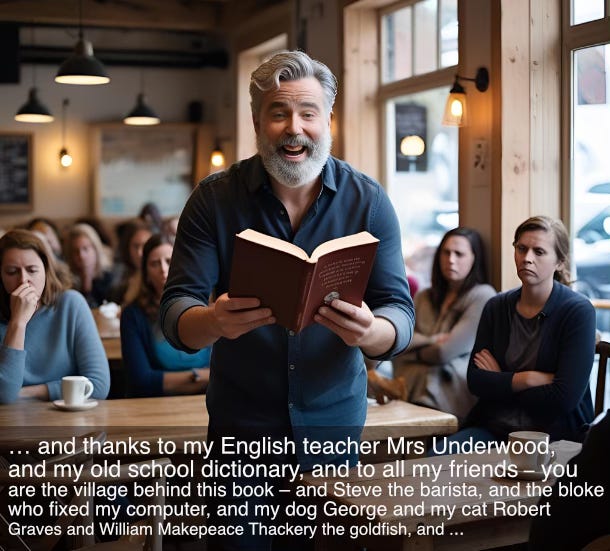
Routh: In ‘Blurbonic Plague’, an article written in 2010 for The Dark Horse, the late Dennis O’Driscoll excoriated blurbs he was finding on the back covers of poetry books. His article is as fierce as it is funny: “What are commissioned blurbs doing on poetry books? Well, fibbing a lot of the time, to tell the truth... So how can poets justify their embrace of exactly the kind of language they claim to counter in their work?” He hammers “Blurbists who damn with over-praise, asserting that some mediocre collection is the best / most exciting / most original, most beguiling / book (blurb terminology is largely interchangeable) they have read in years, [and who] clearly need a change of literary scenery and a rise in reading standards”.
O’Driscoll’s examples – from the back covers of US as well as UK books – are profoundly embarrassing. Would you want to read something “kissed by the lips of eternity”? Probably not. So did that article of his cut through? I’ve just looked at the back covers on a few recent purchases, and they do now seem to nod towards content rather more than to the old “writing at the height of his / her powers” formula.
Nelson: I agree. The Dennis O’Driscoll article nailed it. It changed my entire endorsement policy at HappenStance and on a personal basis I stopped writing them for friends. I’m not sure that “at the height of his powers” has declined, though; I just read it on a recent book — it was on my ‘banned phrase’ list in Sphinxreview so I always notice it.
Routh: This has me wondering what Denis O’Driscoll would have made of ‘Acknowledgements’ these days. They’re becoming longer and ever more fulsome. Is a new book disease spreading among us, Acknowledgmentitis? I first noticed it a few years ago at the back of an American novel – thanks were offered not only to an editor, an assistant, and the publisher, but also to family and to friends who had offered quiet space for writing or accommodation in other landscapes, or comments, or meals, or lifts, or other comforts which ran to three pages’ worth.
Is a new book disease spreading among us, Acknowledgmentitis?
Acknowledgmentitis appears highly contagious. It has jumped species to poetry. I’m looking at some recent poetry pamphlets: after dutiful ‘previous publication’ lists, acknowledgements now take flight, listing and thanking parents, family member, friends, fellow students, workshop leaders (particularly popular names to drop and the more well-known the better) and their participants, without whose love / care / attention / support etc etc the pamphlet could not have been written. (Parents, I grant. But for other reasons.) I’ve one page in front of me which is covered entirely by names. Oh, and I forgot to mention the cat. (Cats – and dogs – are starting to feature too.)
When did this begin? I root around the shelves for an older book and writer: Charles Causley, publication 1957: previous publication acknowledgements only. The infection is recent. I remember asking my own publisher what to put in my ‘Acknowledgements’ for my first book in 2002 and being told no, I shouldn’t be thanking my editor and publisher because they were simply doing their job. (That has shifted: some of my publisher’s recent books do now include such thanks.) I pull out three books by another author to compare: 2002, no extras; 2011, no extras; 2015 – aha, that one has added to the acks a note of thanks for family and for publisher. Come 2022, a book by another author featuring solely previous publication thanks was remarked by its reviewer as having “not a single acknowledgement”.
So it’s a phenomenon of this last ten years – and it seems an obvious step to link it to the enthusiasms of social media. What do all those ‘likes’ actually signify? What do all these thanks really mean? Is it no longer possible to thank someone personally for what they have actually given you by way of real help? Or is Acknowledgmentitis beginning to spread, like Blurbonic Plague, as a sort of self-advertising endorsement in disguise?
What do all those ‘likes’ actually signify? What do all these thanks really mean?
Menos: Where America leads, the UK follows, it seems. Back in 2012 in an article in the New Yorker, ‘Against Acknowledgements’ (paywalled), Sam Sacks decries the fact that authors are asked to promote “not only their books but themselves, with book tours, book trailers, interviews, blogs, and an active social-media presence”. And connected to this is" “the most irritating promotional addendum of all: the acknowledgments page.” These are often, he says, “garrulously narcissistic and strewn with clichés” with an “undercurrent of faux-modest self-promotion”. Sacks finishes up his diatribe with a plea to authors. “We know that the blurbs are very often polite exaggerations and we know that the jacket copy is pablum; we even keep quiet when it’s obvious that your author photo has been retouched. All we ask is that you don’t let that same commercial rot spread inside the book’s covers.” Too late, it seems.
A year later in The New Republic Noreen Malone says “Where readers used to see, perhaps, a paragraph thanking the writer’s editor and agent, a few key researchers, and maybe a family member or two, now we are confronted with a chapter-long laundry list of name after name.” She says that acknowledgments are now a place for “social positioning”, i.e. namedropping, and suggests that acks may be influenced by the sort of social norms which surround tipping – “No one wants to be a less generous tipper,” and “no one wants to be the person who forgets the little people in his or her moment of glory”. Malone also notes that Lorin Stein, then editor of the Paris Review, says that this sort of thing “mars the real intimacy of a novel, which is – or should be – between writer and reader and nobody else.” I think Stein has a good point there.
These two pieces are bemoaning the expansion of acknowledgements in novels rather than poetry, but you’re clearly right, Acknowledgmentitis has spread from the US to the UK, and from novels to poetry. And beyond — see this multimedia essay by Tabitha Carven who discovered what she calls “a kind of poetry” in the acknowledgements pages of PhDs at the Australian National University College of Science and Medicine. Many of the acks pages Carven has encountered in her work on science PhDs at ANU are extensive, effusive, and occasionally absurd.
Nelson: I’ve always removed thanks to me that poets insert, because I think what I do’s part of the job. I prefer to be invisible. Anyway, thanks don’t need to be public. These days, however, typesetters are often named and thanked too. You could argue it’s a good thing that big name novelists acknowledge their editors: at least it means the value of the job is explicit. And in poetry, nobody has any idea of who does what without those acks, though it’s awkward when someone thanks someone on the judging panel of an award for which the book is shortlisted ….
Thanks don’t need to be public
I think modern print techniques help to explain the liberal spread of acks pages. Digital printing means books don’t have to be multiples of four pages any more. The cost of printing two pages more or less is negligible (at one point overall page length was strict).
Menos: In his novel On Earth We’re Briefly Gorgeous, Ocean Vuong thanks not only his mentors, family and friends but also artists alive and dead who have influenced him, including literary greats James Baldwin, Roland Barthes and Frank O’Hara, as well as Whitney Houston, Etta James and Nina Simone. He seems to use the acks page as a place to namecheck artists whose work has influenced his own.
Nelson: Acks can be intriguing because they reveal the secret network of who knows whom (though sometimes I think it might be best for poets to keep that to themselves). Penguin seems to have more pages of advance blurb than any other poetry publisher. But there are extensive paragraphs of endorsement on Amazon as well. For indie publishers, poets often have to write their own blurb and court their own endorsements too. Quite stressful!
Menos: I had a scout through the poetry collections / pamphlets that we have recently considered for review at The Friday Poem, and the results are interesting. Acks in Penguin collections, for example, vary enormously. Peter Gizzi’s Fierce Elegy has a relatively restrained single page of previous publication credits plus a brief cover-all thanks to “good friends”, whereas Amanda Gorman’s collection, Call Us What We Carry, has a ‘Gratitude’ section which runs to five pages (also 12 pages of notes, a seven-page interview, and a six-page discussion guide). Nick Makoha’s recent Penguin UK collection, The New Carthaginians, has two pages of acks which include thanks to more than sixty people for “random acts of kindness” and also the “love and grace of God”. I guess that’s the biggest namedrop of all.
Bloodaxe acks pages also vary; recent collections by Philip Goss and Helen Farish have very brief acknowledgements, perhaps a couple of sentences, whereas Marjorie Lotfi and Jane Clark each have two pages of notes and acks. Lotfi’s book is a debut, so perhaps she hasn’t thanked people before and has a lot to include. Pat Boran’s new collection Hedge School, published by Daedalus Press, has two pages of acks too, but they are mostly notes, and he neatly rounds it off with thanks to “others too numerous to mention”. Martin Malone’s acks in his new Mariscat pamphlet about his mother and her struggle with Alzheimers and dementia are particularly touching; he thanks family and friends, helpers, neighbours, carers and social workers, even the lady from the local caff. In this instance, the acks really add another layer to the poetry.
Publisher Sean Manning says “This kind of favour trading creates an incestuous and unmeritocratic literary ecosystem that often rewards connections over talent.”
I also quite enjoyed the acks pages of Top Doll by Karen McCarthy Woolf, published by Dialogue Books. She thanks the team at Dialogue, naturally, plus a long list of poetry people (“Roger Robinson (who encouraged me to unleash the Barbies), Warsan Shire (maximum belligerent!) […] Jason Allen-Paisant (for advising on Miss Tingle’s Jamaican)”, and also the dolls (who are unlikely to appreciate it). But her acks are more interesting than most, containing details about the genesis of the book, details of posthumous biographies of New York heiress Huguette Clark, and a nice story about how she came to own one of the dolls herself.
Nelson: My favourite acks page of all time’s in Daljit Nagra’s 2023 collection Indiom. In fact I enjoyed it as much as any other page in the book. A poem in its own right, for sure.
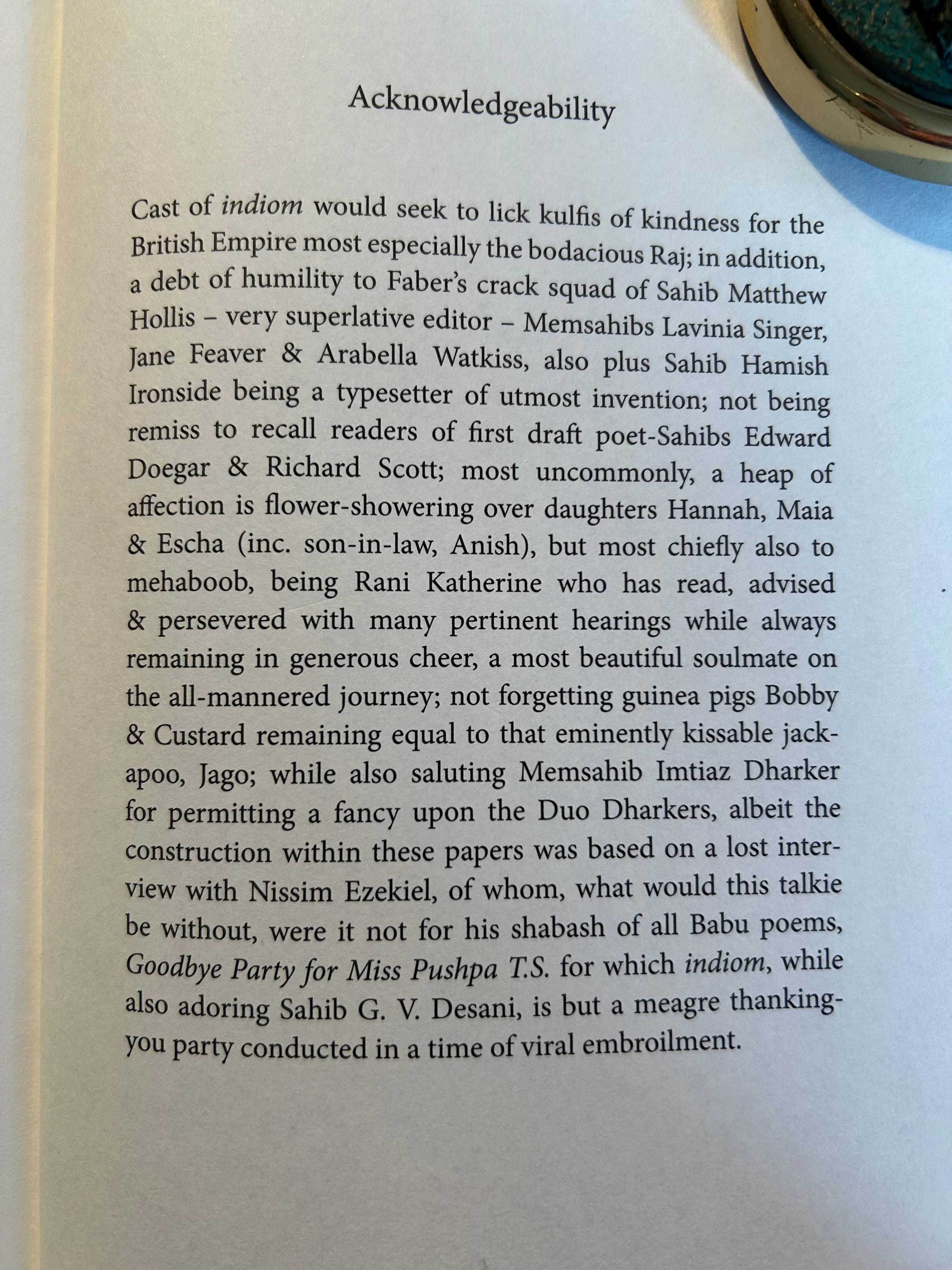
So there’s scope for a poet to be original and enterprising with this page, though few have seized that opportunity to date.
Routh: One thing that gives me hope – the Simon & Schuster flagship imprint no longer requires authors to obtain blurbs for their books! Apparently it’s to do with cost, at least in part; their authors spend too much time and effort pleading for them; and many senior authors are fed up with doing them. In an article for Publishers Weekly in January this year, publisher Sean Manning comes at it straight. He says, "This kind of favour trading creates an incestuous and unmeritocratic literary ecosystem that often rewards connections over talent.” Glorious!
Editors’ note: This piece wouldn’t have been possible without the skilful editing of SpellCheck or the helpful brainstorming of all our colleagues. Thanks, too, to Andy Brodie for his thoughtful comments on the topic. Thanks to our mothers for birthing us, Sir Timothy John Berners-Lee for inventing the Internet, and the Germans and the Romans for the building blocks of the English language. And to Ryder the dog, Sunny the cat, the flock of geese, and the hedgehogs in the barn.
Dennis O’Driscoll’s ‘Blurbonic Plague’ can also be found in his book of essays, The Outnumbered Poet published by The Gallery Press in 2013.
Jane Routh has published five poetry collections and a prose book, Falling into Place (about rural north Lancashire), with Smith|Doorstop. Circumnavigation (2002) was shortlisted for the Forward prize for Best First Collection, and Teach Yourself Mapmaking (2006) was a Poetry Book Society recommendation. Listening to the Night was published by Smith|Doorstop in 2018. A pamphlet, After, was published by Wayleave Press in 2021. She has won the Cardiff International and the Strokestown International Poetry Competitions. Her latest collection is The Luck (2024).
As well as browsing our Substack, it’s worth visiting The Friday Poem website where you can browse our Archive of more than 700 posts dating back to early 2021. For example, if you like Jane Routh’s reviews, try her review of No Man’s Land by David Nash (Daedalus Press, 2024) or her review of The Silence by Gillian Clarke (Carcanet, 2024). If you want to know more about her poetry read her Friday Poem ‘The February Museum: recent acquisitions’, or this review on Substack of The Luck, Routh’s most recent Smith|Doorstop collection.
Help support The Friday Poem — buy us a coffee to help us stay awake as we strive to bring poetic excellence to your inbox every Friday. If you can't afford to donate, no worries, we’re going to keep on doing it anyway! Big thanks for everything, you lovely poetry peeps.
Marvelous. Laugh-out-loud observations on the metastasis of logrolling. I shared with my wife, who is on approach to land her first novel and roll to the gate for an enthusiastic welcome by her not-yet-adoring public (bagpipe fanfare off to the side). She who sleeps with me has been slogging through the publisher's requirement to solicit blurbs from names that mean anything to anybody, as if anybody ascribes meaning to blurbs in the first place. My bride has felt hurt by rejection from other writers who live in the same town, breathe the same air, but have politely declined to blurb, perhaps because they have something better to do, like, um, write their next novel? Can't wait to read a novel that is entirely acknowledgments and blurbs, (insert image of) hippos wallowing in the mud puddle. How fun to watch them splash themselves!
Morning all, Love today’s post re Acknowledgment effusions! Been silently wondering about this since first encountering their emergence on the fiction side ( Seemed a bit grandiose when most of us thought that a one-liner dedication on the imprint page was plenty).