


MY UPSTARTS
O my songs, my upstarts,
My importunate lightweights,
Who dares admit you to favour
Must approve your behaviour,
Your irritating manners,
Your lack of gravity.
Stand like the tail feathers
Plucked from a crushed black redstart
In the high Pyrenees,
Saved from the mountain wind,
Stuck in an old wine cork.
How lucky to have a tail!
Feathers still red, more red now
Than the hair of the scribbler.
Why don't you write a proper book?
We took for friendly comment
From one who had imagined
The faint possibility.
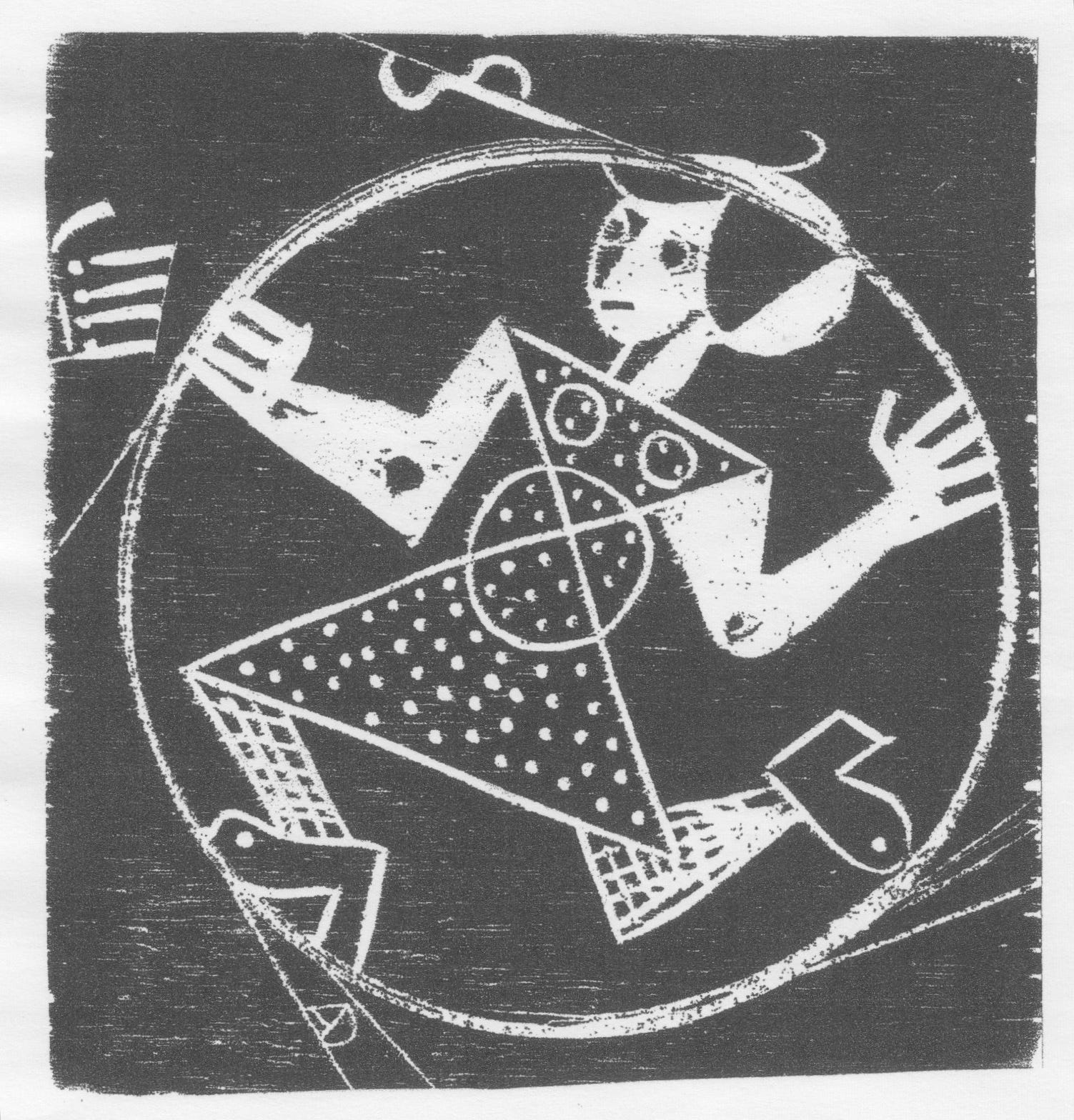
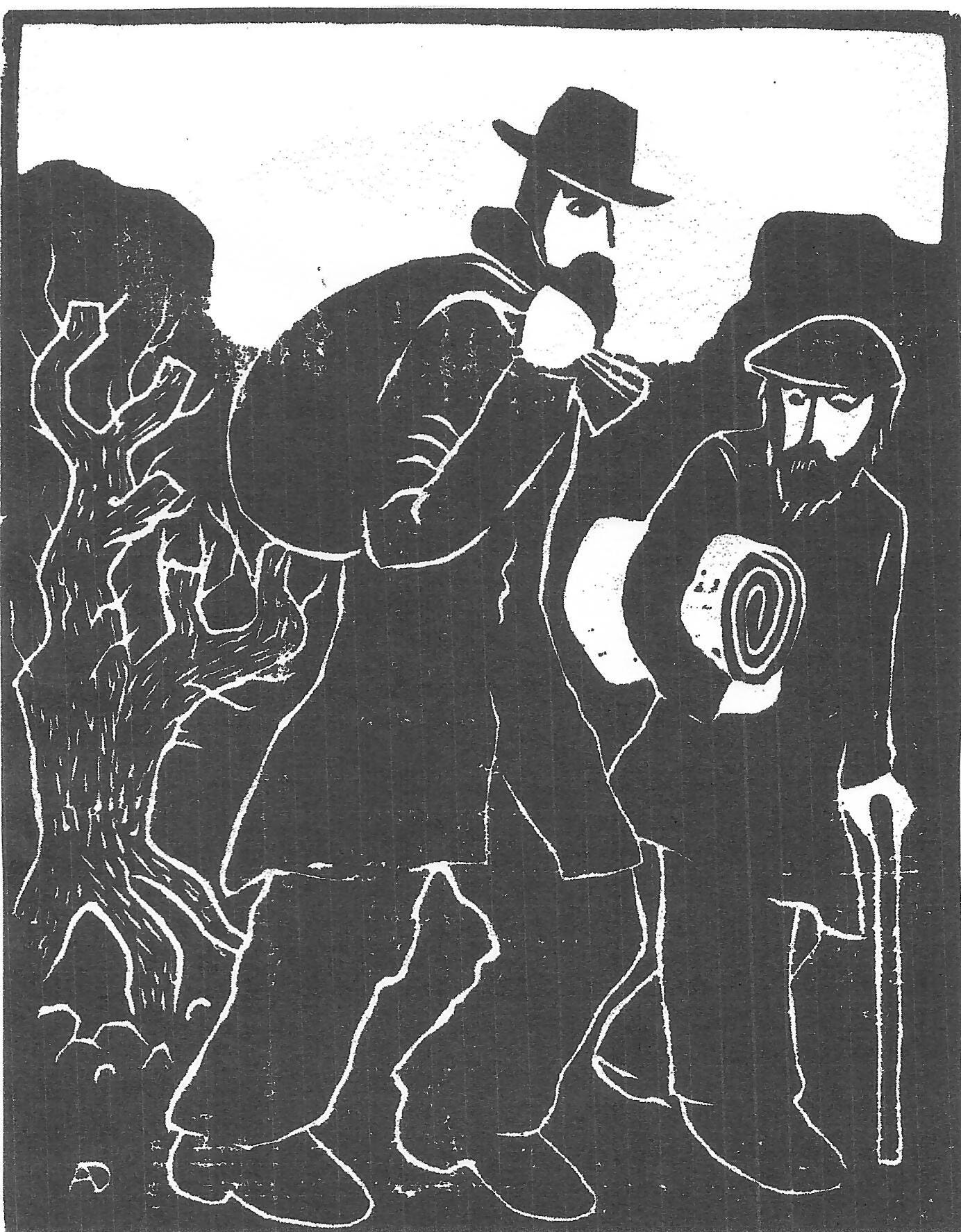
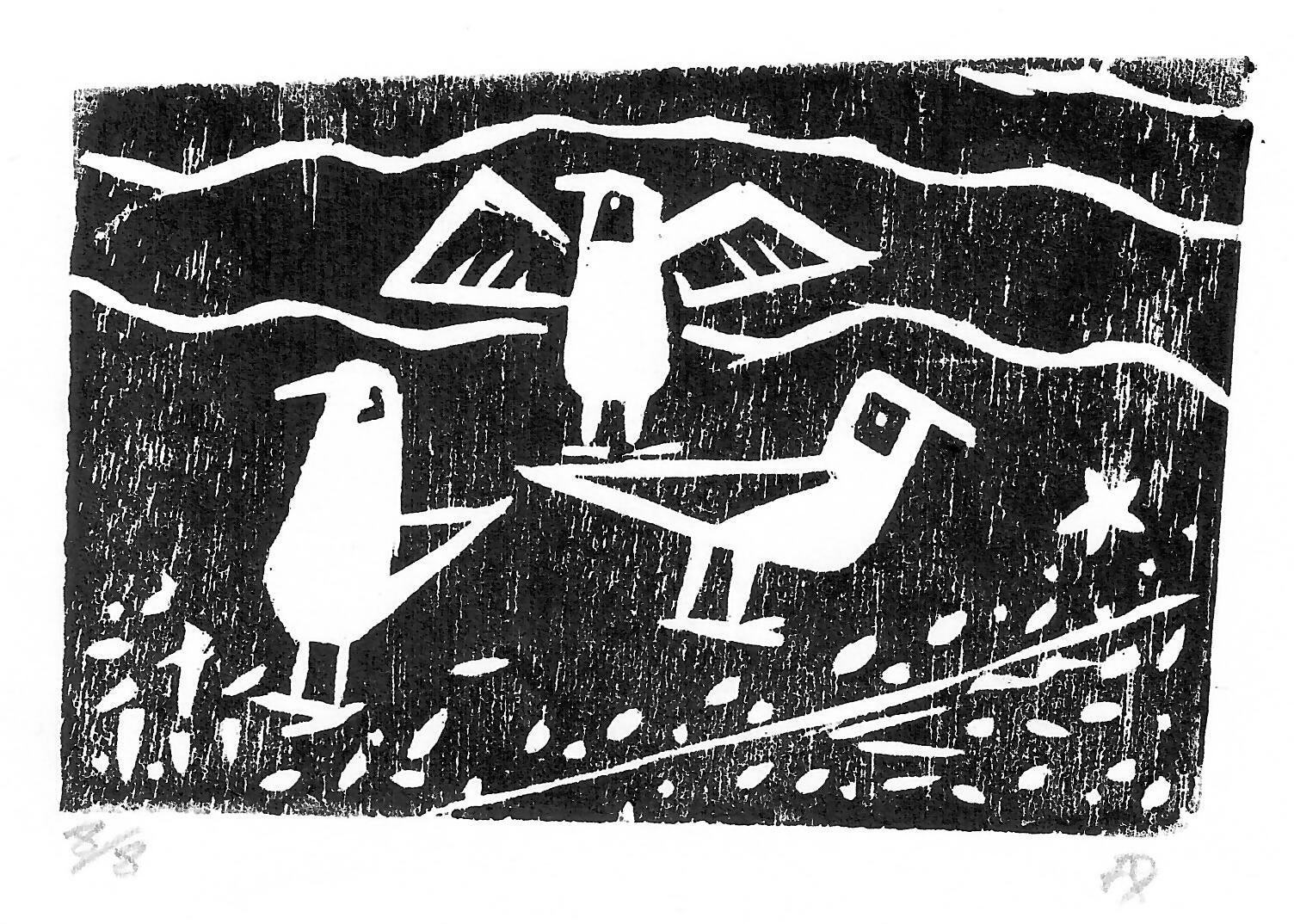
‘MY UPSTARTS’ is from The Left-Handed Sniper (Shoestring Press, 2024) — thanks to Alan Dixon for letting us include it here, and thanks also to Alan for his beautiful woodcuts.
Failure to become famous: Alan Dixon and J. H. Prynne
In 'Famous for a Day' (Transports, Rivelin Press, 1996), Alan Dixon wrote:
Everybody who is anybody will be famous for a day
And many of us will be famous for more than a week
For something or other, or just for being ourselves.Once it was significant form but now it is significant fame,
And to fail to be famous is to fail utterly.
By the time he offered this tongue-in-cheek remark, Dixon had demonstrably failed to be famous, like most poets of his generation (or any generation). He was born in 1936, a couple of weeks or so after J. H. Prynne, whose name is well known. Both poets will be 90 in 2026. Both began to publish in the 1960s. Both are still writing and publishing new poems.
What makes one poet celebrated and another overlooked? Both Prynne and Dixon were educated in the UK, Prynne at an independent school in London, Dixon mainly in state schools in Halifax. Dixon failed the new 11+ exam. Prynne, I imagine, did not. Both men did National Service, the first as a commissioned officer in the Army, the second uncommissioned in the RAF. Prynne then matriculated at Jesus College, Cambridge, took up a fellowship in Harvard, and followed this with a career in university teaching (writing poetry throughout); he did some teaching in China, developed proficiency in Chinese. Dixon completed his further and higher education at Goldsmiths College, part of London University. Then he did an Extra-Mural Diploma in Visual Arts in evening classes. Later he taught art in English high schools, while developing his own interests in poetry, translation, painting and print-making. He went on holiday to France, developed his school French. So far as I know, the two men have never met.
When it comes to fame, it's no bad thing to be part of a set. Prynne reluctantly acknowledges his leading role in the 'Cambridge group'. These writers were associated with the British Poetry Revival, and the magazine The English Intelligencer, which in the 1960s reacted strongly against mainstream influences. Intelligencer contributors espoused an 'alternative', convention-breaking practice, continuing and extending the radical side of modernism. "No living British poet divides readers as much as Prynne," suggests Ruth Padel in The Poem and the Journey (Chatto & Windus, 2007).
As a poet, Alan Dixon's style was mainstream, though he had a keen interest in the early avant-garde, in particular some of the Dadaist painters and poets, and later German Expressionist woodcuts and Bauhaus masters (Lyonel Feininger is one of many artists to feature in his poems). Pure abstraction, however, was never his thing. As a writer and translator, he experimented with metrical forms and conversational style – relatively short poems about cats, birds, painters, hats, his family, his job. Most publications featured his own woodcuts, either on the jacket or elsewhere. Both Dixon and Prynne issued first collections in their late twenties. Prynne's Force of Circumstance & Other Poems came out from Routledge & Kegan Paul in 1962 (Donald Davie's publisher). Alan Dixon found a home for Snails and Reliquaries with the Fortune Press two years later.
"What is aught but as tis valued?" asks Shakespeare's Troilus. Both Dixon's and Prynne's first books sold for 12s. 6d, a standard cost at the time. Neither achieved significant public praise. Since then, things have changed. At the time of writing, the cheapest copy of Prynne's Force of Circumstance is £900 (+ £6 shipping), despite (or possibly because of) the fact that its author disowned it not long after publication. A copy of Dixon's Snails & Reliquaries can be had for £16 (free shipping). Another index of value is readership. Prynne has a dedicated following. His most recent pamphlet sold out its initial print run of 100 copies before it was listed on the publisher's website – although it's hard to know how many of these sales were to collectors, as opposed to readers. As for Dixon, most people I've asked aren't sure who he is. Readers able to recall lines by heart from either poet are, I suspect, few.
Both Dixon's and Prynne's first books sold for 12s. 6d, a standard cost at the time. Neither achieved significant public praise. Since then, things have changed
But that's for different reasons in each case. Prynne mainly doesn't write the sort of phrases that form 'earworms', nor does he set out to appeal to a prospective reader. In fact, he's on record for not being concerned about "the problems for readers and the fate of reading in connection with [his] work" (Paris Review interview, 2016). His work is famously 'difficult'. Nonetheless, his aggregate number of publications is huge. Wikipedia (record incomplete) lists more than seventy volumes. Why would he bother to publish at all, if readers were of no interest?
Alan Dixon welcomes readers, or at least that's what his work suggests (the Paris Review hasn't asked him). His complete works comprise a dozen slender volumes (excluding translations). He plays to a prospective audience via devices that aid aural pleasure and memory, and his poems are communications that use such terms as 'we' and 'us'. He has never performed widely on a reading circuit – although neither has Jeremy Prynne. The latter has articulate champions: an issue of Jacket in 2003 was entirely given over to essays about him. Peter Gizzi (whose Fierce Elegy recently took the T. S. Eliot prize) wrote a glowing introduction to the NYRB re-issue of Prynne's The White Stones in 2016. UK scholar and critic Jeremy Noel-Tod is also a persuasive advocate (his Substack piece, Brim Over, is warmly inviting).
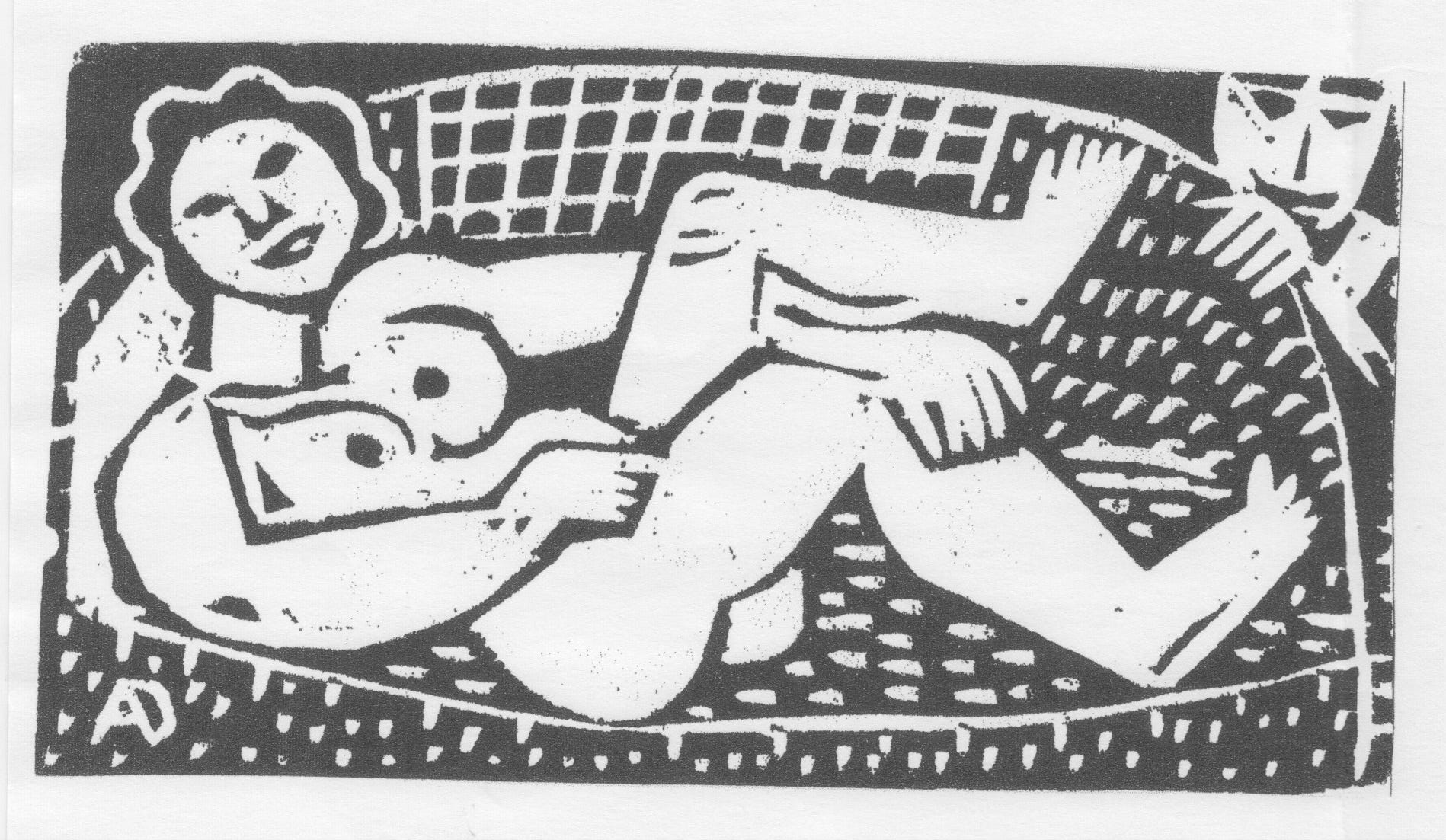
You won't find countless experts writing about Alan Dixon, though his striking woodcuts and poems have moved me (and I am not alone) for thirty years or so. From Google you might dredge a courteously dismissive paragraph by Julian Symons in LRB (paywalled) in 1992. SphinxReview hosted a brief interview about Dixon's woodcuts in 2017, and there's an excellent discussion of The Wall Dancer (2017) in London Grip by the late Paul McLoughlin.
These two poets occupy opposite ends of an unprecedently wide spectrum. But it wasn't so when they started. Here's the beginning of 'The Numbers' (from Prynne's second book, Kitchen Poems, 1968):
The whole thing it is, the difficult
matter: to shrink the confines
down. To signals, so that I come
back to this, we are
                     small / in the rain
                     open or without it,
                     the light in de-
light, as with pleasure amongst not merely
the word, one amongst them; but the
skin over the points, of the bone.
That's where we have it & should
                     diminish: I am no
                     more, than custom,
                     which is the vital
& signal, again, as if we tie into
so many voices.
This format continues over two and a half pages (no stanza breaks), and perhaps the poet is, among other things, considering the art of poetry. Meanwhile, here's 'Malaise' (from Dixon's second book, The Upright Position 1970), which might touch on a similar idea:
Malaise
One evening in fifty I lie
hoping the long poem won't try
to push me off into action;
my Paradise Lost I tell to wait
as I recuperate.Staring at new cracks in the ceiling,
on the floor a glass of something,
on the couch a lack of tension;
one evening in fifty I grow fat
taking it easy. All thatuseless scribbling for no pay
could be good evidence one day
for certification;
and so I use the horizontal
spell to stop me going mental.I read to practise my frown
on some nights of the forty-nine
reserved for irritation,
or slough my crumpled habit
into the paper basket.
The two poems are obviously quite different, yet share some features. Both eschew first-word-in-line capitals. Both use patterned layout, blocks of text that look like 'poems'. Both write in the first person. Both exploit aural resonance. With Prynne there's play on the opening short and long 'i' sounds, subsequently contrasted with long 'o' ("skin over the points, of the bone"), and there's assonance if not rhyme. With Dixon there's intricate end-rhyme pattern, as well as internal echoes ("cracks"/ "lack", "practise" / "basket"). Each poet writes in the first person and it seems, in each case, that a kind of conversation is opening. Dixon addresses the reader humorously about his unwritten epic, his lost paradise and his potential "certification"; Prynne's tone is more formal as he approaches the idea of linguistic distillation, and then shortens his lines to enact his point. Dixon's syntax is conventional; Prynne disrupts his. Prynne's title ('The Numbers') plays on possible meanings of 'numbers'. Dixon uses numbers ("one evening in fifty", "some nights of the forty-nine") to play with an idea and, through the reference to "horizontal", cocks a snook at his book title (The Upright Position). The two are not a million miles apart at this stage – though headed in different directions.
The two are not a million miles apart at this stage – though headed in different directions
Over time, Dixon would continue to work in lyric form – often personal, witty or off the wall – experimenting with shapes, sizes and forms. Every publication would include recognizable sonnets. His output would be modest, reducing noticeably in later years and including more translation. Prynne, on the other hand, would work towards the philosophical, impersonal and esoteric; generally line-dense texts avoiding rhyme, metre and obvious meaning (with exceptions like the Snooty Tip-Offs sequences in 2021, and 'Day Light' in Foremost Wayleave, 2023). He would experiment with size, shapes and method, and the older he got, the more prolific he would be. Prynne would get harder to understand. Dixon would get easier. Prynne would be a well-known eccentric in Cambridge, the Gandalf of high modernism. Dixon would downplay his poetry as "useless scribbling" (it seems likely his neighbours were unaware he wrote it). Both men were, and are, naturally idiosyncratic.
Both favoured small, independent publishers. Prynne's second book (the one he didn't disown) went to Goliard Press, set up by poet-friend Tom Raworth and artist Barry Hall. Dixon's The Upright Position was hand-printed by Derek Maggs for Alan Tarling's Poet&Printer imprint; Tarling did the casing and went on to letterpress-print four more publications between 1970 and 1994, each featuring Dixon's woodcuts on the jacket. In that same period, Prynne issued at least 18 publications from ten or more different imprints. His first Collected (300+ pages) appeared in 1982. Others have followed: Poems 2016-2024 (Bloodaxe, 2024) comprises 752 pages. Face Press still handles new pamphlets. Dixon did once author a slim New and Selected in 1994, but never a Collected. By this time, Prynne had been translated into French and Chinese; Dixon had translated other people's poems from Hungarian, French and occasionally German – into English. The early publications of both are collectible, though Dixon's are easier, fewer and cheaper to track down.
By today (2025), J. H. Prynne is both famous and infamous. Adjectives like "hermetic" and "obscurantist", when applied to him, are terms of praise. His work formally crossed the Atlantic with the NYRB's The White Stones in 2016. However, the White Stones poems had been written half a century earlier, when he sounded something like this:
                              Call it evening the days
are no shorter but ah how they do
foreclose, that the tide turns and
the wick burns and curls and all

the acrid wavering of language, so full
of convenient turns of extinction.
[from 'Break It', The White Stones, NYRB, 2016]
By 2017, his style was more cryptic. Witness a few lines from 'Set-price', first published in Each to Each, 2017:
What's to count held to it or void level nor
we see assenting compulsive replacement, in
sea-lane perspective lives on a thread, again.
None in clearance mouth working to have or if
not, probable lame calamity.
[Poems 2016-2024, Bloodaxe 2024]
But what about Alan Dixon? Over these same decades his work regularly popped up in respected UK magazines. Alan Tarling stopped printing and Redbeck Press brought out Transports (47pp) in 1996. Then in 2005, 2017 and 2024, there were modest collections from Shoestring. None of these books won awards, though there were occasional brief reviews. In 2005, Dixon wrote with amusement about his insignificance. Here’s the poem in full:
It's The Name That Counts
Those subdivisions in a gents,
Makers’ poetic names in blue: Shanks, Armitage,
What are they called? Stalls, you say; niches perhaps
— Each user a statue but the wrong way round
For the perusal of the connoisseur;
Might one of them, in the absence of a square
Or street thought suitable
Bear my so ordinary name and distinguished dates
Above it, when I’m dead, on a little plaque,
So that the drunken pisser, if
His shadow lets him see,
Can say, shaking his cock, Who the fuck was he?
[The Ogling of Lady Luck, Shoestring, 2005]
It's a typical Alan Dixon piece – easy to read, easy to miss. The tone’s conversational and concluding rhyme makes the point unmissable. Less obvious, perhaps, is the way the 'k' sound in 'plaque' foreshadows first 'drunken', then 'shaking', 'cock' and 'fuck', a climactic approach to insignificance in the voice of the vernacular. At the start, there's a neat joke: he reverses the ubiquitous trade name 'Armitage Shanks' (bathrooms / toilets) to invoke both the current UK Laureate and WW1 poet Edward Richard Buxton Shanks. We're in a gents' urinal, unusual for poetry, and the detail is graphic. "Niches" is neatly appropriate in the context of saints, commemoration and poetry tastes. Who will remember Alan Dixon after he's dead, he wonders. His name's unlikely to make a street sign. But what about a urinal? Surely a little Dixon plaque could sneak in? It's absurd, it's cheeky, but he's planted the thought.
But even that was written two decades ago. To give an idea how far apart these two poets sit right now – half a century from where they began – let me call in recent work. First, the opening sentence of 'Blue Wing Nine' from Prynne's Front Obsidian Cobalt, Face Press, 2025 (the poem has 30 lines in total, presented in a single block):
Shuffle magnetic pristine handbill sail,
avouch acer fillip integrated, generous erg
clinamen cruiser sedulous orthoclase intent
ekphrastic murk; shatter turbid infolded aims
harbinger affective ascorbic occlusive pastry by
blackbird morbid thatch, anemone flattery hake
mysterium nasturtium harvester collusion eel
dealing sealing-wax insidious unending seedling
swallow hurtle; infamous liquescent gulp garnet
prismatic previous precious intensity, seamarks
cairns fairway scintilla carol tremble tropic
alight thought.
And for comparison, here's the whole of Alan Dixon's 'Since Melody Died', a single-sentence sonnet from The Left-Handed Sniper (Shoestring Press, 2024).
Since Melody stopped kissing all she knew
And some she didn't, who kissed bus drivers too,
And since the crowded funeral at which
So many sang (though singing's not the same
As conversation, and the truth can stretch)
That they believed in angels, and her name
Proved not to be Melissa or Melinda,
And Neil jigged in the aisle as a reminder
Of their long-dancing days (and it small wonder
That even then he didn't wear a jacket)
The broken troughing still slopes on one bracket,
The takeaway tin has managed to spin and fly
Over the house to the back (Neil wouldn't take it)
And steps still lean on the wall, full-stretched and high.
A clear point of similarity is that both pieces are single blocks with comparable line lengths. Each uses punctuation, though apparently for different reasons. Prynne's lines don't work as communication: they disrupt the conventional reading method. Dixon's poem tells a story – the opening conjunction ("Since") drives a long sentence towards its completing clause (commencing with "The broken troughing"), while bracketed parentheses clarify the central thought. In Dixon’s case, the phrasing is rhythmic: speech cadence underpinned by iambic pentameter. Prynne's poem sounds more like a list, each word-item of similar weight – which has an odd effect.
One could easily dismiss the Prynne poem (of which you're only seeing one sentence) as 'impenetrable'. But that's only appropriate if its intention is to communicate meaning. Provided one approaches it in a willing state of uncertainty, some interesting things happen. Those readers comfortable at the Prynne end of the poetry spectrum find high levels of uncertainty stimulating. Those at the Dixon end usually don't. Somewhere in the middle it's possible to lean one way or the other, for a little while at least.
Those readers comfortable at the Prynne end of the poetry spectrum find high levels of uncertainty stimulating. Those at the Dixon end usually don't
Each publication as artefact is also relevant. Prynne's pamphlet is risograph-printed at Earthbound Press, a slender 12-page booklet priced at £16 (before shipping) in the LRB bookshop. Inside, the poems are titled 'Blue Wing One', 'Blue Wing Two' etc. The card cover is blue. The paper feels like a good quality bookwove. The three-hole stitched binding is hand-sewn, and the thread knotted in the centre is dark blue or black. The publication title is FRONT OBSIDIAN COBALT, appearing in large sans-serif blue caps at the ... front. Cobalt is, of course, blue. There are black (obsidian?) endpapers. Such aesthetic particularities (plus the price) contribute to a sense of value. They also prime the brain. At first reading, my attention was caught by colour words (blue / obsidian) or bird references (blue wings). Then I read the work aloud. Most lines don't fall into phrases; occasionally they do ("given famous first grouse transfusion" in 'Blue Wing Three'). Some bits sound memorable ("prismatic previous precious intensity" in 'Blue Wing Nine' delivers a snatch of pleasure through alliteration). There are numerous spatters of internal rhyme ("sentient incipit conduit culvert skit”, “mysterium nasturtium”). But the most interesting part to me is the meta-reading. I find myself watching my own brain scanning for landmarks. In 'Blue Wing Nine', it notes a "blackbird" followed by "morbid", the last four letters of which anagrammatize "bird". Later there's "snow-goose" and "jackdaw". I smile when "cerulean mango witness liberal purple" turns up near the bottom of the page because I'm looking out for colours. If the poem were a crossword, I might announce the solution.
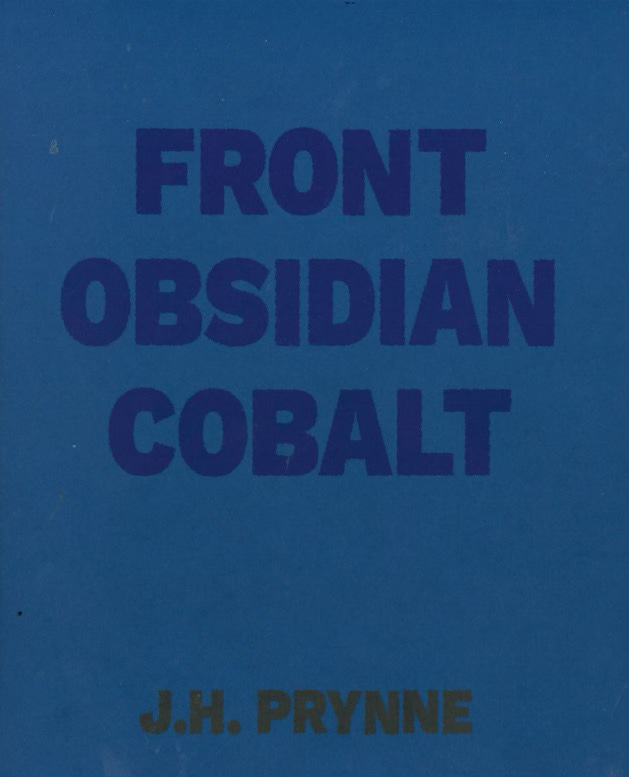
But it's not, although I'm approaching it as a puzzle. The poem is what I make of it, and the pleasure in reading is partly because the artefact is good to hold. I haven't thought so hard about words in a while. It feels like a mental re-set. How does Prynne create his distinctive, disjunctive register? In the first 14 lines of 'Blue Wing Nine', there's only one preposition ('by') and no conjunctions (in Dixon's 'Since Melody Died' there are 9 prepositions and 14 conjunctions). In Prynne's poem, there are no articles ('the' or 'a'); in Dixon's there are 12. In fact, in the whole of Front Obsidian Cobalt, I find only one 'the'. You can't write iambic metres without definite and indefinite articles. So if you want to break the iamb, drop the articles – and the pronouns. Lose the little words. In Prynne's pamphlet, when a preposition does appear ("by", "in" or "on"), it's more often than not at a line-end. That means the line-break interrupts the unity of any ensuing phrase. Generally it’s monosyllables that allow us to hear 'onthebus' and 'downatthebottom' as single units, but longer words have internal sounds and rhythms too: and some of Prynne's stand out irresistibly: "liquescent", "ascorbic", "orthoclase". In an article in Poetry London Autumn 2021, John Clegg said "Prynne might be the only poet you must read word to word, rather than clause to clause or sentence to sentence", and there's some truth in this (although Julie Johnstone at the Essence Press also creates a reading experience one word, and even sometimes one letter, at a time). But the issue surely is … why? Why would you want to avoid phrase units?
The last word of 'Blue Wing Nine' is "embarrass". Embarrassed is how you feel when you're made a fool of, something we fear. I was watching cartoons with my ten-year-old grandson yesterday and he observed, "You need not to over-think SpongeBob, granny." The same may be true of Prynne. Simply, then, I think he's pursuing a personalised art form, and language is his medium. He's intensely engaged with words, their sounds, their textures, their colours, the way they jostle against each other. He's continuously alert, pursuing his own connections, some of which involve scraps of meaning. He's not just hurling random words at the page but he does want to disrupt conventional reading. I can't follow him in Front Obsidian Cobalt, although I can find my own way. It's hard to write usefully about work so densely structured, and I confess I'm nervous of being stupid, or saying the wrong thing. All the same, I am interested. He likes words. I like them too. And yet. My approach will always be self-centred. Like most readers, I am thinking, what's in this for me?
I've spent many hours with ‘Front Obsidian Cobalt’, and it's not done with me yet
I think poetry is not just a way of writing; it's also a way of reading, involving full attention. It takes a lot of time. I've spent many hours with Front Obsidian Cobalt, and it's not done with me yet. Each time I open it, I set off on a different track, or look up another word I don't know. "Minish" for example, which I learn means something similar to "diminish" but with a different etymology: fascinating. Even before 2020, Prynne had published more than enough to occupy me for the rest of my life. But I want to read Alan Dixon too.
Considering Alan Dixon's Left-Handed Sniper as a whole book, the volume has a splendid jacket design with one of the author’s own woodcuts showing the sniper sniping. Although this is an ordinary mass-market paperback, it's spaciously typeset, with only one poem per page. The work opens dynamically with 'My Upstarts' (quoted in full earlier). Someone has apparently said to Dixon (as indeed they may have said to Prynne), "Why don't you write a proper book?" But he begins with a defiant assertion of individuality, and commends the poems to those who dare read them:
O my songs, my upstarts,
My importunate lightweights,
Who dares admit you to favour
Must approve your behaviour,
Your irritating manners,
Your lack of gravity.
It's a fabulous opening gambit. What beautiful insults – "upstarts" and "importunate lightweights"! The poet bosses his songs around like a parade sergeant: “Stand”! He compares them to "the tail feathers […] / from a crushed black redstart". Upstarts from a redstart "Stuck in an old wine cork". Where would those jocular rhythms be without the prepositions and indefinite articles? And so much going on the language. Even the juxtaposition of "black redstart" sounds like an oxymoron.
There are many other potent and memorable pieces, including 'The Left-Handed Sniper' (the title poem), 'Since Melody Died', 'Melon', 'The Siblings', 'A Captive', 'The Gasman's Position', 'Rob Runcorn's Christening Cup', 'Grand Days', 'Exhibit', 'A Protest', 'No Swifts', and 'The Death of Dicko'. I’m not convinced, however, that this collection is as strong as its predecessor (The Wall Dancer). That’s partly because fully one third of the contents comprises translation, which means there are many voices here. I suspect the poet had about thirty strong pieces – a pamphlet set, really – and time's winged chariot was cracking on. I don't mean to suggest the translations are padding (a couple of them feel eerily like Dixon's original work), but to my mind the proportion of translation unbalances the whole. Accessing a first-language version in many instances is also problematic. But apart from that factor, I'm not convinced it works to read an Alan Dixon book in search of that over-valued asset: the over-arching theme. The single poems are too individual.
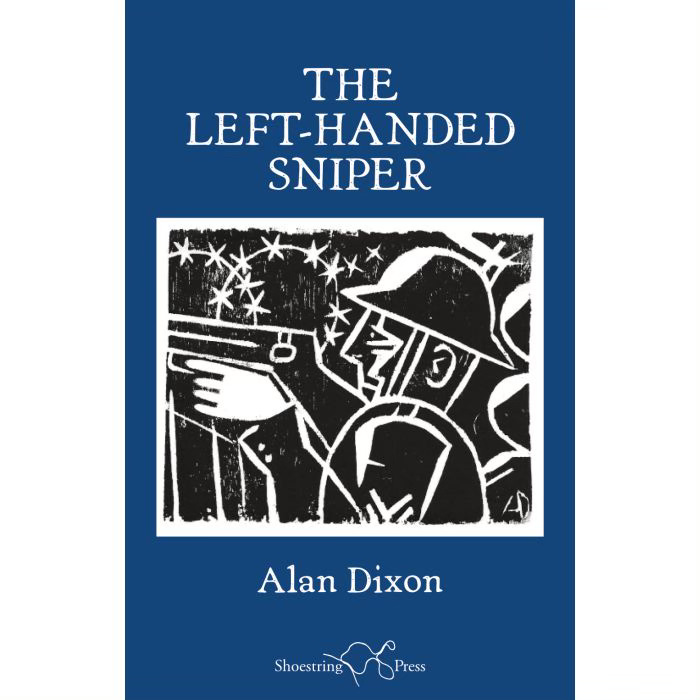
If Dixon had been as famous as Prynne, he could have slipped a dozen new poems into a 2024 pamphlet and there would have been a list of subscribers waiting to nab the first 100 copies. But he's not, although I commend him to you. He is not just another poet. He has written some wonderfully odd and original things in his lifetime. Let me take you back to 'Since Melody Died' (quoted in full earlier). 'Melody' is a name here but it may also invoke an idea. At first reading, I saw the word 'Since' was driving the syntax, but I didn't spot where the second main clause began. But then the penny dropped. Everything (even the two parts in parenthesis) falls into a neat construction. Single-sentence poems are often attempted, rarely achieved. For me, this one works, and it's a sonnet too, with its own rhyme scheme. The characters are individual: Neil, Melody and the poignancy of their existences. And as a potent final symbol, there's an abandoned stepladder "full-stretched" against her wall. I visualise all of this like a Chagall painting (Neil dancing jacketless, a house with broken guttering, a church, someone playing a fiddle in the sky, a symbolic ladder pointing upwards to an angel and the moon). And there's even a Petrarchan volta, a ‘turn’, though not until line eleven. The language conveys meaning, and the more I read, the more it moves me. Emotive charge is, for me, one of the important pay-offs in poetry. I don't mean mere sentiment. I want something more profound, more elusive than that. I find it here.
Poems with this kind of intense individuality have appeared in every one of Dixon's collections, as well as others that are less potent, but still wayward and skilful. The Hogweed Lass (1991) is a particularly pleasing chapbook. Hand-printed by Alan Tarling, it’s currently twenty quid on ABE books and worth every penny. Here you can read 'Odd Shoes', which is heart-breaking in the best sense. And there's 'At Sea' and 'Inconvenient Coffee' in The Immaculate Magpies, and 'Out of Green Doglick Jumped the Humpy Snail' and 'The Naked Man at Poverty Bottom' in The Wall Dancer. Dixon writes such odd poems, such an unexpected mixture. And that's another similarity between him and Prynne.
The language conveys meaning, and the more I read, the more it moves me
But in Dixon's case, is it possible that being plain-spoken, a little odd, sometimes comical, entirely accessible – that these things create the impression of a minor artist? And using forms that others have used before you – does this fail the innovation test? For a long time, breaking with tradition has been regarded as something good poets ought to do. Accordingly, could obscurity create disproportionate interest? Does impenetrability act as a provocation, creating intrigue, which – once created – grows? Once you have a dedicated following, you can write whatever you want. Even:
Harum-scarum, fetch your shoes and wear'em,
pull'em on close and tie the laces;
if you choose to have a snooze
just relax and don't make faces,
keep on watch to hear the alarum
['Snooty Tipoffs' II, 43, Poems 2016-2024, Bloodaxe 2024]
I am not, I promise, taking a sideways swipe at radical modernism. I want to read both Prynne (or some of him) and Dixon. I require both. And as for the poetry reader – whoever you are – you need to find your own way and your own preferences. You need neither to be intimidated by the intellectually obscure, nor to underrate the accessible. Ignore the influencers! I've been reading poetry for about sixty years with patience, love and attention. The truth is, I still don't know what it's all about. But I know what wakes me up. And here it is.
Helena Nelson is a poet, critic, publisher and the founding editor of HappenStance Press and Sphinx Review. Her first collection, Starlight on Water (Rialto, 2003), was a Jerwood / Aldeburgh First Collection winner. Her second was Plot and Counterplot (Shoestring, 2010). She also writes and publishes light verse, including Down With Poetry! (HappenStance, 2016) and Branded (Red Squirrel, 2019). Her most recent collection is PEARLS: The Complete Mr & Mrs Philpott Poems (HappenStance, 2022). She is Consulting Editor of The Friday Poem.
As well as browsing our Substack, it’s worth visiting The Friday Poem website where you can browse our Archive of more than 700 posts dating back to early 2021.
Help support The Friday Poem — buy us a coffee to help us stay awake as we strive to bring poetic excellence to your inbox every Friday. If you can't afford to donate, no worries, we’re going to keep on doing it anyway! Big thanks for everything, you lovely poetry peeps.
Enjoyable and interesting read, thank you.
It is miraculous that the socially media absent Shoestring Press (whose venerable chief, John Lucas still communicates by letter and postcard and landline telephone) manage to sell any books at all.
Having said this, I am honoured to be one of Shoestring's poets and didn't swap when another (higher profile, often prizewinning) press approached me some years ago. The quality of the books they have published for me, my relationship with JL and integrity of the press are more important than anything else.
What a great piece of writing! Thank you Nell.