


Beginnings
Let us begin with the sea and the naming of things:
below the window, just slightly more than a stone’s throw away,
is the water and the nearby Seal Grounds,
and past this, The Gull Fields –
meaning the wet blue pasture that the birds dive in.
In Beowulf they called the sea, The Whale Road –
the name for the waves between the islands,
for the black seaweed like a fringe of oil seeping
from the rocks around the coast.
Here, the name for our stretch of ocean is: The Sound.
The Sound, we say – coming from the Norse word Sund –
meaning a narrow stretch of water that can be swum.
And I like The Sound as its best name,
since it opens up the chance to ask:
who is working on The Sound today?
Whose hands are dipping in The Sound ?
Which fishermen?
And what are they dragging up from The Sound?
Sitting here, so much comes back to the sea and to names.
The names – from memory – of the good boats
that would travel across the earliest window:
The Kintra Lass, The Huba, The Very Likely.
We knew these boats and their families.
We had the name of solid things – of the hill
that shelters the bay being Maraval –
Norse again – Hill of the Horses.
Which brings me, lastly, to the name for this whole place.
This view – let us give it a name, something new-old:
Seat Past Which the Storms Come in; Song’s Harbour.
Let us call it: Place of Cool Sun; Rain’s Last Outpost; First Home.
‘Beginnings’ is from 'The Island in the Sound' by Niall Campbell (Bloodaxe Books, 2024) — thanks to Bloodaxe and to Niall Campbell for letting us publish it.
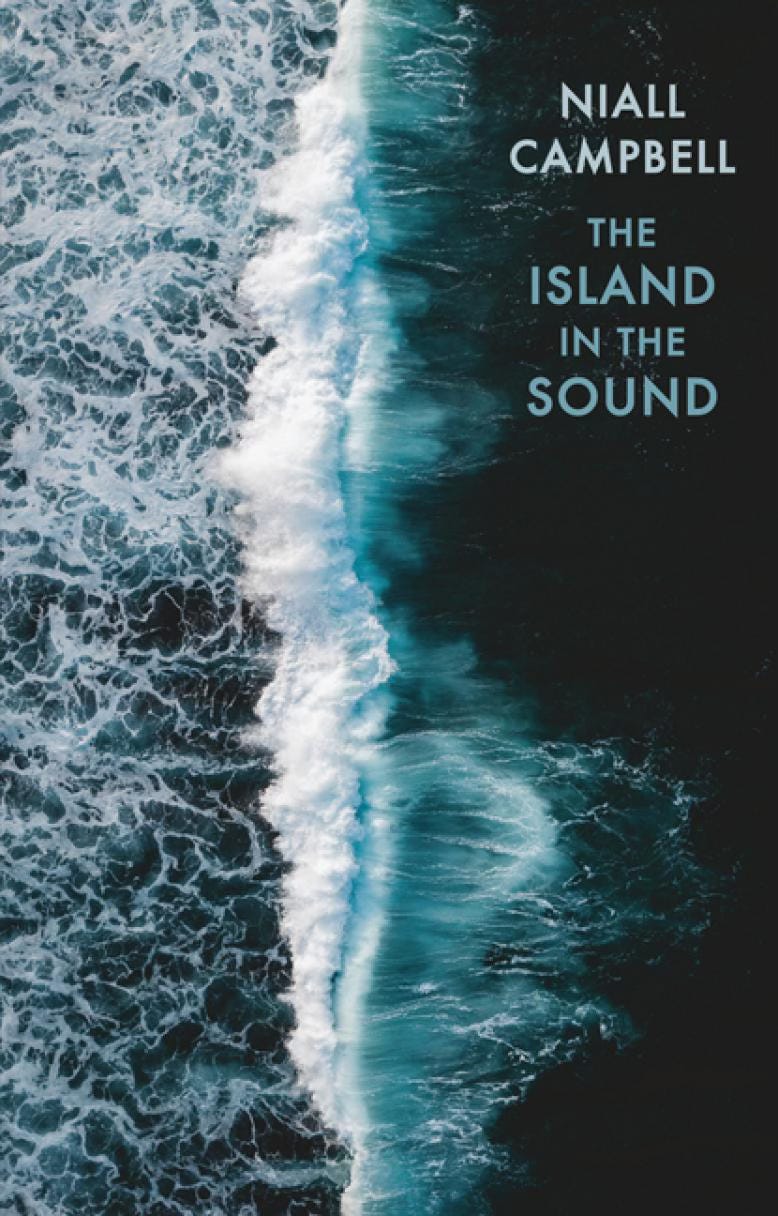
'The Island in the Sound' by Niall Campbell ( Bloodaxe Books, 2024)
You can take the boy out of the country, but you can't take the country out of the boy. In Campbell's case, the country in question is the Outer Hebrides (he was born on South Uist), and the well-known saying (of obscure origin, it turns out) is not this reviewer's deduction from the text so much as the author's own thesis, a claim which his poems deliberately analyse and elaborate.
Consider the second poem, 'Apprenticeship'. Here is the first of its six three-line stanzas:
Dusk on the water, the job was to watch,
unracked, the wet still-dripping creels being tipped
into the grading tray, alive with life.
This is immediately interesting writing. The syntax, I would say, is slightly out of whack, reduced or disrupted (what or whom does 'unracked' modify?). There are a few part-rhymes (water/watch, dripping/tipped, alive/life). There's the playfulness of that final phrase: the more I read it the more apposite it seems, the way it topples over itself, like the mass of falling crabs.
All these aspects of the surface language – syntax, sound effects and phrase-making – are part of what characterises Campbell's work. They combine to achieve a dense and intense lyricism.
All these aspects of the surface language … combine to achieve a dense and intense lyricism
In the case of 'Apprenticeship', the poem goes on to describe how the work is not just to watch, but rather to sort – to sort the crabs by size, picking out "those big as a fist ... as worth a better price". And then the final lines express, first figuratively and then directly, the boy-country thesis i.e. that this local culture, this local colour, has left its mark on the writer:
Big as a fist or heart. The same rain falls
on that shed and on this house. I did it five years,
and then did it for the rest of my life.
The third poem in the collection ('Island Sonnets: Fugay') is, as its title suggests, one of a sequence. None of the six ‘island sonnets’ are conventional in form, no rhymed pentameter, but most are recognisably sonnety. 'Fugay', for example, is in stanzas of 4,4,2 and 4 lines, with a turn after line 10, unrhymed but in a loose, nicely turned, iambic tetrameter. Again, if we consider the beginning and ending, we learn about Campbell's aesthetic. The poem begins:
Bee island. Hive holed in the beach,
their private store of lick-sweet honey
combing strangely in the grit.
It's not simple. Not only is the syntax reduced, but the verb-choices are novel: I'm sure I've never seen 'comb' as an intransitive verb meaning "to become a honeycomb" or something similar.
The rest of the poem, up to the turn, is taken up by a description of the island bees' foraging preferences, ending with the fragment "Tight flavours / of this half-mile, this closed taste-map". Here, 'tight' is an epithet transferred from the geography of the island to the senses of the bees, and 'closed' further exposes the crucial idea that these bees must manage a distinct limit to their foraging, as any small-island dweller must. The sonnet's turn introduces the author:
There are two ways, that I have seen
to be present. The swelling queen
quivers like a just struck match. Nearby
our basking shark steers through its dark.
To know the island, this seems to claim, one must attend to fine sensory detail or else to one's imagination concerning what is hidden. 'Our' is an interesting choice, emphasising the shark's symbolic role, what it shares with the poet in terms of enforced remoteness – a once-removed version of presence.
There's another small sequence threaded through the book: six "Love Letters from the Tenth Year of Marriage". Each is given its own number, and in order these are 3,6,4,2,1,8. I presume the author wants to be true to the order of composition of the letters as well as the best fit to the collection. Compared with the other poems, these are a little freer, with no regular stanzas, no metre, more variety of line length. And of course they're directly autobiographical, and touchingly so, although some draw on cultural analogies – to Virgil's bees, to Aeschylus writing about the Trojan War or, in my favourite of the set, to Van Gogh's letters.
I was delighted to learn (Love Letter 4) that: "In his best letters Van Gogh signs off with I shake your hand." And I appreciate Campbell's argument that this is more compelling than the alternatives he sometimes used, "a handshake / or a handshake in thought" because these lack "the definitive action – the trust / that the ink can carry it." It struck me, also, that this is an insight into Campbell's approach. He trusts the reader to find reasons for what might appear to be odd usages, or else to simply assume that everything has a reason, and to let the boldly figurative language work its trick.
In my case, I don't always respond well to this trust. I perhaps value clarity more than some readers. I'm distracted by anomalies. One such anomaly in this collection is the occasional typographical error. I hate to mention these, because I know how painful they are for the author, who I think has been let down by the process. In the first poem, there's a typo which leads to problem of noun-verb agreement. Likewise in the third poem. A later poem has a misplaced apostrophe, another has 'you' instead of 'your'. Small things, of course, but when the syntax of a poem is challenging, such slips undermine that assumption of reason (there are at least two further occasions where I'm genuinely unsure whether or not there is a misprint) and I hope they might be corrected in future printings.
A further minor anomaly is punctuation. Campbell uses a very large number of colons, dashes and semicolons. 'Theology' is brief (two quatrains) and typically lyrical:
I would explain the soul like this:
as whisky in the barrel cask –
that light caught. Grained, proofed, stored and kept
bound in a dark in wonderment;a swilling ocean inside its drum.
I have nothing in principle against a semi-colon; I side with Nicholson Baker (in his essay 'The History of Punctuation'), who calls it "that supremely self-possessed valet of phraseology". But a valet can be overworked. Perhaps what I am noticing is a mode of thought, in which a main idea is followed, after a pause, by an expansion or analogy.
This is immediately interesting writing
In any case, punctuation conventions are not as stable as we tend to assume, and the history of literature is full of writers with an idiosyncratic approach to it. And, indeed, explicit reference to literature is the final feature of Campbell's collection that I wish to mention. There are poems dedicated to Paul Auster and Ian Duhig, there are epigraphs quoting Shakespeare and Heaney, there are poems after Jules Laforgue, there are poems about Gerard Manley Hopkins and William Blake. (I've already mentioned the in-poem quotations of Virgil and Aeschylus.)
One way for a boy to depart his homeland is through the writings of others. Bringing these writings into discourse with the home's geography and tradition is a way for the boy, now an adult writer, to hold his country close. This is an ambitious tack, and Campbell has the flair to make it work. In the final, almost-title poem, 'Sound', the epigraph quotes 'The Tempest', "Be not afraid, the isle is full of noises", and the poem sings of a Hebridean beach at night:
all the disappearing sounds of the world come back,
here, beneath the percussion of the starlight
and the rustle in the grasses.
Stephen Payne is Professor Emeritus at the University of Bath, where until September 2020 he taught and conducted research in Cognitive Science. He lives in Penarth in the Vale of Glamorgan. His first full-length poetry collection, Pattern Beyond Chance, was published by HappenStance Press in 2015 and shortlisted for Wales Book of the Year. His second collection, The Windmill Proof (September 2021), and a pamphlet The Wax Argument & Other Thought Experiments (February 2022) were published by the same press. Stephen Payne's website is here and he blogs here.
Niall Campbell is a poet, librettist, and editor from the Outer Hebrides. His first collection, Moontide (Bloodaxe Books, 2014), won the Edwin Morgan Poetry Award. Noctuary (Bloodaxe, 2019), his second collection, was shortlisted for the Forward Prize for Best Collection. A selection from these two collections was published as part of the Princeton Series of Contemporary Poets in the U.S. in 2016. As a librettist, his work has been performed by the BBC Philharmonic Orchestra and Scottish Chamber Orchestra. Niall has also written for BBC Radio 3 and Radio 4. He is Poetry Editor of the UK journal Poetry London, and lives in Fife.
As well as browsing our Substack, it’s worth visiting The Friday Poem website where you can browse our Archive of more than 700 posts dating back to early 2021.
Help support The Friday Poem — buy us a coffee to help us stay awake as we strive to bring poetic excellence to your inbox every Friday. If you can't afford to donate, no worries, we’re going to keep on doing it anyway! Big thanks for everything, you lovely poetry peeps.
A beautiful poem to open with! It improved my day.
Can a bee quiver 'like a just struck match'?
The flame can quiver,but does a match? Visualise a match burning. It wilts and blackens and shrivels and drops away.