


Muscle Memory
A wide, blank beach in northeast Norfolk,
my young son learning frisbee-throws.
A backhand, arrowed from his checkered breast pocket.
A second like it, only one which reaches
the other thrower slower, stalls,
to hover right above us, thinking.
A third flicked upwards, angled, from the side,
to climb and climb then carve straight down.
A fourth that, late in flight, will arc
in such a way it might provide
a template for all future beauty.
And, on the boy’s face, as he gets it
and as the world falls open slightly
to show its workings oh the joy
‘Muscle Memory’ is from After the Miracle by Richard Meier (HappenStance Press, 2025) — big thanks to HappenStance for letting us reproduce it.
Buy the book from HappenStance here or from the Poetry Book Society here.
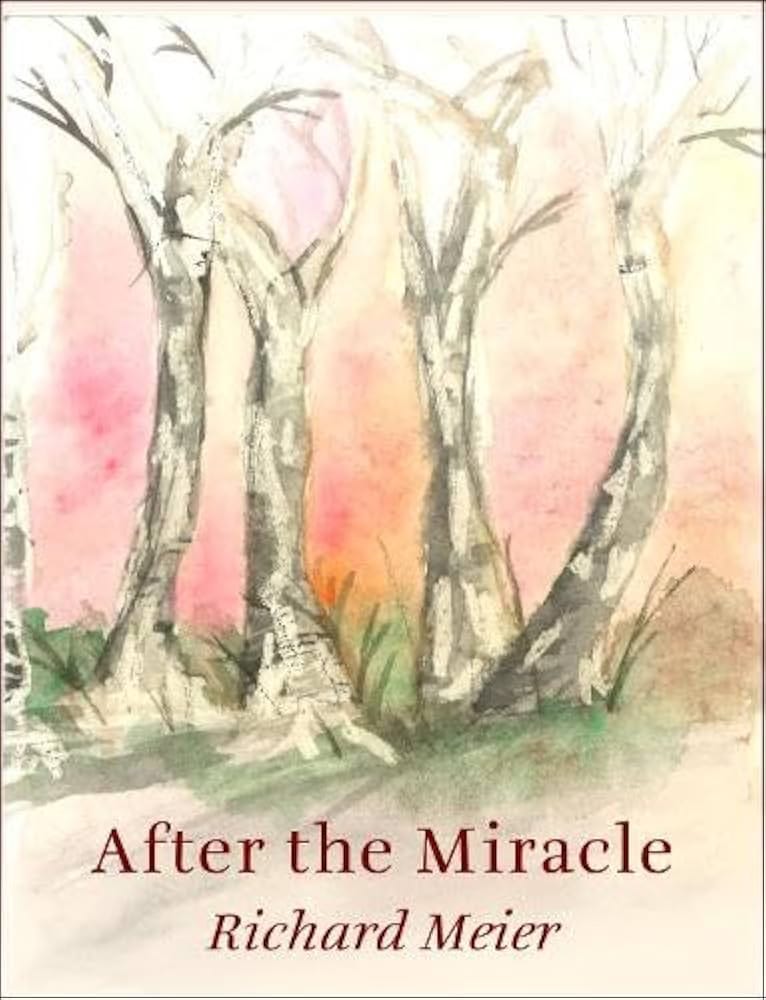
Roy: I was in the middle of this review of After the Miracle when I learned that its author, Richard Meier, had died. Richard was in his mid-fifties and had been ill for some time. As someone who has been interested in contemporary poetry for at least two decades, I am not sure how I managed to miss Meier’s previous two collections, both published by Picador, especially as the first one, Misadventure, was shortlisted for the 2012 Fenton Aldeburgh Prize. This book is published by HappenStance Press, and is a typically lovely product with lush red endpapers and attractive cover artwork by Richard’s daughter, Matilda.
The opening poem shares the title of the collection, and it is a fitting introduction, showcasing in only thirteen lines some of Meier’s admirable poetic strengths, as well as touching on the illness that was a part of his life during his final year. In elegant, understated and direct language, the poet speculates on how Lazarus might have reacted to the miracle that brought him back to life. He himself describes seeing a woman (presumably a medical professional) who “took away the pain / which so long stooped and shaped me”, and wonders whether Lazarus too had “no words / to meet such shocking change”. It is difficult to paraphrase any ‘good’ poem, but this one in particular – apparently simple, but complex in its skilful exploration of the inadequacy of language in the face of two separate ‘miracles’ – is one that needs to be read in its entirety.
The equally memorable ‘Muscle Memory’, quoted in full at the head of this review, is set on a beach where a boy is learning to throw a frisbee with his father. I was reminded of Heaney’s ‘A Kite for Michael and Christopher’ – another poem that reflects on innocence, discovery and joy. Meier’s voice is, however, entirely his own. After one of the boy’s early attempts, the frisbee “stalls, / to hover right above us, thinking”. I like Meier’s confidence here. To have the frisbee ‘thinking’, instead of prefacing the idea with ‘as if’ or ‘as though’, is a bold move that works for me. The image is all the more vivid for being stripped of any supporting structure, so that it floats on its own. Given the subject matter – a boy’s discovery of a new skill and the emotional power for the parent at witnessing the child’s delight – Meier’s skilful avoidance of sentimentality is impressive.
The image is all the more vivid for being stripped of any supporting structure, so that it floats on its own
Just a few poems in, Meier’s command of a variety of forms and structures becomes evident. ‘50’ is a single-sentence poem that owes its pacy movement and colloquial feel to short lines, some only one or two words long. This poem has a darkly humorous edge, as it compares a beech tree, capable of leaning “at forty-five (or maybe forty-three) / degrees” to humans who “teeter” at much less acute angles, so that their feet “unpeel” and they “topple” and “keel”. He also conjures delightful and precise imagery. In ‘The Heron’ the bird itself is “Still, so still, / its focus like a cutting tool”. To fly away “it has to come apart almost, / a loaf being broken open.” In ‘Used Coats, EBay’, a coat is photographed “from the back, hood up, / left arm right-angled, raised” seeming to deliver “a last wave”.
Other poems in this first section explore versions of loss. The creatures in ‘Animals, Wapping’, are not real animals, but pieces of driftwood that have been shaped by the Thames. Given the knowledge of the poet’s illness, I wondered if its seemingly hurried, almost throwaway ending – “like nature cannot stop or something” – might be an expression of the difficulty of having to confront the inevitable and difficult truth of nature’s (and time’s) ceaseless passage.
‘Mistaken’ carries a powerful emotional charge similar to the opening piece, comparing the “terminal lucidity” of people who wake from a coma with the feeling two lovers experience on the verge of separation, their final moments “spent in greeting — // touching one another, / smiling, laughing”. ‘The Undoing’ is another delicate, economical and precise poem in which the speaker is lifting turf he laid when first married, perhaps to replace it with gravel and make a Japanese-style garden. He finds himself surprised (“distressingly so”) at how easily such a change can be made. The emotional punch of realisation is transmitted to the reader through the abruptness of the final line – just two words: “Now what.”
The emotional punch of realisation is transmitted to the reader through the abruptness of the final line – just two words
Hilary: The second section of the book, Sketch of a Pagoda, is an homage to Japanese poet and master of the tanka form, Takuboku Ishikawa, who died at 26 from tuberculosis. Meier has said elsewhere on The Friday Poem that Ishakawa is his “favourite poet ever” (he describes him as the ‘Japanese Keats’), and has written about him in a blog post here. This section consists of 28 short (three line) haiku-like poems. The pieces are untitled, but each has a kind of ‘post-title’ positioned underneath and to the right, in italics and square brackets. (The publisher describes these as ‘afterthought titles’ or ‘un-titles’ and says they are “tentative” with “none of the imperiousness of normal titling”.) The poems work perfectly well without them, but they allow a reader to see things from a different perspective, or to develop further understanding.
Some of the pieces are beautifully observed miniature portraits of natural life:
three rising scoops — the route
the pied wagtail takes
from pavement up to roof[Sketch of a pagoda]
Some simply record a special time – the poet at Evensong in Coventry Cathedral with his young son, for example, or his experience as a child:
getting up at night
to watch the rain fall on our street —
my first act as an individual?[Six or seven]
Others identify moments when the poet was hurt, or experienced insight or some sort of transformation. Put together, they chart the breakdown of a marriage, the poet’s father’s ageing and death, and his own illness. Many are profoundly moving and often painful to read.
the plain white biscuit tin
you gave me on our ten year anniversary
contains my medicines now[A marriage]
There’s a lot of white space in this section of the book, but the power of these compressed, brightly burning and intensely felt poems fully justifies this editorial decision.
The third section, From Memory, is dedicated to Maureen Meier, the poet’s mother, and includes a nine poem sequence about her illness and death (as well as a baker’s dozen other poems). The sequence includes ‘Conviction’, in which the poet’s mother manages to make it to “the top road”, “in early March and a thin, unbuttoned coat / on one egg and an oatcake / down an unpavemented, unlit country lane”. The poem deftly convey the poet’s mixture of frustration and admiration at this feat. Notice the double meaning of the title. This happens with a Meier poem – layers of meaning reveal themselves over time.
The final poem in After the Miracle is ‘From the Darkness‘. It is plain spoken and straightforward, not tricksy, or clever-clever. But there’s so much going on. The poet takes us down into the coalhole “where I tend to store things”. He opens an old tin of red paint and finds “a half-drowned brush, / wild-looking after treading paint for years”. Can’t you feel that sense of release when the lid opens? Can’t you see that brush, the splayed bristles, everything at an angle. The brush becomes animate, becomes a symbol for the drive to survive even in the most difficult circumstances. And the poem ends with a real sense of wonder.
I don’t know how it waited (patiently or not).
Or whether it was tired, or what.
But what I thought of, as I fished it out to use it,
was the heart, the remarkable heart.
Roy Marshall is a UK poet whose first full collection The Sun Bathers (Shoestring Press, 2013) was shortlisted for the Michael Murphy Award. His second collection, The Great Animator, was published by Shoestring in 2017. After Montale, which contains versions of poems by the Italian poet, was published in 2019. Roy’s work has appeared in magazines including The Rialto, Poetry Wales, The North and The Compass. He has worked as a gardener and a nurse, and as a part-time university lecturer.
Hilary Menos is editor of The Friday Poem.
As well as browsing our Substack, it’s worth visiting The Friday Poem website where you can browse our Archive of more than 700 posts dating back to early 2021.
Help support The Friday Poem – buy us a coffee to help us stay awake as we strive to bring poetic excellence to your inbox every Friday. If you can’t afford to donate, no worries, we’re going to keep on doing it anyway! Big thanks for everything, you lovely poetry peeps.
Very sorry to only just hear of Richard’s passing. I remember his reading at PanMacmillan’s offices in London when we shortlistees all gathered for the Picador Poetry Prize in 2010; his understated, emotionally intelligent lyricism made him a worthy winner. The kind of poet we should make much more of in our garrulous age. A lovely, insightful review. I’ll track this one down.
Thank you for this review that prompted me to buy the collection