


Tethers
For the first time you proudly put up
your own tent next to ours –
flimsy offshoot, fairy-lit pod, canvas satellite.
At midnight you wriggle across the boundary
and answer our goodnight, then call again
to say the walls are damp with rain.
The best I can offer is to suggest you give it a go,
and if the storm moves in as forecast
come back to us; I clear a space to make it easy.
It’s your father who goes out
into the cold, dark field and sees
the inner fabric is touching the outer
and tightens all your ropes so you can sleep
at the distance from us you’ve chosen.
‘Tethers’ is from Intimate Architecture by Tess Jolly (Blue Diode Press, 2025) — thanks to Blue Diode for letting us reproduce it here.
Were I asked for one word to describe what Intimate Architecture is ‘about’, I’d probably settle for ‘anxiety’ – but with 800 words or so at my disposal, I can add how it’s also about more than that.
The book is in two sections: the first looking back to Tess Jolly’s own (and others’) childhood; the second moving forward in time as she cares for her children. (It’s her second collection; the first, Breakfast at the Origami Café, had a similar structure, looking back and then shifting forwards to her father’s illness.)
The first section takes us into anxieties like those in ‘The Mischief’ where “the mice / have lined up on the ledge / the crumbs you may eat / one every hour on the dot”. A long poem, ‘White Horse Drive’, moves from child to child at boarding school, naming their sufferings. “Cecily” tries to keep her mouth shut, but
[…] Sooner or later
she’ll have to breathe or eat and the wordswill come gushing out in a shower of bile
and barbs from some kind of horrific
piñata
“Constance”, on the other hand, “scuttles to the library / hood up, head down” and “swaddles herself / in winding sheets / of paper, mildew, dust.”
Written in the first person, ‘An Angry Hatching of Closely Spaced Parallel Lines’ jauntily tracks negotiating anxiety with a therapist’s standard suggestion of snapping a rubber band on a wrist to deal with unwanted thoughts ... which ends up producing the “lines” of the title. By the end of the poem, the ghost who “prefers to think of himself as being / on a spectrum” and who is supposed to be banished, begins to sound more interesting than the therapist – though she, too, has some good lines, when she says the writer “need[s] to leave the ghost and enter the courtrooms // and Co-ops of the living”.
The pieces I’ve mentioned above address more extreme, perhaps less common anxieties. Maybe it’s the act of tackling these that enables the poet to write so well (and in an understated way) about a concern many of us will recognise and at some stage have experienced (even while questioning whether anything really happened). In ‘The Bus’, the poet as a child is on her way to a new school. A boy offers his seat to her mother, who is with her “to show me what to do”. The boy chats to her mother –
[…] – he’s thinking of studying radiology
and holding his palm in front of my skirt,
not touching, nothing anyone could
accuse him of. He winks at his matesand I focus on the streets I grew up in
now blurred on the other side of the glass
The poem doesn’t stay in that long paralysed moment; it goes on to speak from the writer’s present awareness (“When Mum reads this and asks why I didn’t tell her, / I’ll say there was nothing to tell”) before it strides across to the next generation and the daughter who “swears she’d shove his hand away, / she knows she’d confront him.”
By the time Tess Jolly has children of her own, she’s worked out a range of coping mechanisms. During ‘The Tunnel’ – a surprising sonnet’s tour of a football stadium – she tries to focus on the idea of players running through the tunnel, rather than on the “concertina walls” that enclose them, which the guide describes admitting ambulances in case of major accidents. But the thought of accidents sticks: later, when her children don’t answer their phones and the weather’s bad, she tries “to focus on folding their washing: / his favourite jeans, her new halterneck top.”
‘Guitar’ describes a car knocking her small son from his bike. Tess Jolly is able to describe the driver as “a stranger / so distraught I found myself comforting her”. Her child was bruised and shaken – but she thinks of parents who are less lucky “standing forever at bedroom doors / unable to take down the posters”.
Perhaps her experience graces her with an ability to articulate subtle shifts which are hard to put a finger on in relationships
Perhaps her experience graces her with an ability to articulate subtle shifts which are hard to put a finger on in relationships. I admire her delicately understated moments of tension in ‘Daughter’: “I know I’ve asked / too much when she shrugs off my arm”, as well as the care she takes to give children space. ‘Tethers’ is a poem in which a child puts up their own tent next to their parents’, but the guy ropes have to be tightened by the father so the child “can sleep / at the distance from us you’ve chosen”. Giving space is not easy, as ‘Silk’ a couple of pages further on acknowledges. Here she writes of cleaning a child’s wound: “I remember the language of such small intimacies”.
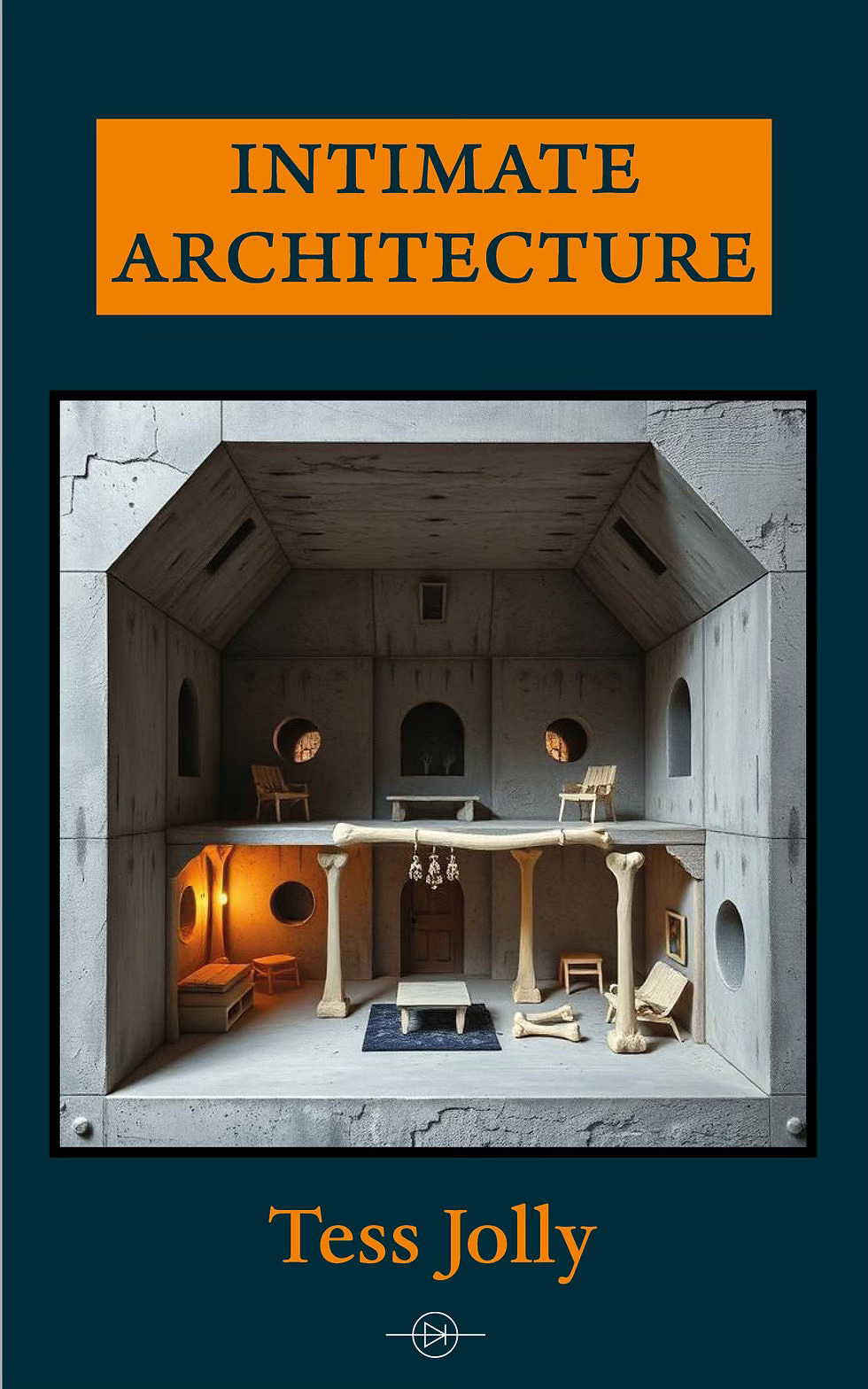
This second section of the book seems to exemplify its title. The poem ‘Intimate Architecture’ (placed near the end) is a wish that the separation between parent and child, “the line I need to put between us”, is only a thin one. The poem steps carefully through memories, building them into similes that reveal how delicate she would wish that line to be:
Can it be as fragile as the airmail letters
we cut and bound into a library
of miniature books scribed
with elaborate stories[…]
Can it be as light as the fibres we crushed
to make our doll’s house walls
(It must be this poem, surely, that lies behind the cover image of a disturbing doll’s house with bones as part of its construction.)
While not usually drawn to poetry that rests heavily on autobiography, I’ve gone back to re-read these well-written pieces several times, perhaps gaining some small sense of how very difficult the taken-for-granted everyday world can be when the spectre of anxiety dominates.
Jane Routh has published five poetry collections with smith|doorstop. Her first, Circumnavigation, won the Poetry Business Competition and was shortlisted for the Forward Prize for best first collection; Teach Yourself Mapmaking received a Poetry Book Society Recommendation. She has taken first prize in the Academi Cardiff International Poetry Competition (with the title poem of The Gift of Boats) and in the Strokestown International Poetry Competition. She contributes reviews and non-fiction to several publications.
As well as browsing our Substack, it’s worth visiting The Friday Poem website where you can browse our Archive of more than 700 posts dating back to early 2021.
Help support The Friday Poem – buy us a coffee to help us stay awake as we strive to bring poetic excellence to your inbox every Friday. If you can’t afford to donate, no worries, we’re going to keep on doing it anyway! Big thanks for everything, you lovely poetry peeps.
Tess Jolly is an amazing poet whose work I devour, not moving from my reading place until I’m breathlessly done, then I read and reread, slowly, painfully, heart in mouth, for years. For always.
I love that the father checks on his son, sees how he can help but doesn't criticize him for not making the guys tight enough. It's such a loving and tender and quiet moment of caring, and enabling growth, separation.