


THIS IS MY SISTER
This is my sister Amani and my brother Abdullah,
on New Year’s Eve, laughing at videos they captured
during the genocide. Amani started talking to us
about my father, about his love and his generosity.
These moments which may seem ordinary
are the most precious. They are the warmth
that shields from the life’s coldness.
You have taught me so much, dear sister.
You’ve shown me how to never let despair
find its way to my heart. Despite everything
you completed your master’s degree, volunteered
to teach children at a school, and cared for Aleen
amidst the horrors of this genocide. On your birthday
I celebrate the light you brought into my world.
I want you to know your presence is not just a blessing
it’s a sanctuary.
’THIS IS MY SISTER’ is from The Age of Olive Trees by Haia Mohammed (Out-Spoken Press, 2025) — thanks to Out-Spoken Press for letting us reproduce it here.
Haia Mohammed is a Palestinian poet and artist from Gaza. She was awarded a scholarship to study Creative Writing at Goldsmiths, University of London, and was evacuated to the UK in September 2025 to begin her studies. Her family remain in Gaza, and she has launched a gofundme fundraiser to support them and bring them to the UK. Please go to the fundraiser page, donate, and share the fundraiser with family and friends. Follow Haia on Instagram.
I have often felt that poets are wrought from fire, and Haia Mohammed’s debut collection confirms it. This slim pamphlet of fourteen poems and three short epigraphs was written when she was 23 years old and a student from Khan Younis, a city in the southern Gaza Strip, now largely destroyed by the Israeli army. Her voice stays with me; she has seen the carnage of occupation and genocide and found language to describe the almost indescribable.
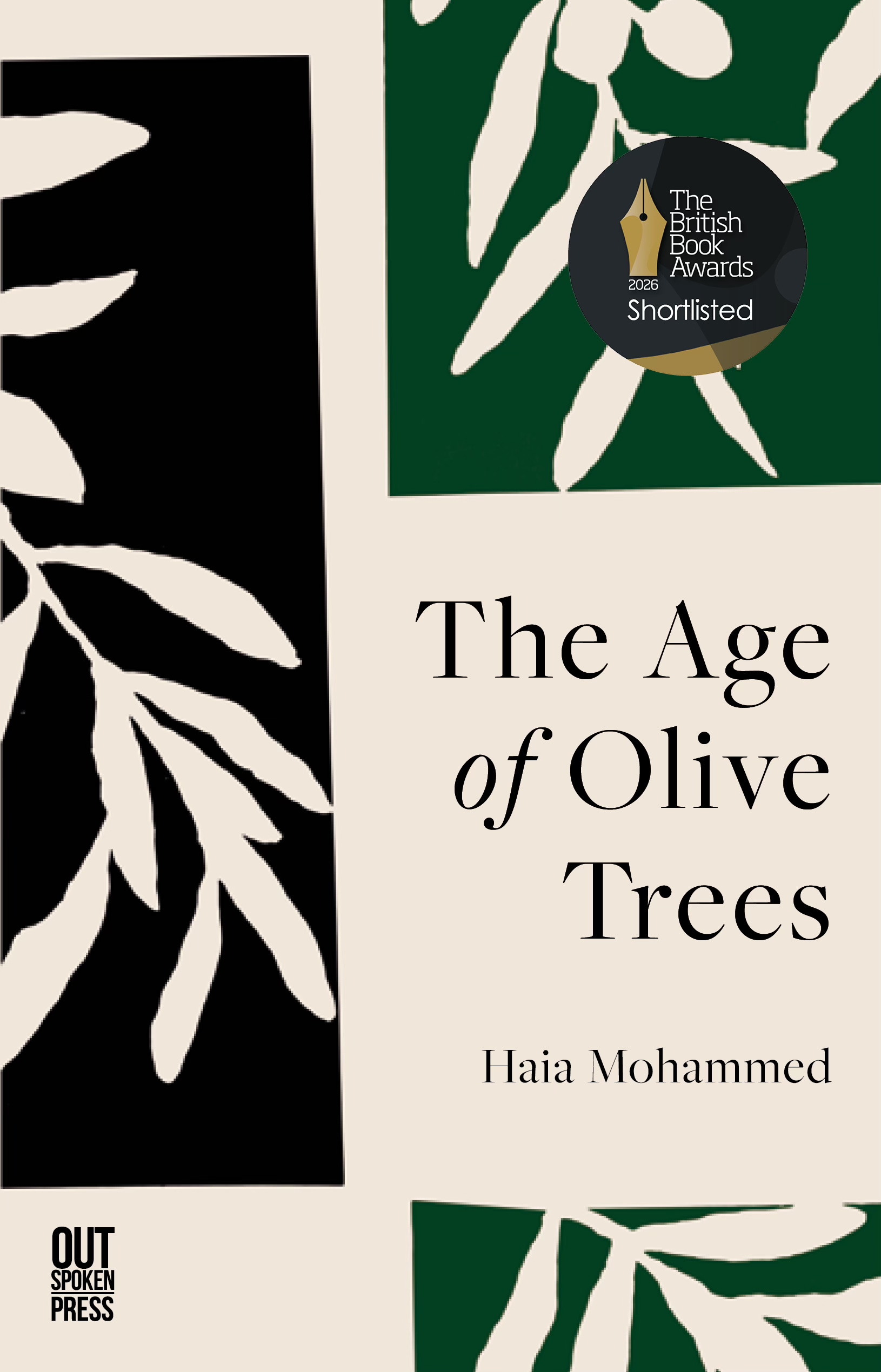
Hers is a poetry of witness. It is urgent, immediate, ongoing. Her collection opens with an epigraph, a call
        to all those with stubborn eyes
like the olive tree who refuses to uproot
            never stop your defiance
This is an entreaty to not look away, as the people of Gaza cannot look away from what is being done to them. The olive trees, ancient symbols of peace, refuse to be displaced, their roots anchored deep in the soil. The act of looking, of bearing witness, becomes an act against erasure.
Mohammed’s writing turns bare statistics into people at a time when there are pressures to silence those who would speak. In 2025 UNICEF estimated that 50,000 children had been killed or injured in the Gaza strip. There are difficulties about writing, protesting or naming the atrocities occurring in Gaza, but there is reliable evidence of genocide given in Gaza Genocide: a collective crime, the report by the United Nations Special Rapporteur on human rights in the Palestinian territories occupied since 1967 (United Nations, October 2025). It is a key human rights issue of our time. Artists, journalists and writers are being actively targeted and attacked. This is a time and place where one can be killed for writing poetry. There is a struggle for accurate language, for truth, and for humanitarianism to prevail.
The Age of Olive Trees brims with emotions, soul, dreams. As the editor Sunnah Khan says in the Foreword, “the truest poems travel the shortest distance from the pen to the heart.” I can’t read this collection without the feeling that blood and ink are the same substance, pulsing defiantly. Surrounded by destruction, forced to renounce material objects and comforts, and constantly aware of the possibility of death, Mohammed’s writing soars into an almost transcendental appreciation of life.
Her poetry disturbs the peace. She shows us what it’s like to live through a calamity, one which makes the limits of freedom all too visible; to experience trauma; to have assumptions about the world and one’s future shattered. Despite this, she holds on to her dreams, yearning to live an ordinary life, wanting peace, even wanting moments of boredom. She practises gratitude, thankful for the physical and celestial world, the moon and stars. She writes of human connection, and the divine; of survival and community.
This is a time and place where one can be killed for writing poetry
In ‘How do you find the way to my homeland’ she writes of how the Palestinian people choose kindness when there is nothing, retaining their humanity. In a heartbreaking image, she describes people showing restraint around a loaf of bread when everyone is starving – the idea that people who have nothing have chosen not to lose their humanity.
when there’s only one loaf of bread left for two days no one touches it / despite everyone starving / until my mother divides it among us.A short poem, ‘نحن الباقون’ or ‘We are the ones who remain’, written in Arabic, shows us the visual beauty of the language. It’s about a beloved olive tree, tended through generations. The trees will remain, witnesses who “speak the truth” and “extend deeper into the soil than the traces of invaders”.
In ‘I am Gaza, I am Haia’, the poet claims her own dignity, resistance, history and the fierce desire to live, concluding: “my voice is louder than any bomb / my spirit deeper than any wound.”
Sometimes, as in ‘I am in the era of daily genocides’, she questions why she should get up quickly in the morning, before demonstrating simple determination to carry on with the daily habits of study, work, and meeting friends. These are her reasons to live. The sobering final lines show the stark reality of her people’s plight:
My mind asked, ‘is the shedding of blood permissible
In this world?’ Bloodshed, home demolitions, displacement,
hunger, thirst – all internationally forbidden, of course,
outside the borders of Gaza. But in Gaza, everything is allowed
even the killing of children.
The poem confronts the devastation of raised hopes, the reality of returning to a home city after the Israeli army had withdrawn. She describes a hellish and unrecognisable place, everything reduced to rubble and ash, the survivors trying to identify bodies and body parts in the streets. The shock is visceral: “I didn’t cry. I couldn’t cry or even know what to cry for.”
In ‘Daughter of the Sea’, she vividly communicates the compulsion to survive. Her central metaphor compels instantly. She is swimming in hard, deep waters “while the world sat on the shore and watched.”
… in Gaza, everything is allowed / even the killing of children
These moving and urgent poems are asking us not to look away, not to sit on the shore and watch. Haia Mohammed has an astonishing ability to articulate the terrible abuses around her. She does so with simplicity and strength, fiercely resisting the wider collapse of language and meaning that is now a such a threat to truth. She refuses to be silent. She defies the human erasure taking place, vividly evoking the humanity of ordinary people trying to survive in the most horrific circumstances. What is happening in her country could happen anywhere, to any of us. As the author, Omar El Akkad asks in his book One Day, Everyone Will Have Always Been Against This, “What good are words, severed from anything real?”. The Age of Olive Trees directly connects us with reality, the reality of what is being inflicted on ordinary Palestinian families. Not only should this concern us readers, poets, writers and citizens, it should encourage us to break the silence that allows such atrocity to continue.
The epigraph at the end brings us back to the emblematic olive trees. During a brief moment of peace, the poet returns to the children of Gaza. From underneath the soil, the voices of those who have been silenced call for justice:
Tonight I can hear the whispers of the wind through olive trees
  I strive to protect, the laughter of children mixed with sorrow,
            the murmurs of the earth urging me to persevere.
Khadija Rouf is a poet and writer with a passion for the arts and collective mental health. Her poetry has been published in Orbis, Six Seasons Review, and Sarasvati and included in the NHS poetry anthology These Are The Hands (2020). She won joint second prize in the health professional awards category of The Hippocrates Prize for Poetry and Medicine in 2021, and her pamphlet House Work was published on International Women’s Day 2022 by Fair Acre Press. She has poems included in the anthologies, Tabula Rasa and Look Away Now (both Linen Press). She is also a member of British South Asian writers collective The Whole Kahani and has work in the anthology Tongues and Bellies (Linen Press).
Vital Statistics: The Friday Poem has more than 3700 subscribers. It is run by four people – Hilary Menos (Editor), Helena Nelson (Consulting Editor), Bruno Cooke (Spoken Word Editor) and Andy Brodie (Web Editor), with contributions from a team of reviewers and writers.
Until recently we maintained the Friday Poem website (thefridaypoemdotcom) as an archive of 700 posts published between 2021 and 2024 (including most of the original Friday poems) but following a catastrophic hack in late April we made the difficult decision to take this down. We’ll be republishing some of these posts – poems, features and reviews – on Substack in the future.
Help support The Friday Poem
Buy us a coffee to help us stay awake as we strive to bring poetic excellence to your inbox every Friday. Heartfelt thanks to everyone who donates, especially to our regular donors. If you can’t afford it, no worries, we’re going to keep on doing it anyway! Big thanks for everything, you lovely poetry peeps.
This is a poet of extraordinary talent and wisdom. Thank you Friday Poem and Khadija Rouf.
Jane Berger Herschlag
Thank you for sharing an amazing poet, who needs her words to be heard 🙏