


There’s a swift
who scythes the miles
screeching, sleeping
on the wing, then curves
towards a small hole
under the eaves
and, finding it filled,
arcs away without pause
as if she had not invested
the whole ocean in it
‘There’s a swift’ is from The Professor of Transformation by Elaine Ewart (New Walk Editions, 2026) — big thanks to New Walk for letting us reproduce it here.
The fifteen poems in Elaine Ewart’s evocative pamphlet take us on a journey of landscapes, birds and flight. Before we even reach the poems, the Contents page speaks powerfully of this journey: of blue tits and collared doves; of the fieldfare and the swift; of the nest, the playing field and the fen.
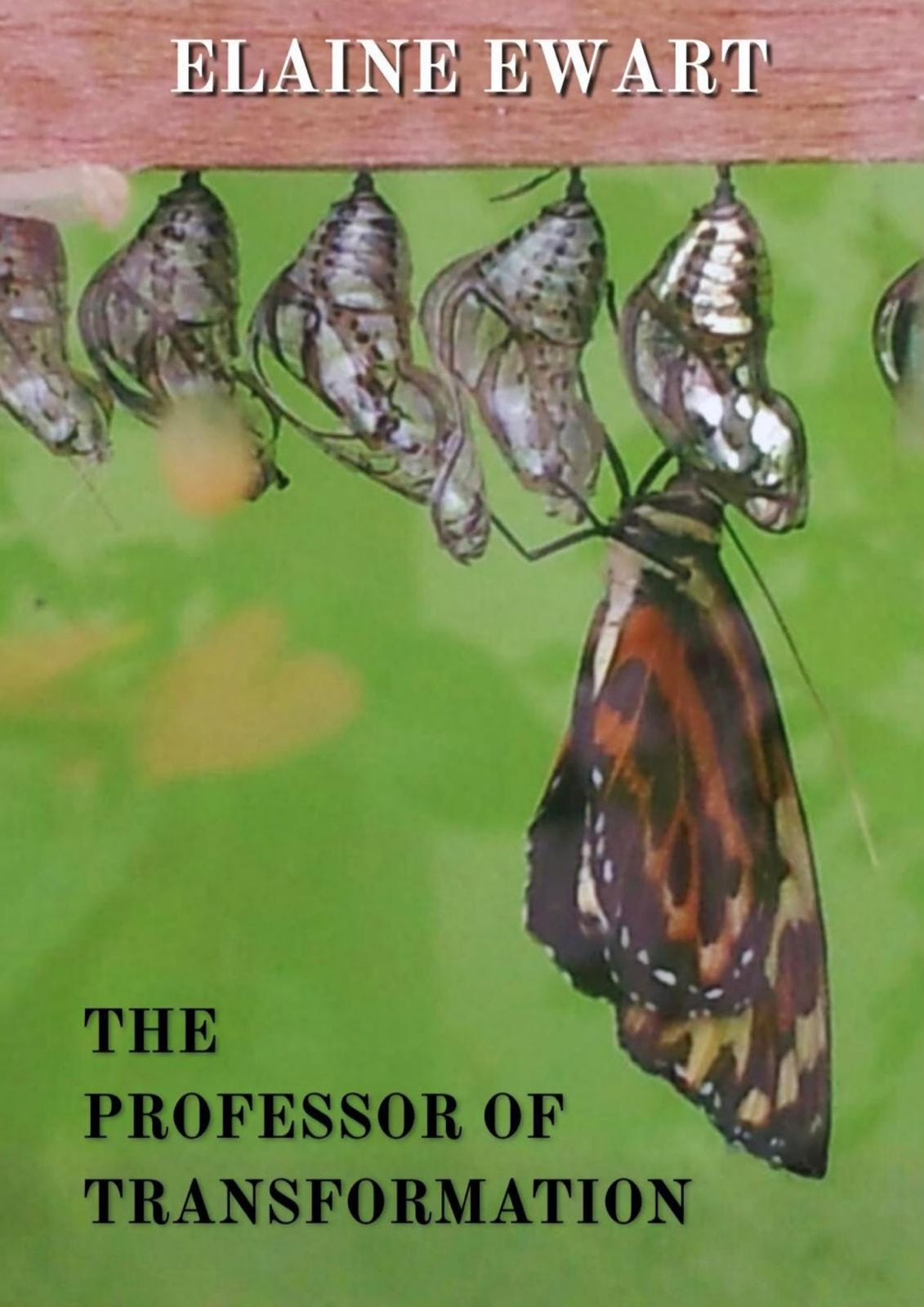
Ewart’s keen attention to detail runs throughout the entire collection. Although The Professor of Transformation does not shy away from large themes – its poems speak of history, loss and transformation – these concerns are always anchored in sharply observed details: the “small hole under the eaves,” the “knuckle-bleeding cold,” the “blunt pencil stub,” the “meagre beakful of spider legs,” the “spell of snow,” the “smell of cut grass.”
At the same time, a haunting feeling of something lost or missing underpins the poems: something destroyed or searched-for; that which is lost when there is a lack of mutual understanding. This kind of absence is powerfully evoked in the innovative use of white space in the three-page poem ‘Inspector Vortex’. Ewart plays interestingly with form throughout other poems in the pamphlet too, from the devastating concrete poem, ‘Michaela brings bad news from the blue tit nest’, to the couplets in ‘Fieldfares’ and the interview format of the title poem, ‘Application for the post of Professor of Transformation’.
Tender, precise and urgent …
At the heart of this collection sits the glorious sonnet, ‘Take the collared dove’, which opens:
       Do a thing badly, often enough, and it becomes
       success. Take the collared dove: fucking all year round,
       pushing out eggs into a construction of three twigs.
Like the collared dove, the poems here persist, trying again – even in the face of “smashed shell and dirty yolk”, in the face of misunderstanding, lost love and unseen birds.
Tender, precise and urgent, The Professor of Transformation calls us to pay attention to the minute ways in which we encounter the world around us, showing us how attention and care can transform devastation into wonder.
Rachel Bower is a poet and novelist from Bradford. Her debut chapbook, Moon Milk, was published by Valley Press in 2018. Her latest works are It Comes from the River (Bloomsbury, 2025), Bee (Hazel Press, 2025) and Family Lines (Faber, 2026).
Sprawl
She’s the sprawlingest bed-fellow said the maid
of the Duchess of Malfi. That am not I. I keep
on the whole to my lane. Except sometimes in sleep
I sling my right leg and arm sideways across the bed
in engulfing embrace and then, unopposed, wake
to find that you’ve gone. Not gone for a pee
or down to the village on your bike for the paper
but always, irrevocably, gone.
‘Sprawl’ is from Tumbling by Elizabeth Cook (Mariscat, 2026) — big thanks to Mariscat for letting us reproduce it here.
Tumbling will be launched on Monday 2nd Nov 2026 at 6:30 pm - 8:00 pm at the Fruitmarket Gallery, Market Street, Edinburgh, with readings from Michael Stephenson and Elizabeth Cook and music from The Self-Righteous Brothers. Book your place at the launch here (it’s free).
I read the first dozen or so poems of this new pamphlet from Mariscat, then left it for a while. One poem — the sixth in the collection, a five-line, untitled piece — stayed with me and kept popping into my mind as I did mundane tasks around the house and garden. I later discovered it’s on the back of the book and in online publicity material, so I’m going to quote it in full:
I thought I would still be the me
that I was when you lived when
you died. I could not then see
that your death would bereave
me not only of you but of me.
Makes you think doesn’t it? Well, it made me think. About marriage, love, companionship, the way a couple grows together over the years, and how much of one’s identity is stored in a kind of shared memory bank. And then about how it might feel to have that memory bank removed, or broken.
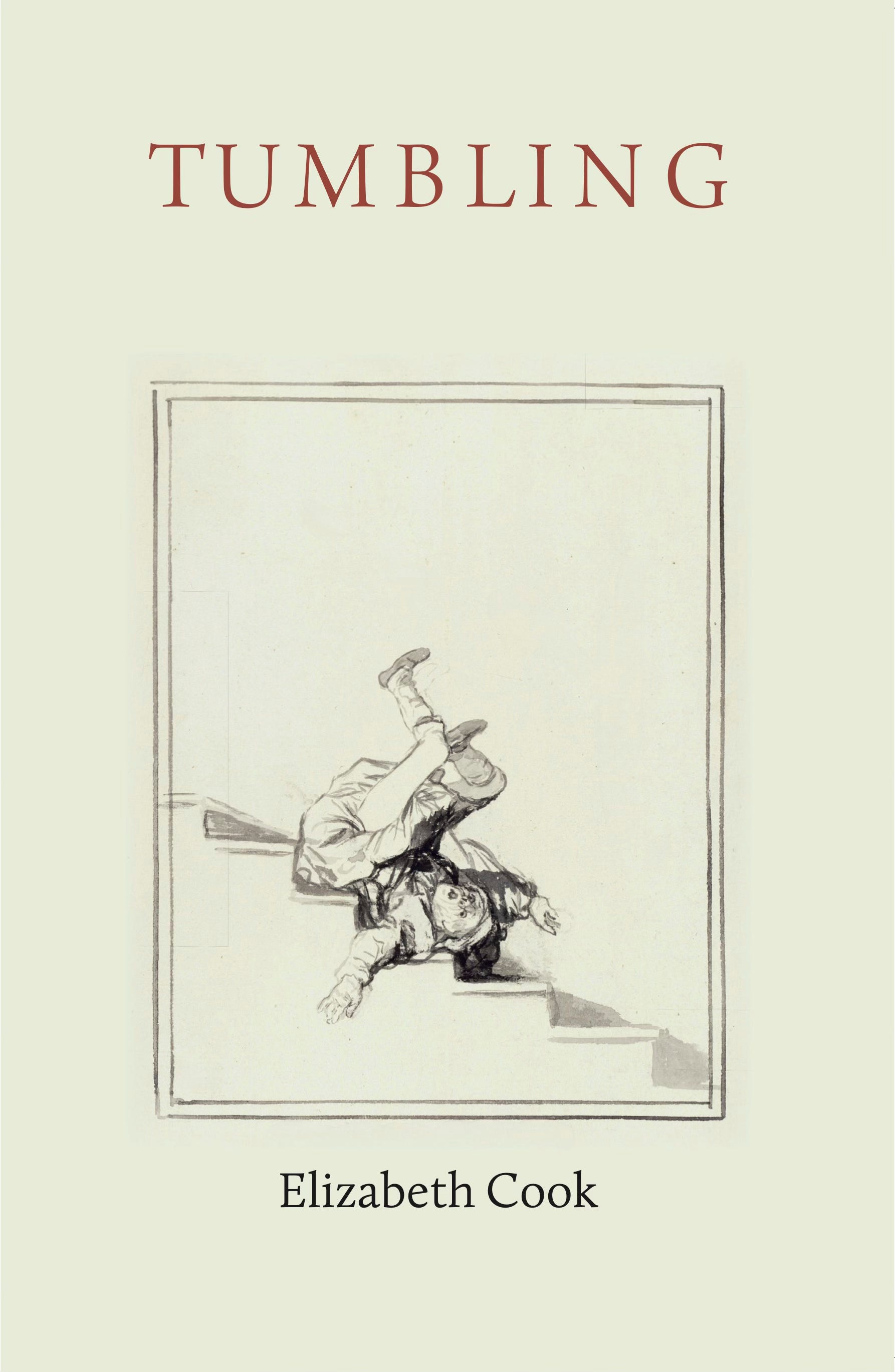
There’s much to reflect on in Tumbling. Elizabeth Cook approaches the serious subjects of bereavement and grief with delicacy, precision and occasional light touches of humour. The pamphlet title, which has the obvious meaning of falling down but also the implication of clowning or acrobatics, fits the work well. These are poems about the “balm of being known”, memories of a generous Sicilian farmer offering “more fruit than we were truly able to carry”, and the reassuring and familiar “friendly fragrant fug” of coupledom.
The poet’s deep appreciation of such things runs alongside a profound sense of loss. In ‘Smoke without …’ the narrator remembers how she and her partner would work together in the garden, which is now overgrown and neglected: “The high grass chokes / the small parched apples”. In ‘Chair’, she dreams of a shared plan to repair and re-upholster the piece of furniture. On waking, she slowly realises that the chair isn’t even there, and that there is “nothing / for us to repair”. Losses and hurts are considered in depth and with subtlety, without veering anywhere near sentimentality.
Elizabeth Cook approaches the serious subjects of bereavement and grief with delicacy, precision and occasional light touches of humour
The diction here is interesting and specific. In ‘Oiling the Tortoise’, the tortoise would “enquire of the foodstuffs ahead” and, after eating, its “equipage” moves on. In ‘Next time’, the poet proposes that she and her late partner should spend their next life together on the eastern coast of Sicily, near a beach with “whiskery / grasses and light / complicated seedheads”. And I learned a new word from the title poem, which opens, “Feu notre mère: ‘our late mother’.“ The idiom is new not only to me, but also (as it turns out) to the narrator’s brother.
Tumbling closes with a delightfully whimsical piece called ‘Balloons’, in which a man at the edge of the park holds a large bunch of balloons that “gently, painlessly, knock and bounce” together. Of course the poem isn’t only whimsy, and of course it’s about more than just balloons. It ends:
Some strain against their strings. He feels their tug —
the tug of his jostling, busy, beloved dead
wanting to be more free, wanting, perhaps,
to lift him from his feet and take him.
Hilary Menos is Editor of The Friday Poem. Buy her books here (signed copies, and posted from France so the postage is a bit of a sod, sorry).
Vital Statistics: The Friday Poem has 3800-plus subscribers. It’s run by four people – Hilary Menos (Editor), Helena Nelson (Consulting Editor), Bruno Cooke (Spoken Word Editor) and Andy Brodie (Web Editor), with contributions from a team of reviewers and writers.
Until recently we maintained the Friday Poem website (thefridaypoemdotcom) as an archive of 700 posts published between 2021 and 2024 (including most of the original Friday poems) but following a catastrophic hack in late April we made the difficult decision to take this down. We have republished some of the poems, features and reviews here on Substack, and will publish more in the future.
Help support The Friday Poem
Buy us a coffee to help us stay awake as we strive to bring poetic excellence to your inbox every Friday. Heartfelt thanks to everyone who donates, especially to our regular donors. If you can’t afford it, no worries, we’re going to keep on doing it anyway! Big thanks for everything, you lovely poetry peeps.
Thank you for this excellent review. I especially like your point about Elizabeth Cook's diction - always both lively and thoughtful.