


As a child, you once found a bird
mauled
left to die
but not quite dead
wings shredded
beyond repair
and with your dad
gently instructing you
over the phone
you tearfully broke its neck.
The bird was so small
you couldn’t even hear
the snap.
This is not like that.
The above is from ‘AND … SCENE’ in The Revelation Tapes by Stefan Mohamed (Broken Sleep Books, 2026) — big thanks to Broken Sleep for letting us reproduce it here.
Out via Broken Sleep Books, Stefan Mohamed’s latest poetry collection The Revelation Tapes sprawls over 100+ pages. There are 38 poems (or pieces) arranged loosely as a screenplay, split into seven acts. Yes, seven. Tapes is dystopian fiction told through poetry, with approximately two thirds of a coherent narrative – it has, at least, a beginning and a middle.
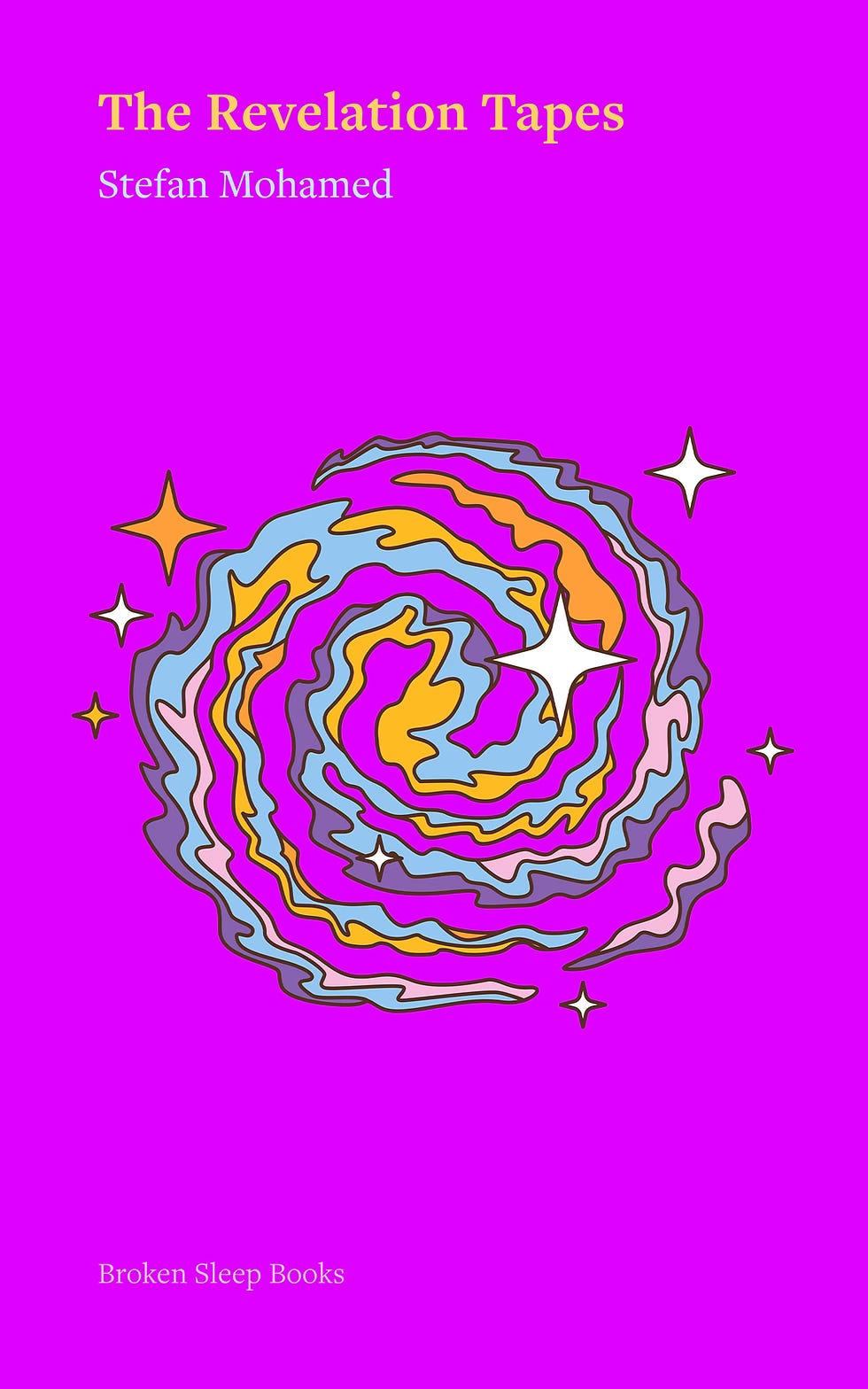
We pick up the story amid ecological collapse. It’s the Anthropocene, except, if you can believe it, it’s got worse. Rivers have begun reclaiming cities. Sludge is taking over. Shadows extend, “chopping murky jade and moist earth / exhausted banks crumbling / like bread into soup”. Mud is turned mutant, and a loose band of youngsters are trying to eke out an existence. Life persists only in the crevices, “vertical villages / squirrelled in the gaps between collapses”.
The scene is set, in Mohamed’s trademark style: social commentary via grotesque imagery and wry little vignettes, plus injections of slang. In ‘Establishing Shot’, descriptions of sad cities and ugly countrysides give way to kids “loitering / lingering / lounging”. They’re in the swamp behind the car park, discussing things. Bodies: “ya wee blood-sick bonebag / ya flimsy sack of milky bits”; sex: “as ache / as holiday / as choreography”; grief: “like a chore”.
In ‘Abstract Mode’, the narrator describes someone recording themselves being attacked by riot police, and who
then made a viral dance hit using the sound
of their own breaking wrist as a snare drum
and now the police are suing them
for a share of the royalties.
Ouch. Maybe likening the sound of a bone breaking to a drumbeat is an easy way to elicit a wince, but it works for me. Elsewhere, we’re introduced to the grim new fauna of this grim new world, featuring some charming forays into the weird imaginary. Superstitions abound about a type of crow that “bear[s] psychic burdens” and offloads quantities of its ennui on unwitting pedestrians as it “wonks past”. There’s life, inevitably, spawning from lines of code. The sun disappears. Folks panic. An age of inertia begins, “defined by / silence”.
To cope, the kids go raving, but not to just any rave. They go to “the rave / that ravers are afraid of” (listening to “the beats / that melting icecaps are made of”). Instead of songs, the DJ plays memories, or triggers them. She has a remix for every punter – “hanging scent of barley fields / trickle of river near grandma’s cottage / crunch of early snow” – and knows when to pivot into teenage angst. ‘DJ set’ is about nostalgia, about realising the world is too far gone and yearning for simpler times, whether such times are characterised by “toes curling in wet sand” or “directionless rage”.
Mohamed relishes the ironies of the modern age by extending them to the point of grotesqueness
Mohamed relishes the ironies of the modern age by extending them to the point of grotesqueness. In ‘“I Wrote About The New Trend They’re Calling ‘Psycho Goblin Pop’ For Old Man Yells At Cloud Dot Com”’, Spotify is not only “sentient” but also “insane and endlessly ravenous”. When a new kind of intelligence emerges from lines of data, it “spawns, un-prompted, degenerative”. It, or she (“They think of her as grandmother”) becomes a “good luck charm”, a beacon of hope for the more everyday algorithms that populate cyberspace.
These forays into the world of post-apocalyptic machine intelligence made me think of Zoë Hitzig’s Not Us Now, which I wrote about in June. I found Hitzig’s efforts to imagine the future of language in a post-machine intelligence world basically unreadable: dry, sincere, lacking any sense that the reader might actually want to enjoy themselves. At his best, Mohamed achieves the opposite: striking imagery, a continuous thread you can keep up with, and a dose of wit:
She spawns, un-prompted, degenerative
a ghost in the pixel mist
staring, always, straight ahead.An early beta version saw her first
passed her down
to their next iteration
After the rave, the kids enter a black hole, fall asleep, and find themselves in heaven – the pearly gates are rusty, the milk and honey curdled. They meet God. He’s a disappointment, “incomprehensibly alone / grey as a funeral morning”. His eyes are “demented”, fingers “red with sores”. They take it upon themselves to, er, kill him with a “metaphorical bullet”, and from then on the collection loses its way. I said above that The Revelation Tapes has a beginning and a middle. I’m not sure if even the author could tell you what happens in Acts Six and Seven.
So far, the titles of the seven ‘acts’ have more or less signposted the plot development. The first is titled ‘Act One: In Which The Kids Are, If Not All Right, Then At Least Persevering’. The second is: ‘Act Two: In Which The Kids Blag Their Way Into The Apocalypse Disco’. The last ‘act’ is titled: ‘Act Seven: In / Which’. When even these titles become vague, the form loses its raison d’être.
The Revelation Tapes has a beginning and a middle. I’m not sure if even the author could tell you what happens in Acts Six and Seven
Mohamed’s strength lies in his creative visualisations and wit. His writing is best when he extends these vignettes over multiple stanzas, such as in ‘AND … SCENE’ (quoted at the start of this piece), and resists the temptation to run lines through his internal thesaurus rather than developing the thread. God, for example, is not only ancient and gigantic, incomprehensibly alone and grey as a funeral morning, but also “deathbed flesh stretched over bone / like too little fabric / over too much rack // great staring demented glass eyes / fingers twitching and red with sores / voice dry as an extinct ocean”. In ‘Establishing Shot’ in a discussion of sex, some youths frame it not only as an act of intimacy but also “as obligation / as penance / as ritual / as catharsis / as tactic / as diversion / as ambush // as lack / as void / as bullet point list / as laboratory experiment / as refuge / as parachute / as farce // as ache / as holiday / as choreography / as tragic finale”. In ‘Fade Out’, the verb ‘blossoming’ is likened to 36 different things. Lots of description, no action.
Many phrases are creative and memorable, but some poems just don’t add up. It is word salad, or line salad. On the book’s jacket, reviewers praise Mohamed as an “unparalleled phrase maker”, or “master” of the “precise timing of a distorted buzz phrase”. I would say he paints with words, but his word paintings lack organisation, finesse and punctuation. They’re more Pollock than Delacroix, and not everyone can be Pollock. In my review of Farewell Tour, which came out in 2023, I took issue with the author’s penchant for writing poems as lists. He may have buried his listophilia deeper in The Revelation Tapes, but it’s still there, limiting his ability to connect emotionally with readers.
With its stage directions, acts, monologues and a dream sequence, The Revelation Tapes asks to be approached as a continuous drama, something like a one-man play. (Farewell Tour ran as a one-man show, and Mohamed is perhaps best known as a performance poet.) But the book’s erasure and concrete poems belong on the page, and various other structural and stylistic features suggest it’s expecting to be read, not read aloud. It presents as a story, but most of the narrative development takes place in the titles of its seven acts rather than in the poems themselves. As for characterisation, the cast of players are a nebulous, anonymous mass, so there’s scant opportunity to feel anything for them. The pages are clogged with lines that are fun to say but don’t establish reader connection. They don’t advance plot, or develop meaning; they merely repeat.
It oozes with imagination and boasts a strong voice, but a stricter editor might have elicited a more meaningful, satisfying collection
In short, The Revelation Tapes is confused, or at least confusing. It oozes with imagination and boasts a strong voice, but a stricter editor might have elicited a more meaningful, satisfying collection. There is form, but many of the poems don’t fit it. From the outset, you wonder whether you even care about plot and characters. And how should you read it? Should you imagine it in the author’s voice? Follow along? Or dip in and out, as one might with a more traditional collection?
The answer, I believe, is to read it however you like. If you like this poet’s sense of humour, experimental approach and formal indulgences, you may enjoy the creative muddle. If you don’t, you won’t. Overall, I would say it’s more than the sum of its parts, although (at least for me) its parts don’t entirely add up.
Bruno Cooke is The Friday Poem’s Spoken Word Poetry Editor. He’s written one novel, Reveries, four plays and two feature screenplays. He has lived in France, China, Sri Lanka and the Philippines, working as a freelance journalist, writer, educator and occasional chef, and likes, among other things, black and white Japanese films, pub quizzes, fermentation and baklava.
Vital Statistics: The Friday Poem has 3900-plus subscribers. It’s run by four people – Hilary Menos (Editor), Helena Nelson (Consulting Editor), Bruno Cooke (Spoken Word Editor) and Andy Brodie (Web Editor), with contributions from a team of reviewers and writers.
Until recently we maintained the Friday Poem website (thefridaypoemdotcom) as an archive of 700 posts published between 2021 and 2024 (including most of the original Friday poems) but following a catastrophic hack in late April we made the difficult decision to take this down. We’ll be republishing some of the poems, features and reviews on Substack in the future.
Help support The Friday Poem
Buy us a coffee to help us stay awake as we strive to bring poetic excellence to your inbox every Friday. Heartfelt thanks to everyone who donates, especially to our regular donors. If you can’t afford it, no worries, we’re going to keep on doing it anyway! Big thanks for everything, you lovely poetry peeps.